I remember the first time I tried to create a “sensory activity” for my nephew when he was about eight months old. I’d seen all these gorgeous Instagram posts with elaborate setups, colored rice in designer bins, perfectly arranged pom-poms, rainbow everything.
I spent way too much money at the craft store, set everything up just right, and within thirty seconds he’d knocked the entire thing over and was more interested in the cardboard box it came in.
That moment taught me something really important. Babies experience the world through direct contact with objects and materials.
They want to touch, bang, squeeze, and yes, taste everything they can get their hands on.
The expensive craft supplies meant nothing to him. The cardboard box had texture, it made sounds when he hit it, and it was exactly his size for investigation.
Over the years working with families and watching babies develop, I’ve learned that sensory play drives infant development forward, but the materials don’t need to be expensive or complicated. Some of the most powerful sensory experiences come from everyday items you already have in your kitchen drawers and closet.
The key is understanding what you’re trying to accomplish and matching activities to your baby’s actual developmental stage, not some idealized version of what baby play “should” look like.
Understanding Sensory Play Beyond the Hype
Sensory play refers to how babies build their understanding of the physical world. Every time your baby touches something new, sees a contrasting pattern, hears a novel sound, or tastes a different texture, they’re forming neural pathways that will support everything from language development to emotional regulation later in life.
The research on this is genuinely fascinating. During the first year, babies are forming synaptic connections at an astounding rate, about 700 to 1,000 new neural connections every single second.
These connections don’t form in isolation.
They develop through repeated sensory experiences.
When your baby squeezes a soft fabric, then a hard wooden block, their brain is actively building categories: “soft things,” “hard things,” and eventually more complex concepts like “things that make noise when I bang them.”
What makes this even more interesting is that sensory experiences are added and interconnected. A baby who regularly explores different textures develops not just tactile discrimination and fine motor control, focus, and even early problem-solving skills. They’re learning to manipulate objects intentionally, which is the foundation for everything from feeding themselves to eventually writing.
The practical implication here is straightforward. Consistent, varied sensory experiences matter far more than any single elaborate activity.
A parent who offers simple daily opportunities for exploration, letting their baby touch different fabrics during diaper changes, providing a few safe kitchen items to bang together, or just narrating textures during walks, is doing exactly what developmental science recommends.
The Foundation: Birth to Three Months
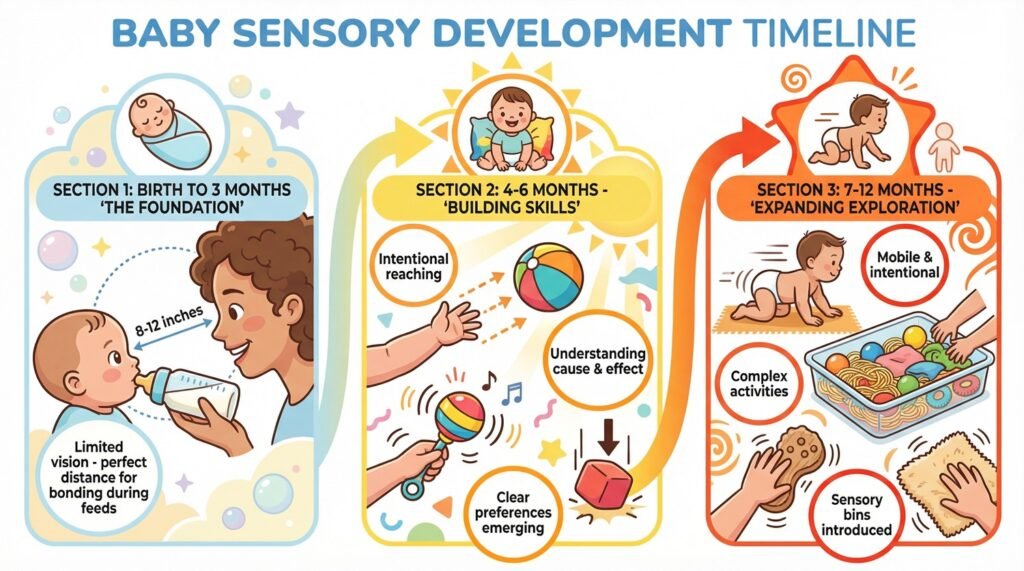
During those early months, your baby’s sensory world is quite different from ours. Their vision is limited to about 8-12 inches initially, which is conveniently the distance to your face during feeding.
They’re drawn to high-contrast patterns, faces, and movement.
Their other senses are more developed. They can already distinguish your voice from others and respond to different touches.
One of my favorite activities for this age is what I call “texture tours.” During tummy time or when your baby is alert and content, gently introduce different fabrics to their hands or bare feet. Take a silk scarf and slowly drag it across their palm.
Follow it with a soft washcloth, then maybe a piece of velvet or fleece.
You’re not looking for any particular reaction. You’re just providing varied input.
Shadow tracking is special for this age. Around 6-8 weeks, when babies start developing better visual tracking, slowly moving a flashlight beam across the ceiling during a calm moment provides exactly the right kind of visual challenge.
The movement engages them without overwhelming them, and you can do it for just 30-60 seconds as part of your wind-down routine.
Sensory bottles are incredibly versatile for this stage. I’ve made versions with colored water and a drop of dish soap (creates gentle bubbles when moved), uncooked rice (creates sound and visual interest), or small lightweight objects that shift when tilted. The key is making sure the bottle is completely sealed. I usually use hot glue around the cap as extra security.
These bottles are genuinely useful for months.
Even older babies find them soothing.
Building Skills: Four to Six Months
This is when things get really interesting. Your baby is gaining control over their movements, reaching intentionally, and showing clear preferences.
They’re also much more aware of cause and effect: “When I hit this, it makes a sound” or “When I drop this, it falls.”
The textured discovery box concept is something I recommend to nearly every parent at this stage. You don’t need anything fancy.
A shoebox or small plastic container works perfectly.
Fill it with safe household items that have distinctly different properties. A wooden spoon feels and sounds different from a soft cloth, which feels and sounds different from a plastic measuring cup.
The variety itself is the value.
What makes this so effective is that it uses a baby’s natural developmental drive at this age: emptying containers. Babies around 4-6 months absolutely love pulling things out of boxes and baskets.
This behavior teaches them about object permanence, spatial relationships, and their own ability to affect their environment.
By providing a discovery box, you’re working with their developmental impulses as opposed to against them.
Water play at this age can be surprisingly simple and incredibly engaging. I’m not talking about a full bath or even a baby pool.
Just fill a shallow baking sheet or small plastic storage container with about an inch of water.
Set it on a towel on the floor with your baby in front of it. Add a few waterproof items, measuring cups, plastic containers, maybe a floating toy.
Your baby will splash, watch the water move, feel the temperature, and experience cause and effect.
The contained nature of a baking sheet means the mess is manageable, which honestly matters when you’re doing activities regularly.
One variation that adds another sensory dimension: use slightly warm water in one container and cool water in another. Babies find temperature differences genuinely fascinating.
You’ll see them pause and really focus when they move from one to the other.
Expanding Exploration: Seven to Twelve Months
By this stage, your baby is likely mobile or becoming mobile. They’re much more intentional about their exploration and can handle more complex activities.
This is when sensory bins become practical, but you need to be really thoughtful about materials.
I avoid traditional sensory bin fillers like dried beans entirely. Raw beans contain lectins that are actually toxic if ingested, and even dry beans can be choking hazards.
Instead, I use materials like uncooked popcorn kernels (large enough not to be choking hazards for most babies this age, but still require close supervision), cooked and cooled pasta, or kinetic sand if you’re comfortable with it.
The real shift at this age is incorporating more complex cause-and-effect exploration. Your baby can now understand that their actions have predictable results.
When they drop something, it falls.
When they bang two objects together, they make noise. When they pour from a cup, contents move from one container to another.
One of my favorite activities for this stage uses ordinary ice cubes on a cookie sheet. Set your baby in their high chair with the tray, or sit them on the floor with the cookie sheet in front of them.
Place several ice cubes on the surface.
Your baby will be fascinated by many properties: the temperature, how slippery they are, how they melt, and how they slide around. You can extend this by having a small bowl of slightly warm water nearby and showing them what happens when ice goes into warm water versus staying on the cold sheet.
Mirror play becomes much more sophisticated at this age too. Earlier, mirrors were just interesting visual stimuli.
Now, your baby is beginning to recognize themselves, which is actually a significant cognitive milestone.
Hold your baby in front of a mirror and play with their reflection. Point to their nose in the mirror, then touch their actual nose.
Wave at the reflection.
Make faces together. This builds body awareness and self-recognition in a really playful way.
The musical exploration activity with hiding bells or rattles uses object permanence, which develops significantly between 8-12 months. When you hide an object that’s making sound, your baby has to mentally track where it is even though they can’t see it.
This is genuinely complex cognitive work disguised as play.
Making Sensory Play Actually Work in Daily Life
What makes the biggest difference between sensory play that becomes a regular part of your routine versus something you try once and abandon is integration and rotation.
Integration means building sensory experiences into moments that are already happening. During diaper changes, let your baby feel different fabrics.
While you’re cooking, hand them a wooden spoon to hold and explore.
During bath time, provide cups for pouring. During walks, point out textures: the rough bark of a tree, soft grass, smooth leaves.
These aren’t “activities” in the formal sense, but they’re providing constant sensory input that builds understanding.
Rotation is your secret sauce against both boredom and clutter. Instead of having all sensory materials available all the time, keep several small collections stored separately.
Maybe one basket has textured balls and fabric squares.
Another has kitchen items for banging and stacking. A third has water play materials.
Rotate which one is available each week.
Your baby will engage much more enthusiastically with materials they haven’t seen in a while, and your home doesn’t become overwhelmed with stuff.
I also strongly recommend setting up a designated sensory play space that’s easy to clean. This might be a washable play mat, a section of tile floor, or even just a large plastic sheet.
Having a contained area makes cleanup faster and gives you permission to let your baby really explore without constantly worrying about mess.
The Edible Sensory Approach
Once your baby starts solids around six months, edible sensory play opens up entirely new possibilities. This is where you can really let go of worry about what goes in their mouth, because everything is intentionally consumable.
Mashed banana is an absolutely perfect first sensory material. The texture is safe, the taste is familiar if they’ve already tried it as food, and the consistency is ideal for squishing and spreading.
Put a small amount on their high chair tray and just let them explore.
They’ll squish it, smear it, maybe taste it, and definitely make a mess. That mess is learning.
Cooked pasta in different shapes provides wonderful texture variety. Penne feels different from spaghetti, which feels different from bowtie pasta.
You can offer it plain or toss it in a tiny bit of olive oil to change the texture.
Again, everything is safe to mouth and taste.
Oatmeal, yogurt, and even safe gelatin all offer distinct tactile experiences. Some babies love the sensation immediately.
Others are more hesitant.
Neither response is wrong. Babies have sensory preferences just like adults do.
If your baby seems uncertain, give them time and reintroduce the material again later.
Repeated exposure in a pressure-free environment helps them build confidence.
One thing I really appreciate about edible sensory play is that it naturally transitions into self-feeding skills. A baby who has experience squishing banana, grasping cooked pasta, and scooping oatmeal is building exactly the hand strength and coordination they’ll need for independent eating.
Avoiding Common Sensory Play Mistakes
The biggest mistake I see is overwhelming babies with too much at once. I’ve watched well-meaning parents set up elaborate sensory stations with many bins, various textures, music playing, and bright visual stimuli, and their baby completely shuts down.
Babies, especially younger ones, have a limited capacity for sensory input.
When they’re overstimulated, they often become fussy, turn away, or zone out.
The solution is starting with single-sense activities and gradually combining senses intentionally. A young baby might explore one textured fabric at a time.
An older baby might have water play with simple containers.
You add complexity gradually as your baby shows they’re ready for more.
Another common issue is inconsistency. Sensory play needs to happen regularly to provide developmental benefits.
A single elaborate activity every few weeks doesn’t create the neural repetition babies need. Simple activities several times weekly matter so much more than occasional complicated setups.
I also see parents getting discouraged when their baby doesn’t respond the “right” way to an activity. Maybe they saw a video of a baby laughing during ice cube play, but their baby seems uncertain or even upset.
Babies are people with different sensory preferences and tolerances.
Some love cold sensations immediately. Others need gradual exposure.
Some are cautious about new textures.
Others dive right in. Both approaches are completely normal, and neither shows a problem.
The key is following your baby’s lead. If they’re not interested in a particular activity, that’s information.
Maybe the activity isn’t developmentally suitable yet, or maybe their temperament prefers different experiences.
Put it away and try again in a few weeks. Offer a different sensory experience instead.
Sensory Play for Different Temperaments
This is something I wish more resources addressed directly. Babies have different temperaments that affect how they approach sensory experiences.
Some babies are what we might call “sensory seekers.” They love intense input, strong textures, loud sounds. These babies might bang toys enthusiastically, love water splashing everywhere, and generally approach everything with high energy.
Other babies are more sensory-sensitive. They’re cautious about new textures, prefer gentler input, and might be overwhelmed by activities that sensory-seeking babies love.
These babies need a different approach: slower introductions, softer materials, and more time to warm up to new experiences.
Neither temperament is better or worse, but they do require different strategies. For a sensory-seeking baby, you might offer chunkier textures, provide opportunities for bigger movements, and embrace messier activities.
For a sensory-sensitive baby, you might start with softer materials, introduce new textures more gradually, and keep activities shorter initially.
Understanding your baby’s temperament helps you customize activities to their needs as opposed to following generic recommendations that might not fit.
Building Complexity Over Time
As your baby approaches their first birthday and beyond, you can start layering more complexity into sensory experiences. Instead of just offering textured fabrics, you might pair them with language: “This feels soft. This feels scratchy.” Instead of simple water play, you might add tools like turkey basters or funnels that require more refined motor control.
The progression should feel natural. You’re noticing what your baby can do and offering experiences that are just slightly beyond their current ability.
This is what psychologists call the “zone of proximal development,” that sweet spot where something is challenging but achievable.
For example, a six-month-old might enjoy pulling items out of a discovery box randomly. A ten-month-old might be ready to match items.
You hand them a wooden spoon, and they find the matching spoon in the box.
A twelve-month-old might follow simple directions: “Can you find something soft?”
People Also Asked
What are sensory activities for babies?
Sensory activities for babies are experiences that engage one or more of their five senses: touch, sight, sound, taste, and smell. These can include simple activities like feeling different fabric textures, playing with water, listening to household sounds like wooden spoons banging together, or exploring safe foods like mashed banana.
The activities help babies understand how the physical world works and build neural connections that support later development.
When should I start sensory play with my baby?
You can start sensory play from birth. Newborns already respond to touch, sound, and visual patterns.
Activities for very young babies might include gentle fabric touches during diaper changes, high-contrast visual cards, or soft music.
As babies grow, you gradually introduce more complex sensory experiences based on their developmental stage and motor skills.
What household items are safe for baby sensory play?
Many common household items work well for sensory play. Wooden spoons, measuring cups, plastic containers, soft washcloths, silk scarves, metal mixing bowls, and kitchen whisks all provide different textures and sounds.
For older babies who can sit up well, cooked pasta, water in shallow containers, ice cubes, and safe foods like banana or yogurt offer edible sensory experiences.
Always supervise closely and avoid items small enough to be choking hazards.
How do sensory bottles help baby development?
Sensory bottles provide visual tracking practice and cause-and-effect learning. When babies watch objects move inside a sealed bottle or hear rice shift when they shake it, they’re developing visual attention, understanding that their actions create results, and learning to focus.
Sensory bottles are particularly useful for younger babies (2-6 months) who are developing eye coordination and hand control.
What is tummy time and why does it need sensory activities?
Tummy time is when you place your baby on their stomach while they’re awake and supervised. This position strengthens their neck, shoulder, and arm muscles needed for rolling, sitting, and crawling. Adding sensory elements like textured mats or interesting objects to look at makes tummy time more engaging and encourages babies to lift their heads and reach forward, building strength while exploring.
Are water play activities safe for babies under one year?
Water play can be safe for babies under one year with proper supervision and setup. Use very shallow containers, just an inch or two of water, and never leave your baby unattended. Babies this age should always be within arm’s reach during water play.
The temperature should be lukewarm, and the play area should be on a surface that can get wet without damage.
What are edible sensory materials for babies?
Edible sensory materials are foods that babies can safely explore with their hands and mouth. Once your baby starts solid foods around six months, options include mashed banana, cooked pasta in various shapes, plain yogurt, cooked sweet potato, oatmeal, and safe gelatin. These materials let babies explore freely without concern about what goes in their mouths, and they naturally support self-feeding skill development.
How often should babies have sensory play?
Babies benefit from sensory experiences many times throughout the day, though these don’t need to be formal activities. Brief moments like feeling different fabrics during diaper changes, touching various objects during supervised floor time, or exploring textures during meals all count as sensory play.
Aim for some form of sensory input several times daily as opposed to one long session.
Key Takeaways
Effective sensory play needs consistency and appropriateness, not complexity or expense. The everyday items in your home, fabrics, kitchen utensils, safe food items, water, and simple toys, provide everything your baby needs for rich sensory development.
By matching activities to your baby’s current developmental stage, rotating materials regularly, and following their person temperament and preferences, you create exactly the kind of exploration opportunities that build neural connections and support learning.
Start with one or two activities that genuinely fit into your daily routine, observe what captures your baby’s attention, and build from there. The goal is consistent, varied sensory input that supports your baby’s natural drive to understand their world.