Baby activity gyms changed everything about how I approached floor time with my infant. Before I understood what separated a genuinely useful gym from a wasteful purchase, I figured they were basically interchangeable, colorful mats with dangling toys that all served the same purpose. Then I learned how specific design elements directly decide whether your baby actually develops skills or just lies there getting frustrated. The right activity gym becomes equipment you use many times daily for months, supporting everything from neck strength to hand-eye coordination.
The wrong one ends up shoved in a closet after three weeks because your baby showed zero interest.
Why Specific Features Create Different Outcomes
When you start shopping for baby activity gyms, every product screams about being “developmental” and “stimulating.” These marketing terms mean absolutely nothing without understanding what actually drives infant growth during those crucial early months.
Your baby’s brain forms neural connections faster during the first year than at any other time in their entire life. The physical environment you provide directly influences which neural pathways strengthen and which ones fade away unused. A quality gym includes intentional design choices that match natural developmental progression.
Babies don’t benefit from seventeen flashing lights and constantly playing music.
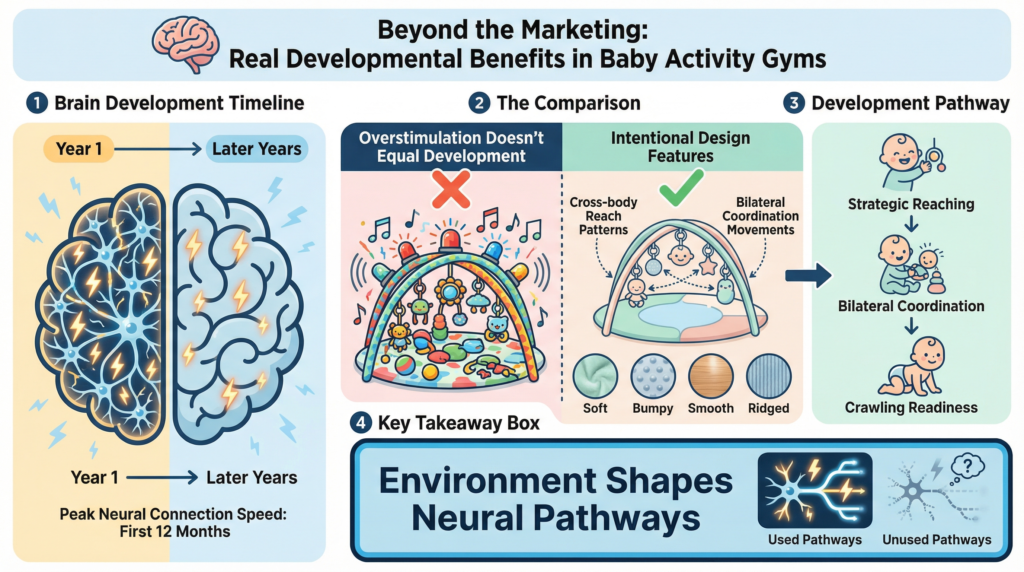
They need strategic toy placement that encourages reaching across their body, building the bilateral coordination required for eventually crawling. They need varied textures that give their developing tactile sense genuine information to process.
They need structures stable enough to support increasingly vigorous movement as they grow stronger and more purposeful in their actions.
I’ve watched so many parents buy activity gyms based purely on how cute they look or which one cost the least, then feel confused when their baby seems completely uninterested after a handful of uses. The problem usually has nothing to do with the baby.
The gym fails to offer enough positioning variety, or all the toys cluster in one spot so your baby repeats identical movements until boredom sets in. Sometimes the mat slides around on the floor, creating frustration instead of providing stable ground for practicing new skills.
Understanding what drives infant engagement changes shopping from an overwhelming guessing game into a straightforward evaluation of features that actually matter.
Mat Quality Creates the Actual Foundation
Your baby spends most gym time lying directly on the mat, which makes this component far more important than the dangling toys that get all the marketing attention. Thin, slippery mats create genuine problems during tummy time because babies slide across the surface instead of building the friction they need to practice pushing up on their arms.
Inadequate padding means uncomfortable pressure points that cut play sessions short before your baby has gained any real developmental benefit.
Look for mats with substantial cushioning that provides actual comfort during extended floor sessions. The surface needs enough grip to stay in place on your specific flooring without sliding around when your baby starts kicking energetically or attempting to roll.
Some parents completely overlook this consideration, then spend every play session repositioning the entire gym because it has migrated halfway across the room.
Washability matters exponentially more than you initially think. Babies produce an astounding amount of mess.
They spit up, they drool constantly, they have diaper leaks at the most inconvenient moments possible.
A mat that only allows spot-cleaning becomes a bacteria-covered disaster within weeks. Machine-washable covers that you can throw in with regular laundry maintain hygiene without adding another exhausting task to your already overwhelming daily list.
Size creates a real dilemma you need to think through carefully. Bigger mats provide more exploration space and accommodate active babies much better as they grow stronger and develop rolling skills.
However, large mats also consume significant floor space and create storage challenges if you don’t plan to leave the gym set up permanently.
You need to honestly assess your available space and whether you’ll leave the gym assembled all the time or break it down between uses. A massive gym that never fits back in the packaging after the first setup becomes permanent furniture whether you intended that or not.
The mat material affects temperature regulation more than you might expect. Some synthetic materials feel cold against baby skin, creating discomfort that reduces how long your baby tolerates floor time.
Others trap heat, making tummy time sweaty and unpleasant.
Cotton or cotton-blend covers generally regulate temperature better, staying comfortable across different seasons and varying room temperatures.
Arch Structure Determines Developmental Value
The overhead arch system controls where toys hang, which directly impacts what developmental benefits your baby actually receives during gym time. Fixed arches with toys that only attach in predetermined spots severely limit how you can adapt the gym to your baby’s rapidly changing needs and emerging abilities.
When every toy dangles directly over your baby’s face in an unchanging pattern, they never practice tracking objects to the side or reaching across their body, skills that build bilateral coordination and lay groundwork for eventually crawling.
Premium designs include many attachment points scattered along the arches, letting you position toys at varied heights and angles. This flexibility matters enormously for tummy time specifically.
When toys hang too high, babies lying on their stomachs can’t see them and have zero motivation to lift their heads up.
When positioned correctly at just the right height within their line of sight, those same toys become powerful incentives to strengthen neck and shoulder muscles through repeated head-lifting efforts.
Detachable arches solve storage problems elegantly and effectively. You can separate them from the mat base for compact storage, then reassemble everything in seconds when you’re ready for the next play session.
Some systems use simple pop-in mechanisms that connect and disconnect efficiently.
Others need more involved assembly with many connection points. Test the attachment system before purchasing if possible, because you’ll potentially gather and disassemble this equipment hundreds of times.
Fiddly mechanisms requiring tools or excessive force become genuinely annoying after the tenth time you deal with them.
Stability under pressure decides both safety and how long the gym lasts through months of increasingly vigorous use. As babies develop stronger muscles and more purposeful movements, they’ll eventually grab hanging toys and pull with surprising force.
Arches that wobble or tip inward create safety concerns and also undermine your baby’s confidence in exploring their environment.
The entire structure should feel solid even when toys get yanked aggressively, maintaining position without threatening to collapse onto your baby.
Toy Selection Drives Engagement Over Time
The specific toys included impact both immediate engagement and whether your baby maintains interest over months of use. A gym with five identical rattles offers no developmental variety whatsoever, your baby gets exactly the same sensory input regardless of which toy they bat at, leading to rapid boredom.
Quality sets include genuinely different toy types that stimulate varied sensory systems.
Mirrors support visual self-awareness as babies begin recognizing their own reflection. Crinkly fabrics provide auditory feedback that teaches cause and effect.
Smooth teething rings offer oral exploration for babies who learn through mouthing objects.
Textured surfaces give tactile differentiation experience. Rattles build understanding that their actions create predictable results.
Removable toys multiply the gym’s value exponentially beyond the initial purchase. You can swap them out regularly to maintain novelty without buying anything new.
You can clean person toys thoroughly without laundering the entire mat.
You can even replace lost pieces if the manufacturer sells components separately, extending the gym’s usable life significantly. Fixed toys that can’t be removed limit your flexibility completely and render the entire gym unusable if one component breaks or becomes too disgusting to clean effectively.
Toy positioning flexibility separates genuine developmental tools from basic entertainment products. You want the ability to place toys off to the sides rather than only centered directly above your baby’s face.
Positioning toys to the left and right encourages your baby to turn their head and track objects through their full range of vision, building the eye muscles and neural pathways that support reading years later.
Positioning toys slightly out of easy reach during tummy time motivates forward movement attempts and builds the core and shoulder muscle strength that eventually enables crawling.
Consider the actual developmental appropriateness of included toys for different ages. Newborns benefit most from high-contrast black and white patterns that their developing vision can actually distinguish, since color vision develops gradually over the first few months.
Older babies need more complex toys that reward manipulation and exploration, like toys with moving parts or hidden squeakers.
Some gym sets include age-appropriate variety from the start, providing options suitable for newborns through sitting babies. Others fill the package with toys that all target the same narrow age range, limiting overall usability as your baby grows and changes.
Sensory Features Should Support Rather Than Overwhelm
Modern baby products trend heavily toward excessive stimulation, lights flashing, sounds playing, vibrations running, and moving parts all competing for attention simultaneously. This approach actually works against infant development in most cases.
Babies need processing time to understand sensory input they receive.
When five different things happen at once, babies often shut down and stop engaging rather than becoming more interested.
Look for sensory features you can actually control. Volume adjustments on musical elements let you adapt to your baby’s current state and needs. Sometimes babies want stimulation and respond well to sounds.
Other times they need calm, especially before naps or when they’re already feeling overwhelmed. Lights that turn off independently from sounds give you flexibility based on time of day and your baby’s energy level.
Optional activation that you control respects your baby’s developing nervous system instead of forcing constant input.
Texture variety provides sensory exploration without requiring batteries or creating noise pollution in your home. Different fabric types give your baby’s developing tactile sense genuine information to process, smooth satin, bumpy corduroy, crinkly material that makes noise when touched, soft plush, slightly rough canvas.
This quiet sensory input often engages babies more effectively than flashy electronic features because they can explore at their own pace without risking overstimulation.
Natural materials offer sensory benefits that plastic simply cannot copy. Wood elements provide different temperature sensations and weight compared to synthetic materials, giving babies more varied tactile information.
Fabric toys move differently than hard plastic ones when batted, teaching different lessons about physics and cause-and-effect.
Cotton rope or ribbon offers different tactile feedback than rubber or silicone. A well-designed gym incorporates material variety intentionally, creating a richer sensory landscape that supports broader learning.
Portability Determines Actual Daily Use
The ability to move your activity gym between rooms directly decides how much you’ll actually use it in real life. A gym that lives permanently in the nursery misses countless opportunities for interaction during your kitchen time, living room family hours, or visits to grandparents’ houses.
Lightweight construction with carrying handles or an included storage bag changes the gym from stationary furniture into flexible equipment you can bring wherever your baby needs entertaining or developmental activity.
Foldability impacts both portability and storage far more dramatically than you might initially think. Designs that collapse flat fit in closets, slide under beds, or tuck into car trunks without requiring dedicated storage space.
This consideration matters especially in apartments or smaller homes where every square foot counts toward your living space.
A gym that refuses to fold or needs complete disassembly to store often ends up as a permanent floor fixture by default, regardless of whether that fits your lifestyle or aesthetic preferences.
Quick setup and breakdown decide whether you’ll actually move the gym regularly or just leave it in one spot forever. Systems requiring tools or complicated assembly processes stay wherever you first put them because the effort of relocating feels too burdensome for the benefit gained. Simple pop-up designs or tool-free assembly encourage flexibility in real daily use.
You can set up the gym for focused play time, then break it down afterward to reclaim floor space for other activities like family room use or your own exercise routine.
Travel-friendly options exist specifically designed for families who move around often. Compact designs with included carry bags make it realistic to bring the gym on vacation, to childcare providers’ homes, or for weekend visits away from your usual environment.
This continuity helps maintain play routines even when everything else changes, providing familiar activities in unfamiliar settings that might otherwise feel disorienting to your baby.
Growth Adaptability Extends Usable Life
Babies change so incredibly rapidly during the first year that equipment perfectly suitable for a two-month-old often feels completely useless by six months. Gyms designed with growth in mind include features that adapt as your baby develops new abilities and interests.
The best purchases serve many developmental stages rather than becoming obsolete after just a few months of use.
Adjustable toy heights accommodate your baby’s increasing reach and strength as they grow. What hangs perfectly positioned for a three-month-old lies far too close for a six-month-old who has developed much longer reach and more purposeful grabbing abilities.
Simple adjustment mechanisms let you raise toys progressively as your baby grows, maintaining suitable challenge levels that encourage continued engagement rather than boredom from tasks that have become too easy.
Convertible designs transform from overhead gyms into side play panels or flat play surfaces as babies develop sitting and crawling skills that make the overhead structure less relevant. Arches might detach to become a separate toy stand positioned at floor level.
Mats might include attached toys along the edges that stay engaging even after your baby stops spending time underneath the overhead structure.
This flexibility extends usability well beyond the typical six to eight month gym lifespan that most basic models provide.
Some premium systems include extra components you can add progressively as your baby grows, pillow wedges for supported sitting practice, attachable mirrors positioned specifically for tummy time viewing angles, or larger mat extensions that accommodate crawling practice. This modular approach means you’re not buying entirely new equipment every few months as developmental needs shift dramatically.
Safety Standards Protect During Exploration
Non-toxic materials protect your baby during the inevitable mouthing and chewing that characterizes how infants explore every object they encounter. Certifications from independent testing organizations verify that materials truly contain no harmful chemicals rather than just claiming to be “safe” without verification.
This consideration matters more than many parents realize because baby products face less strict regulation than you might assume, allowing manufacturers to make safety claims without rigorous independent verification.
Secure toy attachments prevent choking hazards from toys coming loose during vigorous play. Check that attachment mechanisms require deliberate action to remove, toys shouldn’t pop off when pulled by small hands.
Small parts that could detach and become choking hazards have absolutely no place in infant products, yet lower-quality gyms sometimes include components that don’t meet suitable safety standards for the age range.
Structural stability prevents collapse or tipping that could potentially injure your baby during use. Arches should stay firmly in place even when toys get pulled hard or yanked sideways.
Bases should spread wide enough that the structure doesn’t tip when babies inevitably grab overhead elements and yank with their full body weight.
Reading reviews thoroughly about structural integrity protects against designs that look impressive in photos but function poorly under actual use conditions.
Edge and corner safety seems obvious but varies significantly across different products. Rounded edges without sharp points or hard corners protect babies who are learning to roll and inevitably bonk into structural elements repeatedly.
Covered joints where fabric meets frame prevent pinching of delicate skin. Smooth surfaces without splinters or rough areas protect hands and faces during exploration.
Maintenance Realities Affect Long-Term Satisfaction
Machine-washable components literally save your sanity over months of daily use. Baby gear gets dirty constantly and unavoidably.
Products requiring hand-washing or spot-cleaning only become increasingly disgusting over time as stains accumulate and odors set in. Being able to throw the mat cover and fabric toys into your regular laundry cycle means you’ll actually keep things clean rather than letting grime build up until you’re embarrassed by the state of your baby’s play space.
Durable stitching and construction quality decide whether your gym survives months of daily use or falls apart within weeks of purchase. Examine seam quality carefully, loose threads or weak stitching points show poor construction that won’t withstand repeated washing and active play.
Reinforced stress points where toys attach or arches connect to the base suggest thoughtful engineering focused on longevity rather than just initial appearance.
Color-fast fabrics maintain decent appearance through repeated washing cycles. Cheaper materials often fade dramatically or bleed colors after just a few trips through the laundry, making your gym look worn and dingy well before it actually stops functioning.
While this doesn’t affect developmental value, it does impact whether you feel comfortable having the gym visible in your main living space rather than hidden away.
Replacement part availability extends your gym’s useful life significantly beyond what you’d get otherwise. The best manufacturers sell replacement toys, attachment clips, or even mat covers separately so you can refresh worn components rather than replacing the entire gym when one piece breaks.
This option also allows upgrading toy selection as your baby’s interests change without buying completely new equipment.
People Also Asked
What age should you start using a baby activity gym?
You can start using a baby activity gym from birth, though newborns will only tolerate short sessions of a few minutes initially. During the first few weeks, babies benefit most from simple visual stimulation like high-contrast patterns positioned within their limited focal range.
As your baby grows stronger and develops better head control around two to three months, they’ll engage more actively with hanging toys and spend longer periods on the gym.
Tummy time on the gym becomes increasingly valuable once your baby reaches about one month old and starts building neck strength.
How long should my baby use the activity gym each day?
Daily gym time varies dramatically based on your baby’s age and person temperament. Newborns might only tolerate three to five minutes before needing a break or different activity.
By three months, many babies enjoy fifteen to twenty minute sessions.
Six-month-olds often play happily for thirty minutes or more. Watch your baby’s cues rather than following rigid time guidelines, fussing, looking away, or arching their back signals they need a break.
Multiple short sessions throughout the day typically work better than one long session, especially for younger babies who tire quickly.
Can a baby activity gym help with tummy time?
Activity gyms excel at making tummy time more engaging and tolerable for babies who otherwise hate being on their stomachs. Positioning toys at the fix height within your baby’s line of sight gives them strong motivation to lift their head up, which builds exactly the neck and shoulder strength that tummy time aims to develop.
The padded mat provides comfortable support, and having varied textures and toys within reach gives babies something to do besides protesting.
Many parents find their baby tolerates significantly longer tummy time sessions on the gym compared to a plain blanket with no stimulation.
What should I look for in a portable baby gym?
Portable baby gyms should fold flat or collapse down to a compact size for easy transport and storage. Look for lightweight construction that you can carry comfortably with one hand while holding your baby in the other.
An included carrying bag protects the gym during transport and keeps all pieces together.
Quick assembly without tools means you’ll actually use the portability feature rather than leaving the gym in one location because setup feels too burdensome. Check that the folded size fits in your car trunk or wherever you plan to store it between uses.
Are baby activity gyms safe for unsupervised play?
Baby activity gyms designed specifically for infants provide safe environments for supervised independent play, but you should always remain in the same room and check often on your baby. The gym itself poses minimal safety risks when properly assembled with all toys securely attached. However, babies can roll into uncomfortable positions, get frustrated and need help, or spit up and need cleaning.
Young babies especially should never be left truly unsupervised for extended periods.
As your baby gets older and develops better motor control, they can play more independently, but you should still check regularly and stay within earshot.
How do I clean a baby activity gym?
Most quality gyms feature machine-washable fabric components including the mat cover and soft toys. Remove these pieces according to manufacturer instructions and wash in cold or warm water on a gentle cycle, then air dry or tumble dry on low heat.
Wipe down plastic toys and structural elements with baby-safe disinfecting wipes or a cloth dampened with mild soap and water.
Clean the gym weekly at least, or immediately after any spit-up or diaper leak incidents. Regular cleaning prevents bacteria buildup and keeps the gym hygienic for your baby’s daily use.
When do babies outgrow activity gyms?
Most babies outgrow traditional overhead activity gyms between six and nine months when they develop sitting and crawling skills that make lying on their backs less appealing. However, gyms with convertible designs that transform into other configurations can remain useful much longer.
Some babies lose interest earlier around four to five months, while others continue enjoying gym time up to twelve months, especially if you regularly rotate toys to maintain novelty.
Once your baby prefers sitting or crawling to lying down, the gym has served its primary developmental purpose.
Key Takeaways
Mat quality matters as much as the toys themselves, prioritize substantial padding, non-slip backing, and machine-washable construction that withstands frequent cleaning without falling apart or losing shape.
Adjustable toy placement that allows varied heights and angles supports developmental progression far better than fixed designs where everything hangs in identical positions that quickly become boring.
Removable toys enable regular rotation to maintain interest and allow thorough person cleaning, while detachable arches solve storage challenges by permitting compact folding between uses.
Controlled sensory features with volume adjustment and optional activation prevent overstimulation while still providing enriching experiences your baby can explore at their own pace based on their current state.
Strategic toy positioning off-center and to the sides encourages crucial midline crossing and bilateral coordination that builds neural integration between brain hemispheres, laying groundwork for complex skills later.
Regular toy rotation and position changes maintain novelty that drives continued engagement over months without purchasing extra equipment or replacing the entire gym.
Your presence and interaction during gym time amplifies developmental benefits tremendously by transforming solo play into bonding experiences that support social-emotional growth alongside physical skill development.