Toddler Book Subscriptions
I remember the first time someone gave my niece a toddler book subscription for her second birthday. Honestly, I thought it seemed a bit anticlimactic compared to the flashing, noisy toys she was unwrapping.
The robot that sang the alphabet seemed way more exciting in that moment.
But three months later, when I visited again, something had shifted. She’d run to the mailbox every few days asking if her “book box” had arrived. She knew the names of characters from stories I’d never heard of. She’d drag adults to the couch and point at specific books she wanted to read together.
And her parents looked genuinely less frazzled about bedtime routines. They had a system now, one that their daughter actively participated in as opposed to resisting.
That experience made me realize that the best gifts don’t always create immediate excitement. Sometimes they’re the ones that weave themselves into daily life so naturally that you forget what things were like before.
The subscription had become part of their family rhythm in a way that every single toy from that birthday party had not.
Book subscriptions have this really unique quality where they create anticipation, build consistency, and solve multiple problems at once without feeling like a chore or an obligation. They remove the mental load of choosing books while simultaneously ensuring your child has regular access to age-appropriate reading material.
The modern parenting landscape is exhausting. We’re constantly overloaded with advice about limiting screens, choosing educational toys, fostering creativity, and building early literacy skills.
Experts tell us what we should be doing while rarely acknowledging that most of us are barely keeping our heads above water.
Meanwhile, we’re also just trying to survive the day-to-day chaos of tantrums, meal prep, and keeping tiny humans alive. Adding one more thing to research and implement feels impossible most days.
A book subscription won’t solve everything, but it addresses several pain points simultaneously in a way that feels efficient as opposed to like another item on an already overwhelming to-do list. You make one decision, enter payment information once, and then receive curated books automatically for months or years.
Understanding What Makes Book Subscriptions Different
When you buy a single book at a store, you’re making one isolated decision. You might choose well, or you might end up with something that sits unread on the shelf because the reading level was off or the story didn’t capture your toddler’s interest that particular week.
There’s no accountability, no ongoing engagement, and no built-in system for continuing the habit once that book has been read seventeen times and everyone is thoroughly sick of it.
Book subscriptions fundamentally change this dynamic. They create a system as opposed to a moment.
Each month or quarter, a carefully selected package arrives with books chosen specifically for your child’s developmental stage.
The arrival itself becomes an event, something to look forward to and talk about.
This removes the guesswork entirely, which is honestly one of the most underrated benefits for time-starved parents or gift-givers who don’t live nearby and can’t easily assess what a child needs right now. You’re not standing in a bookstore aisle trying to remember if your nephew can handle more complex narratives yet or if he’s still chewing on corners.
The curation aspect matters more than most people initially realize. Quality subscription services employ people who understand child development, literacy progression, and what actually engages young readers at different stages.
They know that a book that works brilliantly for one three-year-old might completely miss the mark for another based on developmental readiness, attention span, and personal interests.
They’re not just randomly selecting books from a warehouse and stuffing them in boxes. Services like Bookroo focus on lesser-known titles that aren’t just the commercial bestsellers everyone already owns.
If you walk into any preschool classroom, you’ll see the same dozen popular books on every shelf.
Bookroo deliberately avoids these, which means your child gets exposed to stories and illustration styles they wouldn’t encounter otherwise.
Twinkl Book Club ties selections to their broader educational resources, creating opportunities for extended learning if you want them but never requiring it. You can read the book and be done, or you can download accompanying activities that extend the learning in age-appropriate ways.
Books2Door emphasizes affordability while maintaining quality across different age ranges. They’ve figured out how to keep costs reasonable without sacrificing the careful selection process that makes subscriptions valuable.
What separates mediocre subscriptions from truly valuable ones is the depth of customization available. Can you specify that your toddler is obsessed with construction vehicles right now?
Will the service avoid sending books with scary themes if your child struggles with nighttime fears?
Do they track what’s already been sent to prevent duplicates?
These details transform a subscription from a generic book delivery service into something that feels genuinely personalized. When books arrive that reflect your child’s actual interests and developmental stage, they get read repeatedly. When they don’t match, they gather dust.
The Developmental Psychology Behind Why This Works
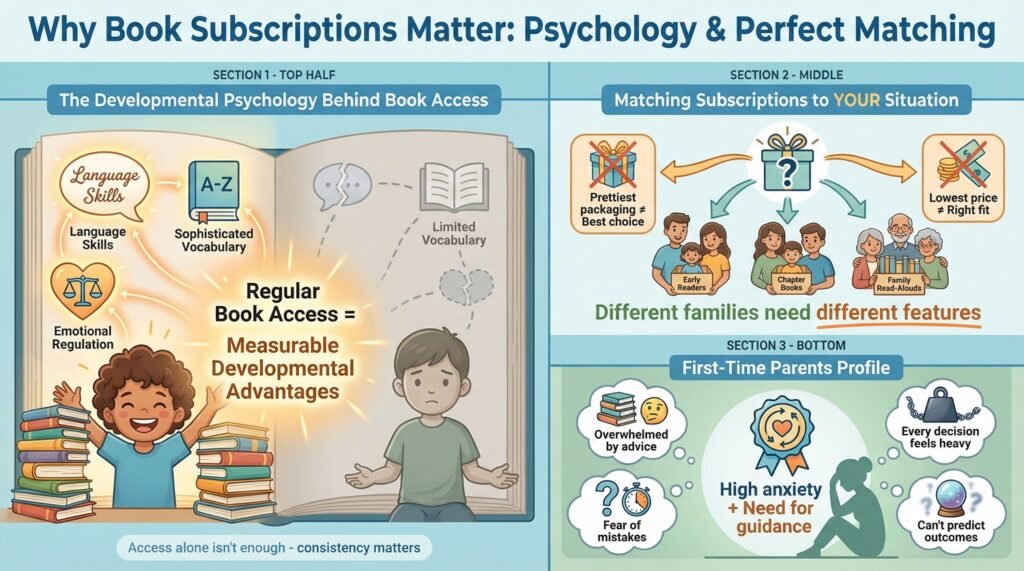
There’s solid research showing that children who have regular access to books develop significantly stronger language skills, more sophisticated vocabularies, and better emotional regulation compared to their peers without consistent book exposure. But access alone isn’t enough.
The magic happens when book exposure becomes routine and anticipated as opposed to sporadic. A child who gets books randomly throughout the year doesn’t develop the same relationship with reading as one who knows that a book box arrives on the fifteenth of every month.
Toddlers thrive on predictable routines because these create a sense of security and control in a world that often feels overwhelming and unpredictable to them. When a book box arrives on a consistent schedule, it becomes a ritual your child can anticipate and mentally prepare for.
The brain releases dopamine in response to anticipated rewards, and this neurochemical response actually strengthens the positive association with reading itself. Your toddler starts getting excited about books days before the box even arrives because their brain has learned to associate the subscription with pleasure.
This is fundamentally different from passive screen time. When a toddler watches a show, they’re receiving information without active cognitive processing.
The show moves forward whether they’re engaged or not.
Their brain can essentially check out while their eyes stay pointed at the screen.
Books require participation. Someone has to turn the page.
The child needs to process images and connect them to words.
Questions get asked and answered. Physical closeness happens naturally during shared reading in ways that don’t occur when a toddler is zoned out in front of a tablet.
The executive function benefits are particularly noteworthy. Following a story from beginning to end builds attention span and sequential thinking.
Your toddler has to remember what happened on earlier pages to understand what’s happening now.
They have to stay focused long enough to reach the conclusion.
Predicting what might happen next develops logical reasoning. When you pause and ask your child what they think will happen, they’re learning to use available information to make educated guesses.
This is the foundation of scientific thinking.
Discussing characters’ feelings and motivations builds theory of mind and emotional intelligence. When you talk about why a character might be sad or what made them angry, your toddler learns that other people have internal experiences different from their own.
They start understanding that behavior comes from feelings and that feelings come from circumstances.
These aren’t abstract academic benefits either. They translate directly into better behavior regulation, improved social skills, and increased school readiness.
A child who can follow a story from beginning to end can also follow multi-step instructions.
A child who understands character motivations can better interpret their playmates’ actions.
Matching Subscriptions to Your Specific Situation
Not all book subscriptions serve the same purpose, and figuring out what you actually need matters more than just picking whatever has the prettiest packaging or the lowest price point. Different family situations require different features.
If you’re gifting to a first-time parent, they’re probably overwhelmed by conflicting advice and secretly terrified they’re going to mess up their kid somehow. Every parenting decision feels weighted with long-term consequences they can’t fully forecast.
In this case, look for subscriptions that include robust supplementary materials. Twinkl’s integration with their educational platform provides activity guides, discussion prompts, and extension ideas that give nervous parents concrete ways to maximize each book’s value.
This scaffolding builds confidence and helps parents feel like they’re actively supporting their child’s development as opposed to just hoping for the best. When you have specific questions to ask and activities to try, you feel more able and intentional.
Working parents dealing with serious time constraints need something different entirely. They don’t want complicated activities or extensive guidance.
They need books that arrive reliably, are immediately age-appropriate, and can be grabbed for a quick bedtime read without requiring preparation or advance reading themselves.
Bookroo’s straightforward curation and focus on engaging stories without mandatory supplementary activities fits this need perfectly. The books themselves do the heavy lifting.
You can literally open the box, sit down with your toddler, and start reading immediately without feeling like you’re missing important preparatory steps.
Grandparents often want something that maintains connection across distance. When you live several hours or states away from your grandchildren, regular visits aren’t always possible.
You miss out on the daily interactions that build close relationships.
A subscription creates a shared experience even when you can’t be physically present. Calling to talk about the books that arrived creates natural conversation topics beyond the usual “how was your day” that toddlers struggle to answer meaningfully.
Some grandparents I know have gotten matching subscriptions, receiving the same books at their house so they can video chat while reading together. This changes the subscription from a gift into an ongoing relationship tool.
The child sees their grandparent holding the same book they’re holding, and suddenly that distance feels less significant.
Families concerned about screen time dependency need subscriptions that genuinely compete with digital entertainment as opposed to just existing as a worthy choice that never actually gets chosen. This means prioritizing highly engaging stories with vibrant illustrations that capture attention immediately.
If your books arrive and they’re visually dull or narratively boring, your toddler will keep reaching for the tablet instead. You need books that are actually more interesting than whatever show they’re used to watching.
Amazon Prime Book Box allows for significant customization around interests, so if your toddler is now obsessed with dinosaurs or mermaids, you can lean heavily into that enthusiasm to create genuine excitement about the physical books arriving. When a package shows up containing three dinosaur books and your child is now in a phase where they talk about nothing except velociraptors, those books will get read.
Setting Up Your Subscription for Maximum Impact
The initial setup process matters more than most people realize. You’re not just entering payment information and an address.
You’re establishing the foundation for how this subscription will function in your household.
Start by honestly assessing your child’s actual reading level as opposed to their age. Subscription services use age ranges as guidelines, but children develop at vastly different rates.
A developmentally advanced two-year-old might be ready for books typically marketed to three-year-olds, while a late talker might benefit from staying with simpler board books longer than the age guidelines suggest.
Most quality services allow you to adjust this over time, but starting in the right place prevents frustration on both sides. If books arrive that are too advanced, your toddler will disengage quickly and might develop negative associations with reading time.
If they’re too simple, your child will be bored and uninterested.
Think carefully about delivery frequency before committing. Monthly deliveries create consistent anticipation and work well for families that read regularly and go through books quickly.
If you’re reading together multiple times daily, monthly arrivals make sense.
But if your household is already chaotic and books tend to pile up unread, a less frequent schedule might actually increase engagement as opposed to decrease it. There’s no shame in choosing quarterly deliveries if that genuinely matches your family’s rhythm better.
Three books arriving every three months might get read more than monthly deliveries that create guilt and pile up.
I’ve found that physically involving your toddler in the subscription setup can increase their investment in the process, even if they don’t fully understand what’s happening. Letting them see you choose preferences, talking about what kinds of stories they like, showing them pictures on the website together all of this builds anticipation before the first box even arrives.
One parent told me they made a paper chain countdown with their three-year-old for the first delivery, and that physical representation of time passing helped their child understand when to expect the package. Each day they’d remove one link, building excitement gradually.
Creating Rituals That Stick
The subscription itself is just a tool. Its effectiveness depends entirely on how you mix it into your family’s life.
Random book arrivals that get tossed on a shelf create minimal impact compared to books that become part of an anticipated ritual.
Designate a specific time for opening the book box together. Some families make it a Friday afternoon transition from work week to weekend.
The box arrives, and suddenly Friday becomes special because that’s when you open it together.
Others use Sunday mornings as a calm, screen-free way to start the day. Before the chaos of the week begins, you sit together on the couch and see what arrived.
The specific timing matters less than the consistency. Your toddler should be able to forecast when book box time happens, and ideally, they should associate it with positive emotions and undivided attention from you.
I really encourage making the unboxing itself part of the ritual as opposed to rushing through it to get to the reading. Let your toddler open the package themselves if they’re able.
Talk about the anticipation before opening it.
Make guesses about what might be inside based on their interests.
Model excitement about books as objects, not just stories. This teaches that books themselves are valuable and worth caring for, which supports gentle handling and respect for belongings more broadly.
Once the books are revealed, resist the urge to immediately read them all in one sitting unless your child is genuinely demanding it. Spacing out the new arrivals across the month creates multiple moments of novelty as opposed to one overwhelming session.
Some families designate specific books for specific times like one for bedtime, one for independent looking, one for bath time discussions afterward. This repetition actually supports comprehension and memory better than single readings.
Your child needs to hear stories multiple times to fully absorb the language patterns and narrative structure.
Create a special place for the subscription books that’s separate from other books in your home. This doesn’t need to be fancy, just distinctive.
A small basket, a particular shelf, a cloth bag with the subscription service’s logo.
Physical separation helps your toddler understand that these books are part of a special category, which enhances their perceived value and the likelihood they’ll be chosen over other options. When everything is jumbled together, nothing feels special.
Frequently Asked Questions
What age should I start a book subscription for my toddler?
Most book subscriptions begin around age zero to six months, though the most value typically starts showing around twelve to eighteen months when toddlers can sit through board books and begin understanding narrative structure. Starting earlier means you’re building a library gradually, but starting later means more immediate engagement.
Are book subscriptions worth it if I can go to the library?
Libraries provide excellent free access to books, but subscriptions offer consistent curation without requiring regular trips. For families with unpredictable schedules or those who struggle with library return deadlines, subscriptions remove friction.
The ownership aspect also matters since toddlers can revisit favorites indefinitely.
How many books should a toddler have at home?
Research suggests having around 30-50 books accessible to toddlers creates the best engagement without overwhelming choice. Book subscriptions help you reach and maintain this number with age-appropriate titles that rotate as your child grows.
Can book subscriptions help with speech delays?
Regular book exposure supports language development significantly. While subscriptions alone won’t address diagnosed speech delays requiring professional intervention, consistent reading time provides crucial language modeling and vocabulary exposure that supports all aspects of communication development.
What book subscription is best for bilingual families?
Several services now offer bilingual options or Spanish-language subscriptions. Bookroo has bilingual selections, and Spanish Schoolhouse offers subscriptions specifically for Spanish language learning.
Look for services that allow you to specify language preferences during setup.
How do I get my toddler excited about books instead of screens?
Start by matching books to existing obsessions. If your child loves certain TV characters, find books featuring them as a bridge.
Make reading time physically close and interactive, and never use book time as punishment or obligation.
The subscription arrival itself creates novelty that screens can’t replicate.
Should grandparents get separate subscriptions for grandchildren?
If grandparents want to maintain long-distance connections, separate subscriptions can work beautifully. Getting matching subscriptions so you receive the same books allows for video calls where you read together despite physical distance, creating shared experiences.
Key Takeaways
A toddler book subscription works best when you treat it as a system for building consistent reading habits as opposed to just a convenient way to acquire books. The value comes from the ritual, the curation, and the removal of decision fatigue more than from price savings.
Match the subscription type to your specific situation. First-time parents need different features than working parents or long-distance grandparents.
There’s no universal best choice.
Set up intentional rituals around book arrivals and reading times. The subscription is a tool, but rituals create the actual impact on your child’s development and relationship with reading.
Expect that not every book will be a hit, and that’s completely fine. The goal is creating positive associations with reading overall, not achieving perfection with every single delivery.
Regularly update preferences as your child’s interests and abilities evolve. Subscriptions that worked brilliantly at age two need adjustment by age three to maintain engagement.
Evaluate whether the subscription is genuinely increasing reading time and enthusiasm versus just replacing books you would have acquired through other means. Only the former justifies the ongoing expense.