For the first twelve months of your baby’s life, every single interaction with the world around them functions as a scientific experiment. When your infant grasps your finger, stares intently at a ceiling fan, or shoves yet another toy into their mouth, they’re constructing the neural architecture that will support every skill they’ll ever develop, from walking and talking to reading and reasoning.
I’ve watched countless parents second-guess themselves about whether they’re doing enough to support their baby’s development. The toy industry certainly doesn’t help, flooding the market with products promising to boost intelligence, speed up milestones, and create tiny geniuses.
What really matters is this: your baby’s brain is wired to learn through sensory experiences, and the most powerful developmental tools are often the simplest ones you already have access to.
Understanding exactly how sensory play connects to specific developmental milestones can transform the way you interact with your baby. Instead of feeling pressured to provide constant entertainment or expensive educational toys, you’ll recognize the profound learning happening when your baby touches grass for the first time, watches sunlight move across a wall, or listens to your voice while you fold laundry.
The Science Behind Sensation and Learning
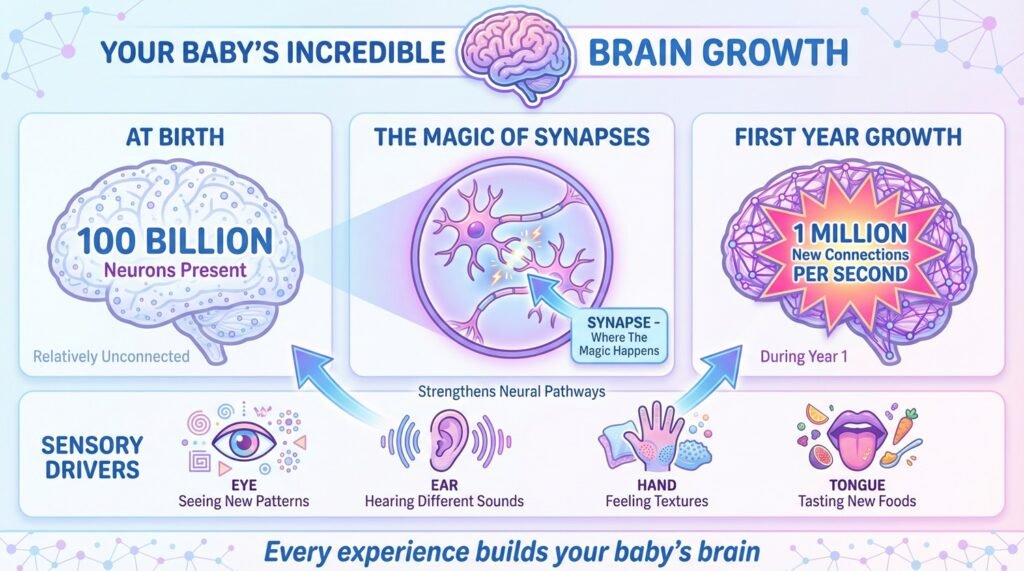
Your baby enters the world with about 100 billion neurons, but these brain cells are relatively unconnected at birth. The real developmental magic happens in the connections between neurons, called synapses.
During the first year, your baby’s brain creates these synaptic connections at a staggering rate of roughly one million new neural connections every single second.
Sensory experiences drive this remarkable growth.
Every time your baby sees a new pattern, hears a different sound, feels an unfamiliar texture, or tastes a novel food, their brain responds by forming and strengthening neural pathways.
The pathways that get used repeatedly become permanent highways of information, while unused connections are eventually pruned away. This process, called neuroplasticity, means your baby’s early sensory experiences are literally shaping the structure of their brain.
Different types of sensory input support different areas of development. Visual experiences strengthen the occipital lobe, where visual processing occurs.
Auditory input develops the temporal lobes, supporting language and sound recognition.
Tactile exploration builds connections in the parietal lobes, which process touch and spatial awareness. When multiple senses are engaged simultaneously, your baby’s brain creates cross-modal connections that support more complex cognitive abilities like memory, pattern recognition, and problem-solving.
Research from neuroscience has revealed something particularly fascinating about infant learning: babies don’t just passively receive sensory information. They actively seek it out, conducting what researchers call “embodied cognition experiments.” When your seven-month-old repeatedly drops a spoon from their high chair, they’re testing hypotheses about gravity, cause and effect, and object permanence.
Each repetition strengthens the neural pathways associated with these concepts, moving them from uncertain theory to established knowledge.
The Sensory Systems You Might Not Know About
Most parents are familiar with the traditional five senses: sight, hearing, touch, taste, and smell. But your baby is actually developing two additional sensory systems that are critical for milestone achievement and often overlooked in discussions of infant development.
The vestibular system, located in the inner ear, provides information about movement, balance, and spatial orientation. This system allows your baby to eventually understand where their body is in space, maintain balance when sitting and standing, and coordinate complex movements.
Vestibular input comes from activities like being rocked, swayed, bounced, or carried. This is one reason why babies universally love being held and moved through space, and why that rhythmic bouncing motion is so effective at soothing fussy infants.
The proprioceptive system involves sensors in muscles, joints, and connective tissues that provide information about body position and movement. This sensory system helps your baby understand how much force to use when grasping objects, where their limbs are without looking at them, and how to coordinate complex motor sequences.
Proprioceptive input comes from activities that provide resistance or pressure, like pushing against surfaces during tummy time, being held firmly, or later, crawling and pulling to stand.
These two systems work together with the traditional five senses to create what neuroscientists call “sensory integration,” the brain’s ability to organize and interpret information from multiple sensory sources simultaneously. Strong sensory integration forms the foundation for reaching physical milestones like rolling, sitting, crawling, and walking, as well as cognitive milestones like object permanence, cause-and-effect understanding, and early problem-solving.
How Sensory Experiences Map to Physical Milestones
The connection between sensory play and your baby’s physical development is remarkably direct. Each physical milestone your baby achieves needs more than just muscle strength.
It needs sensory feedback that tells their brain where their body is and how to move it effectively.
Consider the milestone of rolling over, which typically emerges between four and six months. Before your baby can execute this movement, they need vestibular feedback about which way is up and down, proprioceptive information about where their limbs are positioned, visual input to motivate them toward an interesting object, and tactile feedback from the surface they’re lying on.
Tummy time provides all of this sensory input simultaneously.
When your baby lifts their head during tummy time, they’re strengthening neck muscles while also giving their vestibular system practice with position changes. The slight frustration of being on their belly motivates movement tries, and the interesting textures under their hands provide tactile motivation to reach and shift weight.
Sitting independently, usually achieved between six and eight months, needs even more sophisticated sensory integration. Your baby needs vestibular input to understand balance and detect when they’re tipping, proprioceptive feedback to make constant micro-adjustments in muscle tension, visual input to help orient their head and trunk, and tactile feedback from their sitting surface.
Activities that provide varied vestibular input, like being held in different positions or gentle swaying games, directly support the sensory systems that make sitting possible.
Crawling, which emerges anywhere from six to ten months (and some babies skip entirely, which is also normal), demands coordination between visual, vestibular, proprioceptive, and tactile systems. Your baby needs to see something interesting enough to motivate movement, use vestibular and proprioceptive feedback to coordinate opposite arm and leg movements, and process tactile information from their hands and knees about the surface they’re moving across.
Babies who have regular opportunities to play on varied surfaces like textured mats, grass, carpet, and smooth floors develop the tactile discrimination and motor planning skills that support crawling more easily than babies who spend most of their floor time on a single surface type.
The milestone of pulling to stand and cruising along furniture, typically emerging between eight and twelve months, represents the culmination of a year’s worth of sensory-motor integration. This achievement needs visual motivation to stand, vestibular feedback for balance in an upright position, proprioceptive information about how much force to use when pulling up and how to maintain muscle tension while standing, and tactile feedback from hands and feet about stability and support.
Every earlier sensory experience, from newborn vestibular input during holding to six-month-old proprioceptive feedback during supported standing, has been building toward this moment.
The Cognitive Connection: From Sensation to Thought
While the link between sensory input and physical milestones is relatively intuitive, the connection between sensory play and cognitive development is equally profound but less immediately obvious. Your baby’s early cognitive abilities, things like memory, attention, categorization, and problem-solving, are built on a foundation of sensory experiences.
Object permanence, the understanding that objects continue to exist even when you can’t see them, typically develops between eight and twelve months. This cognitive milestone seems abstract, but it’s actually built from countless sensory experiences.
When you play peekaboo with a blanket, your baby receives visual input when you disappear and reappear, auditory input from your voice continuing even when you’re hidden, and tactile input if they reach out and touch the blanket.
These multisensory experiences teach their brain that things can be temporarily obscured without ceasing to exist. The same learning happens when toys roll under furniture, when you leave the room and return, or when they drop objects and see them reappear when retrieved.
Cause and effect understanding, another major cognitive milestone of the first year, is entirely dependent on sensory feedback. When your baby shakes a rattle and hears a sound, they’re learning that their actions cause outcomes.
When they push a ball and watch it roll, they’re developing understanding of physical causation.
When they cry and you respond, they’re learning about social cause and effect. Each of these lessons needs sensory input: visual feedback about what happened, auditory information about sounds produced, proprioceptive awareness of the action they took, and pattern recognition that connects the action to the outcome.
Early problem-solving abilities emerge from sensory exploration as well. When your nine-month-old encounters a toy that’s partially hidden under a blanket, they need to visually assess the situation, remember what the full toy looks like (object permanence and visual memory), plan a motor action to retrieve it (motor planning based on proprioceptive and visual information), and execute that plan while monitoring success through continued sensory feedback.
This seemingly simple scenario involves visual, tactile, proprioceptive, and cognitive systems all working together, systems that have been developing through every sensory experience since birth.
Memory development during infancy is particularly dependent on multisensory experiences. Research has consistently shown that memories formed through multiple sensory channels simultaneously are stronger and more durable than memories formed through a single sense.
When your baby explores a soft toy while you describe it as “fluffy” and “blue” and “squeaky,” they’re forming connections between the tactile sensation, visual appearance, auditory sound, and language label.
This multisensory encoding creates a richer, more accessible memory than any single sensory input alone could create.
Language Development Through Sensory Contexts
One of the most underappreciated connections in infant development is the link between sensory play and language acquisition. While it might seem that language is purely an auditory skill, research in developmental linguistics has revealed that babies actually learn language most effectively when words are presented in rich sensory contexts.
The reason for this comes from how the infant brain processes and stores information. When you hand your baby a ball and say “ball,” their brain processes more than just the sound of the word.
They simultaneously process the visual appearance of the ball, the tactile sensation of its surface and weight, the proprioceptive feedback from holding it, and potentially the auditory feedback if it bounces or contains a rattle.
All of these sensory inputs become associated with the language label “ball.” Later, when they hear the word “ball,” their brain activates linguistic centers alongside visual, tactile, and motor areas, creating a rich, multidimensional understanding of the concept.
This phenomenon, called “embodied semantics,” means that early language learning is fundamentally grounded in sensory and motor experiences. The more sensory-rich the context in which your baby hears a word, the better they’ll understand and remember it.
This is why labeling objects and experiences during sensory play is so powerful for language development.
When you narrate your baby’s sensory experiences with descriptive language like “You’re touching the soft blanket,” “That’s a loud rattle,” or “The water is cold,” you’re building their vocabulary in the most brain-compatible way possible.
Sensory play also supports the motor aspects of language development. The mouth and tongue movements required for speech are refined through oral exploration.
When your baby mouths toys, brings hands to mouth, and later explores food textures, they’re developing the oral motor control and sensory awareness that will eventually support articulation.
Babies who have rich oral sensory experiences, including varied food textures during the introduction of solids, often develop clearer articulation because they have better awareness and control of their oral structures.
Emotional Regulation Through Sensory Input
Beyond cognitive and physical development, sensory experiences play a crucial role in your baby’s emerging ability to regulate their emotional states. This connection is mediated through the nervous system, which responds to certain types of sensory input by either increasing arousal and alertness or promoting calmness and organization.
Understanding this connection can improve your approach to managing fussy periods and helping your baby develop self-soothing abilities. Certain types of sensory input are inherently organizing and calming to the nervous system.
Slow, rhythmic vestibular input, like rocking or swaying, activates the parasympathetic nervous system, promoting relaxation.
Deep pressure touch, like being held firmly or swaddled, has a similar calming effect. Soft, repetitive sounds, like white noise or gentle singing, help organize the auditory system and reduce sensory overwhelm.
Other types of sensory input are alerting and arousing. Fast, unpredictable movement, bright lights, loud or sudden sounds, and light tickling touch all activate the sympathetic nervous system, increasing alertness and arousal.
Neither type of input is inherently better. Your baby needs both calming and alerting sensory experiences throughout the day.
But understanding the difference allows you to use sensory input strategically to support emotional regulation.
When your baby is overstimulated and fussy, calming sensory strategies can help them regulate. Dim lighting, slow rocking, deep pressure holds, and soft continuous sounds all provide organizing input.
When your baby is lethargic or struggling to stay alert for feeding, alerting sensory input can help.
Upright positions, gentle patting, talking in an animated voice, or a slightly cool washcloth on the face can increase arousal appropriately.
As your baby develops, they begin to seek out sensory experiences that help them regulate their own emotional states. A seven-month-old might mouth a teething toy because the deep pressure on their gums is organizing and calming, beyond just oral exploration needs.
A ten-month-old might repeatedly bang toys together because the auditory and proprioceptive feedback helps them process excitement or frustration.
Recognizing these behaviors as early tries at self-regulation, rather than random actions, helps you support your baby’s developing emotional competence.
Creating a Sensory-Rich Environment Without Overwhelm
One of the biggest challenges parents face is balancing the desire to provide enriching sensory experiences with the very real risk of sensory overwhelm. Your baby’s developing nervous system can easily become flooded with too much sensory input, leading to fussiness, difficulty settling, and signs of stress.
The key is understanding that sensory richness means varied and interesting sensory experiences at suitable times, with plenty of calm periods for processing and integration.
Think of it as offering a varied menu rather than an all-you-can-eat buffet served all at once.
Creating zones in your home can help manage sensory input effectively. A play area might have varied textures, interesting visual elements, and safe objects for exploration, providing rich sensory input during active play times.
A sleep area should be calm and relatively understimulating, with dim lighting, minimal visual complexity, and soothing sounds if any.
This zoning helps your baby’s nervous system know what to expect in different contexts.
Timing matters tremendously for sensory experiences. Your baby’s ability to process and benefit from sensory input varies throughout the day based on their arousal level, tiredness, hunger, and recent experiences.
The same sensory activity that’s delightful and developmental when your baby is well-rested and fed can be overwhelming and distressing when they’re tired or hungry.
Reading your baby’s cues and offering sensory experiences when they’re in a calm, alert state maximizes benefit and minimizes overwhelm.
Quality matters far more than quantity when it comes to sensory experiences. Fifteen minutes of focused, responsive sensory play where you’re narrating experiences, following your baby’s interests, and engaging multiple senses builds more neural connections than an hour of passive time surrounded by toys.
Your presence, attention, and responsiveness are actually sensory inputs themselves, providing emotional regulation, social learning, and motivation for exploration.
Adapting Sensory Play for Different Temperaments
Not all babies approach sensory experiences the same way, and that’s completely normal and expected. Temperament, your baby’s innate behavioral style, significantly influences how they respond to sensory input and what types of sensory play they prefer.
Some babies are sensory seekers who crave intense input. These babies often love vigorous bouncing, don’t startle easily at loud sounds, enjoy rough textures, and seem to have endless energy for exploration.
If you have a sensory-seeking baby, they’ll benefit from opportunities for intense physical play, varied textures to explore, and lots of vestibular and proprioceptive input through movement activities.
These babies often do well with more active sensory play and may become frustrated with slow-paced or gentle activities.
Other babies are sensory-sensitive, responding strongly to relatively mild input. These babies might startle easily at sounds, prefer soft fabrics, become upset with bright lights, or resist certain textures like grass or sand.
If your baby is sensory-sensitive, they need the same diverse sensory experiences as all babies, but introduced more gradually and gently.
Start with familiar, preferred sensory inputs and very slowly introduce new experiences. Respect their protests about certain sensations rather than forcing exposure, as negative sensory experiences can create lasting aversions.
Many babies fall somewhere in the middle, showing a mixed sensory profile where they seek some types of input and are sensitive to others. Your baby might love visual stimulation but be sensitive to touch, or crave movement but dislike loud sounds.
Observing your individual baby’s responses to different sensory experiences helps you tailor activities to their preferences and needs.
Temperament is different from sensory processing disorders, which are clinical conditions that may need professional intervention. Typical temperamental variations are much more common and simply reflect the normal range of human sensory preferences.
A sensory-sensitive baby isn’t damaged or delayed. They’re just wired to respond more intensely to sensory input.
Similarly, a sensory-seeking baby doesn’t have a disorder. They just have a higher threshold for sensory stimulation.
The Overlooked Importance of Everyday Moments
Perhaps the most liberating realization for parents is that the most powerful sensory experiences often happen during routine caregiving moments rather than structured play activities. Diaper changes, getting dressed, bath time, and feeding all provide rich sensory input that supports development just as effectively as deliberate sensory play.
Diaper changes offer an ideal opportunity for tactile exploration and body awareness development. As you clean and change your baby while narrating body parts and sensations, you’re providing language input, tactile stimulation, and helping them develop a mental map of their body.
Allowing your baby to touch the clean diaper, feel the wipes, or grasp your hands during changes changes a practical task into a developmental opportunity.
Getting dressed provides exposure to varied textures and temperatures, developing tactile discrimination. The sensation of fabric moving across skin, arms going into sleeves, and legs going into pants all provide proprioceptive and tactile feedback.
Narrating the process with phrases like “Your arm goes in the sleeve” or “This shirt is soft” supports language development while increasing body awareness.
Bath time is perhaps the richest natural sensory experience in daily routines. Water provides intense tactile and proprioceptive input.
The sensation of temperature, the sight of water moving, the sound of splashing, and the smell of soap all engage multiple senses simultaneously.
Bath time also offers unique opportunities for observing cause and effect (splashing makes sounds and movement), exploring volume and container concepts (pouring water), and experiencing body boundaries (where my body ends and water begins).
Feeding time, especially once your baby begins exploring solid foods, becomes an extraordinary sensory laboratory. Different food textures, temperatures, tastes, and smells provide rich input.
Self-feeding, even when messy, offers crucial opportunities for motor planning, hand-eye coordination, and sensory exploration.
The social context of shared mealtimes adds emotional learning and language exposure to the sensory-motor experience.
Your Role in Sensory Development
Your role in supporting sensory development means being a secure base from which your baby can explore, a narrator who helps them make sense of sensory experiences, and a regulator who helps them manage overwhelming input.
Being a secure base means being physically and emotionally available while your baby explores. Your calm presence allows them to take sensory risks, reaching for new textures or investigating novel objects, because they know you’re nearby if they need reassurance.
This secure attachment actually makes babies more confident explorers, leading to richer sensory experiences and more learning opportunities.
Narrating sensory experiences means offering simple, descriptive language that labels what your baby is sensing.
“You’re touching the cold water,” “That toy is red,” “You’re bouncing up and down.” This narration creates labeling moments that support language development while helping your baby organize and understand sensory information.
Over time, these language labels become tools your baby can use to think about and remember their experiences.
Helping your baby regulate sensory input means noticing signs of overwhelm and responding by reducing stimulation, offering calming input, or simply ending the activity. It means recognizing when they’re understimulated and need more interesting input to stay engaged. This responsive approach teaches your baby that their signals are heard and their needs are met, supporting both emotional security and their developing ability to eventually regulate sensory input themselves.
People Also Asked
What are the seven senses in babies?
The seven senses in babies include the traditional five (sight, hearing, touch, taste, and smell) plus two additional sensory systems that are often overlooked. The vestibular system, located in the inner ear, processes information about balance, movement, and spatial orientation. The proprioceptive system, which involves sensors in muscles and joints, provides information about body position and the force needed for movements.
All seven senses work together to support infant development and milestone achievement.
Why does my baby put everything in their mouth?
Babies put everything in their mouth because oral exploration is a primary way they learn about objects during the first year. The mouth has more sensory receptors than hands in early infancy, making it the most effective tool for gathering information about texture, temperature, size, and shape.
This mouthing behavior also develops oral motor control and sensory awareness that will later support speech articulation and eating skills.
What is vestibular input for babies?
Vestibular input for babies refers to sensory information about movement, balance, and spatial orientation processed by the inner ear. This input comes from activities like rocking, swaying, bouncing, being carried, or any movement through space.
Vestibular experiences help babies develop balance, coordination, and an understanding of where their body is in space, which are essential for physical milestones like sitting, crawling, and walking.
When should I start tummy time with my newborn?
You can start tummy time from the first day home from the hospital. Begin with just a few minutes several times per day, placing your newborn on their stomach on your chest or lap.
Tummy time provides essential sensory input including tactile feedback from the surface, proprioceptive input from weight-bearing, and vestibular feedback from head movements.
This helps strengthen neck and shoulder muscles while supporting overall sensory development.
How do I know if my baby is overstimulated?
Signs of overstimulation in babies include turning their head away from stimulation, arching their back, crying or fussiness, hiccups, yawning, clenched fists, and difficulty making eye contact. Some babies become very still and quiet when overstimulated rather than fussy.
If you notice these signs, reduce sensory input by dimming lights, lowering noise levels, offering slow rocking, or moving to a calmer environment.
What textures are good for baby sensory play?
Good textures for baby sensory play include soft fabrics like fleece or velvet, bumpy textures like textured balls or rubber toys, smooth surfaces like wooden blocks, crinkly materials like tissue paper or crinkle toys, and natural materials like grass or sand (under supervision). Varying textures helps babies develop tactile discrimination, which supports fine motor skills and cognitive development.
Always ensure materials are safe and age-appropriate.
Does crawling help brain development?
Yes, crawling significantly supports brain development by requiring coordination between both sides of the body and brain, which strengthens neural connections between the left and right hemispheres. Crawling combines visual, vestibular, proprioceptive, and tactile sensory systems while developing spatial awareness, motor planning, and problem-solving skills.
However, some babies skip crawling and develop normally through other movement patterns.
Key Takeaways
Sensory play is the basic mechanism through which your baby builds the neural architecture supporting every area of development, from physical milestones and language acquisition to emotional regulation and problem-solving abilities.
Your baby’s brain forms about one million new neural connections per second during the first year, and sensory experiences drive this remarkable growth through repeated activation of neural pathways.
Understanding all seven sensory systems, including the often-overlooked vestibular (balance and movement) and proprioceptive (body position) systems, helps you provide comprehensive sensory experiences that support complete development.
Multisensory experiences that engage several senses simultaneously create stronger neural connections and more durable learning than single-sense activities, which is why narrating sensory play creates more powerful learning than silent exploration.
Physical milestones like rolling, sitting, crawling, and walking need sophisticated sensory integration alongside muscle strength, meaning varied sensory experiences directly support the systems that make these movements possible.
Cognitive abilities including object permanence, cause-and-effect understanding, problem-solving, and memory are built on foundations of sensory exploration and hands-on experience with the physical world.
Language development is fundamentally grounded in sensory experiences, and words learned in rich sensory contexts create stronger and more meaningful language understanding than words learned in isolation.
Certain types of sensory input naturally calm and organize the nervous system while others increase alertness and arousal, allowing you to use sensory experiences strategically to support your baby’s emotional regulation.
Individual temperament significantly influences sensory preferences, with sensory-seeking babies craving intense input while sensory-sensitive babies need gentler, more gradual exposure, and both profiles represent normal variations.
Everyday caregiving moments like diaper changes, getting dressed, bathing, and eating provide rich sensory experiences that support development just as effectively as structured play activities, often with more natural integration of multiple senses.