I remember standing in my living room surrounded by about fourteen partially chewed books, wondering if I’d made a terrible mistake ordering picture books for my eighteen-month-old. The beautiful illustrations were lovely, sure, but they were also now decorated with tiny teeth marks and mysterious sticky residue.
That experience taught me that not all book formats work equally well at every age, and developmental stage matters more than I’d initially thought.
Book subscriptions combine convenience with intentionality in one monthly delivery. They eliminate the exhausting process of browsing hundreds of titles while ensuring your child encounters quality literature curated by people who understand childrens developmental needs. But the format you choose, board books versus picture books, fundamentally shapes whether those books become beloved companions or frustrating objects that don’t quite fit your child’s current capabilities.
Think of it like shoes. You wouldn’t buy your toddler shoes designed for a seven-year-old just because they’re prettier or more sophisticated. The same principle applies to books.
Board books and picture books serve distinctly different developmental windows, and choosing the wrong format wastes money while potentially dampening your child’s emerging relationship with reading.
The stakes feel higher than they might initially appear. Research consistently shows that early literacy exposure profoundly impacts long-term academic success, vocabulary development, and even social-emotional intelligence.
But that exposure only works when books match where your child actually is right now, not where you wish they were or where marketing materials suggest they should be.
Understanding What Makes Board Books Different
Board books are engineered specifically for how babies and young toddlers interact with objects in their environment. They aren’t simply smaller or shorter versions of picture books.
The thick cardboard pages withstand bending, dropping, throwing, and yes, extensive mouthing. Because infants and young toddlers literally explore the world through their mouths, books designed for this age group need to survive that phase intact.
I’ve seen board books go through the washing machine and come out relatively unscathed. Try that with a picture book.
The content differs substantially too. Board books feature simplified narratives, often just single words or short phrases per page.
“Red ball. Blue truck. Happy dog.” Publishers design them this way because language acquisition at this stage focuses on object recognition, word-picture association, and phonetic repetition.
Your nine-month-old doesn’t need plot development. They need to hear “duck” seventeen times while looking at a duck illustration, building that crucial neural pathway between sound and meaning.
Color saturation in board books tends to be higher, with bolder contrasts. Infant vision develops gradually, and high-contrast images with vivid colors genuinely engage developing visual systems more effectively than subtle, watercolor-style illustrations.
You’ll notice board books often feature full-page illustrations with minimal background detail, allowing babies to focus on the primary object without visual confusion.
The physical size matters too. Board books typically measure smaller than picture books, designed for tiny hands that are just developing fine motor control.
Turning pages becomes an accomplishment, a tactile learning experience that builds hand-eye coordination alongside literacy exposure.
Watching a fourteen-month-old concentrate intensely on turning a single page, then beam with pride at their success, reminds you that these seemingly simple books serve complex developmental purposes.
What Picture Books Offer That Board Books Cannot
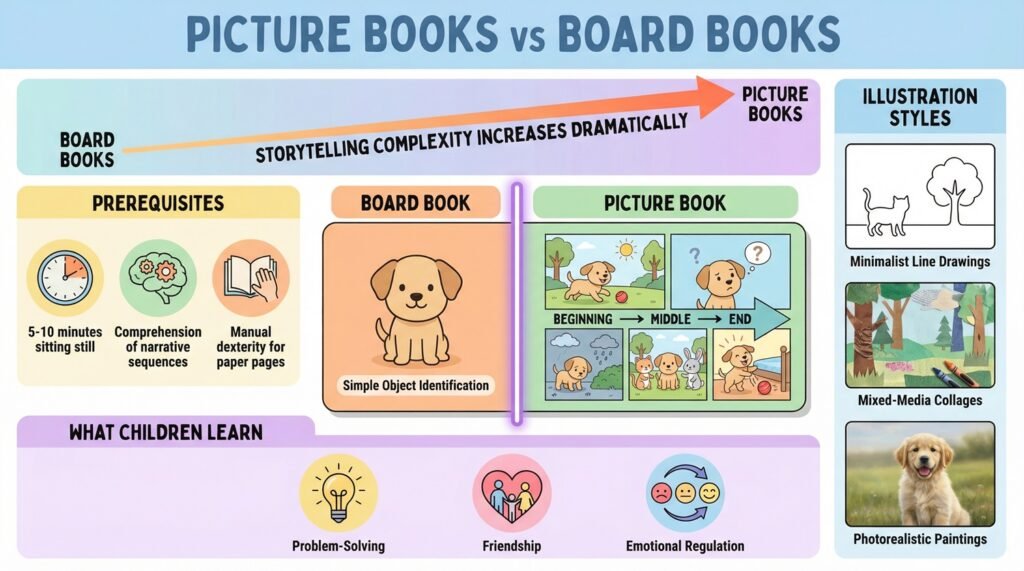
Picture books operate in an entirely different literary universe. They assume certain developmental milestones have already been reached: the ability to sit relatively still for five to ten minutes, comprehension of simple narrative sequences, and enough manual dexterity to turn paper pages without destroying them.
The storytelling complexity increases dramatically. Picture books develop characters, introduce conflict, and provide resolution.
They explore emotions, social situations, and imaginative scenarios that extend beyond simple object identification.
A board book might show a dog. A picture book tells you about the dog who lost his favorite toy, searched everywhere, felt sad, asked his friends for help, and finally found it under the bed. That narrative structure teaches children how stories work, beginning, middle, end, while also introducing concepts like problem-solving, friendship, and emotional regulation.
Illustration styles diversify significantly in picture books. You’ll encounter everything from minimalist line drawings to elaborate mixed-media collages to photorealistic paintings.
This variety exposes children to different artistic interpretations and visual storytelling techniques, expanding their understanding of how images convey meaning and emotion.
A child who sees only one illustration style develops a narrower visual vocabulary than a child exposed to diverse artistic approaches.
The vocabulary richness expands exponentially. Picture books intentionally introduce words beyond everyday conversational language, building linguistic foundations for later reading comprehension.
They use descriptive language, varied sentence structures, and sometimes even playful language patterns like alliteration or rhyme that board books typically avoid.
When a picture book describes a character as “bewildered” instead of “confused,” your child encounters a more sophisticated vocabulary word in context, where its meaning becomes clear through illustrations and story.
Picture books also introduce cultural literacy, fairy tales, fables, stories about historical figures or scientific concepts. They become bridges between home and the broader world, introducing ideas and experiences your child hasn’t encountered directly.
A board book might show a truck.
A picture book might tell the story of how construction workers use different vehicles to build a bridge, introducing concepts of engineering, teamwork, and how cities develop.
Matching Format to Developmental Reality
Here’s where parents often stumble: they choose based on what they want their child to be ready for as opposed to where their child actually is developmentally. I’ve watched friends optimistically purchase picture book subscriptions for their one-year-olds, convinced their child is “advanced,” only to find those books ignored in favor of simpler board books.
Children under two typically lack the attention span for picture book narratives. Their cognitive focus operates differently, they’re interested in labeling and categorizing objects, not following story arcs.
Pushing picture books prematurely doesn’t speed up development.
It just creates frustration for everyone involved.
Between ages two and three, you’ll notice a transition period. Some children start showing interest in simple picture book stories, especially if they’ve been regularly exposed to reading routines.
Others still prefer the familiar comfort of board books.
This variability is completely normal and doesn’t reflect intelligence or future reading ability.
Watch for these signs that your child might be ready to transition from board books to picture books: they can sit through a finish story without wandering away, they ask questions about illustrations, they ask the same story repeatedly (indicating narrative comprehension), and they handle books gently as opposed to treating them as chew toys or projectiles.
Age guidelines on subscription services provide useful starting points, but your specific child matters more than general recommendations. A particularly focused two-and-a-half-year-old might genuinely enjoy picture books, while a distractible three-year-old might still benefit from board books during this transitional phase.
Pay attention to what your child actually engages with as opposed to what developmental charts suggest they should be ready for.
Evaluating Curation Quality Beyond Marketing Claims
Every subscription service claims exceptional curation, but meaningful differences exist in how titles actually get selected. Some services employ former librarians, early childhood educators, or children’s literature specialists who understand developmental appropriateness and literary quality. Others rely primarily on popularity metrics or publisher relationships that may prioritize commercial considerations over genuine quality.
High-quality curation considers many factors simultaneously: developmental appropriateness, literary merit, illustration quality, diversity in representation, thematic variety, and whether books offer genuine engagement versus simply filling box space. The difference becomes obvious when you compare curated selections side by side.
Thoughtful curation delivers books that spark conversation, repeated readings, and genuine connection.
Mediocre curation results in books that get read once and forgotten.
I’ve noticed that services specializing in specific age ranges, like Bookroo’s dedicated board book subscription, tend to show deeper expertise in that category compared to services attempting to cover all ages simultaneously. Specialists understand the nuances of what makes a board book genuinely effective for language development versus merely cute.
They know which illustration styles work best for infant visual development.
They understand pacing and repetition patterns that support early language acquisition.
Look for services that explain their curation philosophy transparently. Vague claims about “hand-selected quality books” mean less than specific statements about criteria used, who makes selections, and how they confirm age-appropriateness.
Services that share actual curator credentials or detailed selection processes typically deliver more consistent quality.
The diversity question matters significantly too. Quality curation intentionally includes books featuring characters of different races, cultures, family structures, and abilities.
Children’s worldviews form early, and books either reinforce narrow perspectives or expand understanding of human diversity.
Services focusing explicitly on diversity, like OurShelves or WAM Book Bundle, fill a genuine gap in children’s literature access that mainstream publishers have historically neglected.
The Economics of Book Subscriptions
Subscription pricing initially seems straightforward until you calculate actual per-book costs including shipping, factor in whether you keep or return books, and consider long-term value.
Bookroo’s board book subscription delivers three books monthly starting at $21.95 plus shipping. With typical $4.95 shipping, you’re paying roughly $26.90 monthly or about $8.97 per book.
That’s reasonable for new, curated board books compared to $7-12 retail prices, especially considering the convenience and curation expertise.
You’re essentially paying about a dollar more per book than retail in exchange for not spending hours researching and selecting titles yourself.
Literati’s model operates differently. Their $9.95 monthly membership gets you five books to preview, but you only purchase books you decide to keep at retail price minus your membership credit.
If you love and keep all five books, you’re paying significantly more than the base fee.
If you return four books and keep one, you’re essentially paying $9.95 for a single book, which isn’t particularly economical unless that book would have cost you $15+ at retail anyway.
Calculate the true monthly cost by including shipping fees, which vary wildly between services. Some include shipping in the listed price, others add $4.95-7.95, substantially changing the value proposition.
A service listing books at $19.95 with free shipping offers better value than one listing books at $16.95 with $5.95 shipping, same total cost, but the marketing obscures the comparison.
Longer commitments typically offer 15-30% discounts off monthly pricing. An annual Bookroo subscription at 20% off reduces monthly cost from $21.95 to $17.56, saving over $50 annually.
But that needs confidence you’ll stay satisfied with the service for twelve months, which you can’t really assess until you’ve received several deliveries.
Consider the long-term value beyond immediate use. Board books have limited lifespan, most children outgrow them by age three.
Picture books stay readable and enjoyable for years, potentially serving many siblings or being donated to maintain value through extended use.
That $9 board book gets maybe eighteen months of active use. That $12 picture book might get read regularly for five years, making it a better long-term investment per reading.
For budget-conscious families, Highlights I Can Read offers exceptional value at $25 monthly for five early reader books, just $5 per book. That’s actually cheaper than purchasing I Can Read books individually through most retailers, where they typically run $6-8 each.
Personalization Versus Curated Surprise
Some families thrive on predictable personalization while others prefer the serendipity of curated surprise boxes. Neither approach is inherently superior.
They serve different family preferences and values.
Personalized services like Literati or Reading Bug Box ask about your child’s interests, reading level, current library, and preferences. Theoretically, this information enables more targeted curation matching your specific child.
In practice, results vary considerably based on how sophisticated the personalization algorithm is and whether human curators actually consider your input meaningfully.
I’ve heard parents describe both delightful and disappointing personalization experiences. One friend raved about how Literati’s selections perfectly matched her daughter’s dinosaur obsession, delivering three excellent dinosaur-themed books in consecutive months.
Another felt frustrated that despite indicating preferences, the delivered books seemed randomly selected without any obvious connection to her detailed responses about her son’s interests in construction vehicles and animals.
Curated surprise boxes eliminate the personalization process entirely. Services like Bookroo or Story Captain select monthly themes and choose books accordingly, without attempting to match person preferences.
This approach works beautifully if you trust the curator’s expertise and enjoy discovering unexpected titles.
It feels disappointing if you value control over book selection or have a child with very specific, narrow interests.
Hybrid approaches exist too. Some services offer theme preferences without deep personalization, you might show whether you prefer animal stories, transportation themes, or social-emotional learning focus without providing extensive detail about your specific child.
This middle ground provides some direction without requiring the detailed questionnaires that personalized services demand.
The surprise element holds genuine value for many families. Monthly deliveries become small celebrations, and children encounter books they’d never have uncovered through typical browsing.
This serendipity expands reading horizons beyond familiar preferences, introducing variety that shapes developing literary tastes.
A child who only ever reads truck books because that’s what they ask misses out on stories about friendship, nature, music, and countless other topics that might spark new interests.
Reading Subscriptions as Gifts
Subscriptions make compelling gifts from grandparents, aunts, uncles, or family friends seeking meaningful, recurring presents. Unlike toys that break or clothes that get outgrown, books build home libraries with lasting developmental value.
Most services offer dedicated gift subscriptions with special packaging and gift messaging. You can typically purchase 3-month, 6-month, or annual gift subscriptions paid upfront, with books delivered monthly directly to the recipient.
This spreads the gift across many occasions as opposed to concentrating everything in one overwhelming delivery.
The recurring nature creates ongoing connection. Grandparents across the country can join in their grandchild’s literacy development through monthly book deliveries, even when geographic distance prevents regular in-person visits.
Some families establish rituals around subscription arrivals, like video calls where grandchildren show received books to gift-giving grandparents, maintaining connection through shared reading experiences.
Gift subscriptions work particularly well when aligned with the child’s current developmental stage. Board book subscriptions for babies under one show thoughtfulness about age-appropriateness as opposed to defaulting to generic baby gifts that may or may not get used. Picture book subscriptions for preschoolers support pre-reading skills during critical developmental windows.
Consider gift subscriptions for specific transitions too, a board book subscription when a baby is born, transitioning to picture books around the second or third birthday, and eventually moving to early reader subscriptions as children begin independent reading. These milestone gifts thank developmental progress while providing resources that support continued growth.
Common Mistakes That Waste Money and Create Frustration
Choosing subscriptions based exclusively on advertised monthly price without calculating per-book costs including shipping creates false economy. A $9.95 service where you keep one of five books costs more per keeper than a $25 service delivering three books you consistently love and keep.
Do the actual math for your specific usage pattern as opposed to comparing headline prices.
Selecting formats beyond your child’s developmental readiness wastes money and creates disappointment. Picture books delivered to a one-year-old who tears pages and can’t focus on narratives gather dust while you feel guilty about the monthly charge.
Board books sent to a five-year-old feel insulting and go unread.
Match the format to where your child actually is right now, not where you hope they’ll be in six months.
Ignoring your child’s actual engagement with received books leads to continuing subscriptions that don’t serve your family. If three months of deliveries have resulted in books your child consistently ignores, that’s valuable data suggesting either the service isn’t the right fit or your child isn’t ready for that format yet.
Don’t keep paying for books that don’t get read just because you feel like you should make it work.
Failing to establish consistent reading routines means subscription books arrive but don’t get read. The subscription itself doesn’t create readers, dedicated daily reading time does.
Without carving out 15-20 minutes daily for book sharing, subscriptions become expensive shelf decorations as opposed to literacy tools.
The books are only valuable if you actually use them.
Neglecting to provide feedback to personalized services prevents improvement in future selections. These services explicitly ask for input after each delivery specifically so they can refine curation for your family.
Silence means they’ll continue sending similar books whether or not they’re actually resonating with your child.
Take two minutes to rate received books and provide brief feedback, it genuinely improves subsequent selections.
Overvaluing packaging extras like activity guides, stickers, or themed items adds cost without necessarily adding value. If your primary goal is accessing quality books affordably, simpler subscriptions deliver better value than services including extensive extras that may or may not get used. Those activity guides often go straight to recycling.
You’re paying for them whether you use them or not.
Starting Your Subscription Experience
Begin with honest assessment of where your child is developmentally right now, not where you hope they’ll be soon. For children under two, board book subscriptions almost always prove more suitable than picture books, regardless of how advanced you believe your child to be.
Developmental readiness shows up in behavior, can they sit through a story, do they turn pages gently, do they ask questions about narratives.
If not, they need board books still.
Take advantage of introductory offers and discount codes aggressively. Many services offer substantial first-order discounts.
Highlights I Can Read provides 80% off first orders.
Literati offers $25 credits through referral links. Bookroo regularly runs 15% off promotions.
These trial periods let you assess curation quality, packaging, and your child’s engagement before committing to longer subscriptions.
Search for current discount codes before subscribing, you’ll almost always find something that reduces initial cost significantly.
Start with month-to-month subscriptions as opposed to annual commitments until you’ve confirmed the service genuinely fits your family. Flexibility matters more than savings during the evaluation period.
Once you’ve received three or four deliveries and consistently loved the selections, upgrading to longer commitments for discount benefits makes sense.
But don’t lock yourself into twelve months based on one good box.
Combine subscriptions with library services as opposed to viewing them as library replacements. Subscriptions introduce new titles and build your permanent home library.
Libraries provide unlimited exploration across formats and topics.
This combination maximizes book exposure while managing household spending. Use subscriptions to acquire books you’ll read hundreds of times.
Use libraries for books you’ll read once or twice to decide if they warrant purchasing.
Monitor and adjust quarterly. Children’s developmental stages shift rapidly during toddler years.
A board book subscription perfect in January might need transitioning to picture books by June as your child’s attention span and comprehension evolve.
Most services allow plan adjustments without penalty. Don’t feel locked into initial choices, adapt as your child grows.
Frequently Asked Questions
What age should I switch from board books to picture books?
Most children transition between ages two and three, but readiness matters more than age. Watch for signs like sitting through finish stories without wandering, asking questions about illustrations, requesting repeated readings, and handling books gently.
Some children show readiness at twenty months, others need board books until three and a half.
Follow your specific child’s developmental cues as opposed to age guidelines.
Are book subscriptions worth it compared to buying books myself?
Subscriptions save time researching quality titles and often deliver books at comparable or better prices than retail once you factor in curation expertise. If you typically spend thirty minutes browsing online or in bookstores for each book purchase, subscriptions eliminate that time investment.
They work best for families who value convenience and trust curator expertise over controlling every selection.
Can I get board books through library instead of subscribing?
Libraries offer excellent board book selections, but availability varies by library system and popular titles often have long wait lists. Subscriptions guarantee new books arriving monthly that become permanent parts of your home library.
Combining both approaches works well, subscribe for books you’ll read hundreds of times, borrow from libraries for variety and exploration.
Which subscription service has the best board books for babies?
Bookroo’s dedicated board book subscription consistently receives high ratings for curation quality, durability of selected titles, and age-appropriateness. Their curators specialize in early childhood literature and understand what makes board books effective for language development.
However, “best” depends on your priorities, if diversity matters most, consider OurShelves or WAM Book Bundle instead.
Do picture book subscriptions work for kids who can’t read yet?
Picture books are designed for pre-readers and work beautifully for children ages three through early elementary years. The adult reads aloud while the child follows along with illustrations.
This shared reading builds pre-reading skills like print awareness, narrative comprehension, and vocabulary development.
Kids don’t need reading ability to benefit from picture books.
How many books should come in a monthly subscription?
Board book subscriptions typically include 2-3 books monthly, while picture book subscriptions range from 2-5 books depending on price point. Three books monthly provides good variety without overwhelming shelf space.
More books aren’t necessarily better, quality of curation matters more than quantity.
What happens if my child doesn’t like the books that arrive?
Most subscriptions offer return or exchange policies, though specifics vary by service. Literati explicitly encourages returning unwanted books.
Others like Bookroo operate on keep-all models without returns.
Check specific service policies before subscribing. If your child consistently dislikes selections, provide feedback to improve future curation or consider switching services.
Key Takeaways
Board books serve infants and toddlers ages 0-3 who need durable materials that withstand mouthing, throwing, and enthusiastic handling while supporting object recognition and early language development through simple, repetitive text.
Picture books target children ages 3-8 who possess enough attention span for narratives, manual dexterity for paper pages, and cognitive readiness for story comprehension, character development, and expanded vocabulary.
Choose based on your child’s actual developmental stage as opposed to age guidelines or aspirational advancement, watching for signs of readiness like sustained attention, gentle book handling, and narrative engagement.
Calculate true subscription costs including shipping fees and consider whether you keep all delivered books or return some, dramatically affecting per-book economics.
Quality curation distinguishes exceptional services from mediocre ones, prioritize services with transparent selection criteria, specialist curators, and commitment to diversity in representation.
Start with trial subscriptions using discount codes before committing to annual plans, watch your child’s genuine engagement quarterly, and adjust formats as developmental capabilities evolve.