You might think the one covered in flashing lights and battery-powered music would be the winner, but babies become genuinely overwhelmed and disengaged from those overstimulating setups. Choosing the right activity gym needs understanding what actually happens in your baby’s brain and body during those precious play sessions.
Creating an environment where your baby can explore at their own pace builds strength and neural connections without bombardment by sensory overload. Parents drop serious money on elaborate systems with every bell and whistle, only to find their baby more engaged with a simple wooden frame and a few thoughtfully chosen hanging toys.
The key is knowing what to prioritize, and honestly, most first-time parents get it backwards because they follow marketing hype instead of developmental science.
When you understand the fundamentals of infant development and what makes a truly safe, effective activity gym, you can make a choice that serves your baby through many developmental stages while actually fitting into your life. This means creating a foundation for your baby’s physical and cognitive growth during those crucial first months when their brain is developing at an absolutely incredible rate.
Understanding What Actually Happens During Play Gym Time
When your baby lies under an activity gym, their brain is forming neural pathways at a rate that will never be matched again in their lifetime. Every time they reach for a hanging toy and miss, then try again and make contact, they build connections between their visual cortex and motor control centers.
The process is really quite remarkable when you think about it.
The physical benefits are equally significant. That seemingly simple act of reaching overhead needs coordination between many muscle groups, with core stabilizers, shoulder muscles, and arm extensors all working together.
When your baby does tummy time on the mat, they build the neck and upper body strength that will eventually allow them to sit, crawl, and walk.
These physical developments are the entire point of play gym time.
What surprised me most when I really dug into the research was how much cognitive development happens through physical exploration. Jean Piaget’s theory of cognitive development emphasizes that babies learn through sensory and motor experiences during those first two years.
When your baby grabs a rattle and it makes a sound, they learn cause and effect, which is a foundational concept for all future learning.
The sensory aspect deserves special attention because many commercial gyms completely miss the mark here. Your baby needs variety in textures, colors, and sounds, but there’s a critical threshold where more becomes too much.
Babies turn their heads away from gyms that have too much going on, and that’s their nervous system saying “this is overwhelming.” The sweet spot is providing enough sensory input to engage multiple senses without pushing into overstimulation territory.
The Safety Foundation You Cannot Compromise On
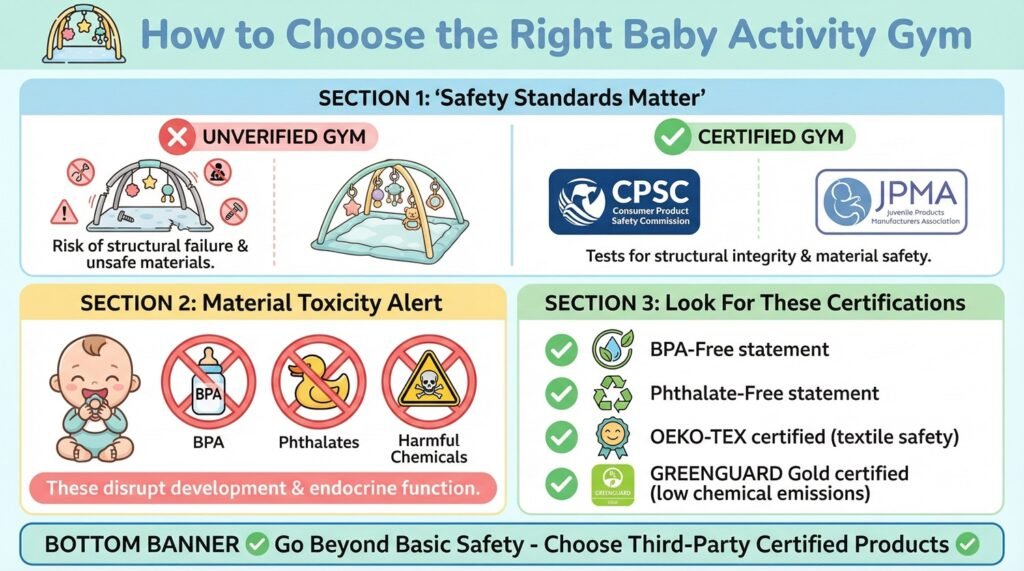
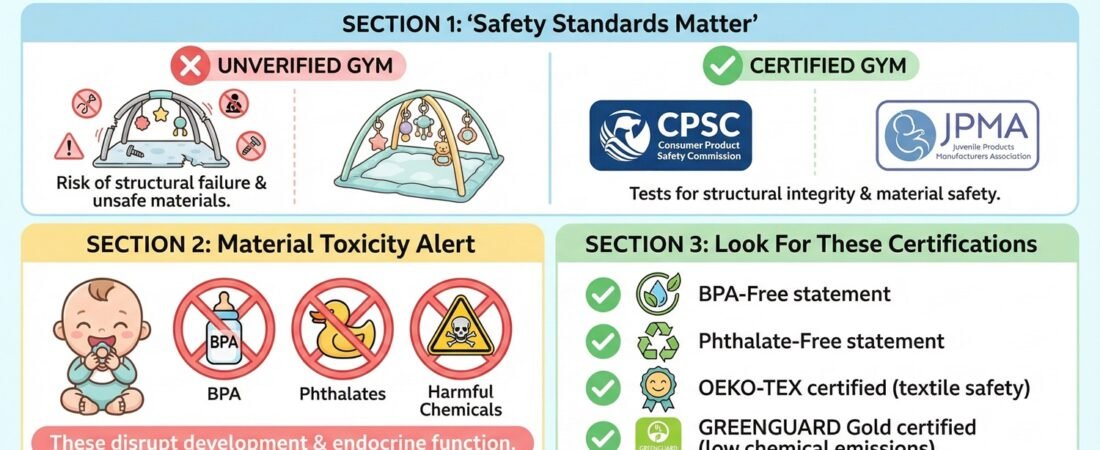
Safety standards vary wildly between manufacturers. You need to verify that any gym you’re considering meets CPSC or JPMA approval standards at least.
These certifications mean the product has been tested for structural integrity and material safety according to specific protocols.
Material toxicity becomes particularly important because your baby will absolutely put these toys in their mouth. BPA, phthalates, and other chemicals commonly used in plastics can disrupt endocrine function and have been linked to developmental concerns.
Look for products that explicitly state they’re free from these substances, and ideally go further with third-party certifications like OEKO-TEX for textiles or GREENGUARD Gold for overall chemical emissions.
The European EN 71 standard is considered the gold standard for toy safety, and it’s actually more stringent than U.S. requirements in several areas. If you find a gym that meets this standard, you get a higher level of assurance about material safety.
This matters because babies spend extended periods in direct contact with these products, and their developing systems are far more vulnerable to chemical exposure than adults.
Construction quality affects both safety and longevity. Cheap gyms show frame connections that start wobbling after a few weeks of use, creating instability that defeats the purpose of providing a safe exploration space.
Check that fasteners are secure, surfaces are smooth without sharp edges, and if toys are removable, they’re large enough to prevent choking hazards.
The frame should have a broad, stable base that won’t tip even when your baby gets more mobile and starts pulling on things.
One aspect that often gets overlooked is the play mat itself. A thin, poorly padded mat provides inadequate cushioning when your baby inevitably face-plants during tummy time or when they’re learning to sit.
The mat needs enough thickness to absorb impact while still being firm enough to provide a stable surface for movement.
Flimsy mats also tend to bunch and slide, creating extra safety concerns.
Wooden Versus Plastic: The Material Debate
The frame material decision has more implications than most parents realize. Wooden gyms offer natural aesthetics and exceptional durability.
They’re the option you can genuinely pass down to a second or third child without significant wear.
Wood doesn’t wobble the way plastic connections often do after repeated assembly and disassembly.
From a toxicity standpoint, untreated or naturally finished wood eliminates concerns about plastic chemicals entirely. The downside is that wooden gyms are typically heavier and less portable.
If you’re planning to move your gym between rooms often or take it when traveling, that added weight becomes a practical consideration.
Wooden options also tend to be pricier upfront, though the longevity often makes them more cost-effective over time.
Plastic gyms can be excellent when they’re made from high-quality, non-toxic materials. They’re generally lighter and more portable, and many designs fold for easier storage.
The challenge is that plastic quality varies enormously.
Cheap plastic will crack, connections will loosen, and colors may fade. If you go the plastic route, verify that it’s sturdy, thick plastic with secure connection points, not the flimsy variety that feels like it might snap under pressure.
The best plastic gyms use wood for the structural frame with plastic elements only for specific features like toy connectors. This hybrid approach gives you durability where it matters most while keeping weight manageable.
The Play Mat Material Makes a Difference
The mat is where your baby will spend most of their time, and the material choices here significantly impact both comfort and safety. Organic cotton mats with OEKO-TEX certification offer softness and breathability while meeting strict chemical safety standards.
Cotton also tends to be more washable than synthetic choices, which is crucial because these mats see their share of drool, spit-up, and diaper incidents.
Padded foam mats provide excellent cushioning, but you need to verify what type of foam is used. Some foams contain flame retardants and other chemicals that you definitely don’t want your baby breathing in or absorbing through skin contact. High-density foam certified as non-toxic offers the cushioning benefits without the chemical concerns.
Natural fiber options like wool or linen bring extra benefits. Wool is naturally antimicrobial and temperature-regulating, while linen is incredibly durable and becomes softer with washing.
These materials often come with a higher price point, but the combination of safety, comfort, and longevity can justify the investment.
Thickness is another consideration that parents often underestimate. A mat that’s too thin provides inadequate protection during tumbles, while an overly plush mat can actually hinder movement as babies struggle against excessive give.
About one to two inches of cushioning hits the right balance for most babies.
Designing for Development Across Stages
Your newborn and your nine-month-old have completely different developmental needs, and the best activity gyms adapt across these stages rather than becoming obsolete after a few months. Understanding how to use your gym throughout these phases maximizes both value and developmental benefit.
For newborns in those first two months, visual stimulation is primary. Their vision is still developing, so high-contrast patterns and toys positioned about eight to twelve inches from their face work best.
At this stage, sessions should be brief, just one to five minutes, because their neck muscles fatigue quickly.
Don’t expect much interaction with toys yet. They’re primarily working on visual tracking and getting comfortable with tummy time.
Between three and six months, things get much more interactive. This is when reaching and grasping really take off, and your baby will start intentionally batting at toys.
They’re building the hand-eye coordination that will eventually allow them to pick up small objects.
Sessions can extend to ten or fifteen minutes, two to three times daily. This is also when toy variety becomes more important.
Different textures and sounds maintain engagement as their curiosity explodes.
The six to nine month period is when many parents think their gym has outlived its usefulness, but actually this is when it serves a different but equally valuable purpose. Your baby is working on sitting and preparing to crawl.
The gym becomes a safe space to practice these skills, with the mat providing cushioning for inevitable topples.
Toys can be positioned to encourage reaching while sitting, which builds core strength and balance.
From nine to twelve months and beyond, the gym transitions into more of a climbing and pulling apparatus for babies working on standing. Some gyms convert to accommodate this stage with adjusted configurations.
Even simple wooden frames can serve as pulling-up supports when your baby is practicing standing, making them valuable well into toddlerhood.
The Toy Configuration Strategy
Fixed toys look clean and integrated, but they create a significant limitation. You can’t adapt or rotate them as your baby’s interests and abilities change.
Babies lose interest in gyms with fixed toys around month four or five simply because there’s nothing new to learn.
Removable toys solve this problem beautifully. You can start with simpler, high-contrast options for newborns, then swap in more complex textures and sounds as development progresses.
Weekly rotation prevents habituation, that process where repeated exposure makes something no longer interesting.
Your brain filters out constant stimuli the same way you don’t notice your home’s smell but guests do.
The practical advantage of removable toys extends to cleaning. You can wash toys individually without dealing with the entire gym structure, which makes maintenance far more manageable.
You can also replace toys if they become damaged or add new options that match emerging interests.
Some parents opt for simple mats without any built-in toys, then add their own hanging options using clips or ribbons. This approach offers most flexibility and allows you to incorporate specific toys that align with your parenting philosophy, whether that’s Montessori-inspired wooden toys, handmade fabric options, or whatever fits your values.
Setting Up the Physical Environment
Placement matters more than you might think. You need a flat, stable surface away from furniture edges, cords, and other hazards.
Parents set up gyms next to couches thinking it’s convenient for supervision, but then their increasingly mobile baby tries to climb onto the couch, creating safety issues the gym was meant to prevent.
Lighting affects your baby’s visual experience significantly. Natural light is ideal, but avoid direct sunlight that creates glare or gets in your baby’s eyes.
If you’re using artificial lighting, confirm it’s bright enough for clear vision but not harsh.
Shadows and contrasts help babies distinguish objects, so some variation in lighting is actually useful.
The room temperature deserves consideration because your baby will be lying still and may cool down, especially during extended play sessions. They’re also typically in lighter clothing to allow unrestricted movement.
Keep the space comfortably warm, but not hot enough that you need to worry about overheating.
Creating a boundary around the gym helps as your baby becomes more mobile. Even if they can’t crawl yet, they’ll start rolling and scooting.
Having clear space around the gym prevents collisions with furniture or other objects.
This boundary also signals to other household members, including pets, that this is baby’s designated space.
The Supervision Balance
Activity gyms are designed for independent play, which is developmentally valuable. Babies need opportunities to explore without constant adult intervention.
But independent doesn’t mean unsupervised. You should always be within line of sight and able to respond quickly if needed.
The supervision sweet spot is what I call “present but not hovering.” Stay in the same room, periodically making eye contact and offering verbal encouragement, but resist the urge to constantly adjust toys or redirect your baby’s attention. Let them work through challenges like reaching for a toy that’s slightly out of range.
The effort builds both physical skills and problem-solving abilities.
This is also time for narration, which dramatically enhances language development even though your baby can’t talk back yet. Describe what they’re doing: “You’re reaching for the yellow rattle” or “That crinkly sound is interesting, isn’t it?” This running commentary builds vocabulary and helps them connect words with actions and objects.
You’ll notice your baby’s cues about when they’ve had enough. Fussing, looking away from toys, or trying to roll off the mat all signal that it’s time for a break.
Pushing past these cues teaches them that their communication isn’t being heard, which isn’t the message you want to send.
Common Setup Mistakes That Limit Effectiveness
The most frequent mistake I see is positioning toys too high. Parents think they’re giving babies something to reach for, but if toys are more than a few inches above their reach range, it’s just frustrating rather than challenging.
Toys should be positioned so that reaching needs effort but success is achievable.
As your baby grows and their reach extends, you can adjust heights accordingly.
Overcrowding the gym with too many toys creates the opposite problem. There’s so much happening that your baby can’t focus on any one thing.
Three to five toys at a time is plenty.
More than that becomes visual clutter that actually reduces engagement rather than enhancing it.
Neglecting the mat quality in favor of focusing on toys is another common misstep. Your baby spends more time in contact with the mat than any individual toy, so mat comfort, cleanliness, and safety are paramount.
A premium gym with a cheap mat is a bad investment.
Using the gym as a containment device rather than an engagement space fundamentally misunderstands its purpose. Parents plop their baby under a gym and then leave the room to do chores, treating it like a baby jail.
The gym should be part of interactive time, even if you’re not directly playing with your baby.
Your presence and periodic engagement make the experience far more valuable.
Ignoring hygiene is surprisingly common. These gyms accumulate dust, drool, and various baby fluids.
Regular cleaning is essential for preventing bacterial growth and maintaining a healthy play environment.
Most mats are machine washable, and toys can typically be wiped down with gentle cleaner. Build this into your weekly routine.
Strategic Toy Rotation and Progression
Toy rotation matches toys to developmental stages. For young babies, prioritize high-contrast visual toys and options with gentle sounds like rattles or crinkles.
Textures should be soft and varied. As visual development progresses around three months, you can introduce more colors and patterns.
When reaching and grasping become more intentional around four to five months, incorporate toys with different grip sizes and weights. Some should be easy to grab, while others need more coordination.
This progressive challenge builds fine motor skills systematically.
Mirror toys become fascinating around six months when babies start recognizing themselves. Textured fabrics satisfy their growing want to explore through touch.
Toys that move or swing when struck teach cause and effect in increasingly obvious ways.
The rotation schedule doesn’t need to be rigid. Weekly swaps work well for many families, but you can adjust based on your baby’s interest level.
If they’re still actively engaged with current toys, there’s no need to change yet.
If they’re showing disinterest, it’s time for something new.
Keep a small basket of “backup” toys that you rotate in when the gym toys need washing or when you need to quickly renew interest. This prevents the desperation of a baby who’s bored with their gym while all the toys are in the laundry.
People Also Asked
What age should babies start using an activity gym?
You can start using an activity gym from birth, though newborns will only have brief sessions of one to five minutes focused on visual tracking. Most babies begin actively engaging with hanging toys around three to four months when their hand-eye coordination develops enough for intentional reaching and grasping.
How long should a baby stay under an activity gym?
Newborns should have brief sessions of one to five minutes, several times daily. By three to six months, sessions can extend to ten to fifteen minutes, two to three times per day.
Always watch for your baby’s cues indicating they’re done, like fussing or looking away from toys, rather than sticking to rigid time limits.
Are wooden baby gyms safer than plastic ones?
Wooden gyms made from untreated or naturally finished wood eliminate concerns about plastic chemicals like BPA and phthalates. However, high-quality plastic gyms made from certified non-toxic materials can be equally safe.
The key is verifying that any gym meets CPSC or JPMA safety standards and explicitly states it’s free from harmful chemicals.
Do I need to buy special toys for a baby activity gym?
Many activity gyms come with toys included, but removable toy options give you flexibility to rotate items as your baby develops. You can use clips or ribbons to attach your own toys to simple wooden frames.
The most important factor is ensuring any toys are appropriately sized to prevent choking hazards and made from non-toxic materials.
How do I clean a baby activity gym mat?
Most activity gym mats are machine washable, though you should check the manufacturer’s instructions. For spot cleaning between washes, use a gentle, baby-safe cleaner and wipe down the surface.
The toys can typically be wiped with a damp cloth and mild soap.
Clean your gym weekly or more often if there are spills or accidents.
Can a baby sleep in an activity gym?
No, babies should never sleep in an activity gym. These are designed for supervised, active play only.
Always move your baby to a safe sleep space like a crib or bassinet when they show signs of drowsiness.
Unsupervised sleep in an activity gym poses suffocation and positional asphyxia risks.
What’s the difference between tummy time and back time on an activity gym?
Back time allows babies to practice reaching and batting at hanging toys while developing visual tracking and hand-eye coordination. Tummy time builds the neck, shoulder, and upper back strength needed for sitting, crawling, and walking.
Both positions serve different developmental purposes and should be incorporated into your baby’s daily routine.
How do I know if my baby is overstimulated by their activity gym?
Signs of overstimulation include turning their head away from toys, fussing or crying, arching their back, clenching fists, or appearing glazed or unfocused. If you notice these behaviors, remove your baby from the gym and provide a calmer environment. Reduce the number of toys or choose options with less intense colors and sounds.
Key Takeaways
Choose safety certifications and non-toxic materials over flashy features. Look for OEKO-TEX certification for mats, CPSC or JPMA approval for overall safety, and explicit BPA and phthalate-free materials for all components your baby will contact.
Match toys and activity expectations to your baby’s actual developmental stage. Start with high-contrast visual stimulation for newborns and progressively add complexity as reaching, grasping, and coordination develop through the first year.
Prioritize removable toys over fixed options. This allows rotation that prevents habituation and adapts to changing developmental needs across months.
Wooden frames offer superior durability and stability for multi-child use. Quality plastic gyms provide portability advantages if your lifestyle needs frequent moves or travel.
The play mat quality matters as much as the frame. Adequate cushioning, washability, and certified non-toxic materials are essential since your baby spends most gym time in direct contact with this component.
Position toys within achievable reach rather than aspirationally high. Limit to three to five toys at once to prevent overwhelming visual clutter that reduces engagement.
Supervise consistently while allowing independent exploration. Your presence and verbal narration dramatically enhance both safety and language development without requiring constant physical intervention.
Start tummy time in brief sessions for newborns and progressively extend duration as neck and upper body strength develop. Use hanging toys as motivation for head-lifting and pushing up.
Regular toy rotation every one to two weeks maintains engagement across developmental stages. This prevents the boredom that makes babies lose interest around four to five months.
Choose aesthetics that combine with your actual living space. A gym you enjoy looking at is one you’ll consistently set up and use rather than leaving packed away because of visual irritation.