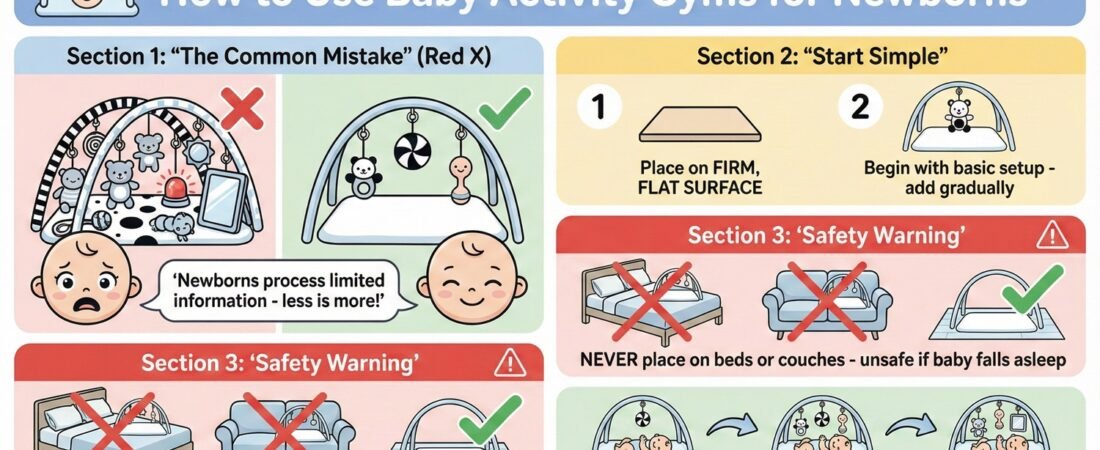
When you bring your newborn home from the hospital, you’re suddenly faced with this tiny human who seems impossibly fragile, and you’re left wondering how exactly you’re supposed to stimulate their development without overwhelming them. I remember looking at my friend’s elaborate baby activity gym with its dangling toys and bright colors, thinking there was absolutely no way my week-old baby was ready for all that.
But activity gyms can be used with newborns right from the start. When used correctly, they’re actually one of the most valuable tools you can have for supporting your newborn’s development in those crucial early weeks.
The research really backs this up. Studies show that suitable sensory stimulation during those first critical months can significantly impact brain development, motor skills, and even emotional regulation.
But newborns have completely different needs, abilities, and tolerance for stimulation compared to what you’ll see even at the four or five-month mark.
Using an activity gym with a newborn needs a thoughtful approach that respects their developmental stage while gently encouraging growth.
Get it right, and you’re setting up a foundation for healthy development. Get it wrong, and you risk overstimulation, frustration, and a baby who associates tummy time with misery.
Understanding Your Newborn’s Developmental Capabilities
Let me start by being really honest with you: your newborn can’t do much. And that’s completely normal and expected. In those first three months, babies are essentially adjusting to life outside the womb while their nervous systems continue developing at an absolutely astonishing rate.
Their vision is limited to about 8-12 inches in those early weeks. They can’t control their movements with any real intention.
Their necks are so weak that they can’t hold their heads up without support.
They spend most of their time either sleeping, eating, or staring blankly at whatever happens to be in their limited field of vision.
But even though they seem completely helpless, their brains are forming neural connections at a rate of about one million per second. Every single experience, every pattern they see, every texture they feel, every sound they hear is literally shaping the architecture of their developing brain. This is why the right kind of stimulation matters so much.
This is also why overstimulation can be genuinely problematic.
When you’re setting up an activity gym for a newborn, you’re not trying to entertain them the way you would an older baby. Your goals are much more specific and developmentally suitable.
You’re supporting visual development by giving them high-contrast patterns to focus on.
You’re encouraging neck and upper body strength through properly supported tummy time. You’re providing varied sensory experiences that help them start making sense of their new world.
And perhaps most importantly, you’re creating positive associations with independent play and exploration that will serve them well as they grow.
The theoretical framework here comes from developmental psychology research showing that babies learn best through what researchers call “just-right challenges.” These are activities that are slightly beyond their current abilities but not so difficult that they become frustrated. For a newborn, this might mean placing a toy just far enough away during tummy time that they need to lift their head slightly to see it clearly, but not so far that they can’t see it at all.
Setting Up Your Activity Gym for Newborn Success
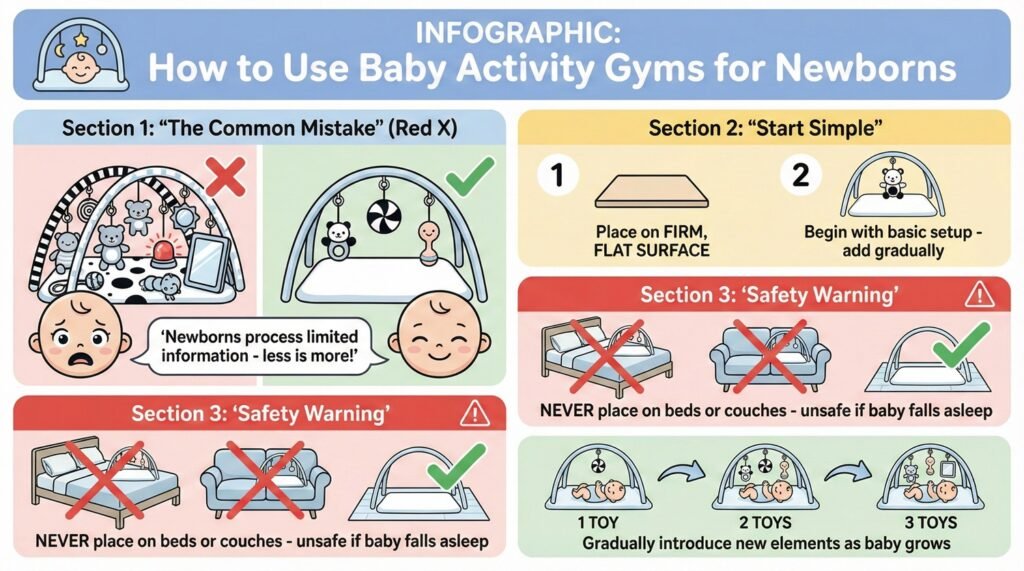
The first time you set up a baby gym, you might be tempted to hang every toy it came with, position the mirror just so, and create this elaborate sensory wonderland. Don’t do that.
Seriously, resist the urge.
Newborns can only process a limited amount of information at once. What seems like a fun, engaging environment to you can feel completely overwhelming to them.
Start with the absolute basics. Place the gym mat on a firm, flat surface.
Never put it on a bed or couch where it might create an unsafe sleeping surface if your baby dozes off.
The mat itself should have some padding but not be so soft that your baby sinks into it during tummy time. I’ve found that mats about half an inch thick tend to work really well for this age group.
For the first few weeks, hang just one or two toys at most. Choose items with high contrast patterns: black and white designs, bold stripes, or simple geometric shapes.
Research on infant vision shows that newborns respond much more strongly to these high-contrast patterns than to pastels or complex multicolored designs.
Their developing visual system simply can’t process subtle color variations or detailed images yet.
Position toys about 8-10 inches above your baby’s face when they’re on their back. This is the sweet spot for newborn vision.
It’s close enough that they can actually see the object, but not so close that it’s alarming.
If you notice your baby’s eyes crossing as they try to focus, the toy is probably too close. Move it up a couple of inches and see if that helps.
The arch height matters more than most parents realize. Some baby gyms have adjustable arches, which is incredibly useful because you want different heights for different activities.
When your baby is on their back doing what I call “quiet observation time,” you want toys positioned closer.
But for tummy time, you actually want to remove hanging toys entirely or raise them significantly higher so they’re not dangling in your baby’s face when they’re trying to practice lifting their head.
Temperature is something nobody really talks about, but it matters for newborns. If you’re doing floor play, make sure the room is warm enough that your baby won’t get cold lying on the mat.
Newborns can’t regulate their body temperature as effectively as older babies, and being cold can make them fussy and resistant to the activity gym.
I usually recommend having the room at least 72-75 degrees Fahrenheit for floor play sessions.
Your First Sessions: Building Positive Associations
The very first time you put your newborn on their activity gym, keep your expectations incredibly low. I’m talking about gentle introduction and creating positive associations.
Nothing more.
Start with your baby on their back, which is their most comfortable position at this age. Stay right there with them.
This is absolutely not the time to walk away and do dishes.
Your presence matters enormously. Get down on the floor at their eye level so they can see your face, which is actually their favorite thing to look at during these early weeks.
Watch for your baby’s cues about how they’re handling the experience. Positive engagement looks like alert, wide eyes, smooth movements, maybe some cooing or contented sounds.
They might stare intently at a hanging toy or even track it slightly with their eyes if they’re having a really good moment.
These are signs that the stimulation level is just right.
But you also need to watch for signs of overstimulation, because newborns can go from contentedly engaged to completely overwhelmed in a matter of minutes. Signs include looking away repeatedly, fussiness or crying, hiccups, color changes (either getting flushed or pale), jerky movements, or what’s called “gaze aversion” where they actively turn their head away from stimuli.
When you see these signs, the session is over. Don’t try to push through it or redirect their attention.
Just pick them up, provide comfort, and try again later.
Duration is critical here. For the first few sessions, we’re talking maybe 3-5 minutes at most.
That might seem ridiculously short, but remember, your newborn’s stamina for any kind of stimulation is very limited. Even 5 minutes of active engagement is actually quite demanding for their developing nervous system.
Do activity gym sessions when your baby is in what’s called a “quiet alert state.” That means awake, fed, changed, and calm, but not drowsy. This is the golden window for learning and engagement.
If you try to use the gym when they’re hungry, tired, or overstimulated from other activities, it won’t go well, and you might create negative associations with the space.
Introducing Tummy Time on the Activity Gym
Tummy time is absolutely essential for newborn development, but it’s also the thing most babies initially hate. The activity gym can actually make tummy time significantly more tolerable and productive, but only if you approach it correctly.
First, let’s talk about timing. Don’t try tummy time immediately after feeding.
That’s a recipe for spit-up and general misery.
Wait at least 20-30 minutes after a feeding. I’ve found that the best time is often mid-morning after the first nap, when babies tend to be most alert and content.
The positioning is crucial. Roll up a small receiving blanket and place it under your baby’s chest and armpits, creating a little bolster that helps support their upper body.
This gives them a slight advantage in lifting their head, which can make the difference between frustration and success in these early tries.
Some activity gyms actually come with a small pillow for this purpose, but a rolled blanket works just as well.
For newborns in the 0-3 month range, you’re not looking for extended tummy time sessions. Start with literally 30 seconds to one minute.
I know that sounds absurdly short, but building neck strength is genuinely hard work for a newborn.
Their heads are proportionally much heavier relative to their body size than an adult’s, and they’re essentially doing the baby equivalent of an intense workout.
Position yourself right in front of your baby during tummy time, down at their eye level. Your face is the most motivating thing in their world, and seeing you right there can encourage them to work harder at lifting their head.
You can also place a high-contrast toy or even a baby-safe mirror slightly in front of them to give them something to focus on.
Some babies really resist tummy time. If that’s the case, you can try alternate positions first.
Tummy time on your chest while you’re reclined is often much more tolerable for babies who hate floor tummy time.
The warmth and heartbeat of your body provides comfort while they’re still building those same neck muscles. You can also try the “tummy time carry” where you hold your baby face-down along your forearm.
This counts as tummy time and helps build the same muscles while feeling more secure to your baby.
The frequency matters more than duration for newborns. I’d rather see you do tummy time 6-8 times a day for one minute each than trying to force a 10-minute session once a day.
Shorter, more frequent sessions are much more developmentally suitable and less likely to create negative associations.
Avoiding Common Mistakes That Undermine Progress
The biggest mistake I see parents make is leaving the baby gym set up in the same configuration for weeks on end. Remember how I mentioned that newborns develop incredibly rapidly?
What was appropriately stimulating two weeks ago might be either too simple or too complex now.
You need to be adjusting the setup every 1-2 weeks based on your baby’s developing abilities.
Another common problem is using the activity gym as a babysitting device. I’m going to be really direct here: you cannot put your newborn on an activity gym and walk away to do other things.
The safety issues alone should prevent this, but beyond that, the developmental benefits of the gym are significantly reduced when you’re not actively engaged with your baby during the session.
Your narration, encouragement, and presence make the experience truly valuable.
Parents also tend to use music and lights features too liberally. Most baby gyms come with electronic components that play music, light up, or both.
These features can be engaging for older babies, but for newborns, they often contribute to overstimulation.
I recommend keeping electronic features turned off for at least the first 6-8 weeks, and even after that, using them very sparingly.
The timing of sessions is another area where I see mistakes. Parents often try to use the activity gym when their baby is already getting fussy, thinking it will distract or entertain them.
This almost never works.
Activity gym time should happen during those alert, content windows, not as a rescue strategy when things are already going downhill.
Temperature regulation gets overlooked too. Newborns on their backs on a play mat can get cold quickly, especially if you have tile or hardwood floors.
But they can also overheat if you’ve got them dressed too warmly.
For activity gym sessions, dress your baby in one layer more than you’re wearing. If you’re comfortable in a t-shirt, your baby should be in a onesie and maybe a light sleeper.
Check the back of their neck.
If it’s sweaty, they’re too warm. If it’s cool, they need another layer.
I’ve also noticed that parents sometimes neglect cleaning the activity gym, which is a genuine concern. Your newborn’s immune system is still developing, and those toys they’re staring at today will be the toys they’re mouthing in just a few months.
Wipe down toys and the mat weekly with baby-safe cleaning products, and wash any fabric components according to manufacturer instructions.
Adapting the Experience as Your Baby Develops
What works for a one-week-old looks completely different from what works for a ten-week-old, even though they’re both technically in the newborn stage. You need to be continuously observing and adapting.
In the first month, you’re really focused on simple visual tracking and just getting your baby comfortable with the space. Keep stimulation minimal, sessions very short, and expectations low.
This is about gentle introduction, nothing more.
As you move into weeks 4-8, you’ll notice your baby becoming more alert and able to sustain attention for slightly longer periods. This is when you can start introducing a second toy, maybe adding some gentle auditory elements (like a soft rattle you shake yourself, not electronic music), and gradually increasing session length to maybe 5-8 minutes.
By weeks 8-12, many babies are starting to show early reaching behaviors, though they won’t successfully bat at toys with any real control yet. This is the stage where you might start positioning toys slightly to the sides to encourage them to track objects through a fuller range of motion.
Their tummy time tolerance usually increases significantly during this window too.
You might get 2-3 minutes at a time, which is actually really substantial progress from those 30-second sessions you started with.
The key is watching your person baby. Developmental timelines are averages, and your baby might be ahead in some areas and behind in others, which is completely normal.
Some babies start showing reaching behaviors at 8 weeks.
Others don’t until 14 or 15 weeks. Some tolerate extended tummy time early on.
Others need much more gradual progression.
If you have twins or many children, resist the urge to compare their progress on the activity gym. The developmental variability even between siblings can be really substantial.
Each baby needs their own individualized approach.
Integrating Activity Gym Time Into Your Daily Routine
The activity gym works best when it becomes a predictable part of your day as opposed to a random activity you do whenever you remember. Newborns thrive on routine, even though that routine might look pretty loose compared to what you’ll establish with an older baby.
I recommend identifying 2-3 optimal windows in your day and committing to activity gym sessions during those times. For many families, this might be mid-morning after the first nap and feeding, early afternoon before a nap, and early evening if your baby has a content period then (though many newborns get fussy in the evenings, so this window doesn’t work for everyone).
Create a little routine around activity gym time. Maybe you do a diaper change first, then spend a minute or two talking to your baby about what you’re going to do, then transition to the gym.
Having this predictable sequence helps your baby start to anticipate the activity, which can actually increase their tolerance and engagement.
Think about the activity gym as part of a broader sensory diet for your newborn. They also need quiet time, feeding time, cuddle time, sleep time, and so on.
The gym is one component, not the centerpiece.
I’ve seen parents get so focused on maximizing activity gym use that they actually create stress around it, both for themselves and their baby.
One practical consideration that nobody really talks about is placement of the activity gym in your home. You want it in a space where you’re comfortable getting down on the floor, where the lighting is good (natural light is ideal, but not direct sunlight on your baby), and where you can easily supervise.
For many families, this ends up being the living room.
But make sure it’s not in a high-traffic area where older siblings might trip over the baby or where pets have access.
Building on This Foundation for Future Development
What you’re doing with your newborn on the activity gym is really laying groundwork that will pay off for months to come. Those early tummy time sessions, even when they’re just 30 seconds long, are building the neck, back, and shoulder strength your baby will need for rolling, sitting, and eventually crawling.
The visual tracking practice your baby gets from watching high-contrast toys is developing the neural pathways they’ll use for reading and writing years from now. That sounds dramatic, but the eye movement control and visual processing skills that begin developing in these early months are foundational for all kinds of later learning.
The positive associations you’re creating with independent play are just as important as the physical skills. Babies who learn early on that floor time can be pleasant and interesting tend to be more willing to practice new skills independently as they grow.
This doesn’t mean they need less parent interaction.
They absolutely do. But it means they develop a healthy capacity for entertaining themselves for suitable periods, which is a valuable skill.
As your baby approaches the 3-4 month mark and you start transitioning from newborn to infant stage, you’ll notice their relationship with the activity gym changing dramatically. They’ll start reaching with purpose, batting at toys, bringing their hands together, maybe even grasping objects.
All of those skills are being set up by the work you’re doing now.
The vestibular and proprioceptive input your baby gets from different positions on the activity gym (back, tummy, even side-lying) is helping their sensory systems develop and mix. This might seem abstract, but these sensory systems are crucial for everything from balance to body awareness to even emotional regulation.
People Also Asked
When should I start using a baby gym with my newborn?
You can start using a baby gym with your newborn as early as the first week home from the hospital. The key is starting with very short sessions of 3-5 minutes, minimal toys (just one or two high-contrast items), and keeping your expectations incredibly low.
The first few weeks are really about familiarizing your baby with the space and creating positive associations as opposed to achieving any specific developmental milestones.
How long should tummy time be for a 2 week old?
For a 2-week-old baby, tummy time sessions should last just 30 seconds to one minute at most. This seems ridiculously short to most parents, but newborns have very weak neck muscles and tire extremely quickly.
The important thing is frequency as opposed to duration.
Try to do these short sessions 6-8 times throughout the day when your baby is alert and content.
What toys are best for newborn vision development?
High-contrast toys in black and white are best for newborn vision development. Simple patterns like bold stripes, checkerboards, or concentric circles work better than complex multicolored designs because newborns can’t process subtle color variations yet.
Their visual system responds most strongly to stark contrasts.
Position these toys 8-10 inches from your baby’s face, which is the optimal distance for newborn focus.
Can a newborn sleep on a play mat?
No, newborns should never sleep on a play mat. While it might seem convenient to let your baby doze off during activity gym time, play mats don’t meet safe sleep guidelines.
Babies should always sleep on their backs on a firm, flat surface in a crib or bassinet with no soft bedding, pillows, or toys.
If your baby falls asleep during gym time, move them immediately to their safe sleep space.
How do I know if my baby is overstimulated on the activity gym?
Signs of overstimulation in newborns include gaze aversion (actively looking away from toys or your face), fussiness or crying, jerky as opposed to smooth movements, hiccups, color changes (getting flushed or pale), and general crankiness. Some babies will also arch their backs or clench their fists.
When you see any of these signs, the session is over.
Pick your baby up and provide comfort as opposed to trying to redirect their attention back to the gym.
What is the best time of day for baby gym activities?
The best time for baby gym activities is during your baby’s “quiet alert state,” which means they’re awake, fed, changed, and calm but not drowsy. For many newborns, this happens mid-morning after the first nap and feeding, or early afternoon.
Avoid trying to use the gym when your baby is hungry, tired, or already fussy.
Many babies have a fussy period in the late afternoon or evening, which is typically not a good time for activity gym sessions.
Do I need to buy an expensive activity gym for my newborn?
You don’t need an expensive activity gym to support your newborn’s development. The most important features are a firm, padded mat and the ability to hang one or two toys at adjustable heights.
You can even create a DIY setup with a blanket on the floor and high-contrast cards propped nearby.
What matters most is how you use the gym, staying engaged with your baby, keeping sessions short and suitable for their development, and adjusting the setup as they grow.
Key Takeaways
Using an activity gym with a newborn needs a completely different approach than you’ll use with older babies, focusing on gentle stimulation, short sessions, and careful observation of your baby’s cues.
Start with minimal stimulation by hanging one or two high-contrast toys positioned 8-10 inches above your baby’s face, and gradually increase complexity only as your baby shows readiness.
Tummy time sessions should begin at just 30-60 seconds, many times daily, with proper support and positioning to set your baby up for success as opposed to frustration.
Your presence and engagement during activity gym sessions is essential since this is not a device for independent play at the newborn stage, and attempting to use it that way undermines both safety and developmental benefits.
Watch for overstimulation signs including gaze aversion, fussiness, color changes, and jerky movements, and end sessions immediately when these appear as opposed to trying to push through.
Adjust the activity gym setup every 1-2 weeks as your baby’s abilities rapidly develop, ensuring the environment continues to provide just-right challenges as opposed to becoming either too simple or too overwhelming.
The skills and positive associations you’re building during these early months create a foundation for rolling, sitting, reaching, grasping, and independent play that will emerge in the coming months.