You’re staring at tuition numbers that rival some college programs, wondering if enrolling your six-month-old in a specialized educational program makes any real sense or if you’re just looking at expensive daycare with a fancy Italian name attached.
I’ve been there, researching at 2 AM while bouncing a crying baby, trying to figure out if this investment will actually matter or if I’m just falling for clever marketing.
After taking a close look at the research, and I mean really deep, peer-reviewed studies, longitudinal data, conversations with certified Montessori educators, and observing actual infant programs in action, I uncovered something that completely changed how I think about early education. The answer depends on what you’re looking for, but what I learned surprised me.
What Actually Happens in a Montessori Infant Program
Before we can assess worth, we need to understand what you’re actually paying for. Most people think Montessori for infants means putting babies in a room with wooden toys and calling it educational.
That’s wrong.
A genuine Montessori infant environment operates on principles that sound almost counterintuitive at first. Instead of brightly colored plastic everything, you’ll find calm, neutral spaces with carefully selected materials.
Instead of constant adult intervention, you’ll see educators observing more than directing.
Instead of age-segregated groups, you’ll notice mixed ages working side by side.
The theoretical foundation comes from Maria Montessori’s observations that infants possess what she called “absorbent minds,” meaning they’re literally soaking up information from their environment without conscious effort. Modern neuroscience has confirmed that the first three years involve explosive brain development, with neural connections forming at rates we’ll never experience again in our lifetimes.
What this means practically is that the environment you place your infant in actively shapes cognitive architecture. A Montessori program capitalizes on this by creating what they call a “prepared environment,” where every element serves a developmental purpose.
I watched this in action at a local program. An eight-month-old spent twenty minutes, genuinely twenty full minutes, transferring large wooden beads from one bowl to another.
No adult interrupted. No one redirected her attention.
She was developing hand-eye coordination, building concentration, and experiencing what happens when she makes things happen through her own actions. The educator later explained that this seemingly simple activity was laying groundwork for executive function, the ability to focus, plan, and execute tasks that forecasts academic success better than IQ.
The Research That Changed My Mind
I was honestly skeptical until I encountered the 2025 national randomized controlled trial. Nearly 600 children across 24 public Montessori programs, followed systematically, compared against traditional preschool peers.
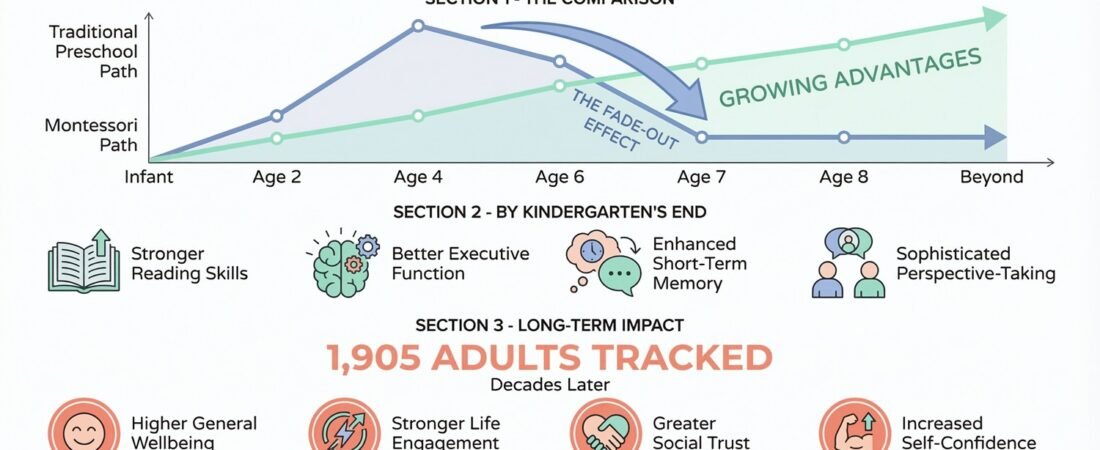
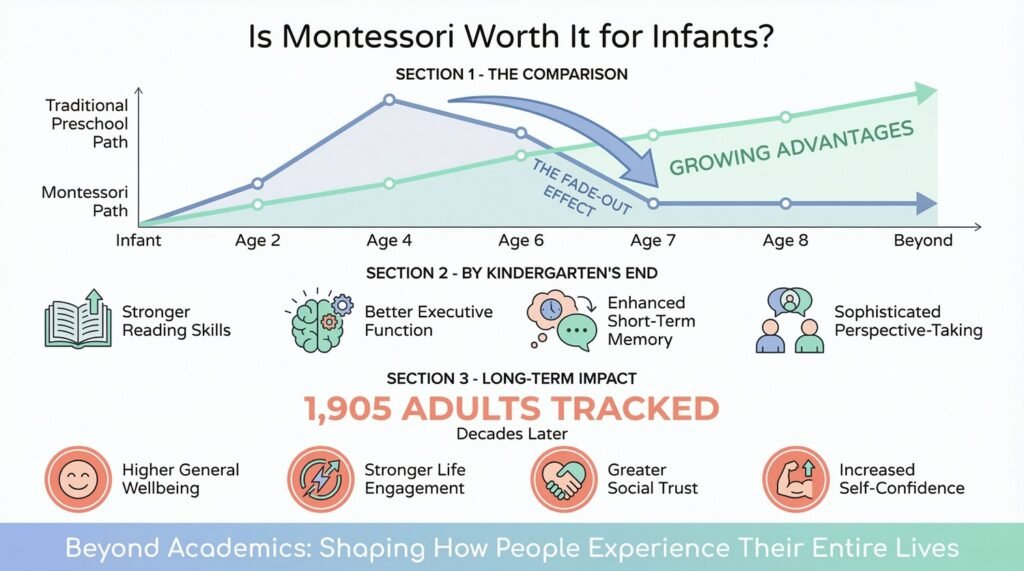
The results showed something I didn’t expect. Most early education research shows an unfortunate pattern where initial gains fade by kindergarten.
Kids in quality preschool programs do better at first, but by age seven or eight, the advantages have largely disappeared. Educators call this “fade-out,” and it’s been the frustrating reality of early intervention for decades.
Montessori programs showed the opposite pattern. The cognitive and social-emotional advantages didn’t just continue, they actually grew over time.
By kindergarten’s end, Montessori students demonstrated measurably stronger reading skills, better executive function, enhanced short-term memory, and more sophisticated perspective-taking abilities compared to peers.
Another study tracked 1,905 adults who’d attended Montessori programs as children. Decades later, these people reported higher general wellbeing, stronger engagement with life, greater social trust, and increased self-confidence.
The effects went beyond academics and shaped how people experienced their entire lives.
Correlation doesn’t equal causation, and I’m not claiming Montessori creates perfect humans. But when you see consistent patterns across many studies using different methodologies, you need to pay serious attention.
Breaking Down the Cost Reality
Private Montessori infant programs typically run between $12,000 and $18,000 annually. Traditional infant daycare ranges from $8,000 to $12,000.
You’re looking at roughly $4,000 to $6,000 more per year.
Over three years of infant and toddler care, that’s an extra $12,000 to $18,000 investment.
Here’s where the calculation gets more interesting. The 2025 study found that public Montessori programs, where they exist, cost about $13,000 less per child than traditional public preschool programs.
This seems counterintuitive until you understand why.
Montessori programs typically have lower staff turnover because teachers report higher job satisfaction. Lower turnover means reduced recruitment and training costs.
The materials, while expensive initially, are incredibly durable.
A set of wooden cylinders lasts decades, while plastic toys need constant replacement. The multi-age classroom structure means more effective use of space and resources.
If you have access to public Montessori, the cost equation flips entirely. You’re potentially saving thousands while accessing higher-quality education.
For private programs, the premium buys you several specific things. First, you’re getting educators with specialized training.
Montessori certification needs extensive study of child development, observation techniques, and material presentation.
These are professionals with specific expertise in facilitating infant learning.
Second, you’re paying for quality materials. Montessori environments use natural, non-toxic materials that engage many senses.
Everything is intentionally designed and manufactured to exacting specifications.
A Montessori mobile for infants is engineered to develop visual tracking, depth perception, and focus.
Third, you’re investing in consistency. High teacher retention means your infant forms secure attachments with consistent caregivers.
This matters enormously.
Infant brain development depends heavily on predictable, responsive relationships. Constantly rotating staff disrupts attachment formation, which can have cascading effects on emotional regulation and social development.
What Makes It Different From Regular Daycare
I visited both traditional daycare centers and Montessori infant programs to understand the practical differences beyond philosophy. The contrasts were immediately obvious.
Traditional infant rooms tend toward overstimulation. Bright primary colors everywhere, dozens of plastic toys in bins, constant background music or television, frequent transitions between activities.
The goal seems to be keeping babies entertained and safe while parents work.
Montessori infant environments feel fundamentally different. The color palette is neutral and calm.
Materials are carefully curated and limited. There’s deliberate quiet, not silence, but the absence of unnecessary noise.
The space is designed for movement, with areas for floor time, pulling up, cruising along low bars, and eventually walking.
Every element in a Montessori environment exists for a reason. The low mirror allows infants to develop self-awareness.
The grasping materials progress systematically from simple to complex.
The practical life area, even for infants, includes opportunities to join in real activities like helping with snack preparation or putting used cloths in a basket.
What struck me most was the respect for infant autonomy. Traditional programs often keep babies in containers: swings, bouncers, exersaucers, moving them from device to device.
Montessori philosophy emphasizes freedom of movement.
Infants spend extensive time on floor mats where they can roll, reach, pivot, and eventually crawl without restriction.
When an infant reaches for an object and successfully grasps it, they’re not just developing fine motor skills. They’re learning that their intentions matter, that they can affect their world through deliberate action.
The Independence Factor Nobody Talks About
Montessori programs for infants emphasize independence in ways that initially seemed unrealistic to me. We’re talking about babies who can’t walk or talk.
How much independence is even possible?
More than I realized. A trained Montessori educator showed me how they approach feeding. Instead of an adult controlling the spoon entirely, they guide the infant’s hand to the spoon, help them scoop, and support their movement to their mouth.
Yes, it’s messier.
Yes, it takes longer. But by eighteen months, these kids are feeding themselves with utensils while peers in traditional programs are still being fed by adults.
Same with dressing. Montessori programs teach infants and toddlers to join in getting dressed as opposed to being passively dressed by adults.
They start with simple tasks like pushing an arm through a sleeve and gradually build toward finish independence.
The principle extends to material selection. Even young infants in Montessori programs are allowed to choose between two or three activities.
This seems trivial until you understand that choice-making is a foundational executive function skill.
People who grow up making age-appropriate decisions develop better judgment and self-regulation than people who have everything decided for them.
I noticed something fascinating watching this play out. Infants in Montessori programs seem more focused and less frustrated than babies in traditional settings.
The educator explained that frustration often comes from wanting to do something but being prevented or not having opportunities to try.
When you create environments where infants can safely try tasks at the edge of their abilities, they develop persistence alongside skills.
Common Concerns and Real Talk About Challenges
Quality varies dramatically. The term “Montessori” isn’t trademarked, so anyone can call their program Montessori without actually implementing the methodology.
I visited one “Montessori” center where the infant room looked identical to traditional daycare but charged premium tuition.
You absolutely must verify credentials. Look for AMI (Association Montessori Internationale) or AMS (American Montessori Society) certification.
Ask about teacher training.
Request to observe classrooms. A genuine program will welcome observation because they’re confident in their approach.
The philosophy needs buy-in at home to maximize benefits. If your infant spends their day in a calm, intentional environment and then comes home to overstimulation and zero independence opportunities, the cognitive dissonance can be confusing.
You don’t need to go full Montessori at home, but some alignment helps.
Montessori’s emphasis on person pacing means development doesn’t follow rigid schedules. Some parents find this unsettling.
They want to know that by X months, their baby will do Y skill.
Montessori educators resist this checklist mentality, focusing instead on each child’s unique trajectory. If you need constant benchmarking and comparison, this approach might feel frustrating.
The social structure differs from what you might expect. Mixed-age groupings mean your infant interacts with one-year-olds and two-year-olds, not just age peers.
This has benefits, younger children learn from older models, older children develop nurturing behaviors, but some parents worry about safety or age-appropriate interaction.
Let’s be honest about access. Quality Montessori infant programs stay concentrated in specific geographic areas and socioeconomic contexts.
If you don’t live near one or can’t afford private tuition and your district doesn’t offer public Montessori, this entire discussion becomes theoretical.
When It Makes Sense and When It Doesn’t
Montessori for infants makes tremendous sense if you value specific outcomes. If you want your child developing independence, concentration, and intrinsic motivation from the earliest ages, and you can access a quality program that fits your budget, the investment pays off.
It makes particular sense if you’re already inclined toward evidence-based parenting, natural materials, and child-led learning. Montessori will align with and reinforce those values.
It makes less sense if your primary need is affordable childcare. There’s zero shame in that.
Quality care at any price point beats expensive care that doesn’t fit your family’s reality.
A loving, safe, responsive traditional daycare is infinitely better than a Montessori program you can’t afford without severe financial stress.
It also makes less sense if you prefer highly structured, adult-directed environments. Some parents want teachers actively teaching, leading group activities, following curriculum timelines.
That’s different from Montessori’s observation and facilitation approach.
And it makes less sense if you don’t have access to authentic programs. A “Montessori-inspired” center that mostly applies traditional methods while charging premium rates doesn’t justify the extra cost.
Building Toward Long-Term Success
Montessori for infants establishes a foundation that compounds over time. The concentration an eight-month-old develops transferring objects becomes the focus a four-year-old brings to complex puzzles.
The independence a fifteen-month-old practices feeding themselves becomes the self-direction a seven-year-old shows managing homework.
The respect for others’ work an infant observes in a mixed-age classroom becomes the collaboration skills a teenager brings to group projects.
The 2025 research showing that benefits grow as opposed to fade supports this compounding effect. Early Montessori shapes how children approach learning itself.
One Montessori educator told me something that stuck with me. She said traditional education often asks, “What does this child need to know?” Montessori asks, “Who is this child becoming?” That shift from content to character, from information to disposition, explains why effects continue decades later.
Practical Steps for Evaluation
If you’re seriously considering Montessori for your infant, start by identifying all options within reasonable commuting distance. Don’t assume you know what exists.
I uncovered a public Montessori program I’d never heard of simply by searching systematically.
Schedule observations at each program. Watch the infant room for at least thirty minutes.
Notice whether babies have freedom of movement or spend most time in containers.
Observe how adults interact with infants during routine care like diaper changes. Quality programs treat these moments as opportunities for connection and communication, not just tasks to finish efficiently.
Ask specific questions about teacher credentials. Don’t accept vague answers.
You want names of certifying organizations and dates of training completion.
Ask about staff turnover rates. High turnover is a red flag regardless of stated philosophy.
Examine the materials. Genuine Montessori materials have specific characteristics.
They’re primarily wood, metal, glass, and natural fibers as opposed to plastic.
They isolate single concepts as opposed to combining many stimuli. They progress logically from simple to complex.
Talk to current parents. Most programs will provide references.
Ask about their experience with communication, their child’s development, whether the program delivers on its promises.
Calculate total costs including tuition, required materials, activity fees, and any extra expenses. Compare this realistically against your budget and choice options.
Finally, trust your instincts about fit. A program can be objectively high-quality but still not right for your family.
The best educational choice is the one you can sustain and support consistently.
Frequently Asked Questions
Does Montessori work for babies?
Montessori works for babies when implemented authentically. Research shows that infants in quality Montessori programs develop stronger concentration, greater independence, and better self-regulation compared to traditional daycare peers.
The prepared environment and respect for infant autonomy support natural developmental processes.
What age should you start Montessori?
You can start Montessori as early as two or three months. Many programs accept infants who can hold their head up independently.
Starting early allows children to develop in an intentionally designed environment during the period of most rapid brain development.
How much does Montessori infant care cost?
Private Montessori infant programs typically cost between $12,000 and $18,000 annually, which is $4,000 to $6,000 more than traditional daycare. Public Montessori programs, where available, can actually cost less than traditional public preschool because of lower staff turnover and durable materials.
What makes Montessori different from regular daycare?
Montessori infant programs emphasize freedom of movement, carefully prepared environments with natural materials, mixed-age groupings, and respect for infant autonomy. Traditional daycare tends toward more adult-directed care, plastic toys, age-segregated rooms, and less emphasis on developing independence.
Do Montessori babies develop faster?
Montessori babies don’t necessarily hit milestones earlier, but they often develop stronger executive function skills, greater concentration, and more independence at younger ages. The approach focuses on quality of development as opposed to speed of achieving specific milestones.
Is Montessori better than traditional preschool?
Research shows Montessori students show cognitive and social-emotional advantages that grow over time as opposed to fade. By kindergarten’s end, Montessori students typically demonstrate stronger reading skills, better executive function, and enhanced perspective-taking abilities compared to traditional preschool peers.
How do I know if a Montessori program is authentic?
Look for AMI or AMS certification, observe classrooms to see freedom of movement and natural materials, verify teacher training credentials, ask about staff turnover rates, and talk to current parents. Authentic programs welcome observation and are transparent about their methodology.
Can I do Montessori at home with my infant?
You can apply Montessori principles at home by creating low shelves with rotating materials, allowing freedom of movement on floor mats, using real objects for play, involving your infant in daily activities, and respecting their choices and developing independence.
Key Takeaways
Montessori for infants delivers measurable long-term benefits when you have access to authentic, well-implemented programs that align with your values and budget. The research supporting cognitive, social, and emotional advantages is stronger than for most early education approaches, with the crucial distinction that advantages compound as opposed to fade over time.
The cost premium for private programs reflects genuine differences in teacher training, material quality, and environmental design, though public Montessori options can actually cost less than traditional choices. The emphasis on independence, concentration, and intrinsic motivation creates foundations that influence lifelong wellbeing and self-confidence, not just academic success.
Quality varies dramatically, making credential verification and careful observation essential. The approach benefits from some philosophical alignment at home to maximize benefits, though you don’t need to adopt the method entirely outside the program.
Montessori for infants makes sense if you’re seeking evidence-based early development in intentional environments and can access quality programs sustainably.