I remember the exact moment I realized I was spending more money on coffee runs than I was on building my daughter’s library.
That realization hit me pretty hard because I’d been telling myself for months that book subscriptions were “too expensive” while simultaneously dropping $6 on a latte I’d forget about halfway through. I wasn’t scared of the cost.
I was scared of committing to something that felt like it might expose me as the kind of parent who didn’t follow through.
The kind who’d sign up with the best intentions and then let the books pile up, unopened, while I scrolled through my phone convincing myself I was “too busy” to read.
So I kept buying random books at Target, the ones with characters from shows my kid watched, thinking that was good enough. And because I approached parenting with a “good enough is fine” mentality when it came to anything that required sustained effort, I continued to bet on convenience instead of acknowledging what I actually wanted: a thoughtfully curated home library that would genuinely excite both of us.
Understanding the Literati Pricing Structure
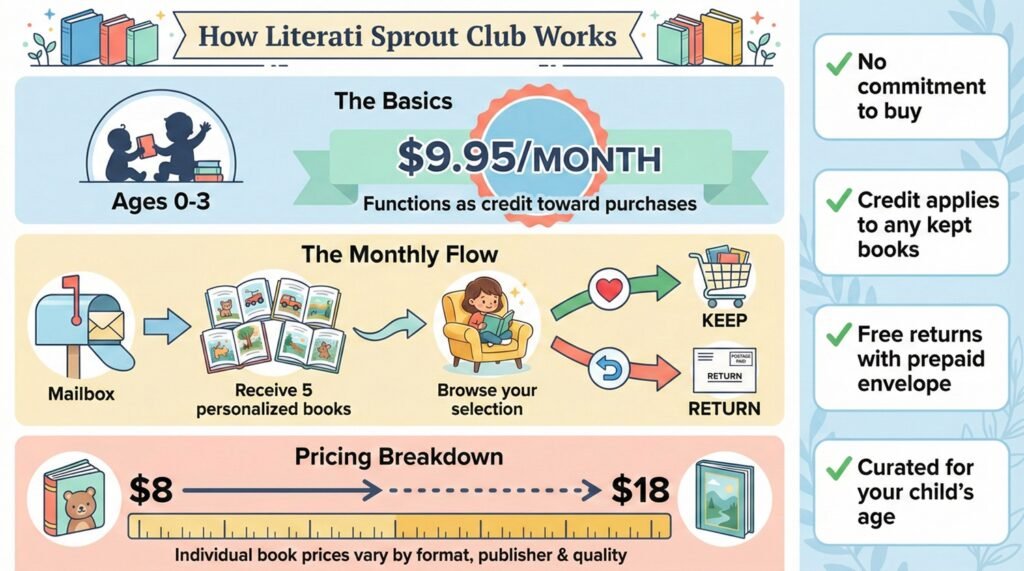
Literati operates on a subscription model that gives you more flexibility than most people realize when they first encounter it. The basic structure works like this: you pay a monthly membership fee, receive a personalized selection of five books each month, and then decide which ones (if any) you want to keep.
The ones you don’t want go back in a prepaid return envelope.
For the Sprout Club specifically, designed for children ages 0-3, the monthly cost sits at $9.95. That membership fee functions as a credit toward any books you decide to purchase from your monthly selection.
The books themselves are priced individually, typically ranging from $8 to $18 depending on whether they’re board books or picture books, the publisher, and the production quality.
This pricing model differs significantly from services where you’re automatically charged for everything that arrives. With Literati, that $9.95 is essentially your access fee to expert curation and the browsing experience, and it rolls over as purchasing credit.
If you decide to keep all five books in a given month, you’re looking at an average total cost of around $50-70 after applying your credit.
If you keep just one or two, you might only pay an extra $5-15 beyond your membership fee.
The psychological aspect of this model is really interesting. It shifts the burden of decision-making to after you’ve physically seen and handled the books with your child.
You’re not committing blindly based on a cover image and a two-sentence description on a website.
This matters more than it might seem at first, because toddler books live or die based on tactile elements that don’t translate online, the thickness of the pages, how the book opens and lays flat, whether the spine can withstand being bent backwards by enthusiastic little hands.
What You’re Actually Paying For
The real value proposition with Literati comes from curation by actual children’s literature experts who consider factors most parents don’t even know to look for.
These curators assess books based on vocabulary complexity, illustration quality, narrative structure for age-appropriate attention spans, and representation across cultures and family structures.
I learned this the hard way after buying a dozen books that looked adorable online but turned out to have weirdly stilted text or illustrations that my daughter couldn’t visually parse at her developmental stage. One book I bought had such busy, detailed illustrations that she couldn’t identify the main character on each page.
Another had rhyming text that was so forced, it actually disrupted the story’s flow.
These aren’t things you can assess from an Amazon preview.
The personalization quiz that Literati uses before sending your first box asks surprisingly specific questions: Does your child prefer realistic illustrations or more abstract art styles? Are you building a diverse library intentionally?
Do you want books that encourage interaction or ones that work better for calm bedtime reading?
Does your child have the fine motor skills to handle lift-the-flap books, or do those just get ripped immediately?
This level of customization means you’re not getting the same five books as every other Sprout subscriber. Your March box might feature books about construction vehicles and getting dressed independently, while another family receives books about feelings and nature exploration.
The algorithm improves over time based on which books you keep and return, refining its understanding of your preferences.
Beyond the curation, you’re also paying for the convenience of not having to research, compare, and individually purchase books yourself. For parents who genuinely value reading but feel overwhelmed by the sheer volume of children’s books published annually, over 3,000 just in the toddler category, this is where the subscription justifies its cost.
The time savings alone, not scrolling through endless options, reading reviews, checking library availability, adds tangible value.
The Credit System and Return Process
Understanding how the credit system actually works is crucial for evaluating whether Literati makes financial sense for your family. That $9.95 monthly membership fee converts to account credit that can be applied to any books you keep.
The credit doesn’t expire if you skip a month or put your subscription on hold, which adds flexibility that many competing services don’t offer.
Here’s where it gets interesting: if you consistently return all five books without keeping any, you’re essentially paying $9.95 per month for what amounts to a toddler book rental service. Some parents actually use it this way intentionally, treating it as a library supplement that delivers directly to their door.
For families dealing with limited storage space or kids who lose interest in books quickly, this approach has merit.
The return process needs you to make your keep-or-return decisions within seven days of receiving your box. You’ll get reminder emails as the deadline approaches, and the return shipping is completely free via the included prepaid label.
The books you’re returning go back in the same sturdy box they arrived in, which honestly makes the whole process feel less wasteful than other subscription models that use excessive packaging.
I’ve talked to parents who stress about the decision-making timeline, feeling pressured to assess books quickly while managing the chaos of toddler life. But seven days is actually pretty reasonable when you consider that toddlers will show you immediately whether a book resonates with them.
If your kid brings you the same book to read seventeen times in the first two days, that’s probably a keeper.
If it sits untouched while they cycle through their existing favorites, you have your answer.
One lesser-known aspect of the credit system: you can accumulate credits over multiple months if you’re keeping fewer books than your membership value. So if you only keep one $10 book in March, essentially “wasting” your credit, it actually rolls forward.
In April, you might keep three books totaling $42, and you’d only pay around $32 after applying your accumulated credits.
Comparing Value Against Alternative Options
The knee-jerk comparison most people make is to simply buying books yourself, either online or at bookstores. On pure per-book pricing, Literati typically costs about 15-30% more than purchasing the same titles on Amazon.
A board book that Literati prices at $12 might be $9.99 on Amazon, or $8 used from a third-party seller.
But that comparison misses several factors that affect the actual value proposition. First, you’re paying for the selection process that filters out the thousands of mediocre titles.
Second, Literati partners with independent publishers and diverse authors that don’t always get prominent placement on mainstream retail sites.
About 40% of the books in my daughter’s Literati selections over six months were titles I’d never seen at Target or Barnes & Noble, despite regular browsing.
The more apt comparison is actually to other curated book subscription services. Bookroo, one of Literati’s main competitors for the toddler demographic, charges $19.95 per month for three board books.
You don’t get return options, whatever arrives, you’re keeping.
The per-book cost works out to about $6.65, which seems cheaper until you factor in that you might receive books that don’t work for your family. With Literati, you’re paying more per book on average, but you’re only paying for books you’ve actively chosen to keep.
Amazon’s Prime Book Box for Kids used to be a popular choice at $19.99 for four books, but Amazon discontinued the program in 2023, which actually tells you something about the challenge of making curated book subscriptions profitable at very low price points. The economics only work if the curation is automated (which reduces quality) or if the service can sustain higher pricing.
For families who have access to well-stocked libraries with robust children’s sections, the value calculation shifts considerably. If you can visit a library weekly and your child is gentle enough with books that you’re not stressed about potential damage fees, the library obviously wins on pure cost.
But library availability varies dramatically by location, and not all libraries have extensive board book collections.
The library in my previous neighborhood had maybe thirty board books total, many with torn pages or missing flaps. Our current library has hundreds, meticulously maintained. Your mileage will vary literally based on your address.
Hidden Costs and Considerations
What people don’t always account for when evaluating Literati’s pricing is the cost of accumulation over time. If you’re keeping an average of three books per month at an average cost of $15 each after your membership credit, you’re spending roughly $35-45 monthly.
Over a year, that’s $420-540 in books, which could easily be 36-50 books depending on board book versus picture book ratios.
That accumulation rate means you’re building a home library of 100+ books over just two years with a single child. For some families, that’s exactly what they want, a comprehensive, high-quality collection that becomes a foundational part of their home environment.
For others, especially those in smaller living spaces or with multiple children at different stages, that accumulation becomes a storage problem pretty quickly.
I’ve found myself doing periodic purges of books my daughter has outgrown, donating them to our local Little Free Libraries or her daycare. That’s not necessarily a negative, I like the idea of books having multiple lives, but it does mean the financial investment doesn’t necessarily correspond to permanent household assets.
Books are consumables, especially in the toddler years when they’re getting chewed on, dropped in puddles, and used as building blocks.
There’s also the hidden cost of subscription fatigue, which is less financial and more psychological. Adding another recurring charge to your monthly budget creates decision fatigue and management overhead.
You need to remember to review your selections each month, make keep-or-return decisions within the timeline, and actually package up and ship back the returns.
For some people, this friction is minimal. For others, especially during particularly chaotic periods of parenting, it becomes one more thing that feels like homework.
The opposite problem can also occur: the subscription becomes too easy to ignore. The box arrives, you get busy, you miss the return deadline, and suddenly you’ve been charged for all five books by default.
Literati does send multiple reminders, but if you’re the kind of person who accumulates unread emails, those reminders won’t help.
I’ve definitely had months where I kept books I was ambivalent about simply because I ran out the clock on the decision window.
How to Maximize Value from Your Subscription
If you’re going to subscribe to Literati, there are specific strategies that significantly improve the value-to-cost ratio. The first is treating your initial personalization quiz seriously and updating your preferences regularly as your child develops.
The algorithm actually works pretty well, but only if you give it accurate information to work with.
I initially undersold my daughter’s interest in more complex narratives because I was worried the books would be too advanced. The result was that our first three boxes skewed toward very simple concept books, colors, numbers, first words, that she breezed through in about thirty seconds before losing interest. After updating our profile to show she was ready for actual stories with beginning-middle-end structures, the selections improved dramatically.
The second strategy is using the “not for us” feedback option aggressively. Every book you return can be tagged with specific reasons: too young, too old, not interested in this topic, didn’t like the illustration style, already own similar books.
This feedback directly tells future selections.
I spent probably five minutes per returned book in our first few months providing detailed feedback, and by month four, the hit rate improved noticeably, we were keeping four out of five books regularly instead of two out of five.
Another value-maximizing approach is coordinating your subscription timing with developmental leaps and interest phases. Toddlers go through intense obsessions, trucks, animals, a specific color, that can last weeks or months.
If you notice your child entering a dinosaur phase, you can update your preferences to prioritize dinosaur books in your next box.
This makes the books you receive immediately more relevant and increases the likelihood you’ll keep (and your child will actually read) most of them.
Some parents treat Literati as a supplement rather than their primary source for books, which changes the value equation. If you’re buying books through other channels anyway, gifts, bookstore impulse purchases, used book sales, then Literati can fill the specific role of introducing you to lesser-known titles and diverse voices you might not find out about otherwise.
In this model, you might only keep one or two books per month, essentially paying $15-25 monthly for high-quality curation of books you wouldn’t have found yourself.
There’s also real value in using Literati to test books before committing to building a collection around certain authors or series. If you learn through your subscription that your child absolutely loves books by a particular author, you can then seek out that author’s finish works through cheaper channels.
Literati becomes a discovery mechanism rather than your sole purchasing channel.
When Literati Doesn’t Make Financial Sense
Some scenarios exist where Literati’s pricing structure just doesn’t align with certain family situations. If you have reliable access to a well-curated library, visit it regularly, and your child is content reading books that other families have before read, the subscription is probably unnecessary.
The convenience factor doesn’t outweigh the cost when the inconvenience of a library visit is minimal.
For families with very tight budgets where even $10 monthly feels like a stretch, there are genuinely more economical ways to build a toddler’s library. Thrift stores often have board books for $1-2 each.
Little Free Libraries in many neighborhoods have regular children’s book turnover.
Buy Nothing groups and neighborhood parent networks often circulate children’s books. Used book sales at libraries can yield bags of books for $5-10.
The books won’t be personalized to your child’s specific interests, and the quality will vary wildly, but the financial trade-off might be worth it.
Literati also doesn’t make much sense if you’re someone who really struggles with subscriptions in general, who forgets to cancel services they’re not using, who feels guilty about unused gym memberships, who has three streaming services they hardly watch. The subscription model works best for people who engage with it actively, and if that’s not your natural tendency, you’ll end up paying for a service you’re not fully utilizing.
If your child is particularly destructive with books, to the point where most books don’t survive more than a few readings, the value proposition weakens considerably. You’re paying premium prices for books that will be destroyed quickly.
In that scenario, cheaper books that you care less about destroying make more sense until your child develops more careful handling skills.
Though the seven-day return window does give you time to assess whether specific books are “precious enough” to keep versus return before the destruction happens.
The subscription also loses value if you have access to hand-me-downs from older siblings, cousins, or friends. If you’re receiving a steady stream of age-appropriate books for free from your social network, paying for curated selections becomes redundant.
The exception might be if those hand-me-downs are dated or don’t reflect the diversity and representation you want in your child’s library, in which case Literati could supplement your free books rather than replace them.
People Also Asked
How much does Literati cost per month?
Literati charges $9.95 per month for the Sprout Club membership, which functions as a credit toward book purchases. Individual books range from $8-18, so your total monthly cost depends on how many books you keep.
Most families who keep 2-3 books spend $30-45 monthly total.
Can you cancel Literati anytime?
Yes, you can cancel Literati anytime without fees or penalties. There’s no least commitment period.
You can also pause your subscription for up to three months or skip person months without losing your account settings or accumulated credits.
Is Literati cheaper than buying books at the bookstore?
Literati typically costs 15-30% more per book than Amazon prices, but less than independent bookstore prices. The subscription includes expert curation and free returns, which adds value beyond the physical books themselves.
What age is Literati Sprout Club for?
Literati Sprout Club is designed for children ages 0-3 years old. The personalization quiz helps tailor selections to your child’s specific developmental stage within that range.
Do you have to keep all the books from Literati?
No, you can return any or all books within seven days using the prepaid return label. You only pay for books you decide to keep.
If you return all five books, you’ve essentially spent $9.95 for a rental service that month.
Are board books better for toddlers than picture books?
Board books are more durable and suitable for younger toddlers (0-2) who are still developing fine motor skills and may chew on books. Picture books work better for older toddlers (2-3) who can handle regular pages more carefully.
How many books should a 2 year old have?
There’s no specific number, but having 20-30 books that rotate regularly provides enough variety without overwhelming storage. Quality and repeated reading matter more than quantity for language development.
What makes a good toddler book?
Good toddler books have simple, engaging narratives, clear illustrations that support the text, durable construction, age-appropriate vocabulary, and themes that resonate with toddler experiences and interests.
Key Takeaways
The $9.95 monthly membership fee functions as a credit toward purchases rather than a flat subscription cost, which means your actual spending varies based on how many books you keep. For families keeping an average of three books monthly, total costs typically run $35-50 per month including the membership fee.
The per-book pricing is higher than discount retailers but lower than independent bookstores, and you’re paying partially for expert curation rather than purely for the physical books.
The return policy and credit accumulation provide flexibility that makes the financial risk lower than committed book-of-the-month clubs. You can genuinely try books before committing to purchase, skip months without penalty, pause for up to three months, and cancel anytime without fees.
Value maximization needs active engagement with the personalization settings and feedback mechanisms. The service becomes more valuable over time as the algorithm learns your preferences, but only if you actually provide that feedback through your keep-or-return decisions and explicit preference updates.
The subscription makes most sense for families who value reading, want to build a diverse home library, have limited time for book research, and don’t have excellent library access. It makes less sense for families with tight budgets, excellent libraries, abundant hand-me-downs, or children who are particularly destructive with books.