An honest look at whether this toddler book subscription delivers value.
So I’ve been looking into Literati for a while now because honestly, picking out toddler books has become kind of exhausting.
You walk into a bookstore or start scrolling Amazon and there are literally thousands of options. Which ones are actually good?
Which ones match the age range properly?
How do you know if your kid will even like it?
And then you end up buying the same Eric Carle books everyone else has (not that there’s anything wrong with that, but still).
Literati keeps popping up as this supposedly better way to get books for little kids. The whole concept is pretty straightforward… they send you five books each month, you test them out with your toddler for about a week, then you decide what to keep and what to send back.
The part that caught my attention is that you’re not locked into buying all of them. You can literally send everything back if nothing works out.
But I wanted to actually break down whether this service makes sense or if it’s just another subscription that sounds good on paper but doesn’t deliver.
How Literati Actually Works
The basic setup is simple. You pay $9.95 per month to get access to the service.
Then Literati sends you a box with five books that are supposedly picked by their team of literacy experts based on your kid’s age and reading level.
You have seven days to look through the books with your toddler. The ones you want to keep, you pay for at regular retail price (they say it matches or beats Amazon pricing).
The ones you don’t want, you stick back in the box with the prepaid return label they include.
If you keep all five books, you get a 5% discount applied. If you keep zero books, you’re just out the $9.95 monthly fee and that’s it.
For toddlers specifically, they have a few different club options. The Dreamer club is for babies up to about 6 months old.
The Seeker club covers ages 0-6 months through 2 years.
The Stargazer club is aimed at 12 months through 3 years old.
The age targeting is actually pretty specific, which matters because a 18-month-old and a 3-year-old are in completely different places developmentally. They don’t have the same attention span, they don’t handle books the same way, and what interests one probably won’t work for the other.
What’s in the Box When It Arrives
The boxes include more than just books, which I wasn’t expecting at first.
You get the five books, obviously. But you also get personalized bookplates with your kid’s name on them, bookmarks, stickers, and some original art illustrations that tie into that month’s theme.
One parent mentioned online that “the personalized items that come in with the books every month make it worth every penny.” That seems like a nice touch if you’re into that kind of thing, though personally I’m more interested in whether the actual books are good.
An elementary reading specialist tested out one of their older kid clubs (ages 7-9) and said she was impressed by the variety. They didn’t just send the typical chapter books… they mixed in nonfiction, graphic novels, and activity books too.
For toddlers, this translates to getting different formats based on developmental stage. Board books with different textures for babies who are still learning how to hold books without destroying them.
Picture books with more complex stories for older toddlers.
Interactive elements like flaps or touch-and-feel sections.
The books are also recently published, which actually matters more than you’d think. Newer toddler books tend to have more diverse representation and contemporary illustration styles compared to older inventory sitting in warehouses somewhere.
The Real Cost Breakdown
Here’s where things get a bit more complicated than just “$9.95/month.”
That monthly fee is just for the curation service. You’re paying them to do the research and pick books for you.
The actual books cost extra.
If you’re selective and only keep 2-3 books each month, you’re probably looking at spending around $30-45 total. If you keep all five books (and get that 5% discount), you’re closer to $50-70 depending on what the individual book prices are that month.
Compare that to buying books yourself. Most children’s hardcover books on Amazon run $8-20 each.
So if you were buying 2-3 books monthly on your own, you’d spend roughly the same amount… but you’d be doing all the research yourself.
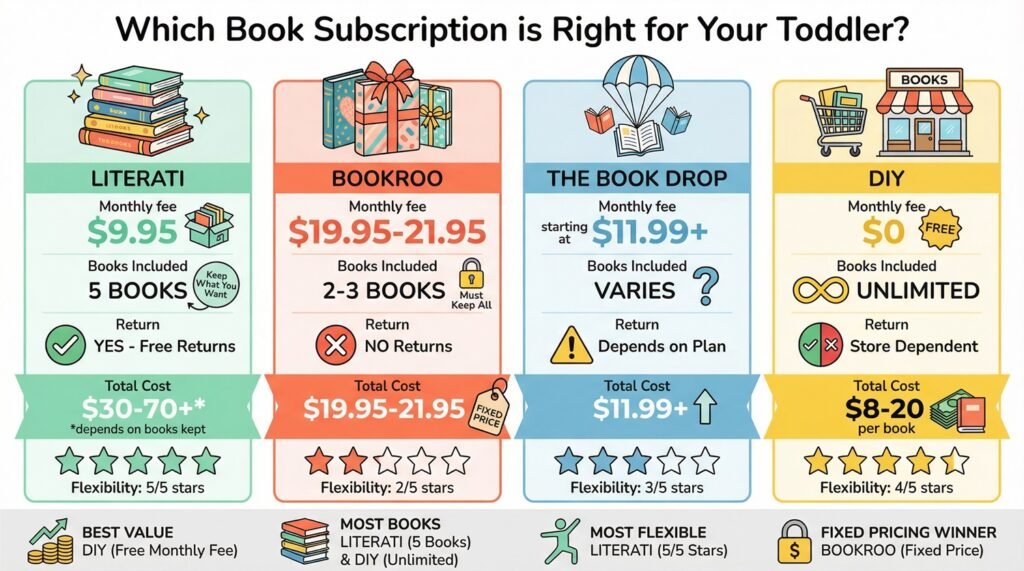
Bookroo is one of Literati’s main competitors. They charge $19.95-21.95 per month and you get 2-3 books with no option to return anything.
You’re stuck with what they send.
| Service | Monthly Fee | Books Included | Return Option | Total Cost |
|---|---|---|---|---|
| Literati | $9.95 | 5 (keep what you want) | Yes | $30-70+ depending on what you keep |
| Bookroo | $19.95-21.95 | 2-3 (must keep all) | No | $19.95-21.95 fixed |
| The Book Drop | $11.99+ | Varies | Varies by plan | $11.99+ |
| DIY (Amazon/Bookstore) | $0 | As many as you buy | Depends on return policy | $8-20 per book |
The financial advantage really depends on how you use it.
If you’re picky and only keep books your toddler genuinely connects with, you can come out ahead. If you end up keeping most of what they send because it’s easier than dealing with returns, you’ll spend more than you would with a fixed-price competitor.
The flexibility is intentional. Literati rewards you for being selective.
Does the Curation Actually Work
The whole value proposition here is that Literati employs literacy experts who supposedly understand developmental milestones and reading progression.
That sounds great in theory, but does it actually translate to better book selections?
Based on subscriber feedback I’ve seen online, it seems like most families are pretty happy with what they get. But no curation service is going to perfectly match every single kid’s preferences 100% of the time.
Your toddler might be obsessed with animals right now and couldn’t care less about vehicles. They might prefer bright, bold illustrations over softer, muted watercolors.
They might only want books that rhyme, or they might hate rhyming books.
Literati can’t always forecast these very specific preferences, which is why the return option exists in the first place.
One parent said something interesting though… sometimes the books they didn’t expect turned out to be the biggest hits. “Sometimes even you don’t expect you get the best gifts when you don’t tell people what you actually want.”
That suggests having books selected for you (instead of always choosing yourself) can actually introduce your kid to stuff they wouldn’t have found otherwise.
For people who are already making 100 tiny decisions every single day, transferring the book selection responsibility to someone else has real value.
What Actually Works About This Service
It solves the overwhelm problem.
When you have a toddler, you’re faced with infinite book options and zero extra time. Literati removes the entire research phase.
Instead of spending an hour on Goodreads trying to figure out if a book is age-appropriate, the books just show up already vetted.
You get rotating inventory without commitment.
Most toddlers go through phases. One month they’re obsessed with dinosaurs.
The next month it’s trains.
The month after that it’s bugs. Having books that rotate prevents you from reading the same twelve books on repeat until you want to scream.
No waste if something doesn’t land.
When you buy books outright and your toddler ignores them, you’re just stuck with them taking up shelf space. With Literati, you can return anything that doesn’t connect.
That removes the financial sting of a bad recommendation.
You can build a home library thoughtfully.
Instead of randomly accumulating books, you’re intentionally building a collection that actually matches your child’s development. The personalized items and themed art also make it feel more special than just another Amazon box showing up.
The Downsides and Limitations
The cost adds up over time.
While individual book prices might be competitive, you’re spending $9.95 every single month perpetually. Over a year, that’s $119.40 in fees alone before you even factor in the books you keep.
If you’re on a tight budget, buying books selectively from library sales or secondhand stores is probably more economical.
You can’t ask specific books.
If your toddler has a beloved author or character (like a specific board book series they’re obsessed with), you can’t ask it. Literati curates what they think fits, which isn’t necessarily what you already know will work.
Timing doesn’t always align.
Toddlers develop on their own timeline. A book might arrive six months too advanced or six months too late.
The seven-day assessment window helps, but some months the selections might just miss the mark timing-wise.
Shipping speed varies.
One subscriber mentioned getting their box in about a week, but shipping speed isn’t guaranteed. If you need books for a specific occasion or as a last-minute gift, Literati’s delivery timeline is unpredictable.
It requires active participation.
You actually need to sit down with your toddler and go through the books within that seven-day window to decide what to keep. This isn’t a passive subscription where books just pile up.
It requires your time and attention to make it worthwhile.
User Experience From Real Subscribers
From what I’ve seen in online reviews and forums, most people seem pretty satisfied overall.
The personalized elements get mentioned a lot. The bookplates with your kid’s name, the themed stickers, the art prints… these little extras make the unboxing experience feel more special than just receiving books in a plain mailer.
Some parents mentioned that their toddlers got excited when the Literati box arrived each month because they recognized it and knew new books were coming.
The return process seems straightforward based on feedback. You use the prepaid label, drop it back in the box, and that’s it.
No complicated return authorization process or customer service hoops to jump through.
A few complaints I’ve seen revolve around book selections occasionally missing the mark for age appropriateness. Like getting books that were clearly too advanced or too simple for the child’s actual reading level despite the age being set correctly in the account.
But these seem to be exceptions as opposed to the norm. Most feedback suggests the curation is pretty solid most of the time.
Who This Actually Makes Sense For
Working parents who are time-poor.
If you’re juggling dual incomes, childcare, work deadlines, and everything else, paying someone $9.95 to eliminate the mental load of finding good books is probably worth it.
People who care about developmental alignment.
If you’re intentional about choosing books that match specific developmental milestones or educational philosophies (Montessori, Waldorf, etc.), having experts make those selections saves you from doing hours of research.
Families with limited shelf space.
If you live in a smaller space or prefer rotating books instead of accumulating hundreds of them, the return model let’s you experience variety without hoarding.
Grandparents looking for recurring gifts.
A Literati subscription is more meaningful than a one-time toy purchase. It arrives regularly, supports literacy, and gives grandparents a way to stay connected through books.
People who struggle with book selection.
Not everyone enjoys researching books or feels confident choosing age-appropriate titles. Outsourcing this decision removes that anxiety completely.
Value for Money Assessment
Literati isn’t the cheapest option available for getting toddler books delivered to your door.
But the combination of low entry cost ($9.95), expert curation, return flexibility, and personalized extras creates real value if it matches your actual needs.
The service works best if you’re willing to engage with the books during that seven-day window, you’re honest about what your toddler actually connects with, and you’re comfortable returning selections that don’t work.
It struggles if you’re looking for absolute lowest cost or you need guaranteed perfect selections every single month.
For people who are overwhelmed by book choices, desperate for convenience, or view $10 monthly as worthwhile for removing one decision from their plate, Literati delivers value.
For budget-conscious families or people with very specific book preferences, a hybrid approach might make more sense. Use the library for most books and do occasional Literati boxes when you want something new.
Final Verdict on Literati
The real test of any toddler book subscription comes down to one thing: will your kid actually read what arrives?
The best curated box in the world means absolutely nothing if the books sit on a shelf unopened.
If your toddler tends to enjoy books across different topics and styles, if you appreciate having selections made for you instead of doing all the research yourself, or if you value the unboxing experience and personalized touches, Literati justifies its cost.
The service does what it promises. You get five books monthly.
They’re curated by people who understand child development and literacy.
You can return what doesn’t work. The prices match or beat Amazon.
The monthly fee feels worth it if you actually use the service the way it’s designed… meaning you engage with the books, you’re selective about what you keep, and you take advantage of the return option when needed.
If you just keep everything they send without really evaluating it, you’ll end up spending more than you would with fixed-price competitors or DIY book buying.
But for the right situation (time-poor parents, overwhelmed first-timers, gift-giving grandparents, people who value expert curation), Literati solves a real problem.
The seven-day return window gives you enough time to actually test the books with your kid and make informed decisions about what to keep. That flexibility alone sets it apart from most other book subscriptions where you’re stuck with whatever shows up.
At the end of the day, this involves whether you value convenience and curation enough to pay for it. If you do, Literati delivers.
If you’d rather save money and do the research yourself, buying books individually makes more sense.
Either approach works. It just depends on what you prioritize… time or money.