Shopping for baby activity gyms gets confusing fast. You’ve got wooden options, fabric mats, electronic light-up things that make 47 different sounds… it’s a lot.
Manhattan Toy makes these wooden activity centers that everyone’s grandparents seem to love buying. They look nice, they’re sturdy, and they don’t need batteries.
But they also take up half your living room and cost more than most fabric choices.
So here’s the breakdown of how Manhattan Toy compares to everything else out there. What you’re actually getting for the money, what works for different situations, and whether the wooden route makes sense for your setup.
Overview: What You’re Actually Comparing
The term “baby activity gyms” covers a pretty wide range of stuff. You’ve got fabric play mats with arches and hanging toys for newborns doing tummy time.
You’ve got wooden cube-style activity centers for toddlers who can sit or stand.
And you’ve got everything in between.
Manhattan Toy focuses exclusively on wooden activity centers designed for older babies and toddlers (usually 12 months and up). Their lineup includes the Tree Top Adventure, Deep Sea Adventure, Celestial Star Explorer, and Playground Adventure.
Each one is basically a wooden structure with four sides packed with different activities.
The competition is all over the place. Skip Hop makes fabric-based baby activity gyms with adjustable toys.
Lovevery does minimalist wooden and fabric options.
Infantino and Baby Einstein lean more electronic with lights and sounds. Then you’ve got budget wooden centers from various brands.
Here’s what matters: fabric mats work better for tiny babies (newborn to about 6 months) who are mainly doing tummy time and batting at things. Wooden activity centers work better for older babies and toddlers who can sit up, pull themselves to standing, or kneel while playing.
Your choice depends way more on your kid’s age and your living situation than which brand is “best.”
Feature Comparison: Breaking Down What Each Type Offers
Manhattan Toy’s Setup
Manhattan Toy loads everything into one structure. The Deep Sea Adventure has bead runs, gliders that slide back and forth, springy coral pieces, spinning gears, and clacking clam shells.
All with an ocean theme.
The Celestial Star Explorer is their biggest model. It’s got 8 wire bead runs, 11 gliders, 2 wooden clacking doors, 5 spinners, and a transparent sliding door.
Four sides of activities.
The Playground Adventure has 20 gliders across seven different tracks, plus an abacus, 5 bead runs, and 2 spinners.
What they all have in common:
Wooden construction with water-based finishes (non-toxic, which matters when your kid inevitably chews on it)
Multiple activity zones spread across four quadrants
Classic toddler stuff like bead mazes, things to spin, things to slide, shape recognition
Thematic designs that actually look decent in your house (sea creatures, space stuff, playground scenes)
Zero batteries or electronic sounds (thank god)
Size around 18-21 inches tall and similar width/depth
The thing with Manhattan Toy is they maximize activities per square inch. You’re getting a LOT of stuff to do in one spot.
What Competitors Offer
Skip Hop’s fabric gyms are flexible. They work for tummy time, back play, and seated play as your baby grows.
Usually come with 15-17 different activities, mirrors, high-contrast cards, toys you can move around.
The big advantage is you can adjust everything as your kid develops.
Other fabric mats (like the Ingenuity Spot Reversible) fold up completely for storage. This is huge if you live in a small space.
Most wooden centers just… live in your living room forever.
Electronic options from Baby Einstein add lights, music, and interactive responses. Your baby hits something and it makes noise or lights up.
Good for cause-and-effect learning, and adds to the general chaos if you’re already dealing with toddler noise levels.
Wooden competitors like Lovevery go for fewer activities but cleaner aesthetics. More minimalist, still durable, but not as much packed into one space.
The main split: Manhattan Toy gives you most activities. Competitors prioritize either portability (fabric mats), minimalism (Lovevery), or electronic engagement (Baby Einstein).
Performance Analysis: How This Stuff Actually Works
Development Support
All baby activity gyms support similar developmental stuff. Babies work on fine motor skills by reaching and grabbing.
They build gross motor strength during tummy time (neck and shoulder muscles).
They learn cause-and-effect by making things happen when they interact with toys.
Manhattan Toy’s design works well for this because the activities need intentional hand movements. Your kid has to reach for bead runs, push gliders across tracks, manipulate spinning elements.
It’s active engagement instead of just watching lights flash.
Parents mention in reviews that their kids find new things to do with these centers as they grow. One day they’re just batting at the beads.
A few months later they’re figuring out how the gliders work.
The variety prevents boredom.
The thematic approach (ocean creatures, playground stuff) supports imaginative play once kids are old enough for that. “The octopus is sliding down” or whatever story they’re making up.
Skip Hop and fabric mats excel with younger babies (newborn to 3-4 months) during the tummy time phase. You can reposition toys as your baby grows, which extends how long you’ll use it.
Electronic options keep some babies entertained longer through novelty. But the engagement is more passive.
If you’re specifically looking for tummy time solutions without constant beeping, the electronic route might drive you nuts.
Durability and Longevity
Manhattan Toy centers last. Wooden construction with non-toxic finishes holds up way better than plastic or fabric over years of use.
Parents use these for many kids.
The wood doesn’t crack or fade like plastic does.
The non-toxic water-based finish means you’re not worried if your kid gnaws on it (and they will).
Fabric mats deteriorate through washing and general wear. They’re more like replaceable items than investments you expect to last 5+ years.
Plastic activity centers show stress marks faster. Cracks, loose hinges, faded colors happen within a year or two of regular use.
One downside: Manhattan Toy centers need assembly. Some reviews mention difficulty getting certain pieces together.
But once it’s assembled, it’s solid.
Cleaning and Maintenance
This is where wooden centers lose to fabric mats.
Fabric mats are machine washable. Spit-up, food, mysterious baby grime… throw the whole thing in the wash.
Manhattan Toy centers need wiping down surfaces or spot-cleaning.
Not terrible, but definitely less convenient.
If keeping things spotlessly clean is your main priority, fabric wins. If you can deal with wiping things down occasionally, wooden centers are fine for routine maintenance.
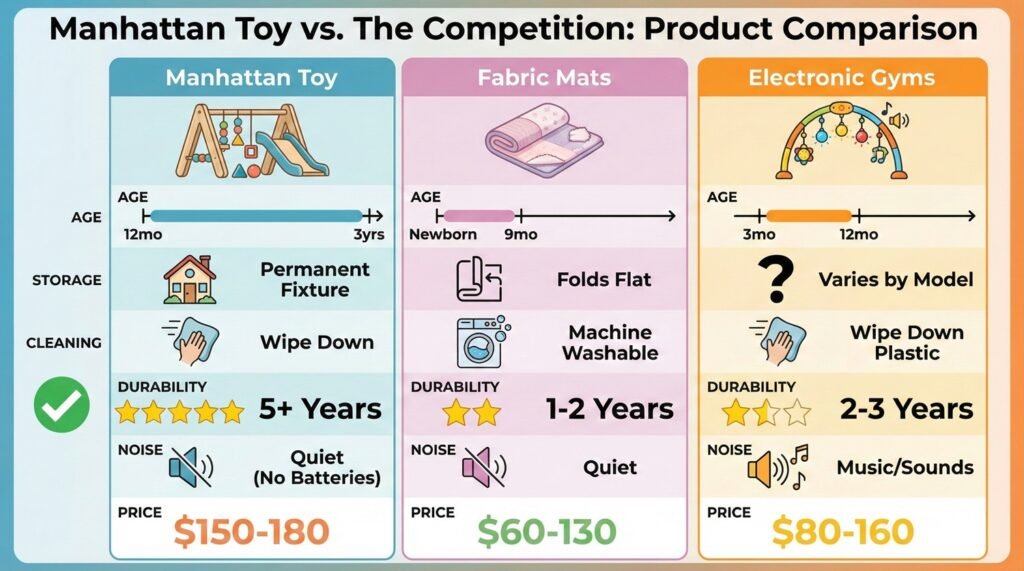
| Feature | Manhattan Toy | Fabric Mats | Electronic Gyms |
|---|---|---|---|
| Best Age Range | 12 months to 3 years | Newborn to 9 months | 3 months to 12 months |
| Storage | Permanent fixture | Folds flat | Varies by model |
| Cleaning | Wipe down | Machine washable | Wipe down plastic |
| Durability | Lasts 5+ years | 1-2 years typical | 2-3 years typical |
| Noise Level | Quiet (no batteries) | Quiet | Music/sounds |
| Price Range | $150-180 | $60-130 | $80-160 |
Price Comparison: What You’re Spending
Manhattan Toy’s Deep Sea Adventure runs about $162. The Celestial Star Explorer (their biggest model with the most activities) costs more, usually in the $170-180 range.
The Playground Adventure and Tree Top Adventure fall in similar price ranges.
For comparison:
Skip Hop’s fabric baby activity gyms typically cost $60-130 depending on how many features you want
Budget wooden alternatives run $100-140
Premium Lovevery options can hit $150+
Electronic Baby Einstein centers cost $80-160
Manhattan Toy sits in the mid-to-premium range for wooden centers. But when you factor in durability, the cost per year of use is actually competitive.
A $162 center you use for two kids over 5 years works out to about $16 per year. A $70 fabric mat you replace after 18 months costs more over the same period if you’re going through many kids.
The price makes sense if you want wooden construction, many activity zones, non-toxic finishes, and thematic design that doesn’t look like a plastic explosion in your living room. You’re paying for durability and developmental support without unnecessary electronic features.
If you’re leaning toward a wooden option and want something that’ll last, Manhattan Toy centers deliver on quality for the price point. The Deep Sea Adventure and Celestial Star Explorer get consistently positive parent feedback for keeping kids engaged over time.
Best For Different Users
Limited Space Situations
If you’re in an apartment or small house, fabric mats that fold away make more sense than a permanent wooden structure. You need things that disappear when not in use.
That said, if you have even a corner you can dedicate permanently, Manhattan Toy’s engagement potential might justify giving up that space. Depends on your priorities.
Gift-Giving (Especially Grandparents)
This is where Manhattan Toy really shines. Grandparents want to give something substantial that won’t fall apart in six months.
A wooden activity center feels like a meaningful gift. It’s durable enough to potentially get passed down.
The thematic design adds visual appeal instead of looking like cheap plastic.
Multiple Kids or Twins
The larger Manhattan Toy models (Deep Sea Adventure, Celestial Star Explorer) have enough space for two kids to play simultaneously. Four sides of activities means less fighting over the same toy.
Fabric mats don’t really accommodate many kids at once.
Eco-Conscious Households
Wooden activity centers with non-toxic finishes appeal to parents who care about sustainable materials and avoiding unnecessary chemicals. No plastic, no electronic components, no batteries to dispose of.
Manhattan Toy’s water-based finishes mean no concerning off-gassing.
These products are also durable enough to donate or sell when you’re done instead of ending up in landfills.
Specifically for Tummy Time
If your main goal is tummy time for a young baby (under 6 months), fabric mats with mirrors and adjustable toys handle this better. They’re designed specifically for that position.
Manhattan Toy centers support tummy time but they’re really optimized for older babies who can sit or kneel.
Noise-Sensitive Households
Manhattan Toy’s lack of electronic sounds addresses a real pain point. No batteries means no unpredictable beeping or music.
The activities need physical engagement instead of passive stimulation.
If your house is already chaotic and you want toys that don’t add to the noise level, wooden centers excel here.
For households that prioritize quiet play and natural materials, Manhattan Toy activity centers check the right boxes. They encourage active engagement without the sensory overload of electronic choices.
Final Recommendation: Making the Right Choice
Manhattan Toy activity centers deliver on durability, engagement, and battery-free play. They’re not perfect for every situation, but they work really well in specific scenarios.
Go with Manhattan Toy if you:
Want something that’ll last through many kids
Prefer wooden, non-toxic materials over plastic
Have space for a permanent activity station
Want minimal noise and no electronic stimulation
Value thematic, imaginative play elements
Go with fabric mats if you:
Need portability and easy storage
Have a young baby (under 6 months) doing mainly tummy time
Want machine-washable surfaces
Have very limited space
Want to spend less upfront
Go with electronic options if you:
Need most distraction capability (no judgment)
Want cause-and-effect learning through lights and sounds
Prefer compact, easy setup
Your choice depends on your specific situation more than which option is objectively “best.” Manhattan Toy represents solid quality at a fair price point for what you get.
The right activity gym is the one you’ll actually use consistently, that fits your space and values, and that your baby engages with regularly. Manhattan Toy delivers on these fronts when you prioritize durability and developmental support over portability or electronic features.
If you’re considering a wooden activity center and want extended play value without batteries or plastic, Manhattan Toy’s lineup justifies the investment through years of reliable use. The Deep Sea Adventure works well for most households, while the Celestial Star Explorer offers most activities if you have the space and budget.
The key takeaway is this: baby activity gyms come in different styles for different stages and preferences. Manhattan Toy occupies the wooden, durable, quiet-play niche.
Fabric mats own the portable, washable, young-baby niche.
Electronic options fill the high-stimulation, cause-and-effect niche.
Figure out which niche matches your situation, and the choice becomes pretty straightforward from there.