I’ve watched countless parents unbox their shiny new activity gym, set it up with great enthusiasm, and then wonder what exactly they’re supposed to do with it. The gym sits there, the baby stares at it blankly, and three months later it’s gathering dust in the garage because “my baby just wasn’t interested.”
The activity gym itself works perfectly fine. The problem comes from the timing, setup, and what parents expect to happen.
When you understand how babies actually interact with these tools as they grow, you unlock a developmentally suitable play space that genuinely grows with your child from week to week.
I’m talking about recognizing where your baby is right now, what they’re physically capable of doing, and how to arrange their environment to support the exact skills they’re working on this week. Development happens in waves rather than straight lines, and your approach to the activity gym needs to reflect that reality.
What Makes Activity Gyms Actually Work
The mechanics seem deceptively simple. You’ve got a padded mat, some arches overhead, and toys dangling at various heights.
What’s happening beneath the surface gets really interesting.
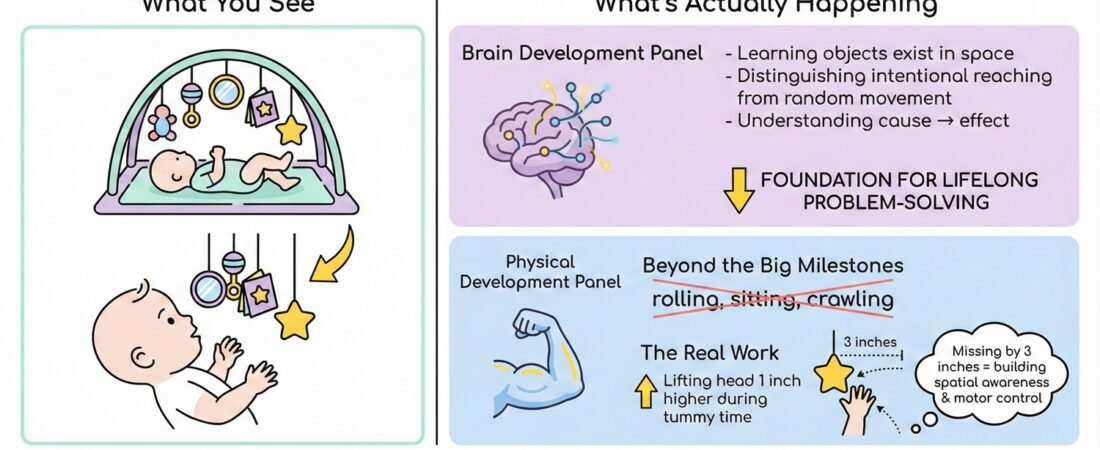
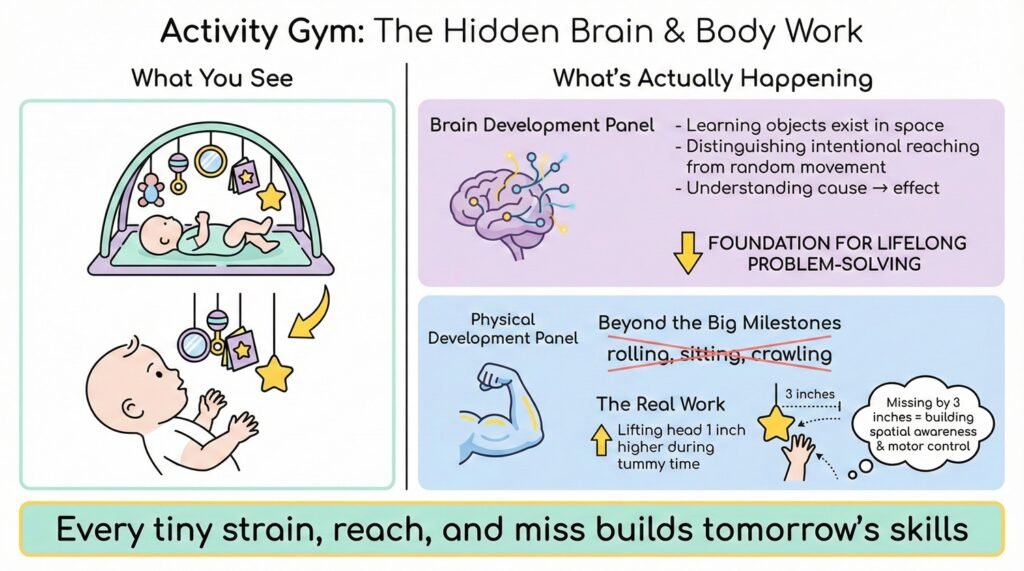
When your two-month-old lies under those hanging toys, their brain processes an enormous amount of information. They’re learning that objects exist in space, that reaching toward something feels different from just waving their arms randomly, and that certain movements produce specific results.
This cause-and-effect understanding forms the foundation for problem-solving skills they’ll use for the rest of their lives.
The physical benefits are equally significant but often misunderstood. Parents tend to focus on the big milestones like rolling, sitting, and crawling.
The real work happens in those tiny moments when your baby strains to lift their head just a bit higher during tummy time, or when they bat at a toy and miss by three inches.
Those “failures” are actually successful practice sessions. The neck muscles are getting stronger, the shoulder girdle is stabilizing, and the neural pathways controlling movement are being reinforced with every attempt.
What separates effective activity gym use from just plunking your baby down and hoping for the best comes down to understanding that sensory input drives motor output. When you position a crinkly toy just within your baby’s reach, you’re creating a sensory target that motivates movement.
The sound, texture, and visual appeal of that toy literally pull your baby’s body into new positions and movements they wouldn’t try otherwise.
Starting in the First Month
The newborn phase is tricky because your baby is essentially adjusting to existing outside the womb. Everything overwhelms them.
Lights, sounds, the sensation of air on their skin. Adding an activity gym too soon or with unrealistic expectations can actually create negative associations.
I recommend waiting until around week three or four, and even then, keeping things incredibly minimal. Your newborn doesn’t need every toy attached and dangling.
In fact, they probably shouldn’t have more than one or two high-contrast elements in their field of vision.
Position your baby on their back on the mat with just one black-and-white toy or pattern visible above them. Stay right there at their level.
Your face is actually more interesting to them than any manufactured toy, so let them look at you while they get comfortable with this new space.
These early sessions should last maybe two minutes, three times a day. You’re simply introducing the concept that this mat is a safe, interesting place to be.
You’re not trying to tire them out or achieve specific developmental goals.
The real work comes later, but these early positive experiences set the stage.
The Two to Three Month Transformation
Around eight weeks, something shifts. Your baby’s periods of alertness get longer, their vision sharpens considerably, and they start showing genuine interest in objects around them.
This is when the activity gym changes from a pleasant backdrop into an actual developmental tool.
At two months, increase your sessions to about five minutes, but really watch your baby’s cues. Some infants can handle more, others get overwhelmed quickly.
The key indicator is engagement.
Are they looking at the toys? Are their eyes tracking movement?
Or are they staring off into space looking glazed?
I’ve found that gently moving one toy across their field of vision helps train that tracking ability. Move it slowly and deliberately.
Don’t shake it vigorously or move it too fast.
You want smooth, predictable movement that their developing visual system can actually follow.
By three months, you’ll notice your baby starting to swipe at toys, though their aim is terrible. This is completely normal and exactly what should be happening.
They’re building the neural pathways that connect “I want to touch that” with “my arm needs to move in this specific direction.” This is incredibly complex neurological work disguised as play.
This is also when tummy time becomes more productive if you position them on the mat facing toys at their eye level. Most babies hate tummy time initially because it’s hard work, but having something interesting to look at makes them more willing to lift that heavy head and strengthen those neck muscles.
The Sweet Spot: Months Four Through Six
If I had to choose one period where activity gyms provide most value, this would be it. Your baby now has decent head control, purposeful reaching ability, and the core strength to stay engaged for longer periods.
They’re also starting to understand object permanence and cause-and-effect relationships, which makes interactive play much more rewarding for everyone involved.
During this phase, you can really experiment with toy variety and positioning. Hang some toys lower so they’re easier to grab, keep others slightly higher to encourage reaching and stretching.
Rotate different textures.
Something smooth, something bumpy, something that crinkles, something with ribbons. Each texture sends different sensory information to the brain, building their understanding of the physical world.
Around month five, many babies start rolling from back to front. This is a critical safety transition point that parents often miss.
Once your baby can roll independently, those overhead toys shift from developmental tools to potential hazards.
They can get tangled in hanging elements or bonk themselves trying to roll with toys in the way.
When rolling begins, remove the arches entirely or raise toys high enough that they’re completely out of reach during floor play. You can still bring the arches down for supervised, short sessions when you’re right there, but unsupervised floor time should happen without overhead obstacles.
What I really love about this stage is watching babies find out about their own bodies through play. They’ll grab their feet, bring toys to their mouths, and start understanding that they have control over objects in their environment.
The activity gym provides a contained, safe space for this crucial exploratory work.
Navigating Months Six Through Nine
This is where many parents get frustrated because their before engaged baby suddenly seems bored with the activity gym. What’s actually happening is that your baby’s developmental priorities have shifted. They’re working on sitting, preparing to crawl, and becoming mobile.
Lying on their back swatting at stationary toys doesn’t align with those goals anymore.
Instead of seeing this as the gym becoming useless, think about repurposing it. Remove the arches completely and use the mat as a cushioned, defined play space.
The familiar mat can become their “home base” during supervised floor time, a safe zone where they practice sitting or play with loose toys.
Some babies at this age still enjoy brief sessions with the traditional setup, especially first thing in the morning when they’re fresh. But if your baby fusses or immediately tries to roll away, don’t force it.
Development means following their lead rather than imposing activities they’ve outgrown.
I’ve seen parents add small obstacles or challenges to the mat. A rolled towel to practice getting over, toys positioned just out of easy reach to encourage movement, different textures taped down to crawl across.
You’re essentially creating a mini obstacle course that supports their current developmental focus on mobility.
When to Actually Stop Using It
There’s no magic day when the activity gym suddenly becomes inappropriate. Instead, you’ll notice a gradual decline in interest as your baby becomes more mobile and seeks out new challenges.
Most babies naturally phase out between seven and twelve months, though there’s enormous person variation.
The clearest sign is simple. Does your baby choose to play there when given options, or do they immediately crawl away toward other things?
Babies are remarkably good at self-selecting developmentally suitable activities.
If they’ve moved on, that reflects successful development rather than a failure of the gym or your parenting.
Some activity gyms convert into play tents or toddler tunnels, which extends their useful life considerably. If yours has this feature, the transition might be less about stopping use and more about transforming how it’s used. A play tent at fifteen months serves completely different developmental purposes like spatial awareness, imaginative play, and gross motor practice climbing in and out.
Even after your baby has completely outgrown active play, the mat itself often stays useful as a clean surface for diaper changes when visiting other homes, a familiar comfort item during travel, or eventually a hand-me-down that keeps sentimental value.
Safety Practices That Actually Matter
I’m not going to list every obvious safety rule because you’ve already read those in the manual. But there are subtle safety considerations that only become obvious with experience.
First, the supervision requirement is about recognizing developmental changes in real-time. The day your baby first rolls over often happens suddenly, without warning.
If you’re not there to see it, you won’t know to adjust the gym setup immediately.
That’s when preventable accidents happen.
Second, regularly checking toy attachments means more than looking for obvious damage. Feel the clips and connectors.
Are they still snapping firmly, or have they loosened with repeated use?
Test the arch stability by applying gentle pressure from different angles. Many activity gyms are sturdy when new but develop weak points after months of use.
Third, the cleanliness factor goes beyond just washing the mat. Those toys are constantly going in your baby’s mouth, getting drooled on, and collecting dust.
Every week or two, remove all detachable toys and actually wash them individually with soap and water rather than just wiping them down.
Fabric toys can often go in a mesh laundry bag through the washing machine.
Maximizing Developmental Value Through Engagement
Your presence during activity gym time multiplies its effectiveness exponentially. When you narrate what’s happening like “You’re kicking the blue rattle! It’s making noise!”, you’re teaching language, cause-and-effect, and attention skills simultaneously.
Position yourself at your baby’s level rather than looking down from above. Get on the floor beside them.
This perspective shift is huge for engagement because babies are wired to be interested in faces, and your face at their level is far more compelling than any toy.
I’ve noticed that babies stay engaged much longer when parents mirror their actions. If your baby bats at a toy, you bat at it too.
If they kick their legs, you gently move their toy in rhythm with the kicks.
You’re showing them that their actions have meaning and that communication is a back-and-forth process.
The other underutilized strategy is introducing controlled novelty. You don’t need to buy new toys constantly, but rotating which toys are attached every week or so maintains interest.
Babies habituate to familiar stimuli quickly, so what was fascinating two weeks ago might barely register now.
Keep a small bin of gym-compatible toys and swap them out regularly.
Common Setup Mistakes That Limit Effectiveness
The most frequent error I see is positioning toys too far away for the baby’s current ability level. If your three-month-old has to fully extend their arm to make contact, they’ll probably just give up because it’s too frustrating.
Toys should be positioned so that your baby succeeds about 70% of the time and has to really work for that last 30%.
Another mistake is keeping the same toy configuration as your baby grows. What worked at two months needs adjustment by three months and finish reconfiguration by five months.
Your baby’s reach lengthens, their hand-eye coordination improves, and their interests evolve.
The gym should evolve with them.
Overloading the gym with too many toys simultaneously is surprisingly common. More doesn’t mean better when it comes to infant stimulation.
Three well-chosen, properly positioned toys will generate more development than eight randomly attached ones.
Babies need to be able to focus on person objects and explore them thoroughly, which becomes impossible when everything competes for attention.
Temperature and lighting also matter more than parents realize. If the gym is positioned where afternoon sun creates glare, or where it’s cold from a floor vent, your baby won’t want to spend time there.
The environment around the gym affects engagement just as much as the gym itself.
People Also Asked
When should I introduce an activity gym to my newborn?
Wait until around week three or four before introducing the activity gym. Your newborn needs time to adjust to life outside the womb first.
When you do start, keep sessions very short at about two minutes, three times per day, with minimal stimulation.
Use only one or two high-contrast toys rather than loading up all the attachments.
How long should my baby use an activity gym each day?
The duration changes dramatically with age. Newborns around three to four weeks old should only have two-minute sessions.
By two months, you can extend to five minutes.
During the peak period from four to six months, babies can often engage for fifteen to twenty minutes at a time. Always watch for signs that your baby is becoming overstimulated or bored and end the session.
What are signs my baby is done with the activity gym?
The clearest sign is that your baby immediately crawls or rolls away when placed on the gym, rather than engaging with the toys. This typically happens between seven and twelve months as mobility becomes their primary developmental focus.
If your baby consistently chooses other activities over the gym when given options, they’ve naturally outgrown it.
Can activity gyms help with tummy time?
Yes, activity gyms can make tummy time more productive starting around two to three months. Position your baby on the mat facing toys at their eye level rather than overhead.
Having something interesting to look at motivates them to lift their head and strengthen neck muscles.
The padded mat also provides a comfortable surface for this challenging exercise.
Is it safe to leave my baby alone on an activity gym?
You should supervise all activity gym sessions, especially once your baby starts showing signs of rolling, typically around four to six months. The day your baby first rolls can happen suddenly, and overhead toys can become hazards if they get tangled or hit themselves.
Remove arches entirely once independent rolling begins unless you’re right there watching.
How do I clean activity gym toys properly?
Remove all detachable toys every week or two and wash them individually with soap and water rather than just wiping them down. These toys constantly go in your baby’s mouth and collect drool and dust.
Fabric toys can often go through the washing machine in a mesh laundry bag.
Check manufacturer instructions for plastic components.
Key Takeaways:
Activity gyms work best when matched precisely to your baby’s current developmental stage rather than used as one-size-fits-all entertainment.
The first month is about gentle introduction with minimal stimulation, just building positive associations with the space.
Months two through six represent peak activity gym value when babies develop reaching, grasping, and intentional movement skills.
Remove overhead toys once rolling begins, typically around four to six months, to prevent safety hazards.
Engagement naturally declines between seven and twelve months as mobility becomes the primary developmental focus, and this is normal and healthy.
Your active participation and narration during gym time multiplies developmental benefits far beyond solo play.
Regular reconfiguration of toy positioning and selection maintains interest and challenges developing skills appropriately.
The transition away from the gym reflects successful development progressing to the next stage.