Have you ever stood in a toy aisle feeling completely overwhelmed by the sheer volume of plastic contraptions, each one promising to make your baby smarter, happier, or more advanced? Or maybe you’ve noticed your infant becoming fussy and distracted when surrounded by too many bright, noisy toys, yet somehow deeply focused when handed a simple wooden spoon from your kitchen?
I’ve watched countless parents struggle with this paradox. We want to give our babies every advantage, yet something feels fundamentally off about the approach we’re taking.
The Montessori philosophy offers a refreshingly different lens for understanding infant play, one that honors how babies actually learn as opposed to how we think they should learn.
What I find really compelling about Montessori for infants is that you don’t need to buy specific branded products or follow rigid rules. You need to understand a few core principles that fundamentally shift how you see your baby’s development.
Once these principles click, you’ll find yourself naturally making better choices regarding toys and your entire approach to your baby’s environment and daily rhythms.
Let me share what I’ve learned about creating genuinely supportive play experiences for infants, the kind that foster deep concentration, genuine discovery, and real confidence.
The Foundation: What Montessori Actually Means for Babies
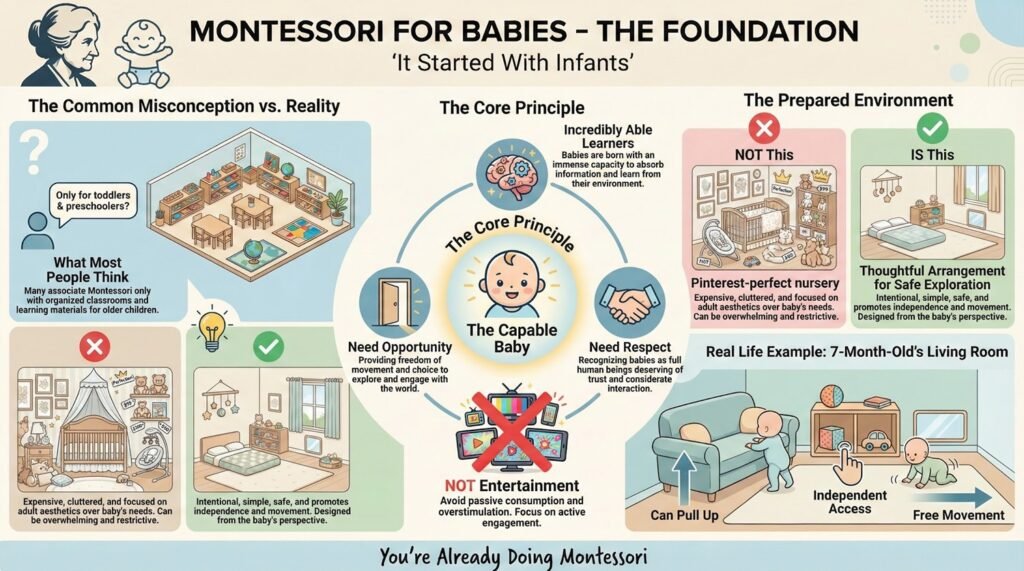
Most people associate Montessori with preschool classrooms featuring tiny furniture and organized shelves. But Dr. Maria Montessori’s observations actually began with infants, and her insights about how babies learn remain remarkably relevant today.
The Montessori approach for infants rests on a simple but radical premise: babies are incredibly able learners who need respect and opportunity, not entertainment. When we treat play as the serious work it is for infants, everything shifts.
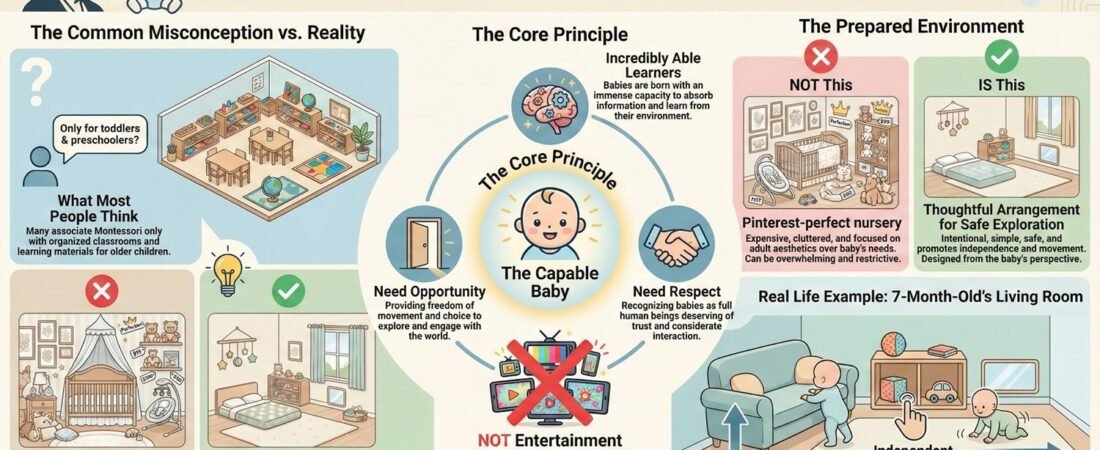
The prepared environment concept becomes your guiding principle here. This doesn’t mean creating a Pinterest-perfect nursery, it means thoughtfully arranging your space so your baby can safely explore without constant intervention.
When your living room allows your seven-month-old to pull up on stable furniture, reach toys independently from a low shelf, and move freely across open floor space, you’re implementing Montessori principles whether you realize it or not.
Freedom within limits sounds contradictory until you see it in action. Your baby gets genuine autonomy, choosing which toy to explore, deciding when they’re done, determining their own pace.
But this freedom exists within carefully considered boundaries that keep them safe and prevent overwhelm.
You’re creating the conditions where real independence can flourish, not just letting your baby do whatever they want whenever they want.
What really distinguishes Montessori from conventional approaches is the emphasis on reality and purposeful activity. Babies don’t need flashing lights and electronic sounds, they need authentic experiences with real materials that respond predictably to their actions.
A wooden ball that rolls when pushed teaches cause and effect more clearly than a battery-operated toy that plays music randomly. Your baby learns to understand their own agency and power when they see direct, consistent results from their actions.
Understanding Sensory Isolation and Why It Matters
The principle of sensory isolation suggests that babies learn most effectively when they can focus on one sensory experience at a time. This challenges much of what mainstream toy marketing tells us.
Think about how you naturally close your eyes when trying to identify a smell or taste something carefully. You’re instinctively isolating one sense to give it your full attention.
Babies benefit from this same focused exploration, but most conventional toys work against this principle.
A typical baby activity center might have mirrors, spinning elements, textured surfaces, buttons that make sounds, and bright contrasting colors all competing simultaneously for attention. It seems like more stimulation would equal more learning, but the opposite is often true.
Your baby’s developing brain gets overwhelmed trying to process many sensory inputs at once, leading to shorter attention spans and surface-level engagement.
Compare that experience to offering your baby a simple wooden rattle. They can fully focus on how it feels in their hand, the weight of it, how it sounds when shaken gently versus vigorously, how it tastes when mouthed. This deep, focused exploration builds genuine understanding and develops concentration skills that will serve them throughout life.
I’ve seen this play out repeatedly with the babies I’ve observed. The ones surrounded by fewer, simpler toys consistently show longer periods of focused engagement. They’re not more “advanced” babies, they’re simply being given the cognitive space to truly explore as opposed to constantly switching between competing stimuli.
This doesn’t mean you can never offer complex toys, but it means being thoughtful about when and how. A texture board with different fabrics works better than a busy board combining textures, sounds, mirrors, and moving parts.
Your baby can give full attention to tactile exploration as opposed to splitting focus across many sensory channels.
Matching Toys to Real Developmental Windows
One of the biggest mistakes I see parents make is selecting toys based on packaging age recommendations or what seems cute as opposed to carefully observing where their specific baby is developmentally. Montessori emphasizes sensitive periods, those windows when a child is particularly primed to master certain skills.
During the first three months, your newborn is primarily working on visual focus and beginning to control their head movements. High-contrast images capture attention because their visual system is still developing color perception.
A simple mobile with black and white geometric shapes positioned about twelve inches above their play mat provides exactly the right level of visual stimulation without overwhelming their developing sight.
But here’s what makes this really practical: you don’t need expensive specialized equipment. I’ve seen parents create effective high-contrast mobiles using cardboard cutouts and ribbon.
What matters is understanding the principle, your baby needs visual stimulation at the right complexity level for their current development.
Around three to six months, a dramatic shift happens. Your baby’s intentionality explodes.
They’re no longer just accidentally batting at objects, they’re deliberately reaching, grasping, and bringing items to their mouth for exploration.
This is when a play gym becomes genuinely valuable, not earlier when your newborn mainly needs floor time for free movement.
The Montessori approach suggests offering toys that match emerging skills slightly before they’re fully mastered, providing just enough challenge to encourage practice without causing frustration. When your baby is beginning to grasp objects but hasn’t perfected the skill, lightweight wooden rings on ribbons offer ideal practice opportunities.
Between six and eight months, as sitting becomes stable and crawling emerges, your baby’s world expands dramatically. Object permanence develops, that understanding that things continue to exist even when out of sight.
This is the perfect window for introducing an object permanence box, a simple wooden box where your baby pushes a ball through a hole and watches it roll out an opening at the front.
The beauty of matching toys to developmental windows is that engagement happens naturally. You’re providing tools that align with their current developmental agenda, not trying to entertain or distract your baby.
When you get this right, you’ll see sustained focus that might surprise you. I’ve watched eight-month-olds work with a simple ball-in-box toy for fifteen minutes straight because it perfectly matched their developmental drive to understand object permanence.
Creating Your Prepared Environment: Beyond Just Toys
The toys themselves matter less than the overall environment you create. I’ve visited homes with extensive collections of beautiful wooden Montessori toys that sit largely ignored because the environment didn’t support meaningful engagement.
Conversely, I’ve seen babies deeply engaged in homes with minimal toy collections but thoughtfully arranged spaces.
Start by thinking about accessibility. Can your baby independently reach their toys, or do they need to cry for you to hand things to them?
A low shelf positioned at your baby’s level changes the entire dynamic.
They become active choosers as opposed to passive recipients of whatever you decide to offer. This shift happens the moment your baby realizes they can get things for themselves.
Organization really matters here, not for aesthetic reasons but because visual clarity helps your baby orient to their options. When toys are jumbled in a bin, extracting one becomes a frustrating challenge.
When each toy has a specific place on a shelf, your baby can clearly see their choices and develop decision-making skills.
The number of visible options needs careful consideration. Three to five toys available at once prevents overwhelm while still offering meaningful choice.
Rotate items regularly based on your observations of what’s capturing attention and what’s being ignored. I typically swap one or two toys every few days, keeping a bin of extra options stored in a closet.
Consider the sensory qualities of the space itself. Soft, neutral background colors allow toys to stand out without competing with busy patterns or bright wall colors.
Natural lighting supports visual development better than harsh overhead fixtures.
A simple cotton rug defines the play space and provides comfortable flooring for tummy time and rolling.
Movement space deserves as much attention as toys. Your baby needs generous open floor area for practicing emerging motor skills.
This means resisting the temptation to fill your living room with baby gear.
That fancy jumper or activity center might seem helpful, but it actually restricts the natural movement progression your baby needs to develop coordination and strength. Floor time builds core strength.
Container time does not.
Safety considerations are obviously paramount, but Montessori safety differs slightly from conventional babyproofing. Rather than making everything off-limits, you’re creating an environment where nearly everything is safe for exploration.
Secure furniture to walls, cover outlets, remove choking hazards and toxic materials, then step back and allow genuine freedom within that safe space.
The Practice of Observation: Your Most Powerful Tool
If I could emphasize one skill above all others for implementing Montessori principles with your infant, it would be developing your observation abilities. This sounds passive, but observing well requires active attention and practice.
Set aside time regularly to simply watch your baby play without intervening. What are they repeatedly drawn to?
Where does their attention linger?
What movements are they practicing? What causes frustration versus satisfaction?
I remember watching a nine-month-old who kept throwing toys off her play shelf. Her parent interpreted this as destructive behavior requiring correction.
But careful observation revealed she was actually in a throwing schema, developmentally driven to practice this newly mastered skill.
The solution wasn’t stopping the throwing but providing suitable throwing opportunities like soft balls aimed at a basket while rotating breakable items temporarily off the shelf.
Notice hand preference and grip patterns. Is your baby using a palmer grasp or beginning to develop a pincer grip?
This tells you which toys will appropriately challenge emerging fine motor skills.
A baby still using palmer grasp isn’t ready for tiny objects requiring pincer grip, but they’re probably ready for larger items that nest inside each other.
Watch for signs of engagement versus overstimulation. Genuine engagement looks like sustained attention, calm breathing, and purposeful movement.
Overstimulation shows up as fussiness, rapid switching between toys without really exploring any, arching away from toys, or shutting down entirely. When you see these signs, your baby needs either a simpler toy selection or a break from play altogether.
Your observations also reveal when toys have outlived their usefulness for your baby’s current development. That rattle that fascinated your four-month-old might bore your seven-month-old who’s moved on to more complex manipulative challenges.
Rotate it out temporarily, and you might find renewed interest months later when it serves a different purpose.
The goal is developing an intuitive sense of where your baby is developmentally and what they need next. This skill proves far more valuable than any toy purchase.
I can usually tell within five minutes of watching a baby play what developmental window they’re in and what materials would support them best.
Practical Implementation: Moving from Theory to Daily Life
Understanding Montessori principles intellectually differs significantly from implementing them in your actual, messy daily life with a real baby. Let me walk through how this actually looks in practice.
Start small as opposed to attempting a finish environmental overhaul. Choose one area of your home, maybe a corner of your living room, and set up a simple play space.
A low shelf or even a firm cushion can hold three toys.
Add a mirror anchored securely to the wall at your baby’s level. Define the space with a simple mat or rug.
That’s enough to begin.
Select your initial toys based on your baby’s current developmental stage. For a four-month-old, you might offer a wooden grasping toy, a soft textured ball, and a simple rattle.
For a ten-month-old, perhaps an object permanence box, a vertical stacker with large rings, and a push toy.
Establish a routine of rotating toys every few days or whenever you notice declining interest. Keep extra toys stored out of sight, bringing them back into rotation periodically.
This maintains novelty without requiring constant new purchases. I’ve worked with families who have fifteen total toys that they rotate through, keeping only four or five out at any given time.
Resist the urge to direct your baby’s play. When you sit with them in their play space, position yourself nearby but avoid hovering or constantly offering toys.
Let them choose what to explore and for how long.
Your role is presence and availability, not entertainment director. I often bring a book and sit near my baby during play time, available if needed but not directing the experience.
When your baby encounters difficulty, pause before intervening. If they’re reaching for a toy that rolled slightly out of range, give them time to problem-solve.
The frustration tolerance and persistence they develop during these moments builds far more valuable skills than always having toys immediately retrieved for them.
Incorporate real objects alongside dedicated toys. Wooden spoons, metal bowls, fabric scraps, and baskets offer rich sensory experiences and connect your baby to authentic household life.
A six-month-old exploring how a metal bowl sounds when tapped is engaged in legitimate learning.
Common Challenges and Realistic Solutions
Family members or caregivers may resist your Montessori approach, especially if it differs significantly from conventional parenting in your community. Rather than evangelizing about philosophy, focus on observable outcomes.
When grandparents see your baby’s sustained concentration during play, they become more open to understanding why you’ve chosen this approach. Show them as opposed to telling them.
Space limitations pose real challenges, especially in small homes or apartments. You don’t need a dedicated playroom to apply Montessori principles.
A corner of your living room works perfectly well.
The quality of the space matters more than the quantity. I’ve seen effective Montessori setups in studio apartments using vertical space cleverly.
Budget concerns are valid since quality wooden toys often cost more than plastic choices. Remember that Montessori emphasizes fewer, higher-quality items as opposed to extensive collections.
Five well-chosen wooden toys will serve your baby better than fifty plastic ones.
Additionally, many Montessori materials can be DIY projects or found objects as opposed to purchased products. Fabric squares for texture exploration cost pennies.
A basket of wooden spoons from the thrift store provides excellent grasping practice.
Guilt about past toy choices often surfaces when parents learn Montessori principles after already accumulating many conventional toys. You don’t need to discard everything and start over.
Gradually shift your approach, keeping items that align with Montessori principles and rotating out those that don’t.
Many toys can be donated to families who’ll appreciate them. I started my Montessori practice when my daughter was seven months old, and we gradually transitioned over several months.
Maintaining the prepared environment requires ongoing effort, especially as your baby becomes mobile and capable of pulling everything off shelves. This is actually a sign of healthy development, not a problem to eliminate.
Your response might be temporarily reducing the number of available toys or providing more opportunities for your baby to help with cleanup as a practical life activity. Even a ten-month-old can learn to place toys in a basket with your modeling.
Frequently Asked Questions
What are Montessori toys for babies?
Montessori toys for babies are typically made from natural materials like wood, metal, or fabric. They’re simple in design, focusing on one skill or sensory experience at a time.
Examples include wooden rattles, grasping toys, object permanence boxes, and simple push or pull toys.
These toys respond predictably to your baby’s actions and don’t require batteries or electronic components.
How do I start Montessori with my newborn?
Start by creating a simple floor space with a firm mat where your newborn can have tummy time and move freely. Add a low mirror on the wall and a high-contrast mobile positioned about twelve inches above where they lie.
Focus on giving your newborn plenty of unrestricted movement time outside of swings, bouncers, and other containers.
Observe your baby carefully to understand their emerging interests and capabilities.
What age is best to introduce Montessori methods?
You can begin implementing Montessori principles from birth. The approach adapts to each developmental stage, from newborns who need simple visual stimulation and movement freedom to older infants exploring object permanence and early problem-solving.
Starting early helps you develop observation skills and creates habits that grow with your baby, but you can successfully introduce Montessori principles at any age.
Do Montessori babies develop faster?
Montessori babies don’t necessarily hit milestones earlier, and that’s not the goal. The approach focuses on developing concentration, independence, confidence, and problem-solving abilities as opposed to accelerating specific developmental milestones.
You might notice your baby showing longer attention spans, greater persistence with challenges, and more confident exploration compared to babies in more conventional environments.
How many toys should a baby have at once?
Three to five toys available at once works well for most babies. This provides enough variety for meaningful choice without creating overwhelm.
Store extra toys out of sight and rotate them regularly based on your baby’s changing interests and developmental stage.
The specific number matters less than ensuring each available toy serves a clear purpose for your baby’s current development.
What is a prepared environment for babies?
A prepared environment for babies means a space thoughtfully arranged to support safe, independent exploration. This includes low shelves where babies can reach toys themselves, open floor space for movement practice, a mirror at baby height, and carefully selected toys that match current developmental needs. Everything in the space is safe for the baby to access and explore without constant adult intervention.
Can I use Montessori with a small apartment?
You can absolutely apply Montessori principles in a small apartment. You don’t need a dedicated playroom, a corner of your living room with a low shelf and play mat works perfectly.
Focus on the quality of the space as opposed to the quantity.
Vertical storage and thoughtful toy rotation become especially valuable when working with limited square footage.
Are plastic toys okay for Montessori?
Montessori philosophy emphasizes natural materials like wood, metal, and fabric because they provide richer sensory experiences and connect babies to authentic textures. However, a few well-chosen plastic items won’t undermine your overall approach.
Focus on simplicity and purpose as opposed to rigid material rules.
A simple plastic ball can align with Montessori principles better than a complex wooden toy with many competing features.
Key Takeaways
Respect your baby’s competence. They’re active learners who need suitable opportunities and trust in their natural development, not constant entertainment or instruction.
Simplify your toy selection deliberately. Three well-chosen toys available at once support deeper learning than thirty competing for attention.
Quality and appropriateness matter infinitely more than quantity.
Match materials to current developmental windows. Observe where your specific baby is right now as opposed to relying solely on age guidelines or what worked for other babies.
Create genuine freedom within safe boundaries. Your prepared environment should allow autonomous exploration without requiring constant supervision or intervention.
Isolate sensory experiences when possible. Simple, focused materials teach more effectively than complex toys stimulating many senses simultaneously.
Your baby’s developing brain needs space to fully process each type of sensory input.
Prioritize real materials and authentic experiences. Natural wood, metal, and fabric provide richer sensory input than plastic.
Real household objects often engage babies more deeply than dedicated toys purchased specifically for them.
Develop your observation skills as your primary tool. Watching your baby carefully reveals exactly what they need next far better than any expert recommendation or product marketing.
Allow problem-solving time before intervening. The persistence and frustration tolerance developed when babies work through challenges builds crucial life skills that serve them long after infancy ends.