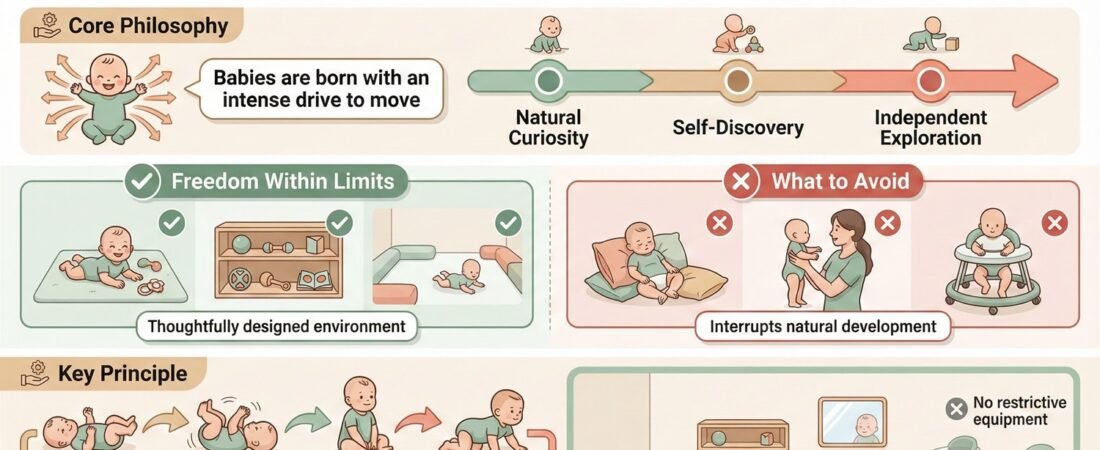
Getting Your Baby Moving the Montessori Way
When I first learned about the Montessori approach to infant movement, everything felt backward. Our culture pushes us to buy every contraption, prop babies up before they can sit alone, and basically rush them through every single milestone as fast as possible.
But then you watch babies who’ve had real freedom of movement from day one.
The difference is remarkable.
Movement development between 6-9 months builds the foundation for spatial awareness, problem-solving, confidence, and physical competence that your baby will rely on for their entire life. Every time they figure out how to roll toward a toy, pivot in a circle on their belly, or pull themselves up on the couch, they’re solving complex problems and building genuine confidence in their own abilities.
Once you understand the philosophy, you’ll see why this approach makes more sense than what most of us were taught was normal baby care.
If you’re overwhelmed by all the baby gear being marketed to you, or wondering why your baby seems frustrated in that jumper, or just curious about a more respectful approach to physical development, this guide will walk you through what movement really looks like in Montessori practice for this age range.
Understanding the Montessori Philosophy on Infant Movement
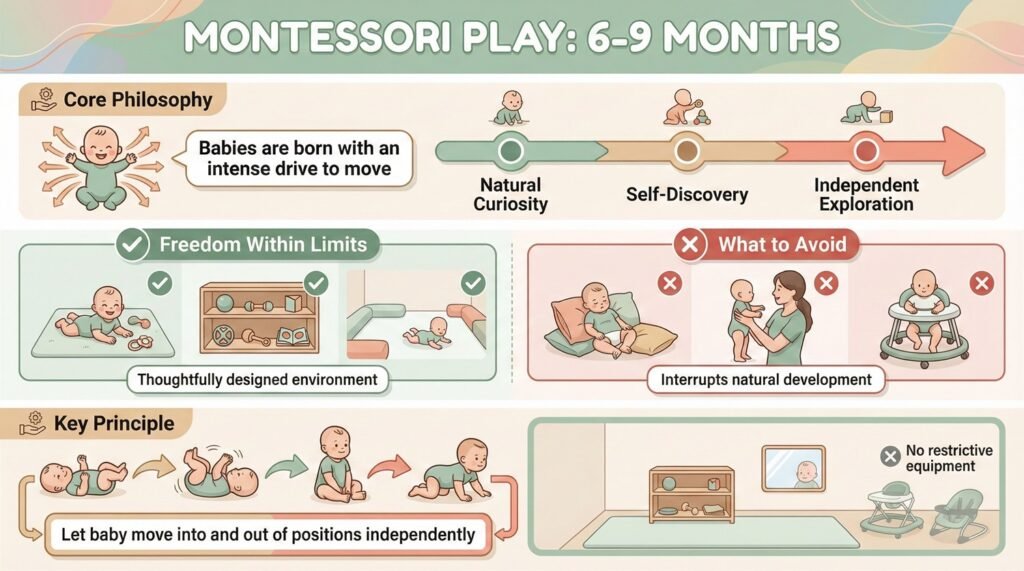
Dr. Maria Montessori observed something over a century ago that still holds true: babies are born with an intense drive to move, and they develop best when allowed to follow their own internal timeline without adults interfering. This doesn’t mean leaving your baby to figure everything out alone in an unsafe space.
It means creating an environment so thoughtfully designed that your baby can explore safely and freely without constant intervention.
What makes this fundamentally different from conventional parenting is the emphasis on freedom within limits. You’re not leaving your baby in an unsafe space to fend for themselves, but you’re also not restricting their natural movement patterns by putting them in positions they can’t get into or out of on their own.
Every time we prop a baby into sitting before they can sit themselves, or stand them up before they can pull themselves up independently, we interrupt a crucial developmental sequence that matters far more than we realize.
The developmental sequence itself matters more than hitting specific milestones by certain dates. Your baby needs significant time on their tummy, building core strength and learning to pivot and reach.
They need hundreds of hours practicing the tiny movements that eventually become rolling, then army crawling, then hands-and-knees crawling.
Each stage builds essential neurological pathways and physical competence that you simply cannot shortcut without consequences down the line.
One of the most fascinating aspects of this approach is how it builds intrinsic motivation. When babies explore they can roll over through their own efforts, after days or weeks of trying, they experience genuine accomplishment.
This feels completely different from the passive experience of being placed in a position by someone else.
That internal sense of “I did this myself” becomes the foundation for perseverance, problem-solving, and confidence in their own abilities that extends far beyond physical development.
The prepared environment sits at the center of making this work. Unlike traditional nurseries filled with cribs, changing tables, and various contraptions that restrict movement, a Montessori movement space prioritizes floor freedom above everything else.
This means a safe, firm surface where your baby can move without restrictions, with carefully selected materials within reach that invite interaction and exploration as opposed to passive watching.
Creating the Ideal Movement Environment
Setting up your space for optimal movement doesn’t need expensive materials or a finish home renovation. What it does need is a shift in how you think about your baby’s daily environment.
The most important investment you’ll make is in safe, open floor space, and that’s essentially free.
Start with a firm, clean surface. Many families use a low-pile rug or play mat directly on the floor, but avoid anything too soft or cushioned. Your baby needs to feel the resistance of a firm surface to develop proper muscle engagement.
Soft surfaces actually make movement harder and less effective for building strength.
If you’re worried about hard floors, remember that babies are naturally much closer to the ground and remarkably resilient.
The movement area should be free from clutter but not sterile or empty. You want maybe three to five carefully chosen materials available at any given time, placed on a low shelf or directly on a mat where your baby can see and reach them.
This differs radically from the overstimulated play areas many of us default to, where dozens of toys compete for attention.
That visual and sensory overwhelm actually stops focused exploration and intentional movement before it can start.
Temperature and clothing considerations matter more than most parents realize. Babies move best when they’re not overheated or restricted by bulky clothing.
In a safely temperature-controlled space, a onesie or even just a diaper is often ideal.
This allows finish freedom for arms and legs to move through their full range of motion. Bare feet are particularly important because they allow your baby to feel textures, use their toes for gripping during crawling attempts, and develop the small muscles in their feet that contribute to balance and coordination later.
Safety obviously comes first, but Montessori safety looks different from mainstream baby-proofing. Rather than restricting access to entire rooms with gates and closed doors, you’re creating a completely safe space where everything within reach is accessible.
Outlets are covered, furniture is anchored, small objects are removed, and anything toxic or dangerous is eliminated entirely from this area.
Within this prepared space, your baby can explore without constant “no” interventions that interrupt their focus and dampen their natural curiosity.
The furniture in your movement space should support independence at every turn. A floor bed instead of a crib allows your baby to see their environment clearly and eventually move in and out independently when they’re ready.
A very low mirror mounted horizontally along one wall becomes an endlessly fascinating tool for self-discovery and motivation to move toward their own reflection.
A sturdy, stable pull-up bar at the right height, roughly mid-chest when your baby is on their knees, provides support for pulling to stand when they’re developmentally ready to attempt it.
Tummy Time Evolution
Tummy time gets plenty of attention in mainstream parenting advice, but the Montessori approach offers a much more nuanced understanding of this foundational activity. For babies in the 6-9 month range who have been practicing tummy time since the newborn period, this position should feel natural and comfortable, a preferred position for play as opposed to a frustrating exercise to endure for a few minutes before being rescued.
If your baby is just starting Montessori practices at 6 months and has spent most of their early months in containers like swings and bouncers, tummy time might still be challenging. You’ll need to build up gradually, with short, frequent sessions as opposed to forcing extended periods that create negative associations.
The key is making tummy time genuinely interesting as opposed to something to simply tolerate until you flip them back over.
Positioning yourself at your baby’s eye level during tummy time creates connection without interference. Lie down facing your baby and simply observe.
Your presence provides security and motivation, but resist the urge to constantly entertain or prop.
Let them work through the physical challenges of lifting their head, shifting weight, and eventually pivoting in a circle. These struggles are where the learning happens.
Strategic material placement encourages reaching and weight shifting without forcing it. A simple wooden rattle placed just beyond comfortable reach invites your baby to extend one arm while supporting themselves on the other, which is a crucial skill for eventual crawling.
A small mirror propped in front of them provides endless fascination and motivation to hold that head up just a bit longer.
These aren’t tricks or manipulations, they’re thoughtful invitations to engage with their environment in ways that support development.
Around 6-7 months, many babies begin pivoting during tummy time, rotating in circles while on their bellies as they reach for objects around them. This is actually a really important developmental stage that often gets overlooked because it looks less impressive than crawling.
Pivoting builds core strength, teaches weight shifting, and develops spatial awareness in ways that matter.
Give your baby plenty of time and space to pivot freely, even though you might be keen to see them crawl forward instead.
The transition from static tummy time to dynamic movement happens gradually and varies enormously between person babies. Some will move straight into army crawling, pulling themselves forward with arms while their belly stays down, while others will push backward first, or develop a unique scooting method that works for their body.
The specific style matters far less than the fact that your baby is solving the problem of self-directed movement in their own way, on their own timeline.
Crawling Preparation and Support
Supporting crawling development without forcing it needs understanding what your baby’s body actually needs to accomplish this complex motor pattern. Hands-and-knees crawling builds bilateral coordination, strengthens the connections between left and right brain hemispheres, and establishes motor patterns that will support later academic skills like reading and writing.
Getting up on hands and knees from a belly-down position needs significant core and upper body strength that doesn’t just appear one day. Your baby builds this through hundreds of repetitions of smaller movements.
Each time they push up from tummy time, shift their weight from side to side, or rock back and forth on hands and knees, they’re practicing the components that will eventually mix into coordinated crawling.
Creating motivation to crawl involves interesting destinations as opposed to coercion or forcing. If everything your baby wants is within arms reach, there’s no reason to develop the challenging skill of crawling.
Place appealing materials slightly out of reach, not so far that it becomes frustrating, but far enough that getting there needs effort.
This teaches your baby that movement has purpose and opens up new possibilities for exploration and discovery.
Rocking on hands and knees is one of those milestone moments that tells you crawling is getting close. When your baby pushes up onto hands and knees and rocks back and forth, they’re developing the motor pattern and building the muscle memory for reciprocal limb movement.
This phase can last days or weeks, and you shouldn’t rush it.
Each rocking session strengthens the neurological pathways needed for coordinated crawling.
Some babies develop variations on standard crawling patterns. Army crawling, bottom scooting, rolling to get places, or asymmetrical patterns where one leg tucks under, all of these are valid forms of self-directed mobility.
While symmetric hands-and-knees crawling has specific developmental benefits, any form of intentional, self-directed movement is building important skills.
The key question isn’t “Is my baby crawling the right way?” but rather “Is my baby motivated to move and solving the movement problem in their own way?”
The surfaces your baby practices on influence how crawling develops. Firm, smooth floors provide the best feedback and resistance for building strength.
Very soft carpets or cushioned mats actually make crawling harder because limbs sink in as opposed to pushing off effectively.
If you have only soft carpet in your home, consider placing a firmer play mat in your movement area for practice time.
Pulling to Stand and Cruising
The drive to be vertical is incredibly strong in humans, and you’ll see this emerging clearly in the 8-9 month range for many babies. This is where that sturdy furniture and appropriately-sized pull-up bar becomes really important.
Your baby needs stable surfaces that won’t tip or roll when they use them for support.
Pulling to stand develops gradually through stages that build on each other in a predictable sequence. First, your baby will pull to kneeling, using furniture or the pull-up bar to support themselves in a kneeling position.
This half-step is really important for building leg strength and confidence before attempting full standing.
Then comes pulling all the way to standing, usually with a very wide stance and both hands gripping the support tightly. Eventually, they’ll stand with one hand, then just fingertips, and finally, briefly let go altogether.
Appropriate support surfaces matter tremendously at this stage. Furniture should be heavy enough not to tip and have edges your baby can grip securely.
A couch works well for this purpose.
A lightweight toy basket or ottoman does not because these create dangerous situations where your baby pulls up and the object tips toward them. If you’re using a pull-up bar specifically designed for infant use, make sure it’s properly mounted and at the right height for your baby’s current size.
Cruising, which means walking sideways while holding furniture for support, usually develops after your baby is comfortable pulling to stand. This is another one of those stages worth savoring as opposed to rushing through.
Cruising builds tremendous leg strength, balance, and confidence.
Your baby is solving complex problems about weight shifting, foot placement, and maintaining stability while in motion.
Resist the urge to hold your baby’s hands and walk them around the room. This is one of the most common ways we unintentionally interfere with natural development.
When you hold a baby’s hands and walk them, you’re putting them in a position they can’t get into or out of independently, and you’re providing artificial balance that prevents them from developing their own.
It feels helpful, but it actually delays independent walking by making them reliant on that external support.
If your baby is pulling up on your legs or reaching for your hands, that’s different because they’re initiating the interaction. You can certainly provide stability if they’re asking for it.
The distinction is in who’s directing the activity.
Child-led exploration and movement always trumps adult-directed positioning.
Strategic Material Selection for Movement
The materials you offer during this movement-intensive stage should invite action as opposed to passive watching. This is where the Montessori approach really diverges from mainstream toy selection.
You’re not looking for electronic toys that do things while baby watches.
You’re looking for simple objects that need your baby to do something.
Balls of various sizes are absolutely essential movement materials. A medium-sized ball, around 8-10 inches, that your baby can push while crawling encourages forward movement and provides incredible motivation.
The ball rolls away, your baby follows it, the ball rolls again, this simple cause-and-effect can engage a crawler for surprisingly long periods.
Smaller balls for grasping and larger therapy balls for rolling over or leaning against add variety to their practice.
Push toys designed for crawlers, not walkers, provide motivation to crawl and later cruise. A simple wooden cart with blocks, a push toy with balls that pop as wheels turn, or even a sturdy cardboard box can serve this purpose.
The key is that your baby needs to be mobile already to use them effectively.
They support existing movement as opposed to replacing necessary developmental stages.
Low tunnels or simple obstacle courses challenge babies to solve spatial problems with their bodies. A play tunnel gives crawlers a goal and an interesting sensory experience.
Sofa cushions arranged on the floor under supervision create gentle elevation changes that need problem-solving.
These variations in terrain build motor planning skills and body awareness that go beyond simple forward crawling.
Furniture arranged for cruising should form a connected path without large gaps. If your couch, ottoman, and low shelf are positioned so your baby can move from one to another while maintaining contact, you’re creating opportunities for extended cruising practice.
Gaps that are too large create frustration and potential falls, while no gaps at all mean no challenge to work through.
Movement Through Daily Routines
The most powerful movement opportunities often happen during care routines as opposed to designated playtime. When you slow down and involve your baby as an active participant in dressing, diapering, and mealtimes, you’re supporting movement development in really meaningful ways that add up over time.
Diaper changes offer opportunities for cooperation and body awareness. Rather than simply doing things to your baby while they lie passively, you can invite participation.
Asking them to lift their bottom, with gentle touch cues initially, engages core muscles.
Allowing them to help push their legs through pant legs builds coordination. These micro-movements practiced many times daily add up to significant physical development.
Dressing and undressing become movement activities when you slow down enough to let your baby join. Pulling socks off is often one of the first self-care skills babies master in this age range because it needs grip strength, bilateral coordination, and intentionality.
Rather than rushing through dressing to get to “real” activities, recognize that the dressing itself is valuable movement practice.
Mealtimes at a weaning table and chair sized for your baby create opportunities to practice getting in and out of seated positions independently. The table is low enough that your baby can pull up on it, step sideways to the chair, and lower themselves down eventually.
This differs radically from high chairs where your baby is placed in and lifted out of a seated position passively.
The independence and movement practice that happens around meals is just as valuable as the eating itself.
Reading Movement Cues and Following Your Baby’s Lead
Learning to observe your baby’s movement tries without immediately intervening is genuinely hard for most of us. We’re conditioned to jump in, help, solve, and prevent struggle at every turn.
But struggle is actually where the learning happens, and physical development needs challenge.
Distinguishing between productive struggle and genuine distress takes practice and careful observation. When your baby is working hard to reach something, rocking on hands and knees, or attempting to pull up, even if they’re vocalizing with effort, that’s productive struggle.
Their face might show concentration or frustration, but they’re engaged and trying.
This is when you absolutely need to resist the urge to help or rescue them.
Genuine distress looks different and feels different. Your baby’s tries have stopped and they’re crying or showing clear signs of dysregulation.
They’ve moved from “I’m working on this” to “I’m overwhelmed and need support.” That’s when you offer help, but often the support isn’t solving the problem for them.
It might be comforting words, moving slightly closer so they feel your presence, or offering a completely different option to shift their attention.
Offering encouragement without interference is a subtle skill worth developing. You can thank your baby’s efforts with simple observation statements like “You’re working so hard to reach that ball” or “I see you pulling up on the couch.” This differs completely from praise like “Good job!” or coaching like “Try using your other hand.” You’re simply witnessing their efforts, which provides connection without interference or judgment.
Common Movement Concerns and What They Really Mean
Parents often worry about movement development in ways that reveal our cultural misunderstanding of what’s normal and necessary. Many common concerns aren’t actually problems at all but normal variations or even important developmental stages that deserve respect as opposed to intervention.
Skipping crawling entirely worries many parents, but some babies move straight to walking without a traditional crawling phase. While research suggests crawling has specific benefits for brain development, babies who scoot, roll, or find other locomotion methods before walking are still developing mobility and independence.
If your baby is showing intentional, effective movement of some kind, that’s the key factor to watch for.
Asymmetrical movement patterns like crawling with one leg tucked, using one side more than the other, or developing an unusual style usually resolve on their own over time. Babies often experiment with different patterns before settling into more symmetrical movement.
The concern would be if your baby consistently cannot use one side of their body, which would warrant professional evaluation, but most asymmetry is temporary experimentation.
Late bloomers cause unnecessary anxiety for parents. Movement milestones have ranges, not deadlines carved in stone.
While 8-10 months is common for crawling and 9-12 months for pulling to stand, plenty of typically developing babies fall outside these ranges.
If your baby is making progress, showing new attempts, building on previous skills, and remaining engaged with their environment, they’re likely developing normally on their own timeline.
Container overuse is one concern that’s absolutely valid and worth addressing immediately. If your baby spends most of their waking hours in swings, bouncers, seats, and other equipment, movement development will be delayed because they’re not getting the practice time needed. The solution isn’t complicated though.
More floor time will allow your baby to catch up even if you’re starting late.
Frequently Asked Questions
What is the Montessori approach to baby movement?
The Montessori approach emphasizes giving babies freedom to move on their own timeline without adult interference. This means lots of floor time, avoiding containers and positioning devices, and creating a safe environment where babies can explore movement independently as opposed to being propped or placed in positions they can’t achieve themselves.
Why is tummy time important for babies?
Tummy time builds core strength, neck control, and upper body strength that babies need for rolling, crawling, and eventually walking. It also helps prevent flat spots on the head and gives babies a different perspective of their environment that motivates reaching and movement.
Should I use a baby walker or jumper?
Montessori philosophy discourages walkers and jumpers because they place babies in positions they can’t get into or out of independently and can actually delay natural development. These devices provide artificial support that prevents babies from building strength and balance on their own terms.
When should babies start crawling?
Most babies begin crawling somewhere between 6-10 months, but the range of normal is much wider than that. Some babies crawl earlier, some later, and some skip traditional crawling entirely.
The specific timeline matters less than whether your baby is making progress toward self-directed mobility.
Is it bad if my baby skips crawling?
While crawling has specific developmental benefits, particularly for brain hemisphere integration, babies who use other methods of mobility like scooting or rolling are still developing important skills. If your baby is motivated to move and finding ways to get where they want to go, that’s the most important factor.
How much floor time do babies need?
Babies in the 6-9 month range should spend most of their awake time on the floor where they can move freely. This might be several hours throughout the day in short stretches.
The more floor time they get, the more opportunity they have to practice and develop movement skills.
What kind of toys support movement development?
Simple materials like balls of various sizes, push toys appropriate for crawlers, low tunnels, and objects that roll or move when touched all encourage babies to move. The best materials need babies to do something active as opposed to watch passively.
Why is bare feet better for babies learning to move?
Bare feet allow babies to feel different textures, use their toes for gripping during crawling, and develop the small muscles in their feet that contribute to balance and coordination. Socks can be slippery and shoes restrict natural foot movement during this developmental stage.
Key Takeaways
Freedom of movement during 6-9 months builds physical competence, spatial awareness, problem-solving skills, and genuine confidence that impacts development far beyond motor milestones. The time, space, and patience you invest in allowing your baby to move freely, struggle productively, and solve physical challenges independently creates a foundation for later learning and self-assurance.
Creating an environment where your baby can spend most of their awake time on the floor, free from containers and unnecessary positioning, is the single most important factor in supporting movement development. This doesn’t need expensive materials or specialized equipment, just safe space, a few thoughtfully chosen objects, and your presence as observer as opposed to director.
Following your baby’s lead means resisting the urge to fast-track, prop, or position them into stages they haven’t reached independently, trusting instead that their internal developmental timeline combined with lots of opportunity to practice will lead to capable, coordinated movement in their own time.