I remember the first time I looked at the mountain of toys scattered across my living room floor and felt completely overwhelmed. My baby was crawling through what looked like a toy store explosion, barely glancing at most of the items, while I was constantly tripping over colorful plastic pieces. That was when I discovered toy rotation, and honestly, it changed everything about how we approached play in our home.
Toy rotation means you strategically limit the number of toys available to your baby at any given time, storing the rest away and periodically swapping them out. The concept fits perfectly within Montessori philosophy, which emphasizes creating prepared environments that support focused, meaningful engagement as opposed to overwhelming children with excessive stimulation.
The basic premise is straightforward. Instead of having 40 toys accessible all at once, you might keep 8-12 toys out for a week or two, then rotate in a fresh selection while storing the previous set.
When those original toys reappear a few weeks later, they feel new again to your baby, sparking renewed interest and exploration.
Why Toy Rotation Actually Works
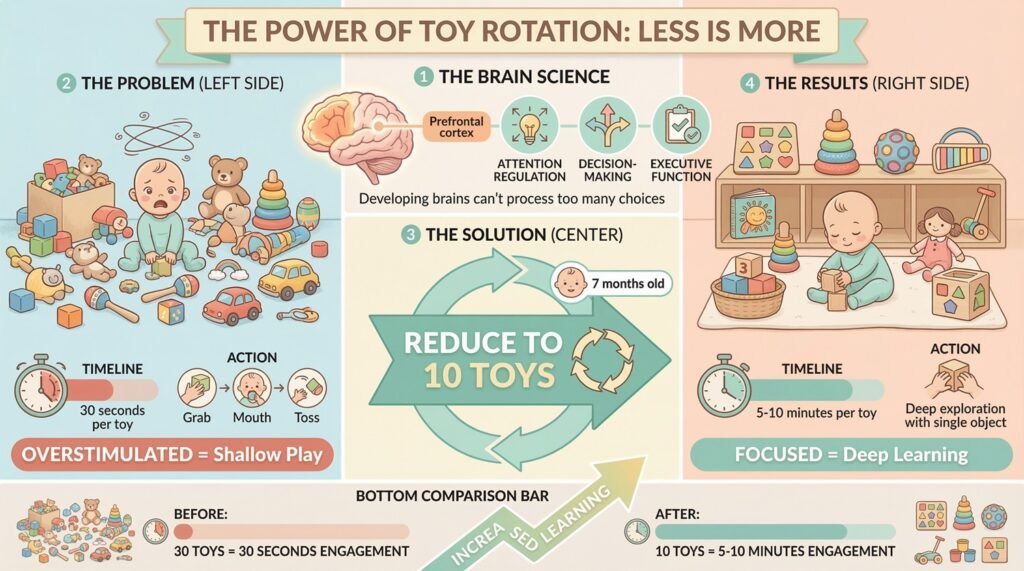
The science behind toy rotation is really fascinating when you dig into it. Babies and young children have developing prefrontal cortexes, which means their executive functioning skills, like attention regulation and decision-making, are still forming.
When faced with too many choices, their brains literally cannot process all the options effectively.
I saw this firsthand when I reduced our toy selection from about 30 visible items down to 10. My daughter, who was seven months old at the time, suddenly started engaging with person toys for much longer periods.
Instead of grabbing something, mouthing it for 30 seconds, and tossing it aside, she would spend five or even ten minutes exploring a single object.
That deeper engagement is where real learning happens.
Research on cognitive load theory supports this observation. When babies face fewer distractions, they can enter what developmental psychologists call “flow states”, periods of deep concentration where learning is most effective.
The Montessori approach has emphasized this for over a century, long before neuroscience could explain the mechanisms behind it.
Beyond the cognitive benefits, toy rotation addresses practical realities that every parent faces. Fewer toys out means less clutter to clean up, easier maintenance of your space, and honestly, less stress for you as the caregiver.
When everything has a designated spot and there are only a manageable number of items to put away, tidying becomes a five-minute task instead of a half-hour ordeal.
There’s also an economic dimension that I really appreciate. When toys rotate out and come back weeks later, they genuinely feel new again to your baby.
This dramatically reduces the pressure to constantly buy new things to maintain your child’s interest.
I found myself spending far less on toys once I implemented a rotation system, because the toys we already owned were getting thoroughly used and re-discovered many times.
The environmental impact matters too. When you’re getting maximum use from fewer toys, you’re not contributing to the cycle of constantly purchasing and discarding plastic items.
Your baby doesn’t need 50 toys, they need 10 really good ones that they can explore deeply and repeatedly.
Setting Up Your First Rotation System
Starting a toy rotation system needs some upfront effort, but it’s totally worth it. The first step is actually the hardest, you need to gather every single toy your baby owns and assess what you’re working with.
I spread everything out on the floor during naptime and was genuinely shocked at how much had accumulated in just a few months.
As you’re looking at this collection, sort toys into categories based on the skills they develop. I use these groupings: gross motor (things that encourage crawling, pulling up, walking), fine motor (grasping toys, stackers, toys with small parts to manipulate), sensory (items with interesting textures, sounds, or visual elements), cause-and-effect (toys where an action produces a result), and practical life (realistic items like wooden spoons, fabric squares, or safe household objects).
You’ll probably notice that you have duplicates or very similar toys. This is the time to be honest about what’s actually useful.
If you have three different rattles that essentially do the same thing, keep your favorite and store or donate the others.
Quality really does matter more than quantity in a Montessori approach.
Once you’ve sorted everything, create your first active set. For babies under six months, I recommend having about 6-8 toys accessible.
For babies six to twelve months, you can increase this to 8-12 items.
The key is ensuring variety across your categories, don’t put out five sensory toys and nothing for gross motor development.
Storage is crucial for making this system sustainable. I use clear plastic bins with labels for my stored rotations, but cardboard boxes, baskets, or even suitcases work perfectly fine.
The important thing is that stored toys are actually out of sight, preferably in a closet or another room.
If your baby can see the storage bins, they defeat the purpose of reducing visual clutter.
Your active toys should be displayed on low, accessible shelves where your baby can see and reach them independently. Montessori emphasizes child-led exploration, so toys crammed in a toy box don’t work well with this philosophy.
Each toy should have its own space on the shelf, creating an organized, calm visual environment.
I use a simple two-shelf unit from a furniture store that cost maybe $30, and it works beautifully.
How Often to Rotate
The timing of rotations depends entirely on your person baby’s interest patterns, which means you need to become a careful observer. Some babies thrive with weekly rotations, while others do better with three or four-week cycles.
There’s no single fix answer here.
I started with two-week rotations and quickly realized my daughter needed longer. She would just be getting really deeply engaged with certain toys around day ten, and switching everything out felt disruptive.
We eventually settled on three-week rotations, which gave her time to fully explore each set while still maintaining freshness.
The best indicator for rotation timing is your baby’s engagement level. When you notice sustained disinterest in most of the available toys, not just one day of fussiness, but consistent lack of engagement over several days, that’s your signal to rotate.
Some babies will literally crawl away from their play area repeatedly, telling you very clearly that nothing is capturing their attention.
That said, you don’t have to rotate everything at once. One strategy I found really effective is partial rotation.
Instead of swapping out all 10 toys, I might switch 5-7 items while keeping 2-3 familiar favorites accessible.
This provides novelty while maintaining some continuity, which can be especially helpful during developmental leaps or other transitional periods when babies seek comfort in the familiar.
Seasonal considerations can also guide your rotation timing. I naturally rotate in more outdoor and water-play items during summer, while winter rotations might include more cause-and-effect toys for indoor exploration.
This keeps things aligned with your family’s actual lifestyle and activities.
Age-Appropriate Toy Selection
The toys you include in rotations need to match your baby’s current developmental stage, which changes remarkably quickly during the first year. A toy that’s perfect for a four-month-old might be completely ignored by that same baby two months later.
For newborns to three months, focus on high-contrast visual items, simple mobiles positioned above changing areas or play mats, and soft toys with varied textures. At this stage, babies are just beginning to track objects with their eyes and bring their hands to midline.
I loved using black and white cards propped on low shelves during this phase, along with lightweight scarves in different fabrics that I could gently brush against my daughter’s hands and feet.
Once babies enter the three to six month period, their motor skills explode. This is when grasping toys become essential, wooden rings, textured balls they can actually hold, and simple rattles they can shake intentionally.
Object exploration through mouthing is huge during this stage, so everything needs to be safe for that purpose.
I made sure each rotation included at least three items of different sizes that my daughter could grasp, manipulate, and bring to her mouth safely.
The six to nine month window brings mobility for most babies, whether through rolling, army crawling, or proper crawling. Now you need toys that encourage movement, balls that roll away, push toys if they’re pulling up, and items placed just slightly out of easy reach to motivate movement.
This is also when simple cause-and-effect toys become suitable.
A ball that drops through a hole and appears at the bottom with a satisfying sound can occupy a seven-month-old for surprisingly long stretches.
From nine to twelve months, babies become much more purposeful in their actions. They can sit independently, manipulate objects with increasing dexterity, and often start pulling up to stand.
This is the stage for more complex cause-and-effect toys, simple shape sorters, stacking rings, nesting cups, and balls of various sizes.
I introduced a simple wooden peg puzzle around eleven months, and watching my daughter work on it with such intense concentration was absolutely amazing.
The crucial thing about age-appropriate selection is that you’re always working in your baby’s zone of proximal development, slightly beyond what they’ve mastered but not so far ahead that it’s frustrating. When a toy consistently gets ignored, it might be too advanced, so I’d remove it and try again in the next rotation or two.
Conversely, if something becomes too easy and no longer holds interest, it’s time to store it for a younger sibling or pass it along.
Observation Is Everything
I cannot overstate how important observation is to making toy rotation work effectively. You need to regularly watch your baby during play, noting which toys they gravitate toward, which ones they ignore, and how their play patterns are evolving.
I keep a simple note on my phone where I jot down observations throughout each rotation period. Things like “really loves the wooden rattle this week, shaking it rhythmically” or “crawled past the stacking rings every single day” give me data for planning the next rotation.
This doesn’t need to be formal or time-consuming, just brief notes whenever something stands out.
These observations reveal developmental patterns you might otherwise miss. When my daughter suddenly started ignoring several toys she’d loved the week before, I initially worried something was wrong.
Then I realized she’d just started pulling up to stand, and her entire focus had shifted to movement and balance.
Her play needs had changed overnight, and my rotation needed to reflect that with more standing-height activities.
Watch for emerging skills and provide toys that support practicing those skills. If you notice your baby starting to use their pincer grasp with thumb and forefinger, include smaller objects they can practice picking up (always supervised, obviously).
When they begin understanding object permanence, that things still exist even when out of sight, simple containers with lids become endlessly fascinating.
Sometimes observation reveals that you need fewer toys, not more variety. I went through a phase where I kept adding items to each rotation, thinking more variety would increase engagement.
Actually, the opposite proved true.
When I pulled it back to just eight carefully chosen toys, my daughter’s concentration deepened significantly.
Pay attention to the time of day when your baby engages most deeply with toys. Some babies are more focused in the morning after a good night’s sleep, while others hit their stride in the afternoon.
This knowledge helps you understand when to introduce new or challenging toys versus when to keep things simple and familiar.
Common Rotation Mistakes
Even with good intentions, it’s really easy to make mistakes when you’re starting out with toy rotation. The most common one I see is rotating too often.
When you switch toys every three or four days, babies don’t have time to move beyond initial exploration into deeper engagement.
That deeper phase, where they start using toys in creative or unexpected ways, is where development really speeds up.
Another mistake is keeping the rotation sets too similar. If every single rotation includes a ball, a rattle, a teether, and a stacker, you’re not actually providing much variety across time.
Mix up the types of toys more dramatically.
One rotation might be heavy on sensory items, the next might emphasize cause-and-effect, and the following might focus on gross motor challenges.
I definitely fell into the trap of rotating based on my schedule as opposed to my baby’s interest. I’d marked rotation days on my calendar and stuck to them rigidly, even when my daughter was clearly still very engaged with the current selection.
Now I view my rotation schedule as a general guideline and stay flexible based on actual observation.
Some parents rotate toys but leave them in jumbled toy boxes or baskets where everything’s mixed together. This completely undermines the Montessori principle of an organized, peaceful environment.
Each toy should be visible and accessible on its own, not tangled with others.
This presentation style encourages babies to choose intentionally as opposed to grab randomly.
Ignoring your baby’s clear preferences is another misstep. If your child returns to the same toy repeatedly across many rotations, that toy has become a significant learning tool for them.
Keep it accessible as opposed to forcing it into the rotation schedule.
Similarly, if something consistently gets ignored across three or four separate rotations, it’s probably just not a good fit for your baby’s interests or developmental level.
The pressure to make perfect, Pinterest-worthy rotations can actually work against the whole philosophy. I spent way too much time initially trying to create beautiful shelf arrangements that looked amazing in photos but weren’t actually functional for my baby.
She’d pull everything down immediately anyway.
The goal is functionality and developmental appropriateness, not aesthetic perfection.
Adapting Rotation to Your Space
Not everyone has a dedicated playroom with lovely Montessori shelving, and that’s completely fine. Toy rotation works in any living situation with some creativity.
In small apartments, I’ve seen parents successfully use a single low bookshelf in the corner of the living room for active toys, with stored rotations in bins under a bed or in a hall closet. The physical footprint of the system is actually quite small because you’re only displaying a fraction of the total toy collection at once.
If you have absolutely no shelf space, even a low windowsill or a cleared bottom drawer can serve as your toy display area. I’ve used a simple rectangular basket placed on the floor against a wall when we were traveling.
The key principle is that toys are visible, organized, and accessible to your baby without being dumped in a pile.
For families with many children of different ages, you’ll need separate rotation systems. I keep my toddler’s toys on higher shelves out of the baby’s reach, with the baby’s rotation on the lowest shelf.
This prevents choking hazards while still maintaining organized, rotating selections for each child.
Shared spaces like living rooms can absolutely accommodate toy rotation. I designate one specific corner as the baby’s play area, with active rotation toys confined to that zone.
This contains the visual impact while still giving my daughter her own prepared environment.
At the end of the day, everything goes back to that corner, keeping the rest of the space clear.
Some families rotate toys between rooms as opposed to just in and out of storage. You might have a bedroom rotation and a living room rotation, swapping them weekly.
This provides environmental variety along with toy novelty.
Frequently Asked Questions
How many toys should a 6 month old have?
A six-month-old baby does best with 8-10 toys available at any given time. This number provides enough variety to keep them engaged across different developmental areas, motor skills, sensory exploration, cause-and-effect learning, without creating overwhelming choice.
The total collection can be larger, maybe 20-30 toys, but only a fraction should be accessible simultaneously through rotation.
What age do you start toy rotation?
You can start toy rotation from birth, though the benefits become more noticeable around 3-4 months when babies begin actively engaging with objects. For newborns, you might rotate between different high-contrast images or simple mobiles.
The practice becomes increasingly valuable as babies develop more focused attention spans and stronger preferences for specific types of play.
How do I organize my baby toys?
Organize baby toys by developmental category as opposed to by type. Group items that support similar skills together, all grasping toys in one category, all sensory items in another, all cause-and-effect toys in a third.
Store inactive rotations in labeled bins in a closet or under furniture.
Display active toys on low, accessible shelves where each item has its own designated space and babies can see everything clearly.
How often should you rotate baby toys?
Most babies respond well to rotations every 2-3 weeks, though some do better with weekly changes while others need a full month. The timing depends on your baby’s engagement patterns.
When you notice sustained disinterest across most available toys for several consecutive days, that signals it’s time to rotate.
Flexibility matters more than strict schedules.
What are the best Montessori toys for infants?
The best Montessori toys for infants include wooden rattles, textured balls made from natural materials, simple grasping rings, fabric books with varied textures, and basic cause-and-effect items like a ball drop box. Real objects from daily life, wooden spoons, metal measuring cups, fabric napkins, also make excellent Montessori materials.
The key is simplicity, natural materials, and clear purposes that match developmental stages.
How do you know if baby has too many toys?
Signs your baby has too many toys include brief, unfocused engagement where they grab and discard items quickly without sustained exploration. You’ll notice scattered toys everywhere with no real play happening.
Babies might seem restless or overstimulated, moving constantly between items without settling into focused activity.
Clean-up becomes overwhelming, and you find yourself constantly saying “not that toy, play with something else.”
Can you do Montessori with limited space?
Yes, Montessori principles work perfectly in limited space. You only need a small designated area, even just one low shelf or a floor basket, for displaying active rotation toys.
The minimal toy approach actually makes Montessori easier in small spaces because you’re not trying to store and display dozens of items.
A corner of your living room or a section of the nursery is enough.
Key Takeaways
Toy rotation reduces overstimulation and significantly improves the quality of your baby’s engagement with person toys by limiting choices to a manageable number, typically 8-12 items for babies under one year.
The optimal rotation frequency depends on your person baby’s interest patterns, typically ranging from one to four weeks, with careful observation being the best guide for timing as opposed to rigid schedules.
Age-appropriate toy selection is absolutely critical, as babies’ developmental needs change rapidly during the first year and toys must match current skills while slightly challenging emerging abilities.
A successful rotation system needs organized storage of inactive toys and intentional display of active toys on accessible, uncluttered shelves where babies can see and choose independently.
Observation of your baby’s play patterns provides essential data for refining rotations, revealing developmental shifts and preferences that should guide your toy selection in subsequent cycles.
Common mistakes include rotating too often, maintaining too much similarity across rotation sets, prioritizing aesthetic presentation over functionality, and rigidly following schedules instead of responding to actual engagement levels.
The system adapts successfully to any living space, from small apartments to larger homes, requiring only a small designated area for displaying active toys and some storage space for inactive items.