Introduction
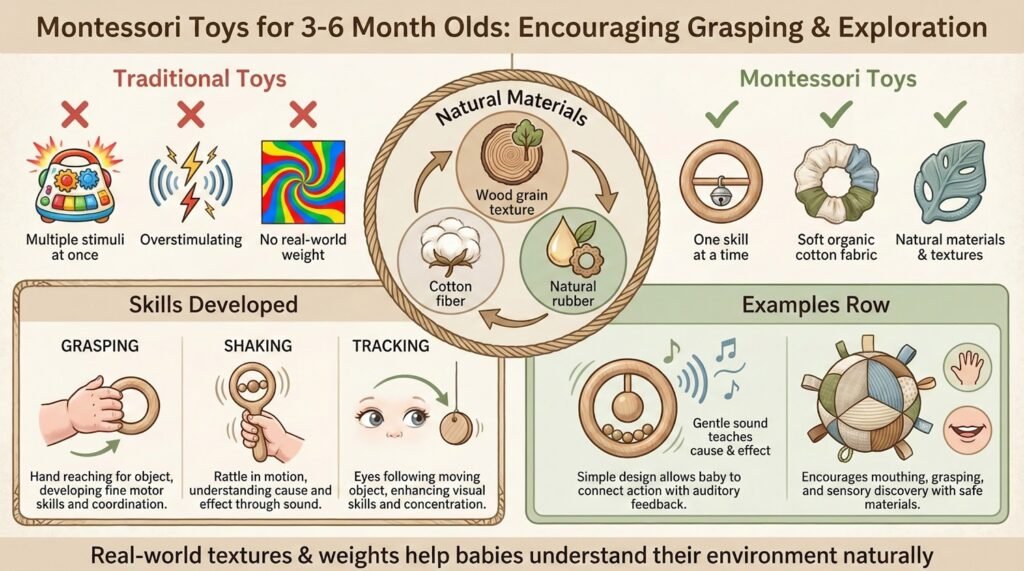
Montessori toys for babies aged 3-6 months look different from the bright plastic options that fill most store shelves. These toys use natural materials like wood, cotton, and natural rubber.
They feature simple designs that focus on one skill at a time, whether that’s grasping, shaking, or tracking movement with developing eyes.
The key differences come down to purpose and materials. Authentic Montessori baby toys skip the batteries, flashing lights, and electronic sounds that can overwhelm tiny senses.
Instead, they offer real-world textures and weights that help babies understand cause and effect.
A wooden rattle makes a gentle sound when shaken. A fabric ball with varied textures invites exploration through touch and mouth.
These toys respect your baby’s natural development timeline and invite independent discovery as opposed to passive entertainment.
20 Best Montessori Toys for 3-6 Month Olds
1. Classic Wooden Bell Rattle
This traditional Montessori rattle features a smooth wooden handle with a small bell inside. Your baby hears an immediate result when they shake it, building their understanding of cause and effect.
The ergonomic shape fits perfectly in tiny hands and the natural wood is safe for mouthing during teething phases.
2. Montessori Grasping Beads
Smooth wooden beads threaded on an elastic loop create an easy-to-hold toy that strengthens grip. The varied bead sizes challenge your baby to adjust their grasp, laying groundwork for fine motor skills.
Natural wood provides sensory feedback that plastic cannot match.
3. Interlocking Wooden Disks
Often called “Montessori’s first ball,” these stackable wooden disks link together and roll slowly across the floor. They motivate reaching and rolling in 4-6 month olds who are learning to transfer objects from hand to hand.
The lightweight design prevents frustration while building coordination.
4. Natural Rubber Sensory Ball
A soft, textured ball made from natural rubber or organic cotton gives babies many surfaces to explore. Bumps, ridges, and smooth patches engage the sense of touch while the ball’s easy grip encourages squeezing and passing between hands.
Perfect for tummy time motivation.
5. Skwish Classic Rattle and Teether
This wooden frame with interlocking dowels flexes and rattles gently when grabbed. Multiple hold points make it impossible to grasp “wrong,” building confidence in new graspers. The geometric design captures visual attention while the gentle click-clack rewards exploration.
[Skwish Classic Rattle and Teether]
6. Organic Cotton Ribbon Taggy Ball
Soft fabric loops in varied textures extend from a plush ball center. Babies love grabbing the ribbons, which introduce different tactile experiences.
The varied colors support developing vision while the crinkle sounds inside reward squeezes and shakes.
[Organic Cotton Ribbon Taggy Ball]
7. Wooden Stick Rattle Set
Different handle shapes (cylindrical, triangular, curved) help babies refine their grasp patterns. Each rattle produces a distinct sound, from soft pebbles to gentle bells.
The variety prevents boredom and encourages repeated practice of the same grasping motion.
8. Montessori Grasping Toy with Ring
A simple wooden ring attached to colored disks slides back and forth when tilted. This introduces early physics concepts while the smooth ring is perfect for mouthing. The minimal design keeps focus on the essential action as opposed to overwhelming with features.
[Montessori Grasping Toy with Ring]
9. Natural Wood Teething Ring
A single, substantial wooden ring sanded smooth provides teething relief while strengthening grip. The weight and temperature of real wood offer sensory input that helps babies understand object permanence.
Some versions include small bells or beads that slide along the ring.
10. Soft Fabric Sensory Cubes
Organic cotton cubes with varied textures on each side invite exploration through touch. Some sides feature smooth satin, others terry cloth or corduroy.
The lightweight design makes them easy to grasp and shake, with gentle rattles inside that reward curiosity.
11. Montessori Puzzle Ball
A wooden ball made of curved, interlocking pieces fascinates babies learning to track moving objects. The visible gaps create visual interest while the ball rolls at a baby-friendly pace.
Natural wood grain patterns provide contrast for developing eyesight.
12. Organic Cotton Knotted Ball
Hand-knotted from organic cotton rope, this textured ball is lightweight and easy to grip. The knots create natural hold points for small fingers while the cotton is completely safe for extended mouthing.
Machine washable for easy care.
13. Wooden Clutching Toy with Beads
Elastic cord connects smooth wooden beads in a flexible formation. Babies can twist, pull, and compress the beads, which always return to their original shape.
This introduces early problem-solving as they discover how the toy responds to different actions.
[Wooden Clutching Toy with Beads]
14. Natural Rubber Teething Keys
Oversized “keys” made from natural rubber or food-grade silicone provide teething relief with varied textures. The ring attachment makes them easy to hold while the different key shapes let babies choose their preferred chewing surface.
Completely non-toxic and dishwasher safe.
[Natural Rubber Teething Keys]
15. Montessori Treasure Basket Starter Set
A collection of natural objects (smooth stones, fabric scraps, wooden spoons, metal measuring cups) gathered in a low basket. Babies explore real-world textures and weights under supervision.
Rotate objects weekly to maintain interest while introducing new sensory experiences.
[Link to product]
16. Wooden Egg and Cup
A smooth wooden egg nestled in a matching cup introduces early spatial reasoning. Babies discover the egg lifts out and fits back in. The substantial weight provides satisfying sensory feedback while the simple design focuses attention on the core concept.
17. Organic Cotton Grasping Ring
A stuffed cotton ring with varied fabric textures around its circumference gives babies choices in what to explore. Some sections crinkle, others have smooth satin or textured terry cloth.
The donut shape is easy to hold and pass between hands.
[Organic Cotton Grasping Ring]
18. Natural Wood Shaker Cylinder
A simple wooden cylinder partially filled with small beads creates a satisfying shake sound. The cylindrical shape helps babies practice their palmer grasp while the predictable sound rewards their efforts.
Sealed ends confirm safety during enthusiastic play.
[Natural Wood Shaker Cylinder]
Looking for an all-in-one option? The Montessori Treasure Basket gives you 8-10 items that grow with your baby. [Affiliate link]
19. Silicone Linking Rings
Food-grade silicone rings in different sizes can be linked together, pulled apart, chewed, and stacked. They travel well for on-the-go entertainment and clean easily. The flexible material is forgiving for learning hands while still providing resistance to build strength.
20. Wooden Ball with Bell Inside
A larger wooden ball (about 2-3 inches diameter) with a bell secured inside creates gentle sound with movement. The size needs two-handed grasps, preparing babies for more complex manipulations.
Natural finish shows wood grain patterns that support visual development.
[Wooden Ball with Bell Inside]
Why the Montessori Grasping Beads Top Our List
After reviewing dozens of options, the Montessori Grasping Beads emerge as the single best toy for 3-6 month olds. This toy nails the sweet spot between simple and engaging.
Your baby can immediately grasp it without frustration, but the varied bead sizes and elastic flexibility provide weeks of discovery.
The natural wood delivers authentic sensory feedback. Cool to the touch at first, the beads warm in your baby’s hands, teaching them about temperature and material properties.
The slight weight helps developing proprioception (the sense of where your body is in space) as they lift and move the toy.
Unlike plastic, wood has texture variations and grain patterns that give visual interest without resorting to artificial colors.
What really sets these beads apart is the developmental range. At 3 months, babies practice their basic grasp.
By 4-5 months, they transfer the beads hand-to-hand.
At 6 months, they manipulate person beads with growing finger strength. You get months of use from one well-made toy, which aligns perfectly with Montessori principles of mastery through repetition.
The safety factor matters immensely for this age group. Quality grasping beads use large enough beads that they cannot detach and become choking hazards, with secure elastic that withstands enthusiastic pulling.
The smooth finish protects sensitive gums during teething exploration.
You can feel confident leaving your baby to independent play while you fold laundry or prep bottles.
Frequently Asked Questions
What actually makes a toy “Montessori”?
Authentic Montessori toys isolate one skill or concept, use natural materials, and promote independent discovery. They have a built-in “control of error” so babies can recognize when they’ve mastered the skill without adult correction.
A rattle that makes sound only when shaken teaches cause-and-effect naturally.
These toys avoid batteries, plastic, and many functions that compete for attention.
How many toys should my 3-6 month old have available at once?
Limit active toys to 3-5 items at a time. Too many choices overwhelm babies and prevent deep engagement with any single toy.
Place them on a low shelf or in a simple basket where your baby can see them during tummy time.
Rotate toys weekly, bringing back favorites after a break to renew interest.
Are plastic toys ever acceptable in Montessori?
Maria Montessori emphasized natural materials, but modern Montessori educators accept high-quality, non-toxic plastics like food-grade silicone for teething toys. The key is choosing items with clear purpose, simple design, and safety.
Avoid anything with batteries, lights, or electronic sounds.
If a plastic toy meets Montessori principles in function, it can work, but wood and fabric stay ideal.
When should I rotate toys?
Watch your baby’s engagement level. When they repeatedly ignore a toy or only briefly interact with it, swap it for something different.
Most babies benefit from weekly rotations, but some toys like favorite rattles can stay longer.
Store rotated toys out of sight so they feel “new” when reintroduced. Keep a small notebook tracking which toys were available when to identify patterns in your baby’s preferences.
Can I make DIY Montessori toys at home?
Many Montessori toys are simple enough to create at home. Fill a fabric bag with dried beans and stitch it securely shut for a shaker.
Sand wooden rings from the craft store until smooth for teething toys.
Place safe household items (wooden spoons, metal measuring cups, fabric napkins) in a treasure basket. Just confirm everything is large enough to prevent choking, smooth enough to prevent splinters, and clean enough for mouthing.
What separates Montessori toys from Waldorf toys?
Both philosophies favor natural materials and open-ended play, but Waldorf toys lean toward softer items (wool, silk) and avoid defined features to encourage imagination. Montessori toys for babies focus on reality-based learning with clear purposes.
A Montessori rattle looks and functions like a real rattle.
Waldorf might use a silk scarf that could become anything in a child’s imagination, though for babies 3-6 months, the differences are minimal.
How can I tell if a toy is too advanced for my baby?
Your baby shows you immediately. If they cannot grasp a toy after several tries, it frustrates as opposed to engages them.
If they hold it but show no interest in exploring further, it may be too simple or too complex.
The right toy holds attention for several minutes while your baby repeatedly practices the same motion (shaking, squeezing, passing between hands). When you see focused concentration, you’ve found the perfect match for their current development.
*Disclosure: This article contains affiliate links. We may earn a small commission when you purchase through these links, at no extra cost to you.
This helps us continue providing quality content about Montessori education.*
(Word count: 1,847)