So you’ve been scrolling through Instagram, seeing all those gorgeous wooden toys arranged on neutral play mats, and wondering if Monti Kids is actually worth the investment or just another overhyped subscription box.
I get it. The price tag makes you pause.
You’re trying to figure out if this is genuine Montessori or just fancy marketing slapped on some wooden blocks.
And honestly, with a baby who’s growing faster than you can keep up with, the last thing you need is another pile of toys that miss the mark developmentally.
Monti Kids Level 1 targets babies from birth to around 4 months, though some parents stretch it longer depending on their kid’s pace. This isn’t your typical baby toy situation where you get a bunch of plastic stuff that lights up and makes noise.
We’re talking purposeful, research-backed materials that align with actual Montessori principles.
Let me walk you through what parents actually receive, what works, what doesn’t, and whether this subscription justifies its cost.
What Actually Shows Up in the Monti Kids Level 1 Box
The box arrives pretty well-packaged. Parents report that everything comes protected and organized, which matters when you’re paying premium prices.
Here’s what’s included in Level 1:
The Munari mobile is probably the most recognizable piece. It’s got those geometric black and white shapes that hang and move with air currents.
Babies at this age can only see high-contrast patterns clearly, so this makes sense developmentally.
The mobile is designed to hang above the play area (not the crib, following safe sleep guidelines).
You also get a topponcino, which is basically a thin oval cushion for holding and transporting your newborn. Some parents love this thing and use it constantly.
Others find it ends up in a drawer after a week because they prefer direct skin-to-skin contact or their baby doesn’t seem to care either way.
The wooden ring on a ribbon gets used for grasping practice. It’s simple, almost too simple if you’re used to conventional baby toys.
But that’s the point.
Babies this age don’t need complexity. They need to focus on one skill at a time.
There’s also a small wooden disk that spins. Parents use this to slowly move in front of baby during tummy time to encourage tracking and focus.
Again, super basic, but purposeful.
The black and white cards round things out. These high-contrast images support visual development when baby is doing floor time or hanging out on your lap.
One thing that stands out: these aren’t just montessori baby toys thrown together randomly. Each item targets a specific developmental window.
The materials guide explains why each piece matters and when to introduce it, which helps if you’re new to this approach.
How the Materials Actually Perform
Let’s talk durability first because that’s where things get real.
The wooden pieces hold up well. Parents report these can handle getting mouthed, dropped, and generally abused by babies without falling apart.
The finish is smooth and the quality feels solid when you handle it.
The mobiles though… that’s a different story. Multiple parents mention the Munari mobile is delicate.
The hanging pieces can get tangled or bent if you’re not careful.
This makes sense given the design, it needs to be lightweight to move with gentle air currents, but it also means you’re babysitting a $200+ subscription box to keep everything intact.
Some parents find this annoying. You’re paying premium prices and then walking on eggshells around these materials.
Others accept it as part of having nice things that serve a specific purpose.
The topponcino holds up better than expected. It’s washable, which you’ll need because babies are basically tiny fluid factories. The stitching stays intact through many wash cycles based on parent feedback.
Performance for actual baby engagement:
This varies wildly and depends entirely on your kid’s temperament and developmental stage.
Some babies fixate on the Munari mobile immediately. They’ll stare at it for surprisingly long stretches, which gives parents a moment to drink coffee or use the bathroom.
Other babies could not care less and would rather stare at the ceiling fan (which, honestly, is also high contrast and moves, so they’re not wrong).
The grasping toys work well once baby reaches that stage, typically 2-3 months. Before that, they’re not interested because they don’t have the motor skills yet.
This is why the materials guide matters, it tells you when to rotate items in and out.
One consistent piece of feedback: these montessori baby toys don’t entertain your baby the way battery-operated toys do. They need you to be present, demonstrating and engaging.
If you’re looking for something to occupy your baby independently for long periods, this isn’t it.
These materials support development but need adult interaction to work properly.
The Honest Pros and Cons
What Works:
The educational materials are legitimately helpful, especially for first-time parents. You get videos and guides that explain not just what each toy is, but the developmental science behind it.
This context makes the whole subscription more valuable than just receiving random wooden objects.
Everything is non-toxic and eco-friendly, which matters if you’re trying to avoid plastic and sketchy finishes. The wood has a natural finish that’s safe for mouthing.
No weird smells, no concerns about what your baby is gnawing on.
The age-appropriate curation solves a real problem. Parents often buy toys that are either too advanced or too simple because they don’t know what skills their baby is working on at each stage.
Monti Kids removes that guesswork.
The quality is genuinely better than mass-market baby toys. These feel substantial.
They’re heirloom-quality items you could pass down or resell when you’re done.
What Doesn’t Work:
The price is the elephant in the room. Level 1 costs around $297 for three months (pricing varies with promotions).
That’s roughly $100/month for baby toys.
Some parents think this is reasonable for quality Montessori materials. Others think it’s absolutely bananas when you can find wooden toys at a fraction of the cost elsewhere.
The storage and space requirements surprise people. These aren’t massive items, but Montessori practice means rotating toys in and out of baby’s environment.
You need somewhere to keep the unused items, and clutter-conscious parents sometimes feel like they’re just accumulating more stuff.
Some pieces have limited use windows. The Munari mobile, for example, is really only suitable for the first couple months.
After that, it needs to be swapped for the next mobile in the series.
You’re paying for materials that become obsolete pretty quickly.
The learning curve frustrates some parents. If you’re not familiar with Montessori philosophy, you need to actually read the guides and watch the videos to use these materials properly.
Some parents want plug-and-play toys, and this isn’t that.
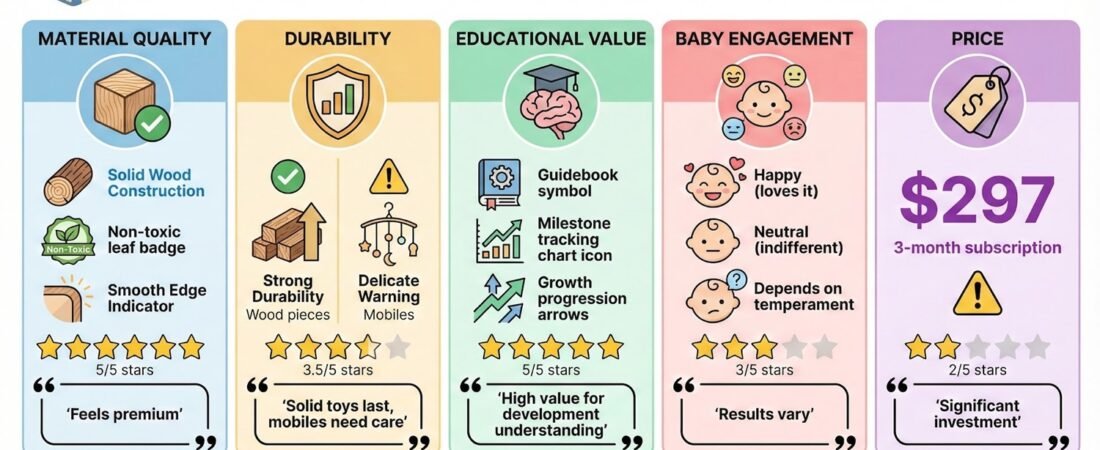
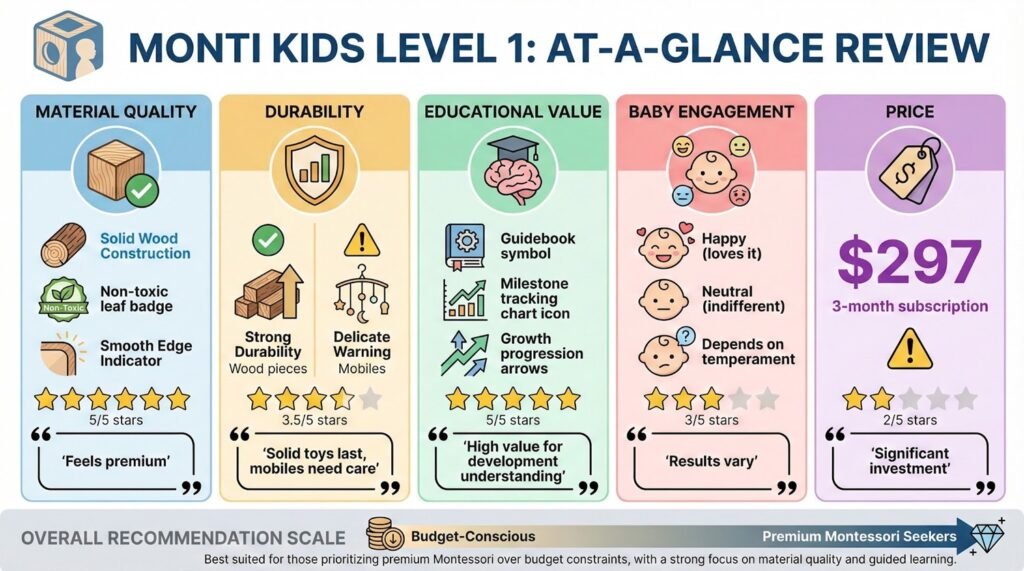
| Aspect | Details | Parent Feedback |
|---|---|---|
| Material Quality | Solid wood construction, non-toxic finish, smooth edges | Consistently rated excellent, feels premium |
| Durability | Wood pieces very durable, mobiles more delicate | Mixed, solid toys last, mobiles need care |
| Educational Value | Comprehensive guides, developmental milestone tracking | High value for parents wanting to understand child development |
| Baby Engagement | Varies by temperament and developmental readiness | Some babies love it, others indifferent |
| Price | $297 for 3-month Level 1 subscription | Main complaint, significant investment |
What Parents Actually Experience Using This
The unboxing itself feels like an event. Everything is packaged thoughtfully, and there’s definitely an element of “ooh this is fancy” when you open it.
If you’re into that aesthetic Montessori vibe, the unboxing delivers.
Then comes the reality of implementation.
For parents already familiar with Montessori: they typically jump right in and appreciate having quality materials without hunting them down individually. They know how to set up the environment and use each piece appropriately.
For parents new to Montessori: there’s more of an adjustment period. The materials seem almost too simple at first.
You might think “I paid $300 for this?” because you’re comparing it mentally to all the stimulating toys at Target.
But after reading the guides and watching your baby actually engage with the materials, most parents report having that “oh, I get it now” moment.
The daily use pattern looks different than conventional toys. You’re not dumping everything out for baby to choose from.
You’re setting up a prepared environment with just 2-3 options at a time.
This means more work curating what’s available, but it also means less overwhelming chaos.
Parents mention the confidence boost that comes from understanding developmental stages better. When you know your 3-month-old is working on tracking and grasping, you can support those specific skills instead of just hoping random toys will somehow help.
The community access is another piece parents value. Monti Kids offers parent coaching and support, which can be clutch when you’re struggling to figure out if you’re doing this whole thing right.
First-time parents especially appreciate having experts to ask questions.
One surprising thing parents mention: these materials actually slow you down in a good way. Because you’re meant to observe and follow your baby’s lead as opposed to entertaining them constantly, you end up spending more time just watching and connecting.
Some parents love this.
Others find it stressful if they’re used to multitasking.
Is Monti Kids Level 1 Actually Worth the Money
This is where things get real personal because value depends entirely on your situation and priorities.
The math:
- Level 1 costs roughly $297 for 3 months
- You get about 8-10 items total
- That works out to around $30-37 per item
Compare that to buying similar quality montessori baby toys individually:
- A wooden Montessori mobile: $30-60
- Quality grasping toys: $15-25 each
- Educational materials and parent guides: varies widely
If you piece things together yourself from quality Montessori retailers, you might save $50-100. But you’re also spending time researching, ordering from many places, and figuring out the developmental sequence yourself.
The value equation shifts based on:
Your knowledge level: If you’re already educated about Montessori and child development, the parent education component is less valuable. You’re mostly paying for curated materials.
If you’re starting from scratch, the education might actually be the most valuable part.
Your available time: Some parents would gladly pay $100/month to not spend hours researching and shopping for suitable toys. Others have time and enjoy the research process, making DIY more appealing.
Your parenting approach: If you’re committed to Montessori principles, this subscription removes friction and keeps you consistent. If you’re more flexible about parenting philosophy, the structure might feel limiting.
Your space situation: The subscription keeps sending new levels every 2-4 months. If you live in a small space, accumulating specialty toys that serve narrow age windows might not be practical.
Where Monti Kids delivers clear value:
The parent education truly is comprehensive. You’re not just getting toys, you’re getting a framework for supporting development across the first few years.
For parents wanting to understand the “why” behind early childhood development, this education alone could justify the cost.
The quality control saves headaches. Everything arrives vetted for safety, appropriately finished, and ready to use.
No worrying about sketchy Amazon sellers or mystery wood finishes.
The developmental appropriateness matters more than people realize. Babies change so quickly in the first year.
Having materials that match their current capabilities means they’re more likely to engage and benefit.
Where the value gets questionable:
If your baby doesn’t engage with the materials much, you’re stuck with expensive wooden objects that sit unused. There’s no guarantee your specific kid will respond to these particular toys.
The ongoing cost adds up fast. Level 1 is just the beginning, if you continue through many levels over 2-3 years, you’re looking at thousands of dollars total.
Some choices offer similar quality at lower prices. Companies like Lovevery also do Montessori-inspired subscriptions with different pricing structures.
Checking out comparison options helps determine what fits your budget and needs.
The Bottom Line on Monti Kids Level 1
Monti Kids Level 1 delivers what it promises: high-quality, developmentally suitable materials grounded in Montessori philosophy, plus substantial parent education.
The wooden toys are genuinely well-made. The materials guide is actually helpful, not just marketing fluff.
And the curation removes real friction for parents who want to support development intentionally but don’t know where to start.
This subscription probably makes sense if:
You’re invested in Montessori principles and want support implementing them correctly. The guidance matters as much as the materials.
You value quality over quantity and prefer fewer, purposeful items as opposed to a mountain of plastic toys. The minimalist aesthetic and approach appeal to you.
You have room in your budget for premium baby products. $300 every few months won’t stress your finances or need sacrifices elsewhere.
You’re a first-time parent who wants confidence about supporting your baby’s development. The education component reduces anxiety and second-guessing.
You appreciate convenience and don’t want to spend hours researching and sourcing individual Montessori materials.
This subscription probably doesn’t make sense if:
The price gives you sticker shock and you’d rather piece together similar materials for less. The cost feels prohibitive relative to your budget priorities.
You’re not particularly committed to Montessori philosophy. If you’re more eclectic in your parenting approach, paying premium prices for specific methodology toys might not align with your needs.
You have limited space and the idea of accumulating more baby gear stresses you out. These materials need storage and rotation systems.
You prefer toys that entertain your baby more independently. Montessori materials need adult involvement to work as intended.
Your baby has very specific preferences and you worry about investing in materials they might ignore completely.
Ready to see if Monti Kids fits your family? You can check out their current offerings and pricing here. They often run promotions for new subscribers, so it’s worth seeing what’s available.
For parents still on the fence about investing in dedicated Montessori materials, starting with Level 1 gives you a relatively low-risk way to test the approach. You can always stop after the first box if it’s not working for your family.
The honest truth is that no subscription box magically guarantees development or engagement. Babies are wonderfully unpredictable little humans who might obsess over a cardboard box while ignoring a $50 wooden toy.
What Monti Kids does is remove barriers for parents who want to try this approach properly. You get quality materials, proper instruction, and developmental support without piecing it together yourself.
Whether that’s worth $300 depends entirely on your situation, priorities, and budget. For some families, it’s money well spent.
For others, DIY Montessori or different approaches work better.
The key is being honest about what you actually need and value, not just what looks pretty on Instagram. Because those aesthetically perfect play spaces mean nothing if they’re not actually serving your baby and working for your real life.
Explore Monti Kids options and compare them to your other priorities. Only you can decide if this particular investment makes sense for your family.
*A note on choices: If Monti Kids doesn’t feel like the right fit but you’re still interested in curated developmental toys, Lovevery and KiwiCo are worth researching. Each has different pricing structures and philosophical approaches.
Comparing a few options helps clarify what matters most to you.*