So I’ve been looking into Literati’s toddler club for a while now and figured it’s time to actually write down what I think about it. The whole concept seemed interesting because honestly, picking books for little kids is way harder than it should be.
You walk into a bookstore or scroll through Amazon and there’s like… thousands of options.
And half of them look the same.
Literati caught my attention because they’re doing something a bit different with their toddler book subscription approach. They’re not just throwing random books in a box and calling it a day.
There’s actual curation happening, which matters more than you’d think when you’re trying to build up a decent home library without buying every single book that looks cute.
I’m gonna break down how this whole thing works, what you actually get, and whether it makes sense for your situation. No BS, just what I’ve figured out from digging into this service pretty thoroughly.
What You’re Actually Getting With Literati
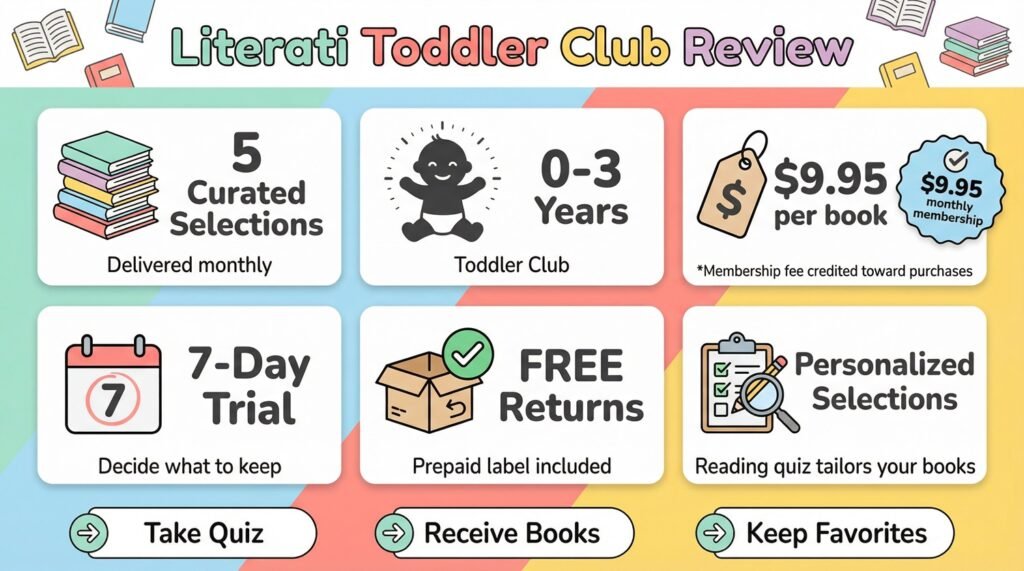
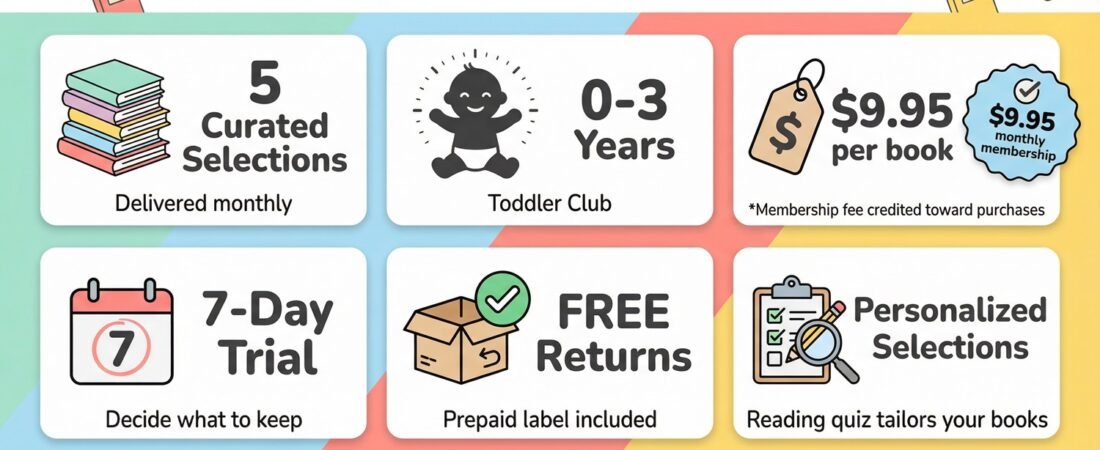
The basics are pretty straightforward. Every month, Literati sends you a box with books picked specifically for your kid’s age range.
For the toddler club, we’re talking ages 0-3 years old.
They’ve got other clubs for older kids too, but that’s not what we’re looking at here.
You get 5 books each month. They arrive in this nice little box (people seem to really like the packaging for some reason).
You have 7 days to look through them with your kid, and here’s the part I actually like… you only pay for what you keep.
The books you don’t want? You send them back for free.
No shipping cost, no hassle.
They include a prepaid return label right in the box.
The pricing structure works like this:
Each book costs $9.95 if you decide to keep it. So if you keep all 5 books, you’re paying $49.75 for that month.
Keep 3 books?
That’s $29.85. You get the idea.
They also have this membership fee situation. It’s $9.95 per month just for the membership itself.
But that fee gets credited toward your book purchases, so if you’re keeping at least one book every month, it basically covers itself.
| What You Get | Details |
|---|---|
| Books per month | 5 curated selections |
| Age range | 0-3 years (Toddler Club) |
| Price per book | $9.95 each |
| Monthly membership | $9.95 (credited toward purchases) |
| Trial period | 7 days to decide what to keep |
| Return shipping | Free (prepaid label included) |
| Customization | Reading quiz personalizes selections |
When you first sign up, they have you fill out this reading quiz thing. It asks about your kid’s interests, what kinds of books you already like, that sort of stuff.
The idea is they’ll use that info to personalize which books they send you.
You can also add “book notes” to give them more specific guidance about what’s working or not working. Like if your kid is obsessed with construction vehicles or hates books about potty training (been there), you can tell them that.
How The Book Selection Actually Performs
This is where things get interesting because the quality of a toddler book subscription really comes down to whether the books are actually good or just filler.
From what I’ve seen, Literati is pulling from legit publishers. We’re talking Penguin Random House, HarperCollins, Simon & Schuster… the big names.
They’re not printing their own books or sourcing weird knockoff versions from random warehouses.
The books tend to be a mix of board books and regular picture books, depending on your kid’s age. For younger toddlers (like 0-18 months), you’re getting more board books because those chubby little hands destroy everything.
For older toddlers pushing 3, there’s more variety with paper pages.
What I’ve noticed about their curation:
They seem to focus on diverse authors and illustrators, which honestly wasn’t even on my radar until I started paying attention to it. Lots of different cultural perspectives, family structures, that kind of thing.
It’s not all just “white suburban family has a dog” books (though there’s nothing wrong with those either).
The themes rotate through different topics. One month might be heavy on animals, next month has more books about emotions or social situations.
They’re trying to give you a balanced mix over time as opposed to sending 5 books about the same topic every month.
Some months are definitely stronger than others. That’s just how it goes with any subscription service.
But the nice part is you’re not stuck keeping books you don’t actually like.
Age Appropriateness
They do a pretty solid job matching books to developmental stages. The 0-12 month selections tend to have high contrast images, simple patterns, and textures to touch.
The 12-24 month range gets more into simple stories and naming objects.
By 24-36 months, you’re seeing longer narratives and more complex vocabulary.
This matters because there’s nothing more annoying than getting a book that’s completely wrong for your kid’s stage. Too simple and they’re bored. Too advanced and they just… wander off to do literally anything else.
You can update your kid’s age in your account settings, and they’ll adjust the selections accordingly. I’ve heard the transitions between age ranges can be a bit rough (like right when your kid turns 2, you might get a mix that’s not quite right for a week or two), but it evens out.
Features Overview
Let me get into the specific features that actually matter day-to-day.
The Personalization Quiz
When you sign up, this quiz takes maybe 5 minutes. It asks about your kid’s age, interests, what kinds of books you’ve liked before, whether you want educational vs. just-for-fun books, all that stuff.
The personalization definitely helps, but it’s not like… magic. You’re still going to get some books that miss the mark.
That’s why the try-before-you-buy model matters so much.
You’re not stuck with books your kid ignores.
Book Notes and Feedback
After each box, you can leave feedback about what worked and what didn’t. This supposedly helps them refine future selections.
I can’t really verify how much impact this actually has because it’s not like they’re sending you a report that says “we adjusted your preferences based on feedback from March.”
But in theory, the more feedback you give, the better your boxes should get over time.
The App and Online Account
They’ve got an app and a website where you manage everything. You can see what’s coming in your next box, skip a month if you need to, update preferences, all that stuff.
The interface is pretty clean and easy to use. You’re not hunting through 17 menus to find the skip button (looking at you, certain other subscription services that shall stay nameless).
One thing people mention a lot is the book tracking feature. It keeps a record of all the books you’ve kept, which is actually useful if you’re trying to remember whether you already have a specific title.
Toddler book collections can get out of hand fast, and suddenly you realize you own three copies of “Goodnight Moon” because grandma also thought it was a great idea.
Educational Resources
Literati includes some reading tips and activity ideas with each box. These are like… fine.
They’re not cutting-edge, but if you’re looking for ways to extend the reading experience beyond just reading the book, there are some simple ideas in there.
Things like “talk about the colors on each page” or “act out the story with your toddler.” Pretty basic stuff, but helpful reminders if you’re in that exhausted parent fog and need a prompt.
Pros and Cons
Let me just lay this out straight because every service has trade-offs.
What Works Really Well
The try-before-you-buy model is legitimately great. You’re not gambling $50 hoping your kid will like these random books. You get to actually test them out for a week.
If your toddler completely ignores a book or you already have it or it’s just not doing it for you… back it goes.
Book quality is solid. These are real, well-made books from actual publishers. The board books are thick and sturdy.
The picture books have good paper quality.
Nothing feels cheap or flimsy.
Curation saves time and mental energy. This is the actual value of the whole thing, honestly. Someone else is doing the research, reading reviews, checking out new releases, and narrowing it down for you.
If you’ve ever spent 45 minutes scrolling through children’s books online getting increasingly overwhelmed… you get why this matters.
The diversity in book selections is better than what you’d probably grab on your own. I don’t mean this in a preachy way. It’s just that when you’re rushing through a bookstore, you tend to grab familiar things.
Having someone else curate means you’re exposed to authors and illustrators and stories you wouldn’t have found otherwise.
It works really well as a gift. If you’re a grandparent or aunt/uncle trying to send something meaningful on a regular basis, this handles everything. The kid gets excited about a box showing up, and you don’t have to figure out what books they already have or what’s age suitable.
What Doesn’t Work As Well
The membership fee situation is a bit confusing at first. You’ve got the $9.95 monthly fee plus $9.95 per book you keep. It’s not complicated once you understand it, but the first time you’re signing up, it takes a minute to figure out what you’re actually going to pay.
You might get repeat themes or similar books. Especially if you’ve been subscribed for several months, you start to see patterns. Like okay, we’ve definitely covered the “learning to share” topic pretty thoroughly at this point.
The price per book is higher than buying from Amazon or a big box store. That $9.95 per book sounds reasonable until you remember you can get board books for $5-7 on sale at Target. You’re paying extra for the curation and convenience, which is worth it for some people and not for others.
Customer service can be hit or miss. Some people have great experiences, others report it takes forever to get responses or decide issues. This seems pretty standard for subscription services tbh, but worth mentioning.
You need to remember to return books on time. If you don’t send back the books you don’t want within the 7-day window, they automatically charge you for all of them. They send reminder emails, but if you’re in the chaos of toddler life, it’s easy to forget.
Not ideal if your kid is a super advanced or delayed reader. The age categories are broad. If your 2-year-old is already into chapter books or your 3-year-old still needs infant board books, the selections might not fit well.
User Experience
The overall experience of using Literati is pretty smooth once you get past the initial setup.
The box shows up around the same time each month (give or take a few days depending on shipping). It’s not huge, so it fits in a mailbox or gets left by the door without taking up half your porch.
Opening it with your kid is actually kind of fun. The packaging is nice enough that it feels like a little event, but not so over-the-top that you’re drowning in unnecessary waste.
There’s some tissue paper, the books are arranged neatly, and that’s about it.
The 7-day trial period is both perfect and slightly stressful. It’s enough time to read through all the books at least once, see which ones your kid gravitates toward, and make a decision. But it’s also a limited window, so if you’re traveling that week or life gets hectic (when does it not with a toddler), you might feel rushed.
Returning books is genuinely easy. You stick them back in the box, slap on the prepaid label that came with it, and drop it off at the post office or hand it to your mail carrier.
Takes like 2 minutes.
The charging process happens automatically after your 7-day window. They send you an email breakdown of what you’re keeping and what it costs.
If you’re keeping all 5 books, you’ll see the $49.75 charge ($9.95 x 5, with your membership fee already credited).
Keep 2 books? That’s $19.90, and your $9.95 membership fee still gets applied, so you actually pay $9.95 out of pocket.
The Skipping and Pausing Situation
You can skip a month anytime before your box ships. This is useful if you’re drowning in books already or money’s tight that month or you’re just not feeling it.
Pausing your subscription is also an option, though there’s some weirdness about how long you can pause and whether your membership fee still charges. The terms seemed a bit vague when I was looking into it, so you’d want to contact their support if you’re planning a longer break.
Canceling is straightforward enough. You can do it through your account settings.
No horror stories about being trapped in subscription he’ll trying to cancel (which is honestly a low bar, but some companies don’t even clear it).
Value for Money
This is where everyone’s situation is different, so I’m gonna try to break it down a few ways.
If you’re comparing to retail bookstore prices: Most board books at a bookstore run $7-10. Picture books are usually $10-18.
So Literati at $9.95 per book is actually pretty competitive with bookstore prices.
You’re not getting a discount, but you’re not paying a huge premium either. The value add is the curation and the try-before-you-buy model.
If you’re comparing to Amazon or discount stores: This is where Literati looks more expensive. You can definitely find cheaper books online, especially if you’re willing to browse and hunt for deals.
Prime Day, used books, discount bins… there are cheaper ways to build a library if price is your main concern.
If you’re comparing to other book subscription boxes: There are a few other toddler book subscription options out there. Bookroo, The Book Drop, that kind of thing.
Most of them are in a similar price range, but they don’t usually have the try-before-you-buy feature.
With those services, you’re paying $20-40 per month for 2-3 books, and you’re keeping whatever they send you whether your kid likes it or not.
The convenience factor: This is hard to put a price on because it’s different for everyone. If you’re working full-time and barely have time to grocery shop, let alone research quality children’s books… the time savings might be worth the extra cost.
If you enjoy browsing bookstores and have time to do that regularly, then Literati’s convenience probably isn’t worth much to you.
For gift-givers: This is actually a really solid value if you’re looking for a recurring gift. Most grandparents would happily pay $30-50 per month to send books to their grandkid. It’s way more personal than just mailing a check, and the books stick around as physical reminders of the gift.
Breaking Down the Math
Let’s say you keep an average of 3 books per month. That’s $29.85 in books, plus your $9.95 membership fee is covered by that first book you keep.
So you’re paying $29.85 monthly, or about $358 per year.
If you keep all 5 books every month, that’s $49.75 monthly or $597 per year. That’s a LOT of books.
Your kid would have 60 new books in a year, which is honestly probably more than you need unless you’ve got unlimited shelf space and budget.
Most people probably land somewhere in between, keeping 2-4 books per month on average. So call it $20-40 per month, or $240-480 per year.
Whether that’s worth it really depends on what you’d spend otherwise and how much you value having the curation done for you.
[If you want to try Literati’s toddler club, they usually have some kind of intro offer where your first box is discounted or you get bonus credit or something like that. Worth checking their current deal before signing up.]
Final Verdict
Literati’s toddler book subscription does what it claims to do pretty well. You get quality books, the curation is thoughtful, and the try-before-you-buy model removes most of the risk.
The pricing is fair for what you’re getting, though you can definitely build a library cheaper if you’re willing to put in the time and effort yourself.
This makes the most sense if:
You’re short on time and decision fatigue is real. If the idea of figuring out which books to buy makes you want to just not buy any books at all, then yeah, having someone else handle it is worth the cost.
You want exposure to diverse books you wouldn’t find on your own. The curation introduces you to titles and authors that don’t make it onto the “bestseller” tables at big chain stores.
You like the convenience of subscription services in general. If you’re already subscribing to meal kits, streaming services, and whatever else… adding a book subscription fits that lifestyle.
You’re looking for a meaningful recurring gift for a grandkid or niece/nephew. This is honestly one of the better uses of this service.
This probably isn’t worth it if:
You’re on a tight budget and every dollar counts. There are cheaper ways to get books, period.
The library is free.
Used books online are cheap. Sale bins exist.
You genuinely enjoy browsing and selecting books yourself. If that’s relaxing for you or something you like doing with your kid, then outsourcing it removes something you actually want to be doing.
You already have a huge book collection and don’t need more. If you’re set on books and just looking for specific titles occasionally, buying person books makes more sense than a subscription.
Your kid is super picky and you know exactly what they like. The personalization helps, but it’s not perfect.
If you already know your kid only likes books about trucks and nothing else, you’re better off just buying truck books.
My Overall Take
Literati fills a specific need for a specific type of person. It’s solving the problem of “I want my kid to have quality books but I don’t have time to research and shop for them.”
If that’s your situation, this service works pretty well. The quality is good, the process is smooth, and the ability to return books you don’t want makes it low-risk.
If that’s not your problem… then this is probably just an expensive way to buy books you could get cheaper elsewhere.
[You can check out Literati’s current pricing and any intro offers on their site. They tend to run promotions pretty regularly, so you might catch a deal.]
The toddler years go by weirdly fast, and reading together is one of those things people always say matters (and actually does). Whether you get those books through Literati or some other method doesn’t really matter that much.
What matters is that you’re reading with your kid regularly and exposing them to stories and language.
Literati just makes it easier to have a rotating selection of age-appropriate, quality books without having to think about it too much. For some people, that ease is worth the cost.
For others, it’s not.
Both answers are fine.
The nice thing is you can try it for a month and see how it feels in practice. If you hate it or it’s not working for your family, you can cancel.
If you love it and your kid gets excited when the box shows up every month, then you keep going.
[Worth mentioning: if you do try out Literati, give it at least 2-3 months before deciding if it’s working. The first box might not be perfect while they’re still figuring out your preferences, but the selections usually improve once they have more feedback from you.]
That’s about everything I’ve figured out about Literati’s toddler club. It’s a solid service doing what it’s supposed to do.
Not perfect, but pretty good at what it’s trying to be.