Parents have been sharing honest feedback about baby activity gyms this year, and the consensus is pretty clear. Some models are earning their floor space, others are getting shoved into closets after a few weeks.
The market has changed quite a bit. You don’t see as many of those garish plastic contraptions with a million blinking lights anymore.
Thank god, honestly.
Parents are pickier now, and brands are actually listening.
What’s interesting is how divided people are on what makes a good gym. Some swear by minimalist Montessori setups with wooden arches and neutral tones.
Others want the developmental bells and whistles (minus the actual bells and whistles that drive everyone nuts).
Both camps make valid points, tbh.
Why These Things Matter (Beyond Just Keeping Baby Entertained)
Baby activity gyms serve a real purpose beyond giving you 15 minutes to drink coffee while it’s still warm.
Starting around six weeks, babies benefit from the structured stimulation these mats provide. They’re building visual tracking skills, learning to focus on objects, and getting comfortable spending time on their backs and tummies.
By four to six months, you’ll see them batting at toys and reaching for stuff. That’s when the gym really earns its keep.
Those movements build hand-eye coordination and strengthen their arms and core.
Tummy time gets mentioned constantly in pediatrician visits because it genuinely matters for neck and shoulder strength. But let’s be real… babies often hate it at first.
A well-designed gym with engaging toys at eye level makes tummy time suck less for everyone involved.
The practical aspect matters too. You need a designated safe space where your baby can explore while you handle basic life tasks.
Showering, cooking, answering emails… all those things that don’t stop happening just because you have an infant.
What Changed in 2025
The shift toward quality over quantity is obvious when you look at what’s selling well.
Parents are rejecting cheap foam mats that smell weird out of the package and fall apart after three months. The standards have gone up significantly.
Two distinct categories dominate the market now:
Minimalist, Montessori-inspired options with natural materials, muted colors, and intentionally limited features. These appeal to parents who prioritize aesthetics and worry about overstimulation.
Feature-rich developmental systems that include stage-based activities, high-quality construction, and components designed to grow with your baby. These cost more but typically last longer and get used more.
The budget category still exists (and serves a purpose), but even those options have improved compared to what was available a few years ago.
The Models Parents Keep Talking About
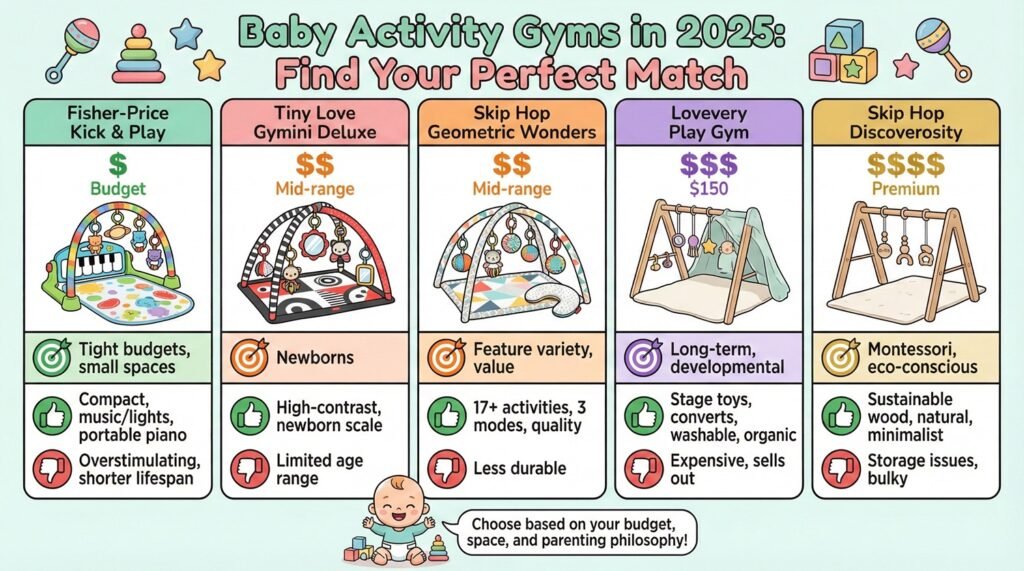
Lovevery Play Gym
This one dominates parent conversations to an almost annoying degree. But… it earned that attention.
The stats back it up. Nearly 25% of surveyed parents named it their favorite baby purchase, with a 4.9-star average rating.
Parents consistently describe it as the most-used item during the first year.
The price sits around $150, which immediately makes it a “think about it” purchase as opposed to an impulse buy. But parents who invest in it rarely regret it.
What makes it different is the intentional design. It grows with your baby from newborn through toddler stages.
The included parent guide explains which toys to use when, based on developmental stages.
That removes a lot of guesswork for first-time parents who have no idea what a four-month-old should be doing.
The materials matter too. Organic cotton, baby-safe silicone, OEKO-TEX-tested polyester.
For parents concerned about off-gassing and chemical exposure, this stuff makes a difference.
You can actually smell the difference between cheap foam mats and quality materials.
The double-sided play mat is clever. One side for newborns, flip it over as they grow.
Eventually the whole thing converts into a tent for mobile toddlers.
Getting 18+ months of use from a single product justifies the cost for most people.
Machine-washable components seal the deal. Baby gear that can’t be easily cleaned is baby gear that gets gross and stays gross.
If you’re looking at the Lovevery, you can check current pricing and availability here. (Just know it sells out sometimes during peak baby season.)
Skip Hop Geometric Wonders
This represents solid value without the premium price tag.
It offers three play configurations: tummy time, back play, and seated. Over 17 developmental activities included, which sounds excessive but parents report their babies actually engage with most of them.
The feature-to-price ratio makes it a smart choice if you want developmental support without spending $150+. Quality is good, not exceptional, but it holds up well enough for most babies’ first year.
Fisher-Price Glow and Grow Kick & Play Gym
The budget option that parents actually buy and use.
It includes music, lights, toys, and a take-along piano. Yes, it’s more stimulating than the Montessori crowd prefers, but babies seem to enjoy it.
And at this price point, expectations are appropriately calibrated.
The smaller footprint works well for apartments or smaller nurseries. Storage is easier compared to larger wooden frames.
Materials are standard Fisher-Price quality… which means plastic, but they’ve been making baby products forever and understand safety standards.
Tiny Love Gymini Deluxe
Specifically designed for newborns.
The compact mat and lower toy bar bring everything down to newborn eye level. The high-contrast black and white design actually supports visual development during those early weeks when babies can’t process colors well yet.
This isn’t a gym that’ll last through the first year, but if you want something specifically suited for the newborn phase, it works well.
Skip Hop Discoverosity
The Montessori answer to overstimulating plastic gyms.
Sustainable wood arch, sensory-focused design, no lights or sounds. Natural materials, textured elements, muted tones.
Storage is the main complaint. Wooden frames that don’t fold take up space even when not in use.
But if you have the room and align with the Montessori philosophy, this delivers what it promises.
You can compare current options and read updated parent reviews here before making your final choice.
Safety and Materials (Because This Stuff Actually Matters)
Parents have become amateur material scientists out of necessity.
The difference between cheap foam and quality construction affects how long the gym lasts and whether it releases chemicals into your home air.
What to Look For
EN71 certification is the gold standard. This European safety standard is more rigorous than many other certifications and protects against harmful chemical migration.
If a company can’t clearly explain what materials their mat contains or what safety standards it meets… that’s your answer. Move on.
Materials to Avoid
- PVC
- EVA foam containing formamide
- BPA
- Lead and other heavy metals
Your baby spends hours with their face pressed against this surface. The materials genuinely matter.
Better Material Options
TPU (Thermoplastic Polyurethane) shows up in high-end memory foam mattresses. It provides cushioning and support without the chemical concerns of cheaper foams.
Organic cotton certified by GOTS or OEKO-TEX means you’re not introducing synthetic pesticides and chemicals into your baby’s immediate environment.
Sustainably sourced wood for frames and arch structures. Look for smooth finishes without toxic sealants.
Shock absorption gets overlooked until your rolling baby bonks their head on a too-thin mat. Proper padding matters once babies get mobile.
Real Parent Feedback on Common Problems
The Storage Issue
Bulky design is a legitimate complaint that doesn’t get addressed enough.
Wooden frames that don’t fold create storage headaches, especially in smaller homes or apartments. Parents love the aesthetic… until they need to put it away or move it to another room.
The Skip Hop Montessori option specifically gets called out for taking up too much permanent floor space.
Parents solving this choose gyms with removable components and foldable frames. Even the Lovevery needs dedicated space when set up, but at least it breaks down relatively easily.
Portability matters for parents who travel often or have multiple living spaces. Lighter, more compact designs appeal to this group even if they sacrifice some features.
Overstimulation Is a Real Thing
This surprises first-time parents until they watch their baby’s reaction.
Constant music, flashing lights, excessive toy variety… it overwhelms young nervous systems. Babies develop better with targeted stimulation as opposed to sensory chaos.
Parents selecting Montessori-inspired gyms specifically cite this concern. The minimalist philosophy directly addresses overstimulation by limiting features to purposeful elements.
Babies actually engage longer with simple, high-contrast designs. The Tiny Love Gymini approach supports this with its black and white newborn focus.
You’ll find parents keeping feature-heavy gyms for short periods before switching to simpler designs where babies actually stay engaged longer.
Durability Problems with Budget Options
Cheap gyms show wear quickly. Ribbons fray, plastic cracks, padding compresses after a few months.
Parents buying budget options should expect replacement. Parents investing in quality expect longevity.
Washability matters more than you’d think until you’re dealing with spit-up, diaper blowouts, and general baby messiness. Machine-washable mats are basically non-negotiable.
This feature alone extends a gym’s lifespan significantly. The Lovevery’s machine-washable design gets consistent praise not because it’s impressive, but because it actually works.
Parents wash these mats regularly and report no degradation.
Wooden components need occasional care but generally outlast plastic alternatives. When you calculate cost-per-use over 18 months, quality options often make more financial sense.
The Eco-Conscious Angle
Sustainable materials matter to specific parents, and brands are responding.
Organic cotton, sustainably sourced wood, non-toxic dyes… these represent genuine choices, not just marketing language.
Parents in this category research production practices and material sourcing. They want confidence their purchase doesn’t harm ecosystems or introduce microplastics into their homes.
The environmental cost of replacing cheap gyms annually versus investing in durable equipment resonates here. A $150 gym used for 18 months and passed to a younger sibling has less environmental impact than three $50 gyms that end up in landfills.
What Actually Determines Value
Value depends entirely on your specific situation.
A $150 gym that gets used daily for 18 months offers better value than a $50 gym that sits unused because your baby finds it boring or overstimulating.
Space constraints matter. A beautiful wooden arch gym has zero value if it doesn’t fit in your apartment or you have nowhere to store it.
Your parenting philosophy affects this too. If you align with Montessori principles, a flashy light-up gym will annoy you even if your baby enjoys it.
If you prioritize developmental features and stage-based activities, minimalist options might feel not enough.
Here’s a breakdown of what different models offer:
| Model | Price Range | Best For | Key Features | Drawbacks |
|---|---|---|---|---|
| Lovevery Play Gym | ~$150 | Long-term use, developmental focus | Stage-based toys, converts to tent, machine-washable, organic materials | High price, can sell out |
| Skip Hop Geometric Wonders | Mid-range | Feature variety, value seekers | 17+ activities, three play modes, good quality | Not as durable as premium options |
| Fisher-Price Kick & Play | Budget | Tight budgets, small spaces | Compact, music/lights, take-along piano | Potentially overstimulating, shorter lifespan |
| Tiny Love Gymini Deluxe | Mid-range | Newborns specifically | High-contrast design, newborn-appropriate scale | Limited age range |
| Skip Hop Discoverosity | Premium | Montessori philosophy, eco-conscious | Sustainable wood, natural materials, minimalist | Storage challenges, bulky frame |
Making Your Actual Decision
Choose based on your real lifestyle, not the aspirational version of yourself.
If you live in a 700-square-foot apartment, that beautiful wooden arch gym might not work regardless of how much you love the aesthetic.
If your budget is tight, a $150 gym simply might not be realistic even if parents rave about it. A good $50 option beats no gym at all.
If you have multiple kids planned, investing in a durable gym that’ll last through several babies changes the value calculation significantly.
Quick Decision Guide
For maximum developmental support and long-term use: Lovevery Play Gym. The price hurts upfront but the cost-per-use works out well.
For best value with good features: Skip Hop Geometric Wonders. Solid middle ground between budget and premium.
For tight budgets or small spaces: Fisher-Price Kick & Play. Gets the job done without breaking the bank.
For newborns specifically: Tiny Love Gymini Deluxe. Purpose-built for those early weeks.
For Montessori/eco-conscious parents: Skip Hop Discoverosity. Just make sure you have the space for it.
The Honest Bottom Line
Baby activity gyms fall into two categories: the ones that get used daily and earn their floor space, or the ones that get shoved in a closet after a month.
The difference comes down to how well the gym matches your parenting approach, your living space, and your baby’s temperament (which you can’t forecast in advance, unfortunately).
What’s encouraging is that quality options exist across all price points now. The entire category has improved significantly compared to even a few years ago.
Parents demanded better, and manufacturers responded.
The most honest feedback from parents with multiple kids: if they used it constantly with their first baby, they bought it again for subsequent kids. If it sat unused, they skipped it the second time around.
Tummy time matters for development. Having an engaging setup that makes tummy time more tolerable benefits everyone.
Whether that’s a $150 premium gym or a $50 budget option depends on what works for your specific situation.
Parents are making smarter choices now, selecting based on actual needs as opposed to marketing promises or pressure from other parents. That shift has elevated the entire market.
Whatever you choose, make sure it meets current safety standards and uses non-toxic materials. Beyond that, trust your instincts about what’ll actually work in your home and with your lifestyle.
The “perfect” baby activity gym is the one that gets used regularly and supports your baby’s development. Everything else is just details.