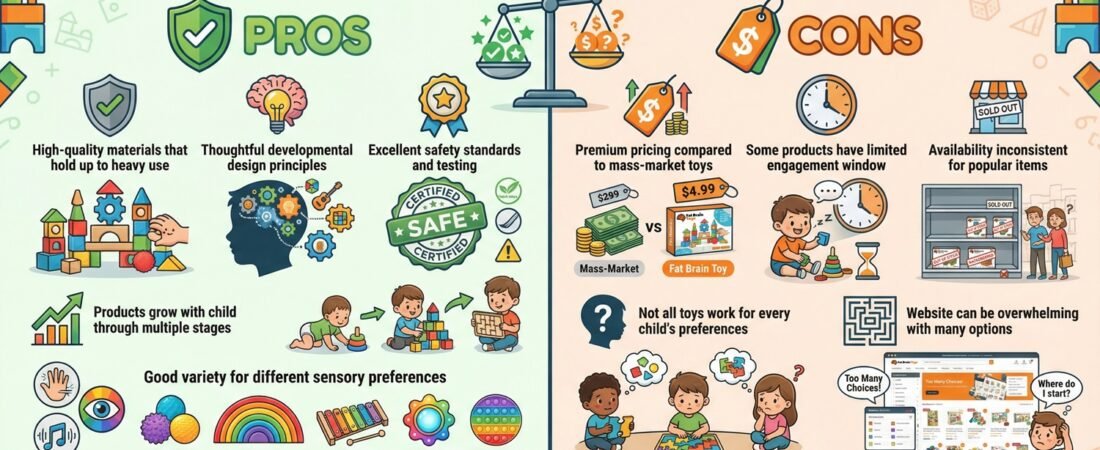
So I’ve been researching Fat Brain Toys for a while now, and honestly… there’s a lot to unpack here. This isn’t one of those random toy brands that pops up on Amazon with zero background.
They’ve been around since 2002, and they’ve built a pretty solid reputation in the educational toy space.
The company focuses specifically on what they call “play with purpose”, basically toys that aren’t just keeping kids busy but actually helping them develop skills. And look, I get it.
The toy market is absolutely flooded with plastic junk that ends up in a donation bin six months later.
So when a brand positions itself as developmental and educational, you want to know if that’s real or just marketing BS.
This fat brain toys review is going to cover everything from their actual product quality to whether the price tags make sense for what you’re getting. I’ve looked at customer feedback, compared their offerings to other educational toy brands, and tried to figure out if this is worth your money or if you’re better off with simpler (cheaper) options.
Features Overview
Fat Brain Toys sells both their own branded products and curated toys from other companies. Their in-house designs tend to focus on sensory exploration, cause-and-effect learning, and open-ended play.
These are the things Montessori and RIE parents get excited about.
What Makes Their Toys Different
The brand puts a lot of emphasis on a few key features:
Material quality, They use BPA-free plastics, sustainably sourced wood, and food-grade silicone for baby toys. The silicone stuff is dishwasher safe, which is honestly a game-changer when you’re dealing with drool-covered toys.
Age-appropriate design, Their toys are sorted by developmental stage, not just age range. So instead of “6 months and up,” you’ll see toys categorized by skills like “grasping and shaking” or “cause and effect.” This actually helps when you’re trying to match a toy to where your kid is at developmentally.
Sensory variety, Lots of different textures, sounds, and visual elements packed into single toys. The Dimpl toys (those silicone bubbles you can poke) are probably their most recognizable product for babies.
Safety testing, Everything meets or exceeds US safety standards. They’re pretty transparent about third-party testing, which is what you want to see.
Popular Product Lines
Their infant-focused toys include the Dimpl series, Pip Squigz (suction cup toys), Tobbles (stacking toys with weighted bases), and various teethers and rattles. For toddlers, they have more complex building toys, puzzles, and pretend play items.
The Dimpl line alone has like 10+ variations now. There’s the original Dimpl (five silicone bubbles in a frame), Dimpl Duo (two-sided version), Dimpl Digits (0-9 numbers), and even a keychain version.
Some people love having the whole collection… others think it’s overkill for what’s basically the same concept.
Performance Analysis
Here’s where things get interesting. Looking at actual customer experiences, Fat Brain Toys generally performs well in the categories parents care most about.
Durability and Construction
The toys hold up pretty well to baby/toddler abuse. Silicone products like Dimpl and Pip Squigz can handle being chewed, thrown, and stuffed into toy boxes repeatedly.
The suction cups on Squigz products maintain their grip even after months of use (though they do eventually wear out… nothing lasts forever).
Wooden toys from their collection feel solid. No splintering or pieces breaking off easily.
The paint and finishes stay intact through normal play.
That said, if your kid is a serious chewer, you might see some wear marks on wooden items over time.
Plastic toys are thick and sturdy. Not the flimsy kind that cracks if you step on it.
I’ve seen feedback from daycare providers saying Fat Brain Toys hold up better than typical toy store brands when multiple kids are using them daily.
Engagement and Interest Level
This varies a lot by kid (obviously) and by toy. The sensory-focused toys for babies tend to get a lot of repeated use.
Kids genuinely seem interested in the different textures and movements.
The Dimpl bubbles are weirdly satisfying to push, adults end up playing with them too.
Some of the more specific toys have a shorter engagement window. Like the Tobbles stacking toy is cool for the wobbling feature, but once a kid figures it out, they might move on.
That’s kind of the trade-off with developmental toys versus open-ended ones.
The really successful toys from this brand are the ones that grow with your kid. Pip Squigz, for example, work as a teething toy at 6 months, a suction/pulling toy at 9 months, and then a building/connecting toy at 18+ months. That extended usability makes the higher price point feel more reasonable.
Developmental Benefits
You can’t really “prove” that specific toys make kids smarter or more coordinated (and I’m not making those claims here), but the design principles behind Fat Brain Toys align with what early childhood development research suggests is beneficial.
Cause-and-effect toys help babies understand that their actions create results. Sensory variety supports neural development as babies process different inputs.
Open-ended toys encourage creativity and problem-solving.
Fat Brain Toys incorporates these principles pretty consistently. Whether that translates to measurable developmental advantages… I mean, that’s going to depend on a million factors beyond which toys a kid plays with.
But the toys at least aren’t hindering development, which is more than you can say for some electronic toys that do everything for the child.
Safety Performance
No major recalls that I could find for their core product lines. That’s actually notable given how many toy recalls happen every year.
Their testing protocols seem legit, and customer reviews rarely mention safety concerns.
The silicone products are especially good for the baby stage when everything goes directly into mouths. No small parts to worry about, materials are safe to chew, and they’re easy to clean thoroughly.
Pros and Cons
Let me break this down based on real feedback and product analysis.
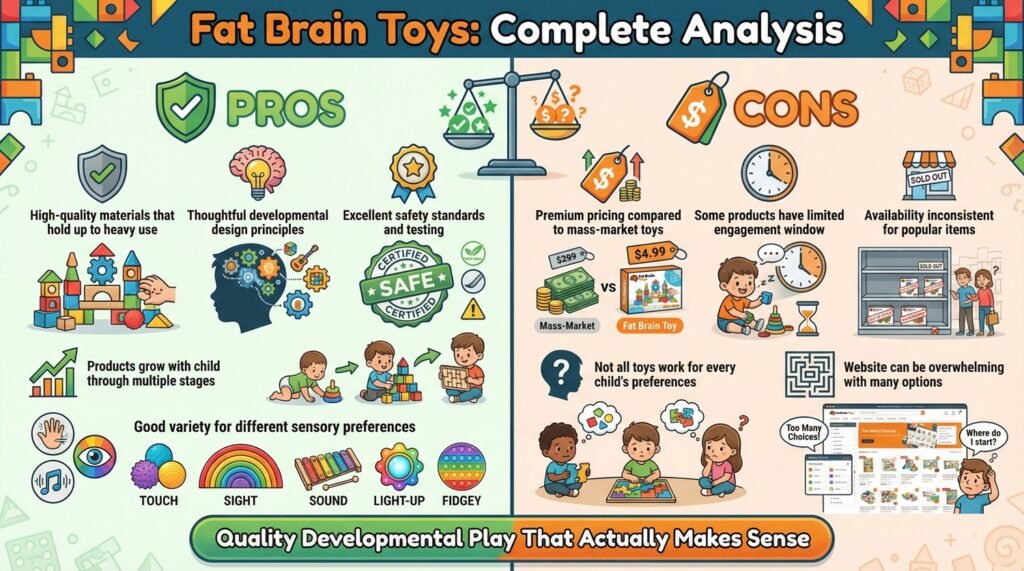
| Pros | Cons |
|———-|———-|
| High-quality materials that hold up to heavy use | Premium pricing compared to mass-market toys |
| Thoughtful developmental design principles | Some products have a limited engagement window |
| Excellent safety standards and testing | Not all toys work for every child’s preferences |
| Many products grow with the child through multiple stages | Availability can be inconsistent for popular items |
| Good variety for different sensory preferences | The website can be overwhelming with so many options |
| Works well with Montessori/RIE approaches | Some products feel overpriced for what they are |
What Works Really Well
The sensory toys for the 3-12 month range are probably their strongest category. Products like Dimpl, Klickity, and their various teethers consistently get positive feedback.
These toys are simple enough that babies can actually use them independently, but interesting enough to hold attention.
Their suction cup toys (Squigz, Pip Squigz) are also really popular. The act of pulling suction cups apart is satisfying, and the building possibilities expand as kids get older.
These work on high chairs, windows, bathtubs… pretty versatile.
The quality control seems consistent. You’re not going to get a toy with missing pieces or defects most of the time.
When issues do come up, their customer service reportedly handles replacements pretty quickly.
Where They Fall Short
The price is the biggest complaint. A set of Pip Squigz runs around $15-20 for three pieces.
Dimpl is usually $12-15.
Tobbles is closer to $30. These aren’t huge expensive toys… but the costs add up fast if you’re building a collection.
Some products feel a bit gimmicky or like variations on the same basic concept. Do you really need five different Dimpl products? Probably not, but they keep releasing new versions.
Certain toys don’t live up to the hype. The educational descriptions on the website can oversell what a toy actually does.
At the end of the day, these are still just toys.
They’re not secret development tools.
And honestly, some kids just aren’t that into them. Babies and toddlers have their own preferences, and no brand hits with every child.
I’ve seen reviews where parents bought highly-rated Fat Brain Toys and their kid ignored them completely in favor of a cardboard box or wooden spoon.
User Experience
Looking at feedback from different types of users gives you a fuller picture of how these toys actually perform in real life.
Parents of Infants
The general vibe from parents with babies is pretty positive. The toys designed for the 0-12 month range tend to be simple, safe, and actually usable by young infants.
Parents appreciate that the toys are easy to clean (important when everything is covered in drool and milk residue).
The Montessori/RIE-focused parents seem especially happy with Fat Brain Toys because the products align with those philosophies. Open-ended play, natural materials, simple designs that don’t overstimulate, that’s the aesthetic these parents want, and Fat Brain delivers it.
There’s some frustration around figuring out which toys are actually appropriate for younger babies versus what’s marketed for “6 months+” but really needs more advanced motor skills. The age ranges can be a bit optimistic sometimes.
Educators and Daycare Providers
This group tends to be more critical because they’re evaluating durability and engagement across multiple children over time. The feedback here is that Fat Brain Toys hold up better than typical consumer toys but aren’t quite at commercial-grade level.
Teachers appreciate the developmental focus and the variety of skill-building options. These toys work well in classroom settings because they’re intuitive enough that kids can explore independently without constant adult direction.
The cost is a barrier for some programs, especially home daycares or smaller centers with tight budgets. Buying enough toys for a whole classroom at Fat Brain Toys prices adds up fast.
Some educators pick a few key items from the brand and supplement with cheaper alternatives.
Gift-Givers
Grandparents and relatives like that Fat Brain Toys feel more substantial and educational than random toy store purchases. The packaging and presentation are nice enough for gifting.
The products come across as thoughtful rather than generic.
The challenge for gift-givers is knowing what the child already has or what stage they’re actually at developmentally. The website offers gift guides, but you really need to know the specific kid to choose well.
This leads to some duplicates or toys that aren’t quite right for the child’s current abilities.
If you’re looking for a gift that feels meaningful and won’t end up in a donation pile immediately, Fat Brain Toys is a pretty safe bet. Just maybe check with the parents first to see what might be useful.
Value for Money
This is where you have to think about what value means to you specifically.
From a pure cost perspective, Fat Brain Toys are expensive compared to Target or Amazon basics. You can get sensory toys and teethers for a fraction of the price from other brands.
If budget is tight, there are definitely cheaper options that function similarly.
But the quality difference is noticeable. Cheaper toys often use thinner plastics, have rough seams, or don’t hold up as long.
The materials in Fat Brain Toys feel more substantial, and the designs are more thoughtful.
You’re paying for better engineering and safety testing.
Cost Per Use Analysis
Here’s how I think about it… if a $15 toy gets used almost daily for 6-12 months, that’s actually pretty reasonable value. The cost per play session ends up being pennies.
But if you buy a $25 toy and your kid uses it twice, that’s terrible value regardless of quality.
Fat Brain Toys that get the most value:
- Dimpl, Used from around 6 months through toddler years, easy to take anywhere, almost indestructible
- Pip Squigz, Grows with the child, multiple use cases, very durable
- Simple teethers and rattles, Used heavily during peak teething months, safe materials matter here
Lower value products tend to be:
- Highly specific toys with one narrow function
- Products that are too advanced for the stated age range
- Toys that duplicate functions of simpler household items
Comparing to Alternatives
Against mass-market brands like Fisher-Price or Infantino, Fat Brain Toys are noticeably more expensive and noticeably higher quality. The materials are better, the designs are more thoughtful, and they last longer.
Against other premium educational toy brands (Lovevery, Melissa & Doug, Hape), Fat Brain Toys are competitively priced. Sometimes cheaper, sometimes a bit more, depending on the specific product. The quality is comparable across these brands.
Against DIY or household items… look, a wooden spoon and metal bowl will entertain a baby for free. You can create sensory bins from materials you already have.
Fat Brain Toys are convenient and well-designed, but they’re not necessary.
If you’re trying to avoid toy clutter or work within a tight budget, there are definitely other approaches.
Final Verdict
After looking at everything, product quality, customer feedback, developmental approach, pricing, and actual performance, here’s what this fat brain toys review comes down to:
Fat Brain Toys delivers on quality and thoughtful design. These aren’t junk toys that fall apart in a week. The materials are safe, the construction is solid, and the developmental principles behind the products are sound.
If you value well-made, purposeful toys, this brand delivers.
The pricing is premium but generally justified for what you get. You’re paying more than mass-market prices, but you’re getting better quality and longer usability. Whether that trade-off makes sense depends on your budget and priorities.
Not every product is going to be a hit with every child. Babies and toddlers have individual preferences, and even the best-designed toy might not interest a particular kid. The open-ended, simple toys tend to have broader appeal than the more specialized ones.
The brand fits really well with Montessori, RIE, and similar parenting approaches. If you’re focused on developmental, screen-free, open-ended play, Fat Brain Toys aligns with those values. If you just want something to keep your kid busy, there are cheaper options that work fine.
Who Should Buy Fat Brain Toys
This brand makes the most sense if you want fewer, higher-quality toys rather than a huge collection of cheaper items. If you’re trying to be intentional about what comes into your home and prioritize developmental benefits, Fat Brain Toys fits that approach.
They work well for gift-giving when you want something that feels thoughtful and substantial. They’re good for educators who need durable, engaging toys that support skill development.
They’re probably not the best choice if you’re on a very tight budget or if you prefer to DIY sensory activities. The quality is excellent, but the prices reflect that.
Specific Recommendations
If you’re going to try Fat Brain Toys, start with their most popular, versatile products rather than buying a whole collection at once. Dimpl, Pip Squigz, and Klickity are solid entry points that tend to work well for most kids in the target age range.
Pay attention to developmental stage more than age range when selecting toys. A physically advanced 6-month-old might be ready for toys labeled 9+ months, while a kid who’s taking their time with motor skills might need simpler options longer.
Check for sales and bundles. Fat Brain Toys goes on sale periodically, especially around holidays.
Some retailers carry the brand at slightly lower prices than buying directly from the company.
If you want to check current prices and availability, you can see their full selection here, it’s worth browsing the different categories to get a sense of what appeals to you.
Fat Brain Toys has built a solid reputation in the educational toy space for good reasons. The products are well-designed, safe, and durable.
They’re not cheap, but they’re not overpriced for what you’re getting either.
Whether they’re worth it for your situation depends on your priorities, budget, and what you’re looking for in toys.
The brand works best when you’re selective about which products you buy rather than trying to collect everything they offer. A few well-chosen Fat Brain Toys mixed with simpler, open-ended play materials makes more sense than replacing your entire toy collection with premium products.
For what it’s worth, the company seems committed to quality and safety, and they continue to innovate with new designs while maintaining their core focus on developmental play. That’s actually pretty rare in the toy industry, where most brands are just churning out licensed character products or electronic gadgets.
So yeah… Fat Brain Toys. Pretty good overall if you’re in the market for well-made educational toys and the price isn’t a dealbreaker.
Not perfect, definitely not necessary, but generally a solid choice for the specific audience that values what they’re offering.
You can browse their full collection and see current offerings here, might be worth checking out if you’re curious about specific products or looking for something particular.