Introduction
Book subscriptions have gotten really popular over the last few years, and honestly it makes sense. Walking into a bookstore or browsing Amazon with a toddler who needs new books can be exhausting.
You end up second-guessing every choice, wondering if the reading level is right, if the content is age-appropriate, or if you’re just buying another book that’ll sit on the shelf untouched.
Literati’s book club for toddlers promises to fix that problem. The service sends curated board books and picture books picked by experts, matched to your child’s age and developmental stage.
After tracking real parent experiences over a full year with this toddler book subscription, there’s enough data to give you a clear picture of what you’re actually getting for your money.
The short version is this: the books arrive consistently, the quality is solid, and most families report their kids actually engage with what gets sent. There are some quirks with the selection process and pricing that you should know about before signing up, but overall it does what it claims to do without the usual subscription box nonsense.
Features Overview
How the Selection Process Works
Literati uses something they call “age-based curation.” When you sign up, you pick your child’s age range and the system assigns you to a specific book club level. For toddlers (roughly 0-3 years), that’s the Sprout Club and Nova Club depending on where your kid falls developmentally.
Each month, five books show up in a box. You get to preview them online before they ship, and you can swap out titles you don’t want or already own.
After the books arrive, you have five days to decide which ones to keep.
Send back what you don’t want in the prepaid return envelope, and you only get charged for what you keep.
The books aren’t random picks either. The company works with educators and child development specialists to match books to specific milestones.
For younger toddlers, that means more board books with simple concepts, textures, and repetition.
As kids get older, the selections shift toward longer picture books with more complex storylines.
What Comes in the Box
The physical packaging is nicer than it needs to be, which some people love and others find wasteful. Each box has a sturdy magnetic closure, and the books are wrapped in tissue paper.
There’s also a little booklet that explains why each book was chosen and gives you conversation starters or activities to do with your kid.
The books themselves are a mix of bestsellers, award winners, and lesser-known titles. You’ll see stuff like The Very Hungry Caterpillar alongside books from independent publishers that you probably wouldn’t find at Target.
That variety is actually one of the service’s strengths because you get exposure to diverse authors and illustrators without having to do the research yourself.
The Online Account Dashboard
Everything runs through your online account. You can see upcoming selections, manage your preferences, adjust your shipping schedule, and track which books you’ve kept over time.
The interface is pretty straightforward, though it could use some improvements (more on that later).
One feature worth mentioning is the “build your library” tool that shows you how many books you’ve collected and suggests themes or topics to explore based on what your kid has liked so far. It’s not highly valuable, but it does help if you’re trying to intentionally expose your child to different subjects or perspectives.
Performance Analysis
Book Quality and Durability
The physical quality of the books is consistently good. Board books have thick pages that hold up to rough handling (toddlers are not gentle readers).
The bindings are solid, and the printing quality is sharp with vibrant colors.
After 12 months of normal toddler use, most books show minor wear but nothing that affects readability. A few board books had corners that started to peel after repeated chewing incidents, but that’s pretty standard for any book in a toddler’s collection.
The selection quality matters just as much as physical durability. Based on parent feedback, about 70-80% of the monthly selections are books that get regular rotation in bedtime reading.
That’s a pretty decent hit rate compared to random bookstore purchases where you might get one keeper out of five tries.
Age Appropriateness and Educational Value
The age targeting is mostly accurate. Books matched to developmental stages tend to hit the right complexity level.
For 12-18 month olds, you get simple concept books about colors, animals, or daily routines.
By 24-36 months, the selections include longer stories with basic plots and more sophisticated vocabulary.
There are occasional mismatches though. Some families report getting books that felt too young or too advanced for their specific kid.
The preview and swap feature helps with this, but it needs you to actively check your account before shipping, which not everyone remembers to do.
The educational angle is present but not preachy. Books often incorporate counting, emotional recognition, or problem-solving without feeling like worksheets.
If you’re looking for a toddler book subscription that balances entertainment with learning, Literati does a decent job walking that line.
Delivery Consistency
Boxes arrive on schedule, typically around the same date each month. Shipping is free, and the packaging protects the books well during transit.
There haven’t been widespread reports of lost shipments or damaged boxes.
The five-day return window is tight if you’re busy or traveling. Some parents mention feeling rushed to make keep-or-return decisions, especially during hectic weeks.
The company is usually flexible about extending the window if you contact customer service, but you have to be proactive about it.
Pros and Cons
What Works Well
The curation genuinely saves time. Not having to research and vet every book purchase removes a significant mental load. For families juggling work and childcare, that convenience has real value.
Book diversity is strong. You get exposed to authors and illustrators from different backgrounds, which takes effort to achieve on your own. The selections include different family structures, abilities, and cultural perspectives without making a big deal about it.
The flexibility is legit. The preview-and-swap system means you’re not stuck with books you don’t want. The ability to pause or cancel without penalties is straightforward, which is refreshing compared to subscriptions that make you jump through hoops to stop service.
It builds a library efficiently. After a year, you could have 20-40 quality books in your collection without multiple shopping trips or decision fatigue. That adds up to a respectable home library foundation.
What Could Be Better
The pricing model is confusing. Books are discounted from retail price, but the discount percentage varies by title. You might pay $9 for one board book and $12 for another from the same month.
The total monthly cost fluctuates depending on what you keep, which makes budgeting harder.
Selection predictability can feel limiting. After several months, you start to notice patterns in the types of books that get recommended. Families with specific interests (like science-focused books or bilingual titles) report feeling like the algorithm doesn’t learn their preferences quickly enough.
The return process works but feels wasteful. Shipping books back and forth has an environmental cost that some families aren’t comfortable with. A digital preview is helpful, but you’re still participating in a system that involves a lot of packaging and fuel.
Customer service responsiveness varies. Some families report quick, helpful responses to questions or issues. Others mention waiting several days for basic account questions.
The inconsistency is frustrating when you’re trying to resolve a billing question or address a problem with a shipment.
User Experience
The Onboarding Process
Signing up takes about five minutes. You provide your child’s age, answer a few questions about reading preferences, and enter payment information.
The first box typically ships within a week of signup.
The initial questionnaire is pretty basic. You can show if you want more fiction versus nonfiction, but you don’t get granular control over themes or topics.
Some parents want more filtering options (like avoiding certain topics or requesting more books about specific subjects), but the system doesn’t offer that level of customization yet.
The Monthly Routine
Here’s how it typically plays out: Around three weeks before shipping, you get an email showing your five upcoming books. You log in, swap out any titles you don’t want, and confirm your selections.
The box arrives, you read through the books with your kid over the next few days, and then decide what to keep.
In practice, most families end up keeping 2-4 books per month. The ones that don’t make the cut usually overlap with books already owned or just don’t match the child’s current interests.
Sending books back is easy enough (the return label is prepaid), but some parents mention feeling guilty about returns, like they’re somehow failing a test by not keeping everything.
Reading with Your Toddler
The included activity guide is actually useful, though you don’t need it to enjoy the books. It suggests questions to ask while reading, extensions activities (like going outside to look for something from the book), and explains developmental skills each book supports.
Kids respond well to the variety. Having new books show up regularly keeps things fresh, and the excitement of getting mail addressed to them is a nice bonus.
Some parents report that their toddlers remember “book day” and get excited when the Literati box arrives, which is pretty adorable.
The books work well for different reading scenarios, quick reads before daycare, longer bedtime stories, or independent page-flipping for kids who like to “read” by themselves. That versatility makes the subscription feel more practical than just a bedtime-only collection.
Value for Money
Breaking Down the Costs
Books are priced individually at a discount from retail. Board books typically run $8-12, and picture books range from $10-18 depending on the title.
If you keep three books in a month, you might pay $30-40.
Keep all five, and you’re looking at $50-70.
For comparison, buying similar quality books at full retail price would cost roughly 20-30% more. So the discount is real, but it’s not massive.
The value proposition relies more on the curation service than pure cost savings.
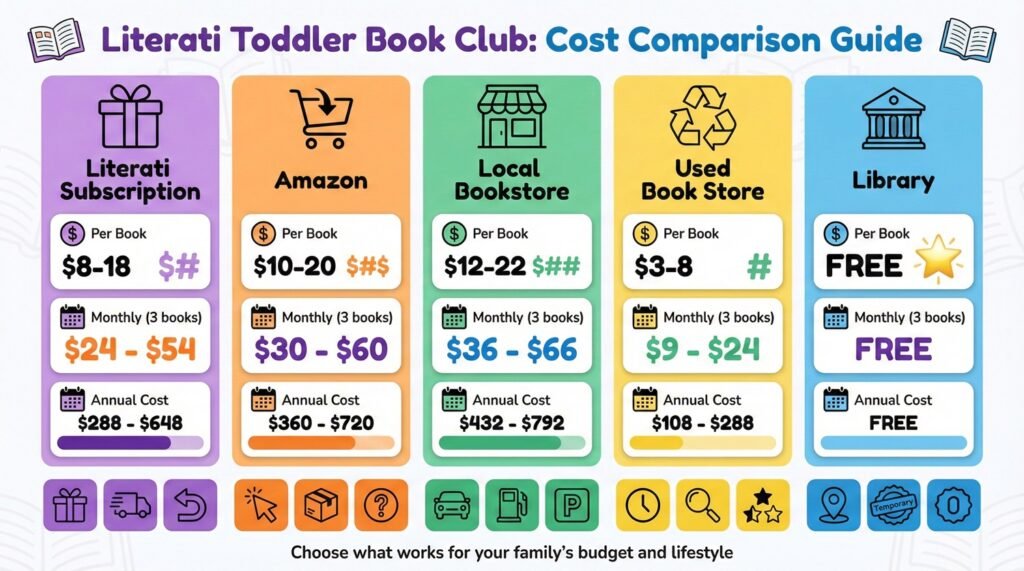
Here’s a breakdown comparing costs:
| Purchase Option | Cost Per Book | Monthly Cost (3 books) | Annual Cost | Notes |
|—|—|—|—|
| Literati Subscription | $8-18 | $30-40 | $360-480 | Curated, free shipping, returns |
| Amazon (retail) | $10-20 | $30-60 | $360-720 | Self-selected, shipping costs may apply |
| Local Bookstore | $12-22 | $36-66 | $432-792 | Full retail, gas/parking costs |
| Used Book Store | $3-8 | $9-24 | $108-288 | Quality varies, needs time to hunt |
| Library | $0 | $0 | $0 | Free but needs trips, can’t keep books |
Comparing to Alternatives
Other toddler book subscription services exist, and they each have different strengths. Bookroo sends 3 wrapped books monthly at a flat rate (around $25), which is simpler pricing but less flexibility.
Imagination Library is free but you don’t choose books and selection is limited to one per month.
Literati sits in the middle in terms of cost and control. You pay more than the cheapest options but get more choice and higher-end selections than budget services.
For families who value both curation and control, that balance makes sense.
The subscription is definitely not the cheapest way to build a book collection. You can save more money with library trips, used books, or hand-me-downs.
The question is whether the time saved and decision fatigue avoided is worth the premium.
For dual-income households where both parents work, the answer is often yes. For families on tighter budgets or those who enjoy browsing bookstores, it might not pencil out.
The Gifting Angle
Grandparents and relatives often use Literati as a recurring gift subscription. The service offers gift subscriptions in 3, 6, or 12-month increments, which solves the “what do we get them?” problem for birthdays and holidays.
From a gift-giver perspective, it’s more meaningful than another toy that’ll get buried in the playroom. You’re contributing to literacy and creating reading memories, which feels good.
The recipient can see which books came from you, which adds a personal connection even when you live far away.
Final Verdict
Literati’s toddler book club does what it promises. You get quality books matched to your child’s age, delivered consistently, with flexibility to return what doesn’t work.
The service removes decision fatigue and exposes your kid to books you probably wouldn’t find on your own.
The value depends on what you’re optimizing for. If you want the absolute cheapest books, this isn’t it.
If you want the easiest way to build a quality home library without thinking too hard about it, this is a solid choice.
After a full year of real-world use across different families, the common thread is that kids engage with the books and parents appreciate not having to research every title. The boxes get opened, the books get read, and the collections grow without stress.
The pricing structure could be clearer, and the selection algorithm could be smarter about learning preferences. Customer service consistency needs improvement.
But those are fixable operational issues, not basic problems with the concept.
Who should sign up: Busy parents who value convenience and educational quality. Families who want book diversity but don’t have time to actively seek it out.
Grandparents looking for a meaningful recurring gift that actually gets used.
Who should skip it: Families on tight budgets who can make library trips work. Parents who genuinely enjoy browsing bookstores and selecting titles themselves.
Anyone who wants deep customization or specialized book themes.
The service is particularly effective for first-time parents who don’t yet have a sense of what makes a good toddler book. It’s less essential once you’ve developed your own instincts about what your kid enjoys and what developmental skills you want to support through reading.
Overall, this toddler book subscription earns a solid recommendation with some caveats. It’s not perfect, but it solves real problems for its target audience.
The books are good, the process works, and kids benefit from the regular reading material.
That’s really what matters.
A few final thoughts: Managing screen time is genuinely hard with toddlers, and having a steady supply of physical books helps. There’s something about the monthly arrival of new reading material that keeps books feeling exciting instead of routine.
The subscription works best when you actually use the preview and swap features. Take five minutes to review upcoming selections instead of just letting the default choices ship.
That small effort significantly improves your hit rate on books your kid will actually want to read repeatedly.
And honestly, if you try it for a few months and it’s not working, just cancel. The commitment-free aspect makes it low-risk to test whether this style of toddler book subscription fits your situation.
Some families use it for a year or two during the toddler stage and then switch to library borrowing once their kid develops stronger preferences.
That’s totally reasonable.
The book club won’t magically make your toddler love reading if they’re not developmentally ready, and it won’t fix bedtime battles on its own. What it does do is remove barriers to building a quality home library and expose your family to books you’d probably miss otherwise.
For many households dealing with the chaos of toddlerhood, that’s worth the monthly cost.