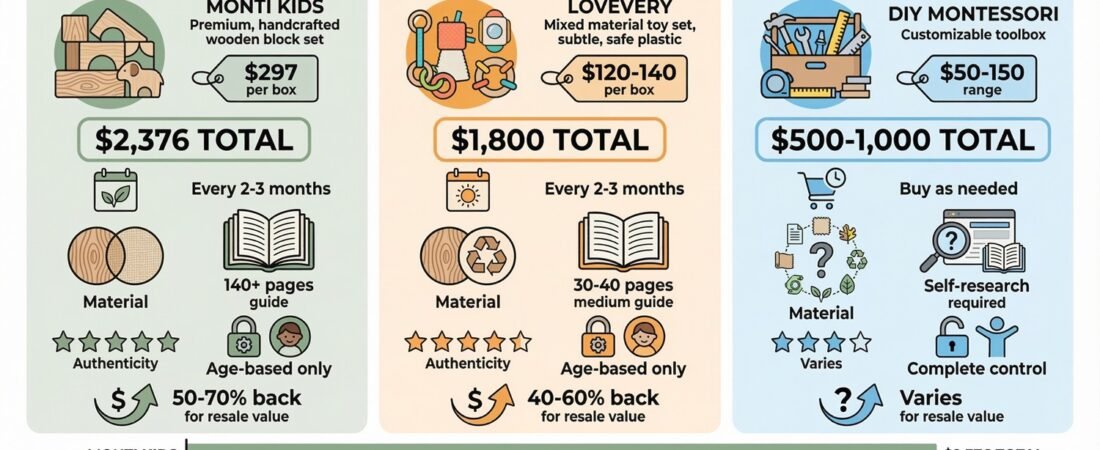
Monti Kids sends curated boxes of Montessori materials to your door every 2-3 months, designed to match your kid’s developmental stage from birth to age 3. Each box costs around $297 and includes wooden toys, learning materials, and a parent guide explaining how to use everything.
The boxes arrive based on your child’s age, with 8 levels total spanning those first three years. Inside each one you’ll find 4-6 Montessori-aligned toys and activities, plus detailed instructions that explain the developmental purpose behind each item.
What sets these apart from regular baby toys is the Montessori philosophy baked into every item. The materials focus on real-world skills, natural materials (mostly wood), and self-directed learning as opposed to flashy lights and sounds.
What You Actually Get in Each Box
The Level 1 box (for newborns to 2 months) includes basics like a wooden grasping ring, black and white visual cards, and a simple mobile. By Level 5 (12-15 months), you’re getting more complex items like object permanence boxes, shape sorters, and early language materials.
Every box comes with a 140+ page guide. These guides break down how to present each material, what developmental milestone it supports, and how to know when your kid is ready to move on.
The guides also include room setup suggestions, which honestly feels like overkill sometimes but is genuinely helpful if you’re trying to create a Montessori space at home.
The toys themselves are solid wood construction. We’re talking real maple and beech wood, not painted particle board.
The materials have a heft to them that cheap plastic toys don’t have.
Each level builds on the previous one, so there’s a progression that makes sense developmentally. The 6-month box isn’t just random toys that seem age-appropriate… it’s specifically designed to support skills introduced in the 4-month box.
How Monti Kids Stacks Up in Daily Use
The materials hold up well to repeated use (and the inevitable throwing, chewing, and dropping). The wooden toys don’t scratch easily, and the fabric items are machine washable, which matters more than you’d think.
Setup time varies by activity. Some materials like the peg board or stacking rings need zero prep.
Others, like the object permanence box, require some initial explanation and modeling before your kid gets it.
The parent guides walk through this, usually taking 5-10 minutes to read the relevant section before introducing something new.
Storage becomes a consideration. Eight boxes over three years means you’re accumulating a lot of materials.
Some families rotate items in and out of circulation, keeping only age-appropriate stuff accessible.
Others keep everything because younger siblings will eventually use them.
The subscription model means you can’t really choose what arrives when. Monti Kids sends what they’ve determined is developmentally appropriate for your child’s age.
Some parents love this (one less decision to make), others find it limiting (especially if their kid is advanced or delayed in certain areas).
If you want to check current pricing and see what level matches your kid’s age, Monti Kids has a quiz on their site that shows exactly what you’d get in your first box.
Breaking Down What Makes These Actually Montessori
Generic “educational toys” often mean anything with numbers, letters, or bright colors slapped on it. Authentic montessori baby toys follow specific principles developed by Maria Montessori over a century ago, and these principles are pretty different from mainstream toy design.
Real Montessori materials isolate one skill or concept. The pink tower teaches size differentiation and nothing else. No colors, no letters, no songs… just ten pink cubes in graduated sizes.
This isolation of difficulty helps kids focus on mastering one thing at a time.
The materials also emphasize reality over fantasy. You won’t find talking animals or anthropomorphized objects.
Instead, you get realistic wooden vegetables for food prep activities, actual photos of real animals as opposed to cartoons, and tools that are miniature versions of real adult items (a small pitcher for pouring practice, tiny tongs for transferring objects).
Control of error is built into the design. When something’s done wrong, the material itself shows the mistake without an adult needing to fix.
Puzzle pieces only fit one way, stacking rings only stack in order, nesting boxes only nest when sized correctly.
Monti Kids follows these principles pretty strictly. Their materials isolate skills, use natural materials almost exclusively, and incorporate that self-correcting element.
This is part of why they’re expensive… you’re paying for specific design philosophy, not just wooden toys.
Some items blur the line a bit. The scarves and fabric balls aren’t strictly traditional Montessori, but they align with the philosophy of open-ended play and natural materials.
The Real Cost Breakdown
Let’s talk numbers because this is where most people hesitate.
The full program costs around $2,376 for all 8 levels over three years. That breaks down to:
- $297 per box
- 8 boxes total
- Roughly $66 per month if you divide it across 36 months
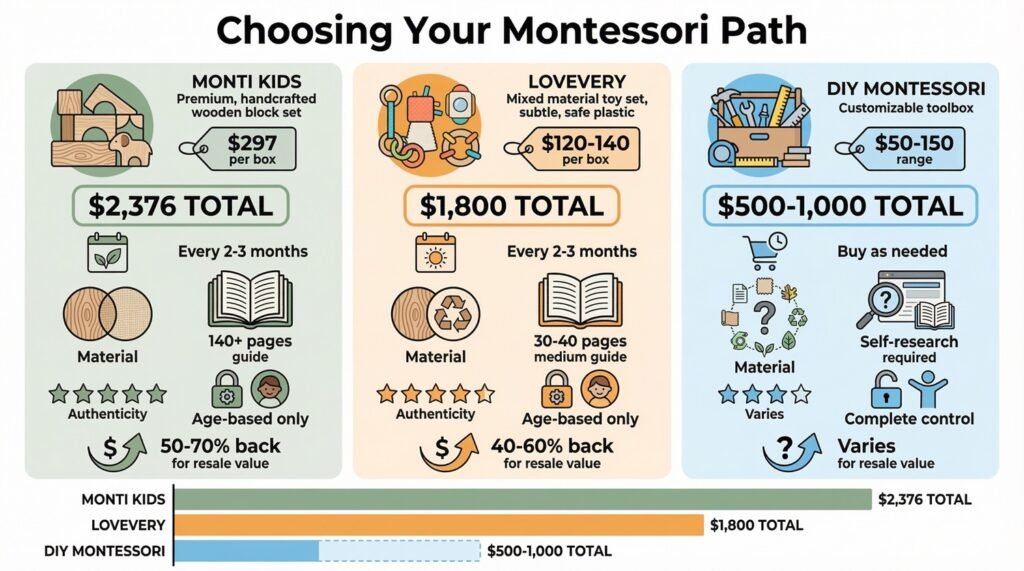
For comparison, Lovevery (a similar competitor) charges $120-$140 per box, which sounds cheaper until you realize they send boxes more often. Over the same time period, you end up spending similar amounts.
Buying Montessori materials separately from specialty shops? Individual items like a proper object permanence box run $40-60.
A set of Montessori mobiles costs $100-150.
Quality wooden puzzles are $20-40 each. If you tried to replicate what’s in one Monti Kids box, you’d probably spend $350-500 shopping around.
Here’s the catch though… you don’t necessarily need everything in the boxes. A minimalist approach to Montessori might involve fewer materials, more household items repurposed for learning, and just buying 3-4 key items per stage.
You could theoretically do that for $500-800 over three years.
The value proposition depends on three factors:
How much you value convenience (curated, arrives automatically, no research needed)
Whether you’ll actually use the parent guides (if you just want toys, you’re paying a lot for the educational framework)
If you plan to have many kids or resell the materials (they hold value well on secondhand markets)
What Parents Actually Say About It
Feedback from families who’ve used Monti Kids tends to split into distinct camps.
The enthusiastic group loves having the decision-making done for them. They were already interested in Montessori but overwhelmed by where to start, which materials to buy when, and how to present them.
For these guys, the subscription solved their main pain point (overwhelm) and the cost felt justified.
Common praise includes the quality of materials, the thoroughness of the guides, and watching kids actually engage with the toys for extended periods. Several parents mentioned their kids would work with a single material for 20-30 minutes at a stretch, which rarely happens with conventional toys.
The disappointed group usually falls into two categories: those who found it too expensive for what they got, and those whose kids didn’t engage with the materials as expected. Some babies just prefer household objects (wooden spoons, empty containers) over designed Montessori materials, which is actually very Montessori but frustrating when you’ve spent $300.
A few parents mentioned the timing felt off. Boxes are spaced 2-3 months apart, and developmental stages don’t always align that neatly.
A few reported their kid outgrew certain materials before the next box arrived, leaving a gap.
The guides get mixed feedback too. Some parents read every page and reference them constantly.
Others found them too dense or time-consuming, eventually just giving kids the toys and figuring it out through trial and error.
Resale value is strong though. Gently used Monti Kids boxes sell for 50-70% of retail price on Facebook Marketplace and resale groups, which softens the financial blow if you decide it’s not for you.
Monti Kids offers a 90-day money-back guarantee, so you can try the first box without fully committing to the whole program.
How It Compares to Similar Programs
Lovevery is the most direct competitor. Their Play Kits cost less per box ($120 vs $297) but include more frequent deliveries.
The toys are similar quality, though Lovevery incorporates more modern toy design alongside Montessori principles.
Their materials include some plastic components and battery-operated elements, which traditional Montessori purists avoid but many parents actually appreciate.
KiwiCo (for slightly older kids) takes a more project-based approach with STEM activities and craft projects. Less Montessori-specific, more hands-on making.
Costs $20-40 per box but needs more parent involvement to complete projects.
Buying straight from Montessori suppliers like Montessori Services or Alison’s Montessori gives you total control over what you buy and when, but needs research to know what’s age-appropriate and how materials should be sequenced. You’ll save money if you’re selective, but spend more time figuring things out.
Building a DIY Montessori setup using household items and basic wooden toys from regular stores is the budget option. It works, especially if you follow Montessori principles (open-ended, natural materials, reality-based), but lacks the curated progression Monti Kids provides.
The subscription model’s main advantage is removing decisions. You don’t need to research what a 9-month-old should be working on developmentally, which specific materials support those skills, or how to present them.
It’s all decided and explained for you.
Who This Actually Makes Sense For
First-time parents who are into Montessori but don’t have teaching training get the most value. The guides basically give you a mini education in child development and Montessori methodology while you use the materials.
You’re not just getting toys… you’re getting a framework.
Grandparents looking for substantial gifts find this appealing too. One box makes a generous birthday or holiday present, and it comes with built-in educational value that most grandparents love to emphasize.
Plus it shows they put thought into buying something developmental as opposed to whatever’s popular at Target.
Families planning many kids can justify the cost more easily. The materials genuinely last through many children if cared for reasonably well.
Divide that $2,376 by two or three kids and suddenly it’s $792-1,188 per child, which feels more reasonable.
Minimalists and eco-conscious parents appreciate the wooden construction and lack of plastic, batteries, and electronic components. These montessori baby toys align with values around sustainability and reducing toy clutter (since each item has specific purpose as opposed to being random plastic stuff).
It makes less sense for parents who prefer a looser approach to development, aren’t interested in the Montessori method specifically, or whose kids just don’t vibe with structured materials. Some babies are happiest with cardboard boxes and kitchen items, and there’s nothing wrong with that.
Budget-conscious families might find better value assembling their own collection of quality wooden toys over time, even if it lacks the specific Montessori progression. The subscription is convenient but definitely premium-priced.
The Realistic Value Assessment
Here’s what you’re actually paying for: materials that cost maybe $150-200 if you sourced them separately, plus about $100 worth of educational content/curation in the guides, plus the convenience of not having to research and shop for everything yourself.
That leaves roughly $0-50 per box that you could call premium pricing or convenience fee, depending on how you value your time.
The materials themselves are legitimately high quality. They’re not overpriced in terms of construction and materials used. Comparable items from Montessori suppliers cost similar amounts.
The guides represent real value if you use them. They’re written by Montessori educators and include developmental information you’d otherwise need to piece together from books, websites, or courses.
If you actually read and reference them, that’s worth something.
The curation and sequencing saves hours of research. Knowing exactly what materials to introduce when, in what order, and why takes significant knowledge or time to figure out.
Monti Kids does that work for you.
But (and this is important) you could achieve similar developmental outcomes with fewer materials and more creativity. Montessori principles can be applied with household objects and basic toys.
You don’t need specialty materials to support development.
So the value equation becomes: Are the premium materials, detailed guides, and curated progression worth $297 every 2-3 months to your specific family? For some, absolutely yes.
For others, clearly no.
Final Take: Is It Worth It?
Monti Kids delivers what it promises. You get quality Montessori materials, comprehensive educational guidance, and a structured developmental progression.
The toys hold up, kids genuinely engage with them, and parents learn useful things about development and Montessori principles.
The cost is high but not outrageous considering what you’re getting. It’s priced as a premium educational product, not just toys.
Whether it’s worth it depends almost entirely on how much you value convenience and structure. If researching developmental stages, shopping for specific materials, and figuring out Montessori methodology sounds overwhelming or time-consuming, the subscription solves those problems effectively.
If you’re already knowledgeable about Montessori or comfortable with a more freestyle approach to baby toys and development, you probably don’t need this level of curation and guidance.
The 90-day guarantee does lower the risk substantially. You can try one box, see if your kid engages with the materials, decide if you’ll actually use the guides, and evaluate if it fits your family’s approach before committing to the full program.
For grandparents, gifting one box ($297) is a solid option that gives parents a sample without the full commitment.
If you want to see what your first box would include based on your child’s current age, Monti Kids has a getting started page that breaks down exactly what arrives in each level.
The subscription works best for families who were already planning to buy quality Montessori materials anyway. It’s less compelling for families just looking for baby toys in general, even educational ones.
Bottom line: Monti Kids is a well-executed Montessori subscription with high-quality materials and genuinely useful guides. It’s expensive but not overpriced for what you get.
It solves specific problems (overwhelm, uncertainty, time spent researching) for families who value Montessori principles and want a structured approach.
Whether those solutions are worth $2,376 over three years depends on your specific situation, values, and how much you’ll engage with the program beyond just handing your kid the toys.
Check current Monti Kids pricing and box contents here – they occasionally run promotions that knock $50-100 off your first box.
Quick Comparison Table
| Feature | Monti Kids | Lovevery | DIY Montessori |
|———|————|———-|—————-|
| Cost per box | $297 | $120-140 | Varies ($50-150) |
| Total program cost | ~$2,376 | ~$1,800 | $500-1,000 |
| Delivery frequency | Every 2-3 months | Every 2-3 months | One-time purchases |
| Materials | Wood, natural fibers | Wood, some plastic | Depends on choices |
| Parent guides | 140+ pages each | 30-40 pages | Must research separately |
| Montessori authenticity | Very high | Moderate to high | Varies |
| Customization | None (age-based only) | None (age-based only) | Complete control |
| Resale value | 50-70% retail | 40-60% retail | Varies by item |
The table makes clear where Monti Kids sits in the landscape… highest cost, most guidance, least flexibility, strong Montessori alignment. Whether that combination works for you comes down to which of those factors matters most.