Have you ever watched your baby stare intently at their own hand, turning it this way and that in the light, completely mesmerized by something you barely notice anymore? Or seen them touch the same textured surface over and over, like they’re conducting their own little scientific experiment?
That’s sensory play in action, and honestly, it’s one of the most fascinating things about the first year of life. Your baby passes time being randomly entertained, but they’re actually building the basic architecture of their brain through every single touch, taste, sight, sound, and movement they experience.
Here’s where many parents get stuck. You know sensory play matters, yet the internet throws a million Pinterest-perfect sensory bins at you that seem designed for older toddlers.
You’re not quite sure what’s actually safe for a three-month-old versus a ten-month-old.
The developmental span from newborn to one year is massive, and what works beautifully at six months might be completely inappropriate at six weeks.
I’m going to walk you through exactly how to approach sensory play throughout this transformative first year, breaking down what actually matters at each stage, what to avoid, and how to know when you’re hitting that sweet spot of engagement without tipping into overstimulation.
Understanding How Babies Process Sensory Information
Before we get into specific activities, you need to understand something that completely changed how I approached infant play. Babies don’t experience the world the way we do.
Their sensory systems are still developing, and they’re literally learning how to interpret the signals their senses send to their brain.
Think of it like this. When you touch velvet, your brain instantly recognizes the texture, categorizes it, and moves on.
When your three-month-old touches velvet for the first time, their brain establishes that neural pathway for the very first time.
They’re creating the reference library they’ll use for the rest of their lives.
The sensory systems develop at different rates too. Touch is actually one of the most developed senses at birth, which is why skin-to-skin contact is so powerful for newborns.
Vision, on the other hand, takes months to fully develop.
Newborns can only see clearly about 8-12 inches from their face, right about the distance to your face when you’re holding them. This evolutionary design confirms they can focus on what matters most during those early weeks.
The vestibular system controls balance and spatial orientation, and it develops through movement experiences. Every time you pick up your baby, rock them, or gently bounce them, you’re helping their brain understand where their body is in space.
The proprioceptive system helps us understand the position and movement of our body parts, and it develops through resistance and pressure.
Things like gentle massage, tummy time against resistance, or pushing against your hands during play all build this system.
What you really need to grasp is that sensory play helps babies build sensory integration, which is the ability to take in information from many senses simultaneously, organize it, and respond appropriately. This foundation supports absolutely everything that comes later: motor skills, language development, emotional regulation, and even social skills.
Sensory Play for Newborns to Three Months
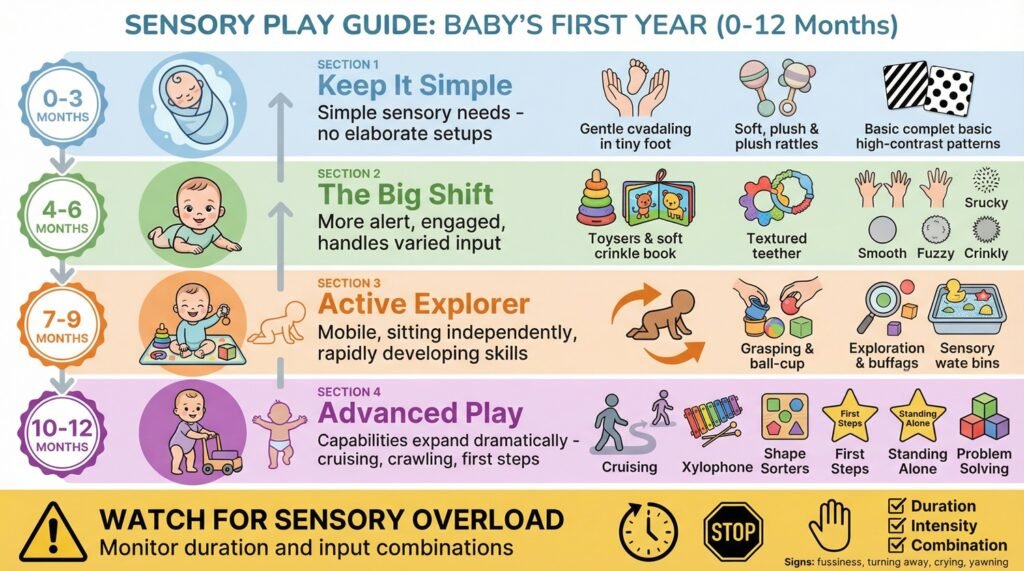
During those first few months, your baby’s sensory needs are actually quite simple, but they’re profoundly important. This is definitely not the time for elaborate setups or complicated activities.
Your presence is the primary sensory experience they need.
Start with high-contrast visual stimulation. Newborns can see best in black and white or very high-contrast colors because their developing vision processes these differences more easily.
Place a simple black and white patterned image about 8-12 inches from where your baby spends wakeful time.
You don’t need fancy cards. Even a simple bulls-eye pattern or bold stripes on paper works beautifully.
Tactile experiences at this stage should focus on gentle, varied touch. During diaper changes or after baths, use different textures to gently stroke your baby’s arms, legs, and back.
Try a soft brush, a silk scarf, a clean makeup brush, or even just different types of gentle touches with your hands.
Use fingertips versus your whole palm, light versus slightly firmer pressure. Watch their response carefully.
You’ll start to notice what they find calming versus alerting.
Auditory stimulation happens constantly, but you can be more intentional with it. Your voice is the most important sound in your baby’s world.
Talk, sing, hum, and narrate what you’re doing.
But also introduce moments of deliberate quiet. Babies need to process silence too.
Try gentle household sounds like running water, rustling paper, or soft music, but keep the volume low and the exposure brief.
Movement-based sensory input is really crucial during this phase. Gentle rocking, swaying while holding your baby, or simply walking while carrying them provides vestibular stimulation.
Vary the direction and speed slightly.
Sometimes side-to-side, sometimes front-to-back, sometimes in slow circles. This soothes and provides developmental work simultaneously.
One technique that’s really powerful but often overlooked is infant massage. Using gentle, firm strokes with a baby-safe oil, massage your baby’s arms, legs, chest, and back.
This provides deep pressure input that many babies find organizing and calming.
It also helps them develop body awareness, understanding where their body ends and the world begins.
The key challenge during this stage is overstimulation. Newborns have a very limited capacity for stimulation before they become overwhelmed. Watch for cues like gaze aversion, fussiness, hiccups, color changes, or going from alert to suddenly drowsy.
These are signs that sensory input needs to stop.
Less is genuinely more during these early months.
Sensory Activities for Four to Six Months
Right around four months, something shifts. Your baby becomes more alert, more engaged, and more capable of handling varied sensory input.
They’re also developing the motor skills that allow them to interact with materials instead of just passively receiving sensory information.
This is when you can introduce simple sensory exploration bags. Take a gallon-sized freezer bag and fill it with hair gel and a few drops of food coloring or small, sealed objects.
Seal it thoroughly.
I typically tape the seal with strong packing tape for extra security. Place it on the floor during tummy time.
Your baby can press on it, watch the contents move, and explore cause-and-effect without the mess or safety concerns of direct contact.
Texture cards become more interesting at this stage. Cut 4×4 inch squares of cardboard and glue different textures to them.
Sandpaper, felt, bubble wrap, velvet ribbon, crinkly material from packaging.
Let your baby touch and explore these during supervised play. They might mouth them too, which is absolutely fine as long as nothing can come loose and present a choking hazard.
Mirror play takes on new meaning now. Place an unbreakable mirror where your baby can see their reflection during tummy time or while sitting supported. They don’t yet understand that it’s their own reflection, but they’re fascinated by the face looking back at them.
This supports visual tracking, social development, and self-awareness.
Water play can be carefully introduced. During bath time, let water dribble slowly over your baby’s hands, feet, and belly. Use a small cup to pour water gently.
Some babies find this incredibly soothing, others find it alerting.
Notice what your particular baby prefers. You can also try different water temperatures, lukewarm versus pleasantly warm, to provide varied thermal sensory input.
Sound exploration becomes more interactive now. Crinkle paper near your baby and watch them turn toward the sound.
Shake a rattle on one side, then the other.
Play different genres of music and observe their responses. Some babies relax to classical music, others to jazz or folk.
There’s no right answer.
You’re simply learning your baby’s preferences while supporting auditory processing development.
One often-missed opportunity during this stage is providing varied positional input. Don’t just keep your baby in the same position all the time.
Tummy time, back time, supported sitting, being held upright, being held horizontally.
Each position provides different proprioceptive and vestibular information. This variety supports motor development and spatial awareness.
The challenge during this stage is balancing increased stimulation capacity with person differences. Some babies stay very sensitive to sensory input, while others seem to crave more intense experiences.
You really have to follow your baby’s lead instead of any prescribed schedule or activity list.
Sensory Experiences for Seven to Nine Months
This phase is incredibly fun because your baby is becoming mobile and can actively seek out sensory experiences. They’re sitting independently, possibly crawling, and their hand skills are developing rapidly.
Sensory play shifts from what you present to them to what you allow them to explore.
Food-based sensory play is safe to introduce now. Cooked and cooled pasta in different shapes, cooked sweet potato chunks, steamed broccoli florets, or rice cereal mixed with breast milk or formula create completely safe sensory experiences.
Place a small amount on their high chair tray and let them squish, grab, and yes, eat it.
You’re supporting fine motor skills, tactile exploration, and self-feeding simultaneously.
Fabric sensory boxes work beautifully at this stage. Fill a small box or basket with various fabric scraps like silk, corduroy, fleece, burlap, and satin. Make sure nothing can unravel into loose threads.
Let your baby reach in, pull out items, wave them around, and explore.
They’re working on so many skills: reaching, grasping, releasing, hand-eye coordination, and tactile discrimination.
Natural materials provide really rich sensory input. Large, smooth river rocks that are too big to be a choking hazard, pinecones, large leaves, or pieces of tree bark can be explored under close supervision.
These offer textures and visual elements that manufactured toys simply can’t match.
Just inspect everything carefully for safety and never leave your baby unattended.
Container play becomes engaging now. Give your baby safe containers and objects to put in and take out.
This might seem simple, but it’s supporting spatial reasoning, cause-and-effect understanding, and fine motor precision.
Use metal measuring cups, wooden bowls, or cardboard boxes and let them explore independently.
Sound-making becomes interactive. Wooden spoons and metal pots create a classic drum set.
Shaking containers with dry pasta or rice inside, securely sealed, makes rattles with different sounds.
Crinkly paper provides auditory feedback with every touch. Let your baby create sounds and explore volume, rhythm, and tone through their own actions.
Temperature exploration can be more varied now. Cold teething toys from the fridge offer one sensation.
Room-temperature water in a small basin offers another.
Slightly warm washcloths provide yet another. These thermal experiences help develop sensory discrimination, which is the ability to notice and categorize different types of sensory input.
The main concern during this phase is safety as mobility increases. Babies this age put absolutely everything in their mouths, and they can move surprisingly quickly.
Any sensory material needs to be either completely safe to mouth or large enough that it cannot possibly be swallowed. Constant supervision is mandatory.
Advanced Sensory Play for Ten to Twelve Months
As your baby approaches their first birthday, their capabilities expand dramatically. They’re likely mobile, whether crawling, cruising, or even taking first steps.
Their fine motor skills allow for more precise manipulation.
Their cognitive abilities support more complex cause-and-effect understanding. Sensory play can become richer and more varied.
Sensory bins become suitable now with careful material selection. A shallow bin filled with large dried beans, oversized pasta shapes, or even torn paper strips provides hours of exploration.
Add large scoops, cups, or containers for transferring.
Stay right there supervising, even with larger materials, but let your baby lead the exploration.
Messy play becomes manageable and valuable. Yogurt painting, which involves letting your baby spread yogurt on their high chair tray, combines tactile input with visual interest.
Mashed banana squishing provides similar benefits.
These are completely safe if eaten, which they will be, while offering rich sensory feedback. Just embrace the mess as part of the experience.
Physical sensory exploration can be more dynamic. Crawling over different surfaces like carpet, tile, grass, and foam mats provides varied tactile and proprioceptive input through their hands and knees.
Walking barefoot across these surfaces adds even more sensory information.
Climbing over cushions or pillows under close supervision challenges their vestibular and proprioceptive systems while supporting motor planning.
Cause-and-effect sensory toys become more sophisticated. Simple musical instruments like drums, xylophones, or shakers allow your baby to create specific sensory outcomes through their actions. Light-up toys that respond to touch or sound connect sensory input with sensory output.
These experiences support cognitive development alongside sensory processing.
Social sensory experiences grow in importance. Games like pat-a-cake, peek-a-boo, or “so big” mix sensory input with social interaction.
Your baby is learning that sensory experiences can be shared, anticipated, and enjoyed together.
This social component of sensory play supports emotional development and bonding.
Outdoor sensory exploration offers unmatched richness. Grass under bare feet or hands.
Wind against their face.
Sun warmth. The visual complexity of natural environments.
The sounds of birds, wind, or water.
Outside provides sensory variety that no indoor environment can copy. Regular outdoor time supports sensory integration in powerful ways.
One aspect that’s really important but often neglected is rest between sensory activities. Your baby’s brain is working incredibly hard to process all this sensory input.
They need downtime to consolidate learning and recover.
If you’re scheduling back-to-back activities, you might actually be hindering development instead of supporting it. Build in quiet time, rest periods, and unstructured moments when nothing particular is happening.
Recognizing and Managing Sensory Overload
Learning to identify sensory overload might be the most practical skill you develop during this first year. Even wonderful, developmentally suitable sensory play can become overwhelming if it goes on too long or combines too many types of input simultaneously.
Early signs of overstimulation include increased fussiness, gaze aversion like looking away from stimulation, color changes such as becoming pale or flushed, hiccups, yawning, or changes in breathing patterns. Some babies get very still and quiet, but they’re not calm, they’re shut down.
Others become increasingly active and disorganized in their movements.
If you notice these signs, immediately reduce sensory input. Move to a quieter, dimmer space.
Remove toys or materials.
Hold your baby calmly without talking or bouncing. Offer feeding or a pacifier if your baby uses one.
Some babies recover quickly, others need significant downtime before they’re regulated again.
Understanding your particular baby’s sensory preferences and tolerances is really crucial. Some babies are sensory-seeking.
They want more input, more intensity, more variety.
These babies might need very robust sensory experiences to feel satisfied and regulated. Other babies are sensory-sensitive. They become overwhelmed more easily and need gentler, briefer, more carefully controlled sensory input.
Neither profile is better or worse, they’re just different. Your job is to observe your baby closely and adjust accordingly.
A sensory-seeking baby might love vigorous bouncing and loud music, while a sensory-sensitive baby might prefer gentle swaying and soft humming.
Both need sensory play, the execution just looks different.
Creating predictable patterns helps manage sensory load. If your baby knows that after active play comes quiet book time, they can mentally prepare for the transition.
Consistent routines around sensory-rich activities like bath time or outdoor play help babies know what to expect, reducing stress and supporting regulation.
Adapting Sensory Play to Your Baby’s Developmental Stage
The developmental stages I’ve outlined are guidelines, not hard rules. Your baby might hit milestones early or late and that’s completely normal.
What matters is matching sensory activities to where your baby actually is developmentally, not where a chart says they should be.
If your eight-month-old isn’t sitting independently yet, use sensory activities designed for earlier stages until they are. There’s absolutely no benefit to pushing more advanced activities before your baby is ready.
You’ll just create frustration for both of you.
Conversely, if your baby is developing ahead of typical timelines, let them explore more complex activities earlier. A five-month-old who has exceptional motor control might be ready for activities typically suggested for older babies.
Watch your baby, not the calendar.
Some babies show strong preferences for particular types of sensory input. A baby who constantly seeks visual stimulation might need more activities focused on looking, tracking, and visual exploration.
A baby who seems driven by touch might need more tactile experiences.
Follow these interests. They’re telling you something about how your baby learns best.
Babies with developmental delays or differences might need more specialized approaches to sensory play. Gentler introduction of new sensations, longer time to process input, or specific types of sensory support might be necessary.
This is where working with early intervention specialists becomes really valuable.
Environmental factors affect sensory play too. A busy household with many children provides constant sensory input that might mean your baby needs less structured sensory activities.
A quiet household might mean your baby needs more deliberate sensory experiences.
Consider your whole environment when planning activities.
Building Long-Term Sensory Processing Skills
The sensory play you provide during this first year creates foundations that last a lifetime. You’re building your baby’s capacity to process and mix sensory information effectively, not just entertaining them or hitting developmental milestones.
Strong sensory processing skills support emotional regulation as your baby grows. Children who can accurately interpret sensory input are better able to manage their responses to sensory challenges, tolerating uncomfortable clothing, adjusting to new environments, or calming themselves when overwhelmed.
Motor development relies heavily on sensory processing. Every movement needs sensory feedback like proprioceptive information about body position, vestibular information about balance, and tactile information about contact points.
The more varied sensory experiences your baby has, the more efficiently their brain can support motor learning.
Cognitive development is deeply connected to sensory experiences. Babies learn through sensory exploration.
Every time they manipulate an object, they’re learning about properties like weight, texture, temperature, and spatial relationships.
These concrete sensory experiences become the foundation for abstract thinking later.
Social and emotional development benefits from well-regulated sensory processing. Babies who are comfortable with sensory input are more available for social interaction.
They can tolerate being held, accept comfort from caregivers, and engage in back-and-forth social exchanges without becoming overwhelmed.
Frequently Asked Questions
What sensory activities are safe for newborns?
Newborns benefit most from simple sensory experiences like skin-to-skin contact, gentle touch with different textures such as soft brushes or silk scarves, high-contrast black and white images placed 8-12 inches from their face, varied gentle sounds including your voice, and movement through rocking or swaying. Keep everything gentle and brief to avoid overstimulation.
When can babies start tummy time?
You can start tummy time from day one, beginning with just a minute or two on your chest while you recline. As your baby gets stronger, usually by 3-4 weeks, you can place them on a firm surface for short periods.
By three months, aim for several sessions throughout the day totaling 20-30 minutes.
How do I know if my baby is overstimulated?
Watch for signs like looking away from stimulation, increased fussiness or crying, sudden drowsiness, color changes in their face, hiccups, stiffening of the body, or becoming very still and quiet. Some babies also show jerky movements or have difficulty calming down.
If you see these signs, immediately move to a quieter space and reduce all stimulation.
Can I use essential oils for baby sensory play?
Essential oils are generally not recommended for babies under three months, and even after that age, extreme caution is needed. Many essential oils can irritate sensitive baby skin or respiratory systems. To introduce scent-based sensory experiences, use naturally scented items like a piece of orange peel, fresh lavender, or vanilla extract on a cotton ball, always supervised and never applied directly to skin.
What textures are best for baby sensory play?
Safe textures for babies include soft fabrics like fleece and silk, slightly rougher materials like corduroy or burlap (for supervised touch only), smooth surfaces like wooden toys, bumpy textures like rubber bath toys, crinkly materials like tissue paper, and natural items like smooth stones or leaves. Always supervise and confirm nothing can come apart into small pieces.
How long should sensory play sessions last?
For newborns, keep sessions very brief, just 3-5 minutes before giving a break. By 4-6 months, you can extend to 10-15 minutes if your baby stays engaged. Older babies from 7-12 months might enjoy 15-20 minute sessions, but always watch for signs of overstimulation and stop before your baby becomes fussy.
Are sensory bins safe for babies under one year?
Traditional sensory bins with small items like rice or sand are not safe for babies under one year because of choking hazards. However, you can create safe versions for babies 10-12 months using very large items like oversized dried pasta, large beans, or torn paper strips, always with constant supervision since babies this age still mouth everything.
What’s the difference between sensory seeking and sensory sensitive babies?
Sensory-seeking babies crave intense sensory input and might need more vigorous movement, louder sounds, and more tactile experiences to feel satisfied. Sensory-sensitive babies become overwhelmed easily and need gentler, quieter, less intense sensory experiences. Both profiles are normal, you just need to adjust activities to match your baby’s person needs.
Key Takeaways
Sensory play during the first year builds your baby’s basic capacity to take in, organize, and respond to sensory information from their environment. Every developmental stage needs different approaches, from gentle, simplified sensory input for newborns to more robust, exploratory experiences for older babies.
Watch your particular baby closely to identify their sensory preferences, tolerances, and interests, then adjust your approach accordingly instead of following rigid activity schedules. Recognize that overstimulation is a real concern and learn to identify your baby’s specific signs of sensory overload before they become overwhelmed.
You don’t need expensive equipment or elaborate setups. Many of the most effective sensory experiences come from simple materials, natural elements, and your engaged presence.
The variety of sensory input matters more than the cost or complexity of any particular activity.
Focus on providing diverse sensory experiences across all systems including tactile, visual, auditory, vestibular, proprioceptive, and eventually taste and smell through safe exploration. Balance structured sensory activities with plenty of unstructured time for your baby’s brain to process and mix the sensory information they’re constantly receiving.