When my sister brought her first baby home from the hospital, she asked me something that completely caught me off guard: “What am I supposed to do with him all day?” She wasn’t joking. Here was this tiny human who couldn’t talk, couldn’t walk, couldn’t even really hold his head up consistently, and she was genuinely worried about whether she was giving him enough stimulation or just staring at him like a confused potato.
That conversation really stuck with me because it highlights something that doesn’t get talked about enough in parenting circles. We hear all the time about baby sensory play being important for development, but what does that actually mean when you’re dealing with a newborn who sleeps 16 hours a day?
And how do you know if you’re doing too much, too little, or just wasting your time with activities your baby couldn’t care less about?
What I’ve learned after taking a close look at the research and watching countless babies grow through that crucial first year is that baby sensory play comes down to understanding how infants learn about their world through their senses and meeting them exactly where they are developmentally. The parents who stress less and see better engagement are the ones who grasp this basic shift in perspective.
Understanding How Babies Process Sensory Information
Before we get into specific activities, you need to understand what’s actually happening in your baby’s brain during sensory experiences. This is solid neuroscience, not just feel-good parenting fluff.
When babies are born, they have roughly 100 billion neurons, which is actually about the same number as adults. But the connections between those neurons are pretty sparse.
During the first year of life, your baby’s brain is forming more than one million neural connections every single second.
That’s not a typo. Every interaction, every texture they feel, every sound they hear is literally building the architecture of their brain.
The way this works is through repeated sensory experiences. When your baby touches something soft, specific neurons fire.
When they touch that soft thing again, those same pathways strengthen.
Do it enough times, and those connections become permanent highways for information processing. This is why researchers talk about the first year being a critical period for sensory development.
You’re helping their brain wire itself properly.
What really surprised me when I dug into the research was learning that babies process sensory information differently than we do. Their nervous systems are brand new and learning to filter and organize sensory input.
Too much stimulation can actually overwhelm their developing systems, while too little can leave them understimulated and fussy.
Finding that sweet spot is the real skill of baby sensory play.
Think of it like this: your baby’s brain is constantly measuring every sensory input against previous experiences to build understanding. The first time they touch something cold, they have no frame of reference.
The tenth time, they’re starting to categorize “cold” as a distinct sensation.
The hundredth time, they can predict what cold will feel like before they touch it. Each repetition is literally changing the physical structure of their brain.
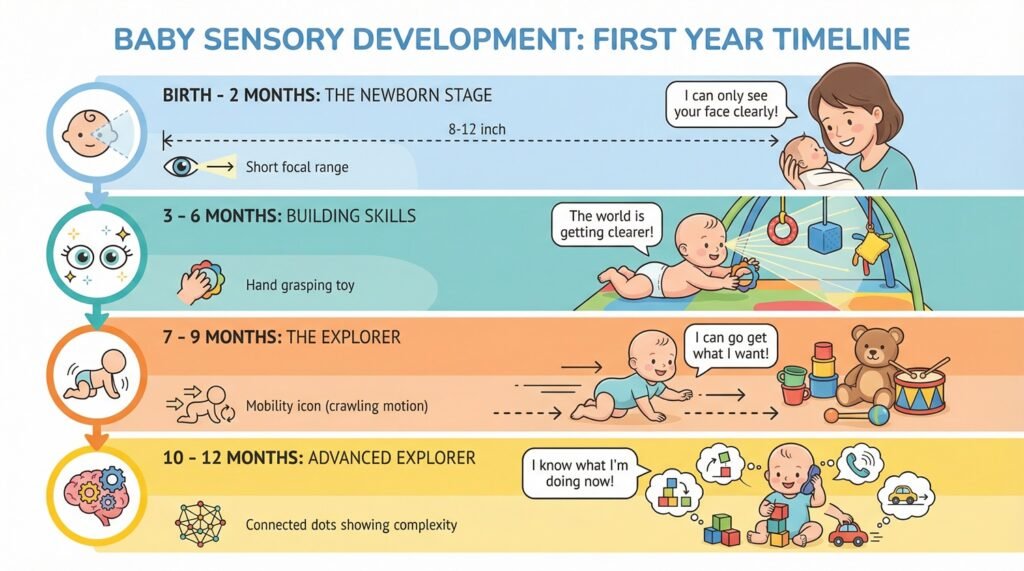
The Newborn Stage: Birth to 2 Months
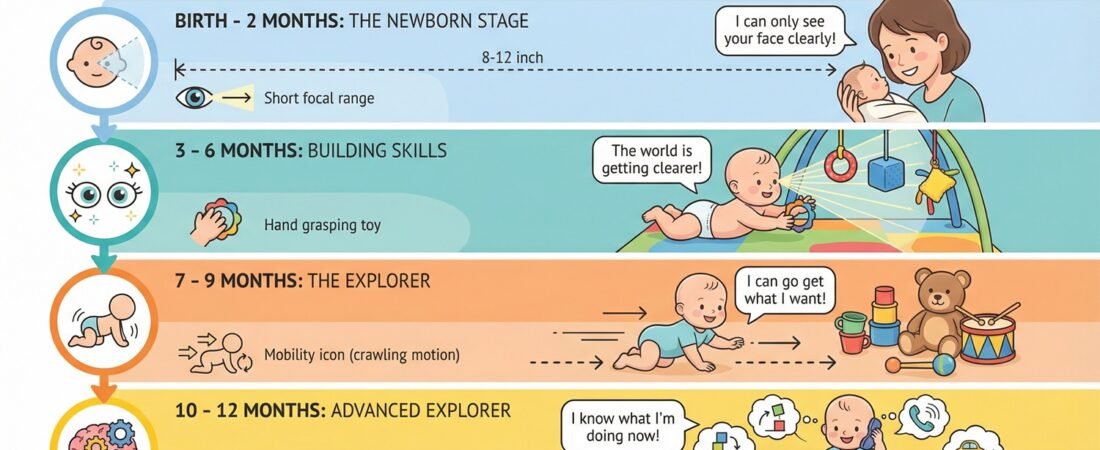
Your newborn can only see about 8 to 12 inches from their face clearly, which is conveniently about the distance to your face when you’re holding them. That’s not an accident.
Evolution designed babies to focus on faces because that’s where they get crucial social and emotional information.
For the first two months, baby sensory play is honestly pretty simple. Your face is the most engaging toy your baby has.
When you make exaggerated facial expressions, you’re giving them visual input that helps develop their vision and teaches them about emotions.
When you talk to them in that high-pitched voice that adults naturally use with babies (yes, even the ones who swear they won’t baby talk), you’re providing auditory stimulation that helps their language centers develop.
One of the most effective sensory activities for this age is actually just moving your baby’s position throughout the day. Put them on their back under a window where they can see shadows and light patterns.
Move them to their tummy for short supervised periods where they experience a completely different perspective.
Hold them upright against your shoulder where they feel your movement and heartbeat. Each position change provides new sensory input without overwhelming them.
The tactile experiences at this stage should be gentle and simple. Skin-to-skin contact provides crucial tactile input that helps regulate their nervous system.
Different fabric textures against their skin as you hold them, the feeling of air during diaper changes, warm water during bath time – these are all sensory experiences that are teaching their brain about the world.
I’ve watched new parents stress about not doing enough structured activities with their newborns, and honestly, that stress is misplaced. Your newborn is getting sensory input from literally everything in their environment. The goal is to be intentional about the experiences they’re already having.
You don’t need special equipment or complicated setups.
You need presence and awareness of how your baby is experiencing the world around them.
The sounds in your home provide rich auditory input during this stage. Your voice, household sounds like running water or the dishwasher, music playing softly – these varying sounds teach your baby’s brain to process different types of auditory information.
What you want to avoid is constant background noise that prevents them from hearing and processing person sounds clearly.
Building Skills: 3 to 6 Months
Around three months, something really shifts. Babies become much more alert and interested in their surroundings.
Their vision has improved dramatically, and they’re starting to gain some control over their hands.
This is when baby sensory play becomes more interactive and honestly more fun for both of you.
This is the stage where tummy time becomes crucial for many types of sensory development. When babies are on their tummies, they’re working against gravity, which provides vestibular input (movement and balance sensations).
They’re pushing up with their arms, building proprioceptive awareness (understanding where their body is in space).
And they’re getting a whole new visual perspective of their environment.
Here’s where you can start getting creative with minimal effort and zero cost. Lay your baby on different surfaces during tummy time – a soft blanket, a slightly textured yoga mat, a clean towel.
Each surface provides different tactile feedback.
Place safe objects at their eye level – a small mirror (babies are fascinated by faces, even their own), a black and white patterned card, a colorful scarf. You’re giving their developing visual system interesting things to focus on without trying to entertain them constantly.
The hand-to-mouth exploration that ramps up during this period is essential sensory development. Babies learn an enormous amount about objects by mouthing them.
They’re getting tactile information from their hands and oral sensory input from their mouths simultaneously.
This dual sensory processing helps build those neural pathways we talked about earlier.
One activity that consistently works well during this stage is introducing different textures for supervised touching. Take your baby’s hand and gently brush it against something smooth, then something rough, then something cool.
You’re teaching their brain to differentiate between sensory inputs.
A cold metal spoon, a soft cotton ball, a slightly rough washcloth, a smooth wooden spatula – these everyday household items provide rich sensory experiences without requiring special purchases.
The auditory development at this stage is particularly interesting. Babies start cooing and making vowel sounds, and they’re actually experimenting with cause and effect.
They make a sound, you respond, which teaches them that their actions have results.
Simple sound games become powerful learning tools. Crinkle paper near them, shake a container with rice in it, tap on different surfaces to create different sounds.
Each sound is teaching their brain to process auditory information and distinguish between different types of sounds.
What I find really fascinating about this stage is how much babies are learning through simple observation. They’ll stare intently at your hands as you do ordinary tasks.
They’re watching how objects move, how your hands manipulate things, how causes lead to effects.
This passive sensory learning is just as important as active exploration.
The Explorer Phase: 7 to 9 Months
Around seven months, most babies are sitting independently, and many are starting to crawl or scoot. This mobility completely changes the game for sensory play because now babies can seek out sensory experiences themselves rather than just receiving whatever you provide.
This is when I really recommend creating a safe sensory-rich environment rather than focusing on structured activities. Babies this age are natural scientists, conducting experiments all day long.
They drop things repeatedly to test gravity.
They bang objects together to see what sounds they make. They put everything in their mouths to gather information.
Your role shifts from providing sensory input to facilitating safe exploration.
Water play becomes incredibly valuable during this phase, though it needs constant supervision. A shallow basin with an inch of water and a few floating toys provides many types of sensory input simultaneously.
The feeling of water, the visual experience of splashing, the sound of water moving, the temperature sensation – all of this is rich sensory data for their developing brains.
You don’t need fancy water tables or special toys. Plastic measuring cups, a small ball, a washcloth for them to squeeze and watch water drip from – these simple items are genuinely engaging.
Texture exploration gets more sophisticated during this period. You can create simple sensory experiences by placing different materials on a clean, safe surface for them to explore.
A piece of fake fur, some wax paper, a textured placemat, a smooth cutting board – lay them out and watch your baby move between them, touching, patting, sometimes tasting.
They’re building mental categories for different textures and learning to process complex tactile information.
The really important thing to understand about this stage is that repetition is essential for babies. Adults get tired of the same activity after a few minutes, but babies learn through repeated experiences.
If your baby wants to open and close the same cabinet door 47 times, they’re conducting experiments, strengthening neural pathways, and building understanding of how objects work in space.
What looks like mindless repetition to you is sophisticated learning to them.
Sound exploration becomes more interactive. Give your baby two wooden spoons and watch them bang them together.
Put some dried beans in a sealed plastic bottle and let them shake it.
Tap on a pot while they watch and then hand them the spoon to try. These activities teach cause and effect while providing rich sensory feedback.
Advanced Exploration: 10 to 12 Months
As babies approach their first birthday, their sensory play becomes increasingly intentional and complex. They’re not just experiencing sensations anymore.
They’re actively seeking specific types of sensory input and combining different senses to understand objects more fully.
This is when messy play becomes really valuable, though I know it makes some parents want to run screaming. But the sensory input from squishing something soft and wet between their fingers teaches lessons that no clean toy can copy.
You don’t need to let your baby destroy your kitchen.
Start small and controlled. Put your baby in just a diaper in a bathtub or outside. Give them a handful of cooked, cooled spaghetti.
Let them squeeze it, drop it, maybe taste it.
That’s baby sensory play at its finest.
Natural materials provide some of the richest sensory experiences at this age. Smooth river rocks (too large to be choking hazards), pieces of different types of wood, shells, pine cones, leaves – these items have complex textures and weights that manufactured toys often lack.
Supervised exploration of these materials provides tactile, visual, and proprioceptive input as babies handle objects of different sizes and weights.
The vestibular system (balance and spatial orientation) gets a workout during this period as most babies are moving independently. Simple activities that change their position in space are incredibly stimulating.
Gently swinging them, carefully spinning them, moving them up and down – these movements help their inner ear develop and teach them how to process information about their body’s position in space.
Something that often gets overlooked at this stage is the importance of allowing babies to experience different environments. The sensory input in a quiet carpeted room is completely different from a park with grass, wind, and ambient sounds.
Taking your baby to different locations provides varied sensory experiences that help them learn to adapt to different environments and process diverse types of input.
The social aspect of sensory play becomes increasingly important as babies approach one year. They start watching other babies and toddlers with intense focus.
Group play situations, even if babies are just playing near each other rather than with each other, provide visual and social sensory input that you can’t copy at home.
Recognizing Sensory Overload and Understimulation
One aspect of baby sensory play that doesn’t get discussed enough is learning to read your baby’s cues about their sensory needs. Some babies have nervous systems that process sensory input very efficiently and can handle lots of stimulation. Other babies get overwhelmed more easily and need quieter environments with less sensory input.
Signs of sensory overload in babies include turning away, arching their back, crying that escalates quickly, clenched fists, and what researchers call “gaze aversion” – actively looking away from stimuli. When you see these signs, your baby is telling you their nervous system is overwhelmed. The response is to reduce the sensory input and give them time to regulate.
Pushing through or trying harder to engage them only makes things worse.
On the flip side, understimulation shows up as fussiness that isn’t solved by feeding or diaper changes, seeming bored or disconnected, not making eye contact, and general crankiness. These babies need more sensory input to feel engaged and content.
This is where intentional sensory activities become really valuable.
Most babies fall somewhere in the middle, but understanding these extremes helps you calibrate the right amount of sensory input for your specific baby. The goal is finding that sweet spot where your baby is engaged and learning without being overwhelmed.
Learning your baby’s unique sensory profile takes time and observation. Some babies need movement to stay regulated and happy.
Others find too much movement distressing.
Some babies love being touched and cuddled constantly. Others need more personal space and get cranky with too much handling.
There’s no right or wrong here, just different temperaments that need different approaches.
Creating a Sensory-Rich Environment Without Overwhelm
The most effective approach to baby sensory play involves creating an environment where sensory exploration happens naturally throughout the day. This needs some thoughtfulness but very little money or special equipment.
Think about the spaces where your baby spends time. Is there visual interest at their eye level?
When they’re on the floor, are there things to look at that aren’t just the ceiling?
A small mirror mounted on the wall at floor level, some high-contrast images, a window where they can see movement – these permanent additions provide ongoing visual stimulation without any effort from you.
Consider the textures in your baby’s environment. If everything they touch is soft fabric, you’re missing opportunities for tactile learning.
Add some smooth wooden items, some items with different textures, some things that are cool to the touch.
A basket of safe household items with different textures and weights can provide weeks of exploration – measuring spoons, a wooden spatula, a silicone oven mitt, a metal whisk.
Think about opportunities for proprioceptive input throughout the day. Proprioception is the sense of where your body is in space, and it develops through movement and pressure.
Carrying your baby in different positions, allowing them to push against you when you hold them, giving them opportunities to pull themselves up on furniture – these everyday activities provide crucial proprioceptive input.
The auditory environment matters more than most parents realize. Babies need to hear language to develop language skills, but they also need some quiet time.
The research on this is really clear – background TV or constant noise isn’t helpful and can actually hinder language development.
Better to have periods of conversation and singing mixed with periods of relative quiet where babies can hear and process person sounds.
Safety Considerations That Actually Matter
Let me be really straight with you about safety because I think the fear-mongering around baby play has gotten out of hand. Yes, supervision is essential.
Yes, choking hazards are real.
But creating a reasonable safety framework doesn’t mean eliminating all sensory experiences that involve any risk.
The choking hazard rule is simple: nothing smaller than a toilet paper roll tube. If an object can fit through a toilet paper roll, it’s too small for a baby under one year.
This is a much more practical standard than trying to judge sizes by eye.
For texture exploration and messy play, the real safety concern is non-food items going in mouths. Everything will go in their mouth – that’s how babies explore.
So the items you provide for sensory play need to be safe if mouthed. This doesn’t mean they need to be food-grade, but they need to be clean, non-toxic, and without small parts that could break off.
Temperature is something that often gets overlooked. Babies are experiencing temperature differences as part of sensory learning, but their skin is sensitive. Test everything against the inside of your wrist before giving it to your baby.
Cool is fine.
Cold is interesting. Ice cold can be uncomfortable or even harmful.
The most important safety consideration is really about supervision. Baby sensory play should never be something you set up and walk away from.
The exploration itself is safe when you’re present and paying attention.
Most accidents happen when parents are distracted or babies are left alone with materials that need supervision.
Frequently Asked Questions
What activities help baby brain development?
Activities that engage many senses simultaneously provide the richest learning experiences for babies. Tummy time on different textured surfaces, water play with various containers, exploring household items with different weights and textures, and simple games like peekaboo all contribute to neural development.
The key is variety and repetition – giving babies chances to experience the same sensory inputs many times so their brains can build strong neural pathways.
How do I know if my baby has sensory processing issues?
Most babies show person preferences for different types of sensory input, which is completely normal. However, if your baby consistently shows extreme reactions to ordinary sensory experiences – screaming at normal sounds, refusing to touch certain textures, becoming inconsolably upset with typical movement, or seeming completely unresponsive to sensory input that should interest them – these patterns might indicate sensory processing differences worth discussing with your pediatrician.
What household items are safe for baby sensory play?
Wooden spoons, metal measuring cups and spoons, silicone spatulas, clean washcloths in different textures, plastic containers with lids, metal whisks (with supervision), smooth stones larger than a toilet paper roll, fabric scraps in various textures, and empty cardboard boxes all make excellent sensory materials. The key is ensuring items are clean, too large to be choking hazards, and free of small parts that could break off.
When should I start tummy time?
You can start tummy time from day one, though newborn sessions should be very brief – just a minute or two several times per day. As your baby gets stronger and more alert, gradually increase the duration.
By three months, aim for 20-30 minutes of tummy time spread throughout the day.
Some babies hate tummy time initially, but persistence pays off because the sensory and motor benefits are really significant.
How much sensory stimulation does a newborn need?
Newborns need surprisingly little structured sensory stimulation because they’re getting sensory input from every aspect of their environment. A few short periods of alert interaction each day, combined with the natural sensory experiences of feeding, diaper changes, and being held, provide plenty of input for their developing nervous systems.
Overstimulation is actually a bigger concern than understimulation in the newborn stage.
What are sensory bins for babies?
Sensory bins are containers filled with materials for babies to explore through touch. For babies under one year, these need careful supervision since everything goes in their mouth.
Simple versions include a shallow container with dry pasta shapes (large enough not to be choking hazards), a bin with different fabric scraps, or a tray with an inch of water and floating objects.
The goal is giving babies safe materials to explore through many senses.
Can too much sensory play be harmful?
Yes, overstimulation can overwhelm a baby’s developing nervous system. Signs include increased fussiness, difficulty settling for sleep, gaze aversion, and general crankiness.
Babies need downtime between sensory experiences to process what they’ve learned. The goal is balance – enough sensory input to support development without overwhelming their capacity to process information.
Do babies need special sensory toys?
Special sensory toys can be nice, but they’re definitely not necessary. Babies learn effectively from household objects, natural materials, and simple interactions with caregivers.
The variety of textures, sounds, and visual experiences matters more than whether items are marketed as developmental toys.
A set of measuring spoons often provides more learning opportunities than an expensive toy.
Key Takeaways
Baby sensory play from 0-12 months means understanding that your baby is learning through every sensory experience, and your role is to provide safe, varied opportunities for exploration.
The first year involves dramatic changes in how babies process sensory information, and effective sensory play looks completely different at two months versus ten months, requiring you to continuously adapt your approach to their developmental stage.
Creating a sensory-rich environment matters more than scheduled activities, and most effective sensory experiences come from household items and natural materials rather than expensive specialized toys.
Reading your baby’s cues about sensory overload and understimulation allows you to calibrate the right amount of input for their specific nervous system, which varies significantly between person babies.
The sensory processing skills developed during this first year create the foundation for motor skills, cognitive development, language acquisition, and emotional regulation that will matter throughout childhood and beyond.