I’ll be honest with you, when I first came across Fat Brain Toys sensory products, I was skeptical. How could these simple-looking silicone toys possibly make such a difference for kids with sensory needs?
But after watching countless children (including those on the autism spectrum and with sensory processing challenges) absolutely light up when playing with Squigz and Dimpl toys, I became a believer.
These toys represent thoughtfully designed tools that actually support development while keeping kids engaged for way longer than I expected. They provide real value beyond just being another plastic distraction.
The thing is, choosing between Squigz and Dimpl requires understanding what your child actually needs. Both come from the same company, both use high-quality silicone, and both target sensory development. But they work completely differently and suit different children.
Let me break down everything you need to know to make the right choice for your specific child.
Understanding What Makes These Toys Different
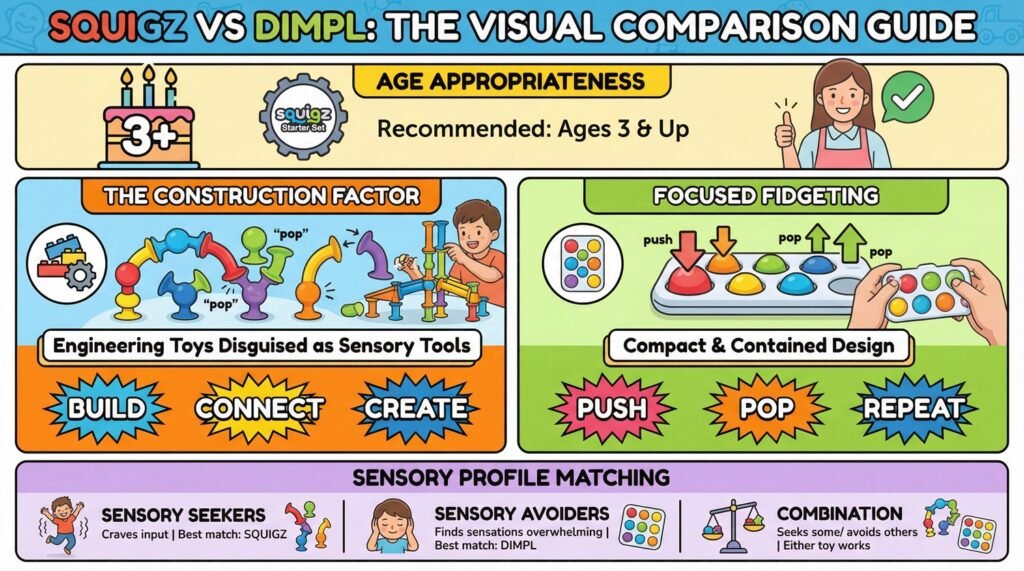
Here’s what you need to know right off the bat: Squigz and Dimpl serve fundamentally different sensory purposes, even though they both fall under the sensory toy category.
Squigz focus on construction, suction, and three-dimensional building. They’re quirky little silicone shapes with suction cups that stick to each other and to smooth surfaces.
Kids can pull them apart, connect them in different configurations, and build structures that actually stay together.
Dimpl features a board with colorful silicone bubbles that you can push in and pop out. Think of it as a more sophisticated, reusable bubble wrap experience.
The bubbles sit in a sturdy frame, and pressing them provides that satisfying tactile feedback that some kids absolutely crave.
The sensory input they provide differs completely. Squigz offer proprioceptive and tactile feedback through pulling, pushing, and the resistance you feel when separating the suction cups.
That satisfying “pop” when you pull them apart provides deep pressure input that many sensory-seeking kids actively look for.
The resistance gives their muscles and joints feedback that helps them understand where their body is in space.
Dimpl provides a different kind of tactile experience. The smooth silicone domes give gentle resistance as you press them, and then they pop through to the other side with a subtle click.
The experience centers on repetitive motion and the satisfying feeling of the bubble inverting.
For children who are sensory seekers (meaning they actively look for sensory input and stimulation), both toys can be incredibly useful, but in different contexts. Squigz tend to engage kids who need stronger proprioceptive feedback and who benefit from problem-solving activities.
These are often the kids who crash into furniture, love wrestling, and seem to have endless energy.
Dimpl works brilliantly for kids who need calming, repetitive motions or who do well with focused fidgeting. These might be the kids who pick at their clothes, tap their fingers constantly, or need something to do with their hands while they’re thinking or processing information.
Age Appropriateness Really Matters Here
This is where a lot of parents get tripped up. The Squigz Starter Set is officially recommended for ages 3 and up, and honestly, that recommendation is pretty accurate.
The suction cups need a decent amount of hand strength to pull apart. Younger toddlers (especially those under 24 months) struggle with this and often get frustrated. I’ve seen 18-month-olds try to use Squigz, and while they can stick them together on a window, they can’t really separate them without adult help, which defeats the purpose of independent play.
The repeated failure to separate the pieces creates frustration as opposed to the satisfaction and confidence that these toys are meant to build. By age 3, most kids have developed enough hand strength and coordination to manipulate Squigz successfully.
Dimpl has a slightly lower age recommendation at 10 months and up, but let me add some context here. Yes, a 10-month-old can push the bubbles and get some sensory satisfaction from it.
But the toy really comes into its own around 18-24 months when children start understanding the cause-and-effect relationship better and develop the fine motor skills to intentionally push each bubble.
Before that age, Dimpl functions more as a mouthing toy than anything else (which is totally fine since the silicone is safe and easy to clean). Babies will chew on it, bang it against surfaces, and occasionally push a bubble by accident.
But they’re not getting the full developmental benefit that older toddlers receive.
What’s really interesting is that both toys have incredible staying power as kids get older. I’ve worked with occupational therapists who use Squigz with elementary-aged kids for hand strengthening exercises.
The resistance from pulling apart the suction cups builds the small muscles in the hands that support handwriting and other fine motor tasks.
And Dimpl has become a surprisingly popular fidget tool for older children and even teenagers who need something to do with their hands during homework or while focusing on tasks. The discrete, silent nature of Dimpl makes it acceptable in situations where other fidget toys would be disruptive.
So while the starting ages differ, both toys grow with your child in ways that typical toddler toys don’t. They transition from developmental toys to functional tools, which is rare in children’s products.
The Construction Factor with Squigz
Let’s talk about what makes Squigz truly unique. These things function as engineering toys disguised as sensory tools.
The starter set typically comes with about 24 pieces in various shapes. Some are balls, some are curved pieces, some have many suction points.
Kids can build three-dimensional structures that actually stay together, which is super satisfying.
Unlike blocks that topple over or magnets that sometimes repel, Squigz create stable connections that hold.
The educational component here goes beyond just sensory input. When children build with Squigz, they develop spatial reasoning skills.
They figure out which pieces will balance, how to create stable structures, and how different shapes fit together.
They’re learning to visualize three-dimensional relationships and planning several steps ahead.
The play is open-ended without instructions, which means kids are problem-solving the entire time they’re engaged. There’s no right or wrong way to build, which removes performance pressure while still challenging their thinking. For children who struggle with traditional building toys like blocks (which can be frustrating when towers fall), Squigz offer a more forgiving building experience since the pieces actually stick together.
The suction aspect also introduces basic physics concepts. Kids start to understand that Squigz stick better to smooth surfaces than textured ones.
They figure out that pulling straight creates more resistance than wiggling pieces apart.
They learn that pressing firmly creates a stronger seal. These are all foundational science concepts being absorbed through play without any formal instruction.
But here’s the challenge: Squigz need more physical space and really benefit from smooth surfaces like windows, mirrors, or glossy tables. If you live in a heavily textured environment or don’t have access to large smooth surfaces, the play experience becomes more limited. They work best when kids can stick them to vertical surfaces and watch their creations hold against gravity.
They also have small parts that can be mouthing hazards for younger siblings, so you need to be mindful about where and when they’re used. If you have a baby and a preschooler, you’ll need to keep the Squigz in a location where only the older child can access them during play.
The Focused Fidgeting of Dimpl
Dimpl operates on an entirely different principle. The design is compact, contained, and provides exactly what the name suggests: dimples that you can push.
The original Dimpl is a small rectangular board with five silicone bubbles in graduated sizes and bright colors. There’s also Dimpl Pops, which is larger with more bubbles arranged in different patterns.
Each version offers slightly different sensory experiences based on the number and arrangement of bubbles.
What I find really fascinating about Dimpl is how it serves as a bridge between baby toys and legitimate therapeutic tools. For toddlers, it functions as a cause-and-effect toy that teaches them about their ability to manipulate their environment.
Push the bubble, it goes in. Push it again from the other side, it comes back out.
Simple, predictable, satisfying.
For older kids, especially those with autism, ADHD, or anxiety, Dimpl becomes a self-regulation tool. The repetitive motion of pushing the bubbles provides proprioceptive input that can be really calming.
It gives restless hands something to do without being disruptive.
I’ve heard from many teachers who allow students to use Dimpl during class time because it actually helps them focus as opposed to distracting them like traditional fidget spinners did. The silent operation means it doesn’t disturb other students, and the contained design means pieces don’t go flying across the room.
The portability factor is huge with Dimpl. The toy is small enough to throw in a purse or diaper bag, it doesn’t make noise, and it doesn’t have loose pieces to lose.
This makes it absolutely perfect for situations where you need to keep a child occupied in a confined space: restaurants, waiting rooms, car rides, airplane trips.
The durability means you don’t have to worry about it breaking when it inevitably gets dropped or stepped on.
The main limitation with Dimpl is that construction plays no role in the experience. There’s no building, no creating, no end product.
For some kids, this actually works in the toy’s favor because the lack of performance pressure makes it accessible.
But for children who thrive on creating things and need more complex engagement, Dimpl might not hold their attention for extended periods.
Sensory Profiles and Which Toy Matches
Understanding your child’s sensory profile makes this decision so much easier. Children with sensory processing differences generally fall into a few categories: sensory seekers who crave input, sensory avoiders who find certain sensations overwhelming, or a combination where they seek some types of input while avoiding others.
For strong sensory seekers (kids who crash into furniture, love rough play, and constantly need to touch everything), Squigz often provide the intense proprioceptive feedback they’re looking for. The act of pulling apart those suction cups gives deep pressure input that can be organizing for their nervous system.
These are the kids who will build massive Squigz structures and then take enormous satisfaction in ripping them all apart.
The destruction can be just as satisfying as the construction for these children.
For sensory avoiders or kids who get easily overwhelmed, Dimpl is usually the better choice. It provides gentle, predictable sensory input without any surprises.
There’s no loud noise when the bubbles pop, the texture is consistently smooth, and the experience stays completely within the child’s control.
They can push one bubble or all of them, slowly or quickly, without any external demands.
For kids who are sensory seekers specifically for tactile input (they love touching different textures, playing with slime, or running their hands through materials), both toys can work, but for different reasons. Squigz offer variety in shapes and the interesting contrast between the silicone and the suction sensation.
Dimpl provides that satisfying bubble texture that’s similar to bubble wrap but endlessly repeatable.
Children with autism who engage in stimming behaviors often benefit tremendously from both toys, but in different contexts. Squigz can be part of active play and purposeful stimming that also builds skills.
The construction element gives the stimming a productive outlet that adults tend to view more favorably than non-functional repetitive behaviors.
Dimpl works better for self-soothing stimming when a child needs to regulate themselves in a less active way. When a child with autism is feeling overwhelmed or anxious, the predictable, repetitive motion of pushing Dimpl bubbles can bring them back to a regulated state without requiring a lot of space or drawing attention.
Real-World Use Scenarios
Let me paint some pictures of how these toys actually get used, because that’s where the differences really become clear.
Squigz typically get pulled out during dedicated play time. A child might spend 20-30 minutes building a structure on the sliding glass door, or creating a long chain of connected pieces.
The play has a beginning, middle, and end.
Parents often set up a “Squigz station” near a window where kids can build, and the structures sometimes stay up for days. It becomes part of the room’s landscape until someone decides to tear it down and start fresh.
The play tends to be more active and involved. Kids move around, try different configurations, experiment with heights and angles. They might build a creation, photograph it proudly, then dismantle it to build something new.
The play feels purposeful as opposed to absent-minded.
Dimpl gets used in totally different ways. The toy comes out during transitions: in the car on the way to therapy, in the shopping cart at the grocery store, at the table while waiting for food at a restaurant.
It gets used for tiny pockets of time as opposed to extended play sessions.
Many parents report that Dimpl stays in the diaper bag or car permanently because it’s just so convenient for those moments when you need something immediately. When a child starts getting restless in line at the post office, you can hand them Dimpl and buy yourself several minutes of patience.
It’s become the modern equivalent of the small toy parents used to keep in their purse for emergencies.
In therapeutic settings, occupational therapists use Squigz for specific hand-strengthening exercises and fine motor skill development. They’ll have kids pull apart specific combinations of Squigz or build following certain patterns.
The therapy has clear goals and measurable outcomes.
Therapists can increase difficulty by using Squigz with stronger suction or requiring more complex constructions.
Dimpl shows up in therapy too, but more as a self-regulation tool. Therapists will give kids a Dimpl to hold during challenging activities as a calming mechanism, or use it as a reward after difficult tasks.
Some therapists use it as a “thinking tool” that kids can fidget with while processing instructions or working through emotional regulation.
The Durability and Maintenance Question
Both toys are made from food-grade silicone that’s BPA-free, latex-free, and generally very safe. They’re both dishwasher safe, which is honestly a game-changer when you’re dealing with toys that get constant hand contact.
I’ve known families who’ve had the same Squigz and Dimpl toys for years without any degradation.
That said, Squigz have more points of potential failure. The suction cups can collect dirt and debris, which reduces their sticking power over time.
You need to wash them periodically to maintain that strong suction.
A quick rinse under warm water usually does the trick, but if they’ve been used on outdoor surfaces or dirty windows, they’ll need a more thorough cleaning.
Some of the thinner connection points on certain Squigz shapes can eventually tear if a child is really aggressive with them, though this is pretty rare with normal use. I’ve only seen tears in situations where kids were really yanking on the pieces with excessive force or twisting them while pulling.
Dimpl is nearly indestructible. The silicone bubbles can handle thousands of pushes without wearing out.
The frame is solid plastic that holds up to being dropped, stepped on, and thrown.
The biggest complaint I’ve heard is that aggressive chewers can eventually tear the silicone if they really go at it, but this typically only happens with kids who have significant oral sensory needs and are using Dimpl primarily as a chewy toy as opposed to for its intended purpose.
One practical consideration: Squigz can get scattered all over the house and need cleanup, while Dimpl is a single piece that stays together. For parents who are already drowning in toy pieces, this might actually factor into your decision more than you’d expect.
At the end of a long day, fishing Squigz pieces out from under the couch can feel like just one more thing to deal with.
Cost Considerations and Value Proposition
Let’s talk money for a second. Squigz Starter Sets typically run between 25 and 35 dollars depending on where you buy them, while Dimpl usually costs between 10 and 15 dollars.
At first glance, Squigz seem significantly more expensive, but you’re getting around 24 pieces compared to Dimpl’s single board.
The value equation changes when you consider longevity and use patterns. Squigz have a longer age range of intense use.
Kids from about 3 years old through elementary school can get meaningful engagement from them.
That’s potentially 5-7 years of regular use. The toys don’t have batteries to replace, screens to break, or electronics to malfunction.
They’re purely mechanical, which means they last indefinitely with proper care.
Dimpl tends to be intensely used for a shorter window (maybe 18 months to 4 years as a primary toy), though it remains useful as a fidget tool for much longer. The value comes more from the convenience and regulation support than from hours of active play.
If budget is tight and you can only choose one, your child’s age and needs should drive the decision. For a 2-year-old, Dimpl is probably the better value because they’ll get immediate use from it and it costs less.
For a 4-year-old who loves building, Squigz will provide more complex engagement even though it costs more upfront.
Many families end up getting both eventually because they serve such different purposes. They’re not really competing products once you understand their distinct roles: one for active construction play, one for portable fidgeting and regulation.
People Also Asked
What age is Squigz good for?
Squigz are officially recommended for ages 3 and up, and that recommendation reflects the hand strength needed to pull apart the suction cups. While some advanced 2.5-year-olds might manage them, most kids under 3 will struggle with the physical demands and get frustrated. The toy can be used successfully through elementary school and beyond for hand strengthening and creative play.
Can you use Dimpl for babies?
Dimpl is rated for 10 months and up and is safe for babies to mouth and explore. However, babies under 18 months typically use it more as a teething toy than a developmental toy.
They’ll chew on the silicone bubbles and occasionally push them by accident, but they don’t have the fine motor control or understanding to engage with the cause-and-effect aspects until they’re older toddlers.
Do Squigz work on textured walls?
Squigz work best on smooth, non-porous surfaces like windows, mirrors, glossy tables, refrigerators, and tiles. They don’t stick well to textured walls, painted walls with any texture, or porous surfaces like unsealed wood.
The suction requires an airtight seal, which textured surfaces can’t provide.
If your home has mostly textured walls, you’ll want to identify smooth surfaces like windows or mirrors where kids can use them effectively.
What is Dimpl good for?
Dimpl provides tactile sensory input through the repetitive motion of pushing silicone bubbles. It helps with fine motor skill development, hand-eye coordination, focus and concentration, self-regulation for kids with anxiety or sensory needs, and keeping hands busy during waiting times.
Teachers and therapists use it as a silent fidget tool that helps kids maintain focus without disturbing others.
Are Squigz good for autism?
Many children with autism benefit from Squigz because they provide strong proprioceptive input through the resistance of pulling apart the suction cups. This deep pressure feedback can be organizing for kids who are sensory seekers.
The construction aspect also gives purposeful direction to repetitive behaviors (stimming) while building spatial reasoning and problem-solving skills.
However, some children with autism who are sensory avoiders might find the resistance overwhelming.
Can you take Dimpl on an airplane?
Dimpl is perfect for airplane travel because it’s compact, silent, doesn’t have loose pieces, and provides calming sensory input. It fits easily in a carry-on bag or even a pocket.
The toy doesn’t make noise that would disturb other passengers, and it gives kids something to focus on during takeoff, landing, and the long periods of required sitting.
Many parents keep one specifically in their travel bag.
How do you clean Squigz?
Squigz are dishwasher safe, so you can throw them in with your regular dish load. For quick cleaning, warm water and mild soap work well.
Make sure to rinse them thoroughly and let them dry completely before storing.
If the suction cups lose their sticking power, washing them removes the dirt and oils that interfere with the seal. Avoid using harsh chemicals or abrasive scrubbers that could damage the silicone.
What surfaces do Squigz stick to best?
Squigz stick best to glass windows, mirrors, glossy ceramic tiles, laminated tabletops, metal refrigerators, and sealed granite or marble counters. The surface needs to be smooth, clean, and non-porous for the suction to work effectively.
Any texture, even slight texture in painted walls, will prevent a good seal.
Clean the surface before use if there’s any dust or residue.
Key Takeaways
Choose Squigz if your child is 3 or older, loves building and construction, needs strong proprioceptive input, has the hand strength to pull apart suction cups, and has access to smooth surfaces for building. They’re the better choice for active play sessions and developing engineering thinking.
The higher price point reflects that you’re getting many pieces that can be used for years as both toys and therapeutic tools.
Choose Dimpl if you need a portable sensory tool for transitions and waiting times, have a child from 18 months up who needs calming sensory input, want something quiet and contained for use in public spaces, or have a child who benefits from repetitive, predictable sensory experiences. The lower cost and single-piece design make it perfect for keeping in your bag as an emergency entertainment option.
Consider getting both if your budget allows, because they truly serve different purposes and complement each other well in a sensory toy collection. Use Squigz for dedicated play time and skill building, and keep Dimpl in your bag for on-the-go regulation.
Many families find that having both options means they’re prepared for different situations and different regulation needs.
Match the toy to your child’s specific sensory profile as opposed to just their age. Sensory seekers often prefer Squigz, while kids who need calming tend toward Dimpl, though there are absolutely exceptions to this pattern.
Watch how your child naturally seeks sensory input throughout the day to guide your decision.