I remember standing in the children’s section of our local bookstore when my daughter was 18 months old, completely paralyzed by choice. Hundreds of board books stared back at me, their bright covers promising developmental milestones and bedtime magic.
I had no idea which ones were actually good, which were age-appropriate, or whether we’d already accumulated half of them from well-meaning relatives.
That overwhelming afternoon planted the seed that eventually led me down the rabbit hole of toddler book subscriptions.
The promise seemed almost too good to be true: experts would choose quality books aligned with my child’s development, wrap them up, and deliver them monthly. No more decision fatigue.
No more wondering if I was choosing books that were too advanced or too babyish.
Just curated literature showing up at my doorstep like clockwork.
Here’s what I’ve learned after years of testing these services and talking with hundreds of parents: not every subscription delivers on that promise equally. Some genuinely transform how families engage with reading, creating monthly rituals that kids anticipate for years.
Others feel like expensive solutions to problems you didn’t actually have, delivering books that sit unread while your toddler reaches for the same worn favorites.
The explosion of subscription options means you’re now choosing between services that prioritize completely different values. Some emphasize sheer volume and affordability.
Others focus on literary awards and diverse representation.
A growing number mix books with crafts, activities, or even AI-generated personalized stories where your child becomes the protagonist.
If you’re juggling work deadlines, managing developmental milestones, and trying to build a meaningful home library without constant trips to bookstores, understanding these distinctions matters tremendously. The right subscription becomes a genuine parenting tool that reduces stress and enriches your child’s literacy development.
The wrong one just adds clutter and monthly charges you resent.
Understanding Book Subscription Economics
Before looking at specific services, you need to understand how these companies actually make money and what that means for the books landing in your mailbox.
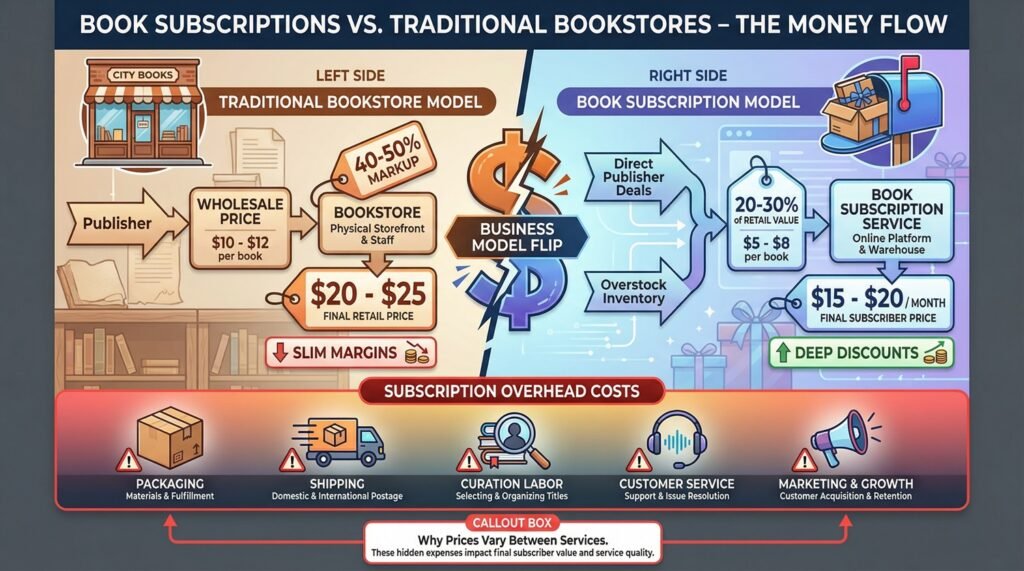
Traditional bookstores operate on slim margins, typically marking up wholesale prices by 40-50%. Book subscriptions flip this model entirely.
Most services negotiate direct publisher relationships or purchase overstock inventory at deep discounts, sometimes paying 20-30% of retail value.
This purchasing power theoretically allows them to deliver better value than you’d get buying individually.
However, subscriptions also carry costs that bookstores don’t: packaging, shipping, curation labor, customer service infrastructure, and marketing to maintain subscriber growth. These overhead expenses explain why you’ll see such dramatic price variation between services.
A $12.50 monthly subscription delivering five pre-loved books operates on fundamentally different economics than a $34.99 service employing librarians to handpick award-winning titles.
The key metric that actually matters is cost-per-quality-book-you-actually-read. I’ve seen families spend $40 monthly on premium subscriptions where their kids devour every selection, making the effective cost-per-engaged-read maybe $10-13.
I’ve also watched budget subscriptions deliver five books monthly for $15 where only one captures the child’s interest, making that engaged read cost $15 despite the obvious bargain.
This is why blanket recommendations miss the mark. Your family’s reading patterns, existing library size, and values around book ownership dramatically affect which service delivers genuine value versus expensive disappointment.
You need to calculate the real per-book engagement cost based on what your child will actually read repeatedly, not just what arrives in the box.
How Curation Quality Varies Between Services
The word “curated” gets thrown around constantly in subscription marketing, but what it actually means varies wildly between companies.
At the sophisticated end, services like Bookroo and Bookworm Box employ teams who spend hundreds of hours reviewing new releases, analyzing developmental appropriateness, considering literary merit, and tracking subscriber feedback to refine selections. Bookworm Box specifically hires librarians and child development specialists, which explains their premium pricing.
You’re essentially paying for professional expertise that would take you years to develop independently.
These services maintain extensive databases tracking which books subscribers already own, reducing duplication risk. When Bookroo claims they’ve delivered over a million books, that volume creates data advantages smaller competitors can’t match.
They know which titles generate the most positive feedback across different age ranges and which consistently disappoint despite strong reviews.
This institutional knowledge translates directly into better selections for your family.
Mid-tier services often use hybrid approaches, combining algorithm-driven selection with lighter human oversight. This works reasonably well for families with smaller existing collections who aren’t yet experiencing diminishing returns from popular mainstream titles.
The algorithms identify highly-rated books within your child’s age range and filter out obvious duplicates, but they lack the nuanced judgment that professional curators bring.
Budget services typically curate through pure volume economics as opposed to expertise. Murphy’s Bulk Books, for instance, sources quality pre-loved inventory and applies condition standards, but they’re not making literary merit judgments or tracking your family’s specific reading history.
This approach absolutely has value for families building foundational collections from scratch, but it serves different needs than discovery-focused curation.
Then there are mission-specific curators like Mosaic Reads and Little Feminist, where editorial perspective matters as much as literary quality. These services make conscious choices prioritizing representation, values alignment, and social-emotional learning themes.
A family seeking books featuring disabled protagonists or non-binary characters finds immense value here, while a family simply wanting excellent storytelling regardless of representation might find the selection limiting.
The Hidden Value of Supplementary Materials
Here’s something I wish I’d understood earlier: the books themselves are often less important than what surrounds them.
Services including discussion guides, activity suggestions, or thematic materials fundamentally change how you engage with subscriptions. Little Feminist doesn’t just send books about women scientists, they provide conversation starters helping you talk about gender stereotypes with your three-year-old in developmentally suitable ways.
Mosaic Reads includes background information about authors and cultural contexts, transforming reading time into broader learning opportunities.
For my family, these additions justified paying $8-12 more monthly. We weren’t just accumulating books, we were building routines around them.
The discussion prompts gave me language for concepts I struggled to explain. The activity extensions meant books generated value beyond the initial reading.
My daughter would ask questions prompted by the guides that I never would have thought to raise on my own.
Conversely, some families I’ve spoken with found supplementary materials overwhelming. They wanted simple book delivery without feeling obligated to finish activities or facilitate structured discussions.
For them, streamlined services like Highlights I Can Read!
Book Club felt appropriately focused as opposed to limited. These parents already had demanding schedules and didn’t want reading time to become another task requiring preparation and follow-through.
KidArtLit and Banyan Tree Kidz take supplementary materials to their logical extreme by including finish craft projects with all necessary supplies. This integration appeals tremendously to parents who would otherwise separately purchase activity kits, effectively getting two subscriptions in one.
The thematic connection between story and craft reinforces comprehension and creates memorable experiences around books.
But it also increases box complexity and storage requirements, which minimalist households find burdensome.
The question becomes whether these materials match how your family actually engages with books. If you’re already the parent who naturally extends stories through conversations and activities, paid access to expert-designed materials saves you planning time.
If you prefer straightforward reading without elaboration, those materials just create guilt over unused resources sitting in a drawer.
Subscription Format and the Psychology of Anticipation
One aspect that surprised me was how much presentation format affects long-term engagement.
Bookroo wraps each book individually as a gift, creating monthly unboxing excitement that my daughter anticipated for days. That theatrical element built ritual around reading that transcended the books themselves.
Even mediocre selections got read many times because they arrived wrapped in colorful paper she got to tear open.
The anticipation started building around the 25th of each month, when she’d start asking daily whether her books had arrived yet.
This matters more than it seems. Child development research consistently shows that rituals and routines strengthen neural pathways around activities.
When book arrival becomes an anticipated event as opposed to just another delivery, you’re psychologically priming positive associations with reading.
The wrapping ceremony became as important as the reading itself in establishing books as something special and exciting.
However, gift wrapping also generates waste that bothers environmentally conscious families. And the excitement factor diminishes as kids age.
By the time my daughter reached four, she cared more about the actual books than the presentation.
Paying premium prices for wrapped delivery felt less justified when she’d rip through the paper in ten seconds and toss it aside.
Literati takes a completely different approach with their try-before-you-buy model. You receive five books, keep what resonates, and return the rest.
This eliminates waste and buyer’s remorse, but it also eliminates the “gift” psychology entirely.
Books arrive as provisional loans as opposed to permanent additions, which changes the emotional dynamic. There’s less ceremony and more practicality.
For our family, Literati’s model worked brilliantly during the overlap period between naps ending and bedtime routines solidifying. We could cycle through many books weekly without accumulating clutter, keeping only the handful that became genuine favorites.
We’d receive a box, read everything within a few days, make quick decisions about keepers, and send back the rest.
But I’ve talked with parents who found the return logistics annoying and preferred committing to fewer books they’d definitely keep.
LoveToRead.ai represents yet another format entirely: AI-generated personalized stories where your child becomes the main character with custom illustrations. This addresses the unique want for personalization as opposed to discovery, serving fundamentally different needs than traditional subscriptions.
My nephew absolutely loved seeing himself illustrated as a superhero or dinosaur explorer.
The technology has improved dramatically, with illustrations now looking cohesive as opposed to uncanny. Still, this works best for kids ages 5-10 who are old enough to appreciate seeing themselves in stories but young enough to find it magical as opposed to cheesy.
Making Subscriptions Work in Real Life
The gap between subscription marketing and daily reality often comes down to really practical logistics that nobody talks about in comparison articles.
Shipping timing matters enormously when you’re managing toddler expectations. Services shipping mid-month mean books arrive when kids have mostly forgotten about them, creating pleasant surprises.
Services shipping predictably on the first mean your toddler asks daily starting on the 27th whether their books have arrived yet, building anticipation that sometimes tips into crankiness.
I learned to manage expectations by not mentioning book deliveries until boxes actually arrived, which worked better than marking calendars and counting down days.
Box size affects where you can receive deliveries. Our apartment building’s package lockers couldn’t accommodate KidArtLit’s larger boxes including craft supplies, forcing us to coordinate with the front desk.
This minor friction eventually contributed to canceling that subscription despite loving the actual content.
Small apartment dwellers need to verify box dimensions before subscribing, particularly for activity-inclusive services.
Age tier transitions caught me off guard with several services. Bookroo’s board book tier served us beautifully from 12-30 months, but transitioning to their picture book tier meant suddenly receiving books my daughter found too text-heavy.
There was an awkward gap period where neither tier fit perfectly.
She’d grown beyond simple board books but wasn’t ready for lengthy picture book narratives. Services with more granular age divisions handled these transitions more smoothly, though they also cost more.
Return windows for try-before-you-buy services need active management. Literati’s model works wonderfully if you consistently read selections within the first week and make decisions promptly.
It becomes frustrating if books sit unread for three weeks, you suddenly remember the return deadline, realize you’re keeping everything by default, and face a $50 charge you didn’t plan for.
I started scheduling “book decision night” on my calendar to force the discipline this model needs.
Duplicate management is genuinely challenging. Even services tracking your existing library can’t account for books received as gifts, borrowed from libraries, or acquired through school.
I’ve received duplicates from many services despite providing wish lists.
Some handled it gracefully with quick exchanges, others made the process difficult enough that I just kept duplicates as opposed to deal with customer service. Bookroo’s exchange policy worked smoothly, while smaller services sometimes made me feel like I was inconveniencing them by requesting swaps.
When Subscriptions Actually Save Money
Let me be really transparent about the financial math, because subscription marketing often obscures whether you’re actually saving money or just paying for convenience.
Board books at retail typically cost $6-9 each. Bookroo at $19.95 monthly for three books equals $6.65 per book, which is basically retail pricing.
You’re not saving much on the books themselves, you’re paying for curation and presentation.
This is fine if those services have value to you, but thank you could buy three random board books at Target for similar cost.
Murphy’s Bulk Books at $15 monthly for five pre-loved books equals $3 per book, which is genuinely below retail even for used books from thrift stores or library sales. Here you’re actually saving money, though you’re sacrificing new release access and some control over condition and selection.
The real savings potential comes from opportunity cost reduction. Before subscriptions, I estimate I spent 45-60 minutes monthly researching books, driving to bookstores, browsing, and making selections.
If I value that time at even $20/hour (far below my actual hourly rate), that’s $15-20 monthly in time costs.
A subscription saving that time pays for itself before considering book costs.
Subscriptions also reduce impulse purchases. Previously, bookstore trips meant buying 4-5 books when I planned to buy two because I got excited browsing.
Subscription limits force discipline.
For our family, this impulse reduction saved $30-40 monthly, making even premium subscriptions net cheaper than our previous unstructured buying.
The financial calculus flips entirely if your family has robust library access. Why pay $20-35 monthly for curated books when your library offers free checkouts?
The answer depends on whether you value ownership, whether your library stocks diverse recent releases, and whether you actually make library visits happen consistently.
For busy working parents, paid subscriptions often cost less than accumulated late fees from forgotten library books. We racked up $60 in late fees one quarter before admitting that our good intentions about library visits didn’t match our actual follow-through.
Key Takeaways
The sophisticated book subscription decision matches subscription characteristics to your family’s specific circumstances, values, and reading patterns as opposed to searching for a universally “best” service.
Curation quality varies dramatically between services, with premium options employing librarians and child development experts while budget options prioritize volume economics. You’re paying for fundamentally different value propositions at different price points, and understanding what you’re actually buying matters more than comparing prices alone.
Supplementary materials like discussion guides, activity extensions, and craft projects justify higher pricing for families who’ll actually use them but create obligation and clutter for those who won’t. Know which type you are before paying for features you’ll ignore or resent.
Presentation format affects engagement through psychological mechanisms around anticipation and ritual. Gift-wrapped deliveries, try-before-you-buy models, and personalized stories serve different emotional needs beyond just book quality.
Cost-per-engaged-read matters more than cost-per-book. A $35 subscription delivering three books your child reads twenty times each provides better value than a $15 subscription delivering five books read once or not at all.
Your optimal subscription will likely need adjustment as your child develops through toddlerhood. What works at 18 months rarely still works optimally at 40 months.
Build flexibility into your strategy as opposed to committing long-term to single services.
Frequently Asked Questions
Are toddler book subscriptions worth it?
Toddler book subscriptions provide value when they save you time researching and shopping for books, introduce titles you wouldn’t find independently, or reduce impulse purchasing. Calculate your current monthly book spending and time costs to decide if subscriptions offer savings.
Families spending $40+ monthly on ad-hoc book purchases and 60+ minutes shopping typically save money with subscriptions, while families with strong library habits may not.
What age should I start a book subscription?
Most services offer board book tiers starting at 0-3 months, though subscriptions provide maximum value starting around 12-18 months when toddlers begin engaging actively with books. Earlier subscriptions can help build foundational libraries, but newborns don’t yet have preferences making curation valuable.
Wait until your child shows consistent interest in books and you’re establishing reading routines.
How do I avoid getting duplicate books?
Choose services with robust preference tracking and customer libraries where you list existing books. Photograph your current bookshelf and send it to customer service during signup.
Select services with flexible exchange policies stated upfront, and test their customer service responsiveness during your first month by requesting a swap to gauge how they handle issues.
Which book subscription has the most diverse books?
Mosaic Reads specifically curates for diversity, representation, and multicultural content. Little Feminist focuses on gender-diverse protagonists and feminist themes.
Bookworm Box includes diversity as a curation criterion alongside literary quality.
Services with mission-specific curation cost more because their selection criteria are more rigorous than general services prioritizing popularity or awards alone.
Can I pause book subscriptions during busy months?
Most major services allow pausing for 1-3 months without losing your account preferences or subscription rate. Bookroo, Literati, and Bookworm Box all offer straightforward pausing through account settings.
Smaller services may need contacting customer service.
Check pause policies before subscribing if you anticipate needing flexibility around vacations, moves, or hectic periods.
Do book subscriptions ship internationally?
Bookroo and Literati ship to choose international locations with extra shipping fees ($15-25 monthly). Most services focus exclusively on US shipping because of cost and logistics complexity.
International families should verify shipping availability and calculate total costs including duties before subscribing, as international fees can double subscription costs.
What’s better: board books or picture books for toddlers?
Board books work better for 12-30 month olds who are still developing fine motor skills and may chew or tear pages. Picture books suit 30+ month olds with gentler handling and longer attention spans.
Many subscriptions offer both in different tiers, allowing transitions as your child develops.
Some advanced 24-month-olds handle picture books fine, while some 36-month-olds still need board books’ durability.
How many books should toddlers get monthly?
Three to five books monthly balances variety with manageable volume for most families. More books risk overwhelming reading routines and creating clutter if you’re not actively managing your library through rotation.
Fewer books limit discovery but work for families prioritizing deep engagement over breadth.
Match monthly volume to how many books your child typically reads per week.