Real parent insights included.
Introduction
The thought that you might be wasting money on toys that do nothing for your baby’s development can be hard to consider. And I’m not saying that every toy in your nursery right now is useless.
Though if you’ve never looked at the difference between authentic Montessori materials and regular baby toys, then it’s important to realize that you can’t just trust packaging labels claiming “educational” or “developmental,” but you can learn what actually matters for those crucial first twelve months. Taking a close look at toy options and understanding real Montessori principles could make you feel defensive, perhaps even frustrated, as the suggestion that your choices could have been influenced by clever marketing as opposed to developmental science may seem uncomfortable.
But if you keep buying flashy battery-operated toys because they’re popular and assume expensive means better quality, you’ll realize that you need to understand what authentic Montessori baby toys actually offer if you ever want to support your child’s natural learning without the clutter and waste.
I totally get how stressful it is that every baby product claims to be the best thing for development. I mean, you’re already sleep-deprived and now you need a degree in child development just to buy a rattle?
When you’ve spent $40 on a toy, some guilt will be there if your baby ignores it. And when you see other parents buying different things, comparison might creep in, but that doesn’t mean following trends is the answer.
That’s actually an important reason why your solution isn’t going to be a cookie ccutter, one-size-fits-all approach, and it’s more a matrix or systematic approach, depending on whether your baby is in the 0-3 month sensory discovery phase needing high-contrast visuals and simple grasps, or the 6-12 month active exploration stage where they need toys supporting crawling, standing, and problem-solving.
Here’s a quick overview of how to choose wisely: Match toys to your baby’s current developmental window, prioritize natural materials that engage many senses, and choose items that encourage independent exploration as opposed to passive entertainment.
You want toys that grow with your child across several months, giving you actual value for the investment while supporting the skills they’re naturally ready to develop right now.
What Makes a Toy Actually Montessori
Before taking a close look at specific products, you need to know what separates authentic Montessori materials from toys with Montessori slapped on the label. Real Montessori toys are made from natural materials like wood, metal, or organic fabrics because these materials have weight, texture, and temperature that plastic can’t copy.
Your baby learns more from feeling the coolness of a metal ring or the grain of wooden blocks than from lightweight plastic.
Authentic Montessori baby toys focus on one skill at a time. A rattle teaches cause and effect through sound.
A ball teaches rolling and tracking.
You won’t find flashing lights, electronic sounds, or many functions competing for attention. The toy invites your baby to be the active player, not a passive observer watching a battery-operated show.
The other key element is reality-based play. Montessori emphasizes real objects and natural consequences over fantasy.
A wooden egg in a cup teaches object permanence better than a cartoon character that pops up randomly.
Your baby is learning how the real world works, building neural pathways that serve them for years.
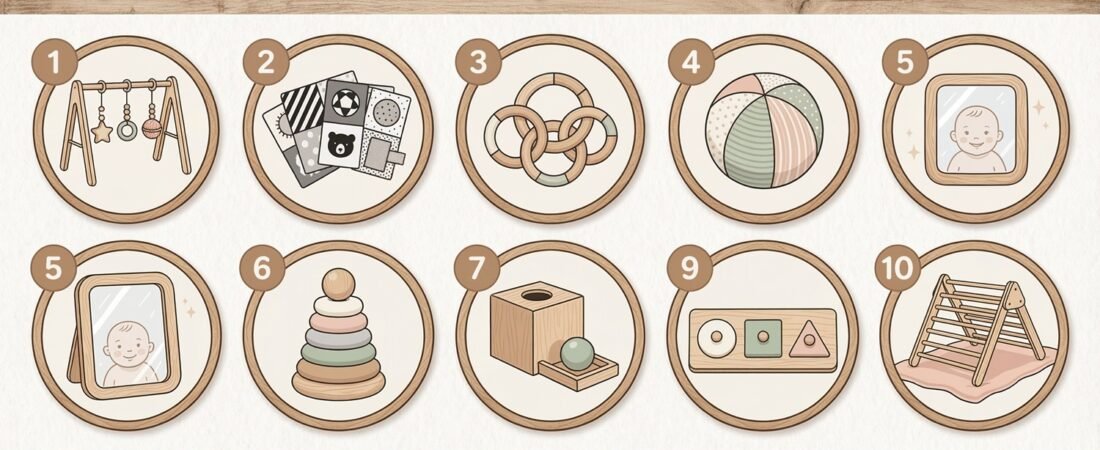
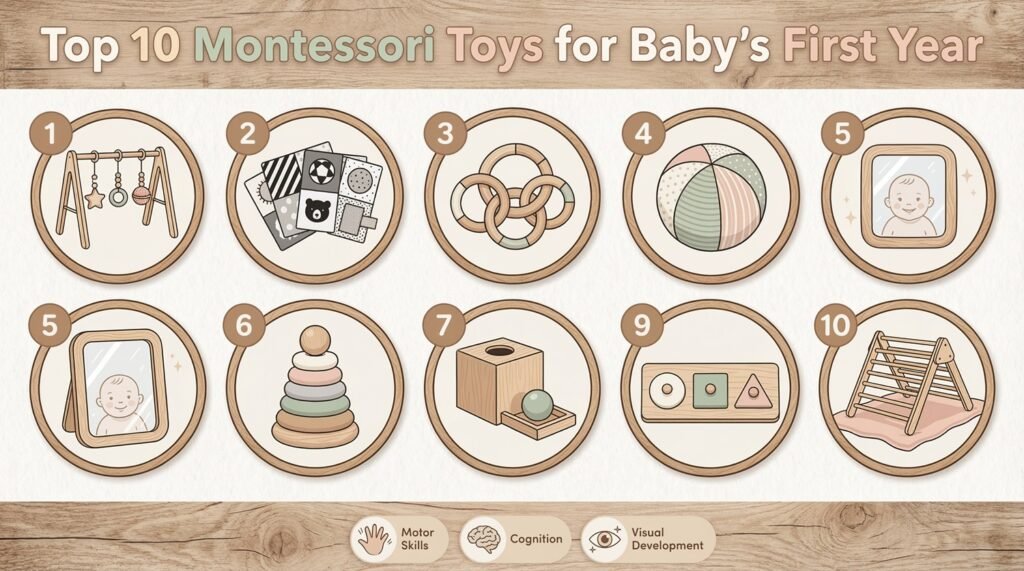
Top 10 Montessori Toys for Your Baby’s First Year
1. Wooden Baby Gym with Natural Hanging Toys
A simple wooden arch with dangling rings, wooden beads, or fabric toys gives your newborn something to focus on during tummy time and back play. Unlike plastic activity gyms with overwhelming sounds and colors, a wooden gym let’s your baby learn movement at their own pace.
They learn to track objects, reach intentionally, and eventually bat at the toys to make them swing.
The Lovevery Play Gym is probably the most well-known option, though brands like Tiny Land and Etsy makers offer beautiful choices. Look for untreated or food-safe finished wood, and toys you can swap out as your baby grows.
Age range: 0-12 months
Best for: Visual tracking, reaching, tummy time motivation
2. High-Contrast Cards or Fabric Books
Your newborn can only see about 8-12 inches away, and they see high contrast better than subtle colors. Black and white cards or fabric books give their developing vision something to lock onto.
You can prop cards nearby during tummy time or hold them at the right distance during alert periods.
These seem almost too simple to matter, but watch your baby’s face when they spot those bold patterns. Their brain is working hard to process visual information, building the foundation for all future learning.
Age range: 0-4 months
Best for: Visual development, focus, early pattern recognition
3. Wooden Grasping Toy or Ring Rattle
Around 3 months, your baby starts working on the palmer grasp, trying to hold objects intentionally. A simple wooden ring or a grasping toy with connected wooden pieces gives them something substantial to work with.
The weight provides feedback that helps them understand their grip, and the natural texture is interesting to explore with hands and mouth.
The Grimm’s wooden rattle is a classic choice, as is the Haba Clutching Toy. These last through many children because quality wood doesn’t break down like plastic teethers.
Age range: 2-8 months
Best for: Grasping, hand-eye coordination, teething
4. Soft Fabric Ball
A simple ball made from organic cotton or wool, about the size of your palm, is one of the most versatile toys you can offer. Young babies can grasp it easily because it doesn’t roll away like hard balls.
Older babies can practice rolling it, tracking its movement, and eventually crawling after it.
The Montessori approach often uses a puzzle ball made from fabric strips, creating easy grip points. You can find these on Etsy or make one yourself.
This toy works from about 3 months through toddlerhood, evolving with your child’s abilities.
Age range: 3-18 months
Best for: Grasping, rolling, tracking, gross motor development
5. Baby-Safe Floor Mirror
An unbreakable acrylic mirror that sits at floor level changes tummy time. Your baby sees another baby staring back, which is fascinating.
They’ll work harder to lift their head and hold that position when there’s something interesting to look at.
Around 6-9 months, they start to realize that baby in the mirror is them, an important step in self-awareness.
Mount it securely or get a freestanding version that won’t tip. The Tots peekaboo mirror or similar options from Lovevery work well.
Position it in front of your baby during floor play and watch them engage for much longer periods.
Age range: 0-12 months
Best for: Tummy time extension, self-awareness, visual engagement
6. Wooden Stacking Rings
The classic ring stacker teaches so much: size differentiation, sequencing, hand-eye coordination, and problem-solving. Look for one with a wobble base as opposed to a fixed post.
The wobble adds challenge and interest as your baby figures out how to stabilize it while stacking.
Around 6-8 months, your baby might just chew the rings or bang them together. By 10-12 months, they’re working on actually stacking them.
By 18 months, they might even get the size order right.
This is a toy that truly grows with your child.
Age range: 6-24 months
Best for: Fine motor skills, size concepts, concentration
Ready to give your baby tools for real learning? Check out this wooden ring stacker that’ll last for years. [Affiliate link]
7. Object Permanence Box
This is one of the most clearly Montessori toys you’ll find. A wooden box with a hole on top and an opening in front, paired with a wooden ball.
Your baby drops the ball in the hole, it rolls down a ramp inside, and appears in the opening at the front.
This teaches object permanence – the understanding that objects continue to exist even when you can’t see them.
Around 8-10 months, when babies naturally develop this concept, the box provides concrete experience with it. They’ll repeat the action over and over, fascinated by the disappearance and reappearance.
The repetition builds neural pathways and teaches cause and effect.
Age range: 8-18 months
Best for: Object permanence, cause and effect, fine motor control
8. Nesting Wooden Boxes or Cups
A set of wooden boxes or cups in graduated sizes offers endless possibilities. Stack them, nest them, hide small objects inside, use them for pretend play.
Early on, your baby just explores each piece individually, mouthing and banging them.
Later, they figure out the nesting puzzle, which requires spatial reasoning and problem-solving.
Unlike plastic stacking cups, wooden ones have weight and don’t slide around as easily. The challenge is suitable for developing motor skills.
Look for sets with about 5-7 pieces made from single pieces of wood as opposed to glued constructions.
Age range: 8-24 months
Best for: Spatial reasoning, size concepts, open-ended play
9. Simple Wooden Puzzle with Knobs
A basic 3-4 piece puzzle with large knobs helps develop the pincer grasp and problem-solving skills. Choose puzzles with realistic images – farm animals, vehicles, fruits – as opposed to cartoon characters.
The knobs should be substantial enough for little fingers to grasp easily.
Start with single-piece puzzles where each piece has its own defined space. As your baby masters these around 10-12 months, you can gradually introduce puzzles with more pieces.
The satisfaction of fitting the piece in the right spot builds confidence and persistence.
Age range: 9-18 months
Best for: Pincer grasp, problem-solving, shape recognition
10. Pikler Triangle or Climbing Arch
This is the biggest investment on the list, but it’s transformative for gross motor development. A Pikler triangle is a wooden climbing frame that let’s babies and toddlers climb, crawl through, and eventually pull themselves up to standing.
It supports their natural drive to move and explore their physical capabilities safely.
You can introduce it around 6-8 months for crawling under and pulling up on the lower rungs. By 12-18 months, they’re climbing up and over.
By age 2-3, they’re incorporating it into imaginative play.
Many families use these for 3-4 years, making the $150-300 cost reasonable when broken down over time.
Look for models that fold for storage if space is tight. Make sure the wood is smooth and the structure stable.
Always supervise climbing play, though the Montessori approach encourages letting children explore their limits with your presence nearby as opposed to constant intervention.
Age range: 6-36 months
Best for: Gross motor development, confidence, body awareness
Give your baby the gift of confident movement. This climbing triangle supports natural development beautifully. [Affiliate link]
Choosing What Your Baby Actually Needs Right Now
You don’t need all ten of these toys immediately. Start with where your baby is right now developmentally.
For a newborn, the high-contrast cards, wooden gym, and floor mirror make sense.
For a 6-month-old, add the grasping toys, ball, and beginning stacker. For a 9-month-old ready for more challenge, introduce the object permanence box and puzzles.
The Montessori approach emphasizes rotating toys to maintain interest and prevent overwhelm. Keep out 4-6 toys at a time, stored on low shelves where your baby can see and access them independently once they’re mobile.
Rotate weekly or when you notice decreased engagement.
Watch your baby to know what to introduce next. Are they trying to pull up on furniture?
Time for something that supports standing.
Are they fascinated by putting objects in containers? Introduce nesting cups or a simple shape sorter.
You’re following their lead as opposed to pushing skills they’re not ready for.
Quality matters more than quantity with Montessori baby toys. One well-made wooden toy that lasts through many children is better than five plastic toys that break or get ignored. Natural materials hold up to chewing, dropping, and years of play.
They also feel better in little hands and provide richer sensory experiences.
Budget-conscious? Look for secondhand Montessori toys on Facebook Marketplace or Mercari.
Wooden toys clean up easily with soap and water or a vinegar solution.
You can also DIY some Montessori materials. A fabric ball, treasure basket with household objects, or simple drop box can be made at home for minimal cost.
What I Actually Recommend Most
If I had to pick just one item from this list for a baby shower gift or for your own little one, I’d choose the wooden play gym for young babies (0-6 months) or the Pikler triangle for older babies (6+ months). The play gym supports so many early milestones – visual tracking, reaching, grasping, and tummy time engagement.
It’s the foundation for everything that comes after.
For older babies, the Pikler triangle supports the crucial gross motor development that builds confidence and body awareness. Babies who can move competently tend to be more willing to explore and take on new challenges.
That fearless curiosity serves them well beyond the baby stage.
The object permanence box comes in a close third because it so clearly teaches a specific cognitive concept at exactly the right developmental window. Watching a baby’s face light up when they understand the ball didn’t disappear, it just went somewhere else, is pure magic.
You’re not going to ruin your baby if you also have some plastic toys or battery-operated items. I’m not talking about perfection or rigid adherence to one philosophy.
It revolves around understanding what simple, well-designed toys can offer and making intentional choices when you can.
Your baby will develop beautifully with or without the perfect Montessori setup. These toys just offer a thoughtful path that aligns with how babies naturally learn.
Ready to start your Montessori journey? Pick one toy from this list that matches your baby’s current stage and introduce it this week. Watch how they explore it, follow their lead, and trust that simple really is better when it comes to supporting those precious first milestones.
Shop my top pick, the Lovevery Play Gym, and use code NATURAL15 for 15% off your first order. [Affiliate link]
Frequently Asked Questions
What actually makes a toy “Montessori”?
A toy is Montessori if it’s made from natural materials, focuses on one skill or concept at a time, and encourages independent exploration as opposed to passive entertainment. It should be reality-based as opposed to fantastical, appropriately challenging for the child’s developmental stage, and beautiful enough to invite engagement.
The toy puts your baby in control of the action as opposed to just watching something happen.
Are expensive Montessori toys actually worth the cost?
Quality wooden Montessori toys typically cost more upfront but last for years and often through many children. A $40 wooden stacker that lasts five years and engages your child throughout toddlerhood costs less than $8 per year.
Compare that to plastic toys that break, get ignored, or end up in landfills within months.
The value comes from longevity, engagement, and supporting real skill development. That said, you can find affordable options secondhand or make some items yourself.
Can I just make Montessori toys at home instead of buying them?
Absolutely. Many Montessori materials can be DIY projects.
Treasure baskets filled with safe household objects (wooden spoon, metal measuring cups, fabric scraps, large shells), fabric balls, drop boxes made from shoeboxes, and homemade sensory books all follow Montessori principles.
The key is using natural materials, keeping it simple, and focusing on one learning concept. Some items like climbing triangles are better purchased for safety reasons, but many early baby toys can be homemade.
At what age should I start using Montessori toys with my baby?
From birth. High-contrast images and simple mobiles work for newborns.
Natural materials and simple toys that support each developmental stage can be introduced as your baby shows readiness.
Montessori isn’t about pushing skills early. It’s about offering suitable materials when your baby is naturally developing those abilities.
A 3-month-old gets different toys than a 9-month-old because they’re working on different skills.
How many toys should my baby have accessible at once?
Four to six toys at a time prevents overwhelm and helps your baby focus. Display them on a low shelf where your baby can see options and eventually choose independently once mobile.
Rotate toys weekly or when interest drops, keeping the rest stored out of sight.
This rotation keeps toys feeling fresh and maintains engagement better than having everything out constantly. You’ll also find cleanup much easier with fewer toys in circulation.
Do Montessori toys actually make a difference in development or is it just a trend?
Research supports that open-ended toys, natural materials, and child-led play promote longer engagement, creativity, and problem-solving skills compared to electronic or single-function toys. Montessori toys align with these research findings.
While your baby will develop fine either way, these toys tend to hold attention longer, get used in more varied ways, and support skills that build on each other.
The difference isn’t magical, but it’s measurable in terms of engagement quality and developmental support.
What’s the difference between Montessori and Waldorf toys?
Both emphasize natural materials and open-ended play, but Waldorf toys lean more toward imaginative and fantastical elements (fairies, rainbow colors, soft forms), while Montessori emphasizes reality-based, specific-skill-focused materials. Waldorf often uses softer, more flowing designs in pastel colors.
Montessori uses defined shapes, natural wood tones, and toys that teach concrete concepts.
Both are valuable approaches. Many families blend elements from each philosophy based on what resonates with them and engages their child.
References
Research on infant development and play-based learning from sources including the American Academy of Pediatrics guidelines on suitable toys, Montessori methodology principles, and current child development research on sensory learning and motor skill acquisition.