I remember standing in a massive baby store three weeks before my nephew was born, completely paralyzed by the sheer volume of options. Bright plastic contraptions lined every aisle, each one promising to make babies smarter, happier, or more entertained. Everything beeped, flashed, or played forty different songs at ear-splitting volumes.
I left empty-handed and frustrated, knowing instinctively that none of it felt right but having absolutely no framework for what would be right.
If you’re asking what Montessori toys for infants really are, you’re probably feeling that same confusion I felt, overwhelmed by marketing claims and genuinely wanting to make choices that actually support your baby’s development as opposed to just occupy their time.
Understanding What Makes a Toy “Montessori”
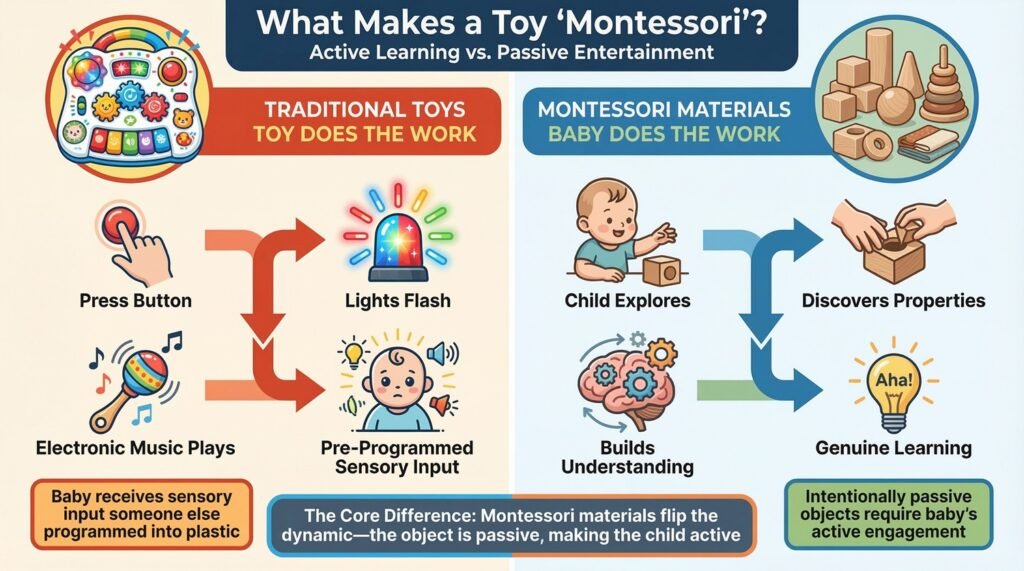
Montessori infant toys are materials designed for active learning as opposed to passive entertainment. That distinction matters more than it might seem at first.
Traditional toys do the work for the baby. Press this button, watch lights flash.
Shake this rattle, hear electronic music.
The baby receives sensory input that someone else programmed into a plastic she’ll. Montessori materials flip that entire dynamic completely.
They’re intentionally passive objects, meaning the baby has to do all the work, and through that work, they build genuine understanding of how the world operates.
Maria Montessori observed over a century ago that infants are active learners from birth, desperately trying to understand their environment through every sense available to them. She designed infant materials around this reality, creating simple objects that respond only to a baby’s actions, providing authentic feedback about cause and effect, weight, texture, temperature, and spatial relationships.
The core philosophy centers on three principles that really resonate once you understand them. First, materials should isolate a single quality or concept so babies can focus deeply as opposed to being overwhelmed. A wooden rattle teaches grasping and the relationship between movement and sound, nothing more.
Second, materials should be made from natural substances that provide rich sensory information.
Wood has weight, warmth, grain patterns, and even a subtle scent. Plastic provides none of that sensory complexity.
Third, materials should contain what Montessori educators call a control of error, meaning the material itself provides feedback when used incorrectly, eliminating the need for adult correction and building intrinsic motivation.
These three principles work together to create learning experiences that match exactly how infant brains actually develop. When you understand the neuroscience behind early development, the choices start making a lot more sense.
How Infant Development Actually Works
To really understand what Montessori toys for infants are, you need to understand what’s happening in a baby’s brain during that first year. The research is genuinely mind-blowing when you look at it closely.
Infants are born with about 100 billion neurons, roughly the same number they’ll have as adults. But a three-year-old has about twice as many neural connections as an adult.
During those first three years, babies are forming synaptic connections at an absolutely staggering rate, up to one million new neural connections every single second.
The brain is essentially building its operating system through lived experience.
What decides which connections strengthen and which get pruned away? Repetition and meaningful interaction with the environment.
When a baby grasps a wooden bead, brings it to their mouth, explores its weight and texture, drops it and watches it fall, then retrieves it and repeats the entire sequence, they’re literally building the neural architecture that will support all future learning.
This is why the materials matter so much. A battery-operated toy that plays music when you press a button teaches one thing: press button, receive reward.
That single neural pathway gets reinforced. A simple wooden rattle that responds differently depending on how forcefully you shake it, what angle you hold it, how quickly you move it creates hundreds of potential neural pathways being explored and strengthened through varied interaction.
Montessori identified specific sensitive periods during infancy when babies are neurologically primed to develop particular skills. From birth to about four months, infants are intensely focused on developing vision and beginning to coordinate hand movements.
From four to eight months, they’re working on purposeful grasping and hand-to-hand transfer.
From eight to twelve months, they’re mastering pincer grip, object permanence, and beginning problem-solving. Authentic Montessori materials are calibrated to these sensitive periods, offering exactly the right challenge at exactly the right developmental window.
The timing of material introduction makes an enormous difference in how effectively babies can engage with them. Offering an object permanence box to a four-month-old won’t accomplish much because their brain hasn’t developed the capacity to understand object permanence yet.
But offering that same box to an eight-month-old creates this beautiful alignment between what the brain is ready to learn and what the material teaches.
What Actual Montessori Infant Materials Look Like
Let me walk you through what you’d actually see on a Montessori infant shelf, because the specificity matters here.
For newborns to three months, the materials are remarkably simple. High-contrast visual cards in black and white mounted on natural wood or heavy card stock provide optimal visual stimulation without overwhelming.
Newborn vision only perceives high contrast during the first weeks, so these cards work with the baby’s current visual capacity as opposed to against it.
Montessori mobiles designed for specific developmental stages hang above movement areas. The Munari mobile uses geometric shapes in black, white, and transparent materials.
The Octahedron mobile introduces primary colors as color vision develops.
These aren’t the electronic, battery-powered mobiles that spin and play music. They’re incredibly simple, often handmade, and move only with air currents, teaching babies to track movement with their developing eye muscles.
You’d also find wooden grasping beads, a single large wooden bead on a natural cotton cord. The bead is big enough that there’s no choking hazard but small enough for tiny hands to eventually grasp.
The cord is soft. The wood is smooth but has texture.
When the baby accidentally grasps it during those early reflexive movements, they get tactile feedback that gradually becomes purposeful grasping.
From three to six months, materials expand as babies develop more voluntary control. Natural wood rattles appear, but these aren’t the plastic maracas you see everywhere.
They’re carefully weighted wooden cylinders or rings that produce gentle, natural sounds when shaken.
Some contain wooden beads inside that create quiet clicking sounds. Others are solid wood that makes a satisfying thunk when it hits something.
The variety teaches babies that different objects produce different sounds, building auditory discrimination.
Fabric balls made from natural fibers like cotton or linen become available. Unlike plastic balls, fabric balls are soft enough for babies still developing motor control.
They’re easier to grasp because fingers can sink into the material slightly.
When dropped, they don’t roll far, which reduces baby frustration and supports the developing understanding that actions have predictable consequences.
Natural teething rings made from untreated hardwood like maple or beech appear as teething begins. The wood is finished only with food-safe oils.
Unlike silicone or plastic teethers, wooden teethers provide resistance that actually helps with teething discomfort.
They’re cool to the touch, which soothes inflamed gums. The natural material means babies aren’t ingesting chemicals when they inevitably spend hours with these in their mouths.
From six to twelve months, materials become significantly more complex as cognitive development speeds up. The object permanence box is probably the most iconic Montessori infant material from this stage.
You have a wooden box with a tray and a hole in the top.
The baby drops a wooden ball through the hole, and it rolls down an internal ramp and reappears in the tray. Simple, right?
But this simple action teaches one of the most important cognitive concepts of infancy: object permanence, the understanding that objects continue to exist even when you can’t see them.
I’ve watched babies become absolutely absorbed with object permanence boxes, repeating the action dozens of times in a single sitting. That repetition strengthens the neural pathways that support this concept, which is foundational for memory, anticipation, and eventually abstract thinking.
Nesting boxes or cups appear during this stage. These are graduated in size so only one fits inside another in a specific way.
Babies work through trial and error to figure out the relationships, building spatial reasoning and problem-solving skills.
The control of error is built in. If you try to put a larger box inside a smaller one, it simply doesn’t work, and the material itself provides that feedback without adult correction.
Simple wooden puzzles with large knobs appear toward the end of the first year. These aren’t complex puzzles with interlocking pieces.
They’re single-shape puzzles where each piece lifts out independently with a knob perfectly sized for practicing pincer grip.
A circle puzzle might have just one circular piece that fits into one circular hole. The baby practices grasping the knob, lifting the piece, and fitting it back in the fix orientation.
Stacking rings on a wooden dowel base teach hand-eye coordination and size relationships. Unlike plastic stacking toys that often have the rings permanently graduated so they only stack one way, quality Montessori stacking materials sometimes have uniform-sized rings so babies can stack them in any order, supporting creative problem-solving as opposed to rote pattern following.
The Natural Materials Question
One aspect that really sets Montessori infant materials apart is the almost exclusive use of natural materials, and there’s substantial reasoning behind this that goes beyond just aesthetic preferences.
Wood has properties that plastic simply cannot copy. It has weight that provides proprioceptive feedback to developing muscles.
When a baby holds a wooden rattle versus a plastic one, their muscles work differently to hold and manipulate it.
That muscular work builds strength and coordination. Wood has temperature.
It feels warm in the hand, unlike plastic that often feels cool and inert.
Wood has texture, even when sanded smooth. The grain patterns provide visual interest.
The material even has a subtle scent, particularly woods like cedar or maple.
All of these sensory qualities provide information to the developing brain. Neuroscience research increasingly shows that rich, varied sensory input during infancy builds more robust neural networks than uniform, limited sensory input. A baby exploring wooden materials receives tactile, visual, proprioceptive, and even olfactory information simultaneously, all slightly different with each wooden object.
That sensory richness creates the complexity that supports brain development.
Natural fabrics like cotton, linen, wool, and silk provide similar benefits. Each has a distinct texture, weight, and even temperature regulation property.
A cotton ball feels completely different from a wool ball, and that difference is valuable sensory information.
Leather, another traditional Montessori material, has yet another completely unique texture and scent profile.
Beyond the developmental benefits, natural materials have practical advantages. Wood is naturally antimicrobial.
Bacteria don’t thrive on it the way they do on plastic.
This matters enormously for infant materials that spend significant time in babies’ mouths. Quality hardwoods are incredibly durable.
A wooden rattle can serve an infant, get passed to a younger sibling, maybe even a cousin, and still be fully functional.
Plastic toys break, fade, and degrade relatively quickly.
There’s also the environmental consideration. Natural materials are renewable, biodegradable, and don’t leach chemicals.
For eco-conscious parents, this alignment between developmental benefits and environmental sustainability makes the choice even more compelling.
Setting Up a Montessori Infant Environment
The materials are only part of the equation. How you present and arrange them matters almost as much as what the materials are.
The Montessori approach for infants emphasizes a prepared environment organized around the baby’s needs as opposed to adult convenience. This means creating spaces where babies can move freely, access materials independently as they develop mobility, and practice emerging skills safely.
For young infants not yet mobile, this might mean a movement area with a firm mat on the floor, not a soft blanket that restricts movement, where the baby spends awake time. A low mirror mounted horizontally at floor level allows the baby to see themselves, which supports visual development and body awareness.
A few carefully chosen materials are placed within reach, maybe a grasping bead hung from a simple wooden frame, a fabric ball, a wooden rattle.
The key here is limited choice. Three or four materials most at this stage.
Infant brains can’t process dozens of options, and overwhelming environments actually prevent concentration.
You rotate materials based on observation. When the baby shows sustained interest in grasping, you keep grasping-focused materials available.
When interest wanes, you swap one material for something focusing on a different skill.
As babies become mobile, low shelves become essential. These are typically around twelve to fifteen inches high, open with no doors, and hold just a few materials displayed attractively.
The baby can see exactly what’s available and, as they develop, can choose what to explore and return it when finished. This setup teaches order, decision-making, and independence from a remarkably young age.
Furniture also shifts in Montessori infant environments. Instead of a changing table where babies need to be lifted, floor-level changing areas allow the baby to join in the dressing process, even if that just means holding a diaper or reaching toward their clothes.
Floor beds instead of cribs allow babies to see their environment upon waking and eventually move in and out of bed independently.
These are practical applications of the principle that even infants can be active participants in their own care.
Storage and rotation systems help manage the too-many-toys problem that plagues many families. Most Montessori parents keep the majority of materials in storage, rotating items onto the shelf every week or two based on what the baby shows interest in. This keeps the environment fresh and interesting without overwhelming, and it extends the useful life of materials because they’re not all available simultaneously.
Adapting Montessori Principles to Real Life
I want to be really honest here: implementing pure Montessori principles in a typical family home with typical constraints is challenging. Not impossible, but it requires intentionality and often compromise.
Maybe you can’t afford all wooden toys right now. Start with one or two key materials that address your baby’s current sensitive period.
Prioritize materials that will get the most use.
An object permanence box at eight months serves a critical developmental window. A wooden rattle at four months supports emerging grasping.
Choose strategically.
Maybe well-meaning relatives keep giving your baby electronic toys. You don’t have to be militant about refusing gifts.
Keep a few in rotation, store others, and slowly emphasize the materials you prefer.
Many parents find that once relatives see how engaged the baby is with simple wooden toys compared to flashy plastic ones, the gift-giving naturally shifts.
Maybe your living space doesn’t allow for a dedicated Montessori infant area. Adapt what you can.
Even a small basket of materials that you bring out during floor time is valuable.
A single low shelf in a corner of a shared living space works. The principles matter more than perfect implementation.
Maybe you’re doing daycare or have a nanny, and you can’t control everything in the baby’s environment. Focus on what you can control during home time.
Communicate your preferences to caregivers, but recognize that consistency at home still provides significant benefits even if other environments differ.
The guilt that comes from not doing everything perfectly is counterproductive. Montessori herself emphasized observation and responsiveness over rigid rule-following.
The spirit of the approach, respecting the child as an active learner, providing materials that support genuine development, allowing independence and concentration, can be implemented in varying degrees across different life circumstances.
Frequently Asked Questions
Are wooden toys safer than plastic for babies?
Wooden toys made from untreated or food-safe finished hardwoods are safer than most plastic toys because they don’t leach chemicals, are naturally antimicrobial, and don’t contain BPA, phthalates, or other harmful substances commonly found in plastic. Wood is also less likely to harbor bacteria when babies put toys in their mouths during teething.
What age should I start using Montessori materials?
You can start using Montessori materials from birth. High-contrast cards and simple mobiles are suitable for newborns.
The materials evolve as your baby develops, with different items introduced at different stages based on your baby’s sensitive periods and emerging capabilities.
Do I need to buy expensive Montessori toys?
You don’t need expensive commercial Montessori toys to follow the principles. Many effective materials can be made at home, like treasure baskets filled with safe household objects, fabric balls sewn from scrap material, or simple grasping toys made from untreated wooden dowels.
The principles matter more than branded products.
How many toys should a baby have at once?
For infants under one year, three to five materials available at any given time is sufficient. Too many choices overwhelm babies and prevent deep concentration.
Rotate materials weekly or biweekly based on your baby’s interests and developmental stage to keep things fresh without overstimulating.
What is an object permanence box used for?
An object permanence box is a wooden box with a hole in the top where babies drop a ball that rolls down an internal ramp and reappears in a tray. It teaches the cognitive concept that objects continue to exist even when you can’t see them, which typically develops between eight and twelve months.
Can Montessori toys help with teething?
Natural wooden teething rings made from untreated hardwoods like maple or beech help with teething because the wood provides resistance that soothes inflamed gums. The wood stays naturally cool and doesn’t contain chemicals that babies might ingest during prolonged chewing.
How do I know which materials my baby needs?
Observe your baby daily for about fifteen minutes without interacting. Note what they look at, reach for, and how long they engage with different objects.
This observation reveals which sensitive period they’re in and guides material selection.
If they’re focused on grasping, provide grasping-focused materials.
Are Montessori materials only for wealthy families?
Montessori materials don’t need wealth. While quality wooden items cost more upfront than plastic alternatives, they last through many children and can even be resold.
The approach also emphasizes fewer, better materials as opposed to accumulating many toys, which often costs less overall than conventional toy purchasing patterns.
Key Takeaways
Montessori materials for infants are passive objects requiring active baby engagement as opposed to entertaining devices that do the work for the child.
Natural materials, primarily wood and natural fabrics, provide sensory richness that supports optimal neural development during the critical first year when babies form one million new synaptic connections every second.
Authentic Montessori materials isolate single concepts, contain built-in controls of error allowing babies to self-correct, and are carefully calibrated to specific developmental sensitive periods.
The prepared environment matters enormously. Limited choices of three to five materials, accessible presentation on low shelves, and organized spaces support infant independence and deep concentration.
Implementation doesn’t need perfection or significant wealth. The principles can be adapted to various circumstances while still providing substantial developmental benefits that extend throughout childhood.
The foundation built through suitable infant materials supports concentration, problem-solving, motor development, and emotional resilience that research shows continues into adulthood.