Have you ever watched your baby become completely captivated by something as simple as a crinkly piece of paper or a colorful scarf? There’s something genuinely magical about seeing their eyes light up when they learn a new texture, sound, or visual pattern.
If you’re wondering what sensory activities for babies actually are and how they support your little your development, you’re in exactly the right place.
In this article, I’ll walk you through practical, engaging sensory activities that don’t need expensive equipment, just creativity and items you probably already have at home.
Why Sensory Play Matters for Brain Development
When I first became a parent, I thought sensory play was just another trendy parenting buzzword. But the science behind it is actually compelling.
Your baby’s brain is developing at an absolutely incredible rate during their first year, forming neural connections at a speed that will never be matched again in their lifetime. Every time your baby touches something soft, hears a new sound, or sees a bright color, their brain is literally building pathways that will support learning for years to come.
The orienting reflex is particularly fascinating here. This is your baby’s natural response to new stimuli, and it forms the foundation of their ability to focus and pay attention.
When you expose your baby to varied sensory experiences, you’re exercising their concentration muscles.
The more diverse sensory input they receive, the more skilled they become at processing information and maintaining focus.
What’s even better is that sensory activities support many areas of development simultaneously. A simple activity like exploring different fabrics helps with tactile processing, fine motor skills, hand-eye coordination, and even early mathematical thinking as babies begin to notice patterns and differences.
You’re getting tremendous developmental value with these activities.
Understanding Your Baby’s Sensory Development Timeline
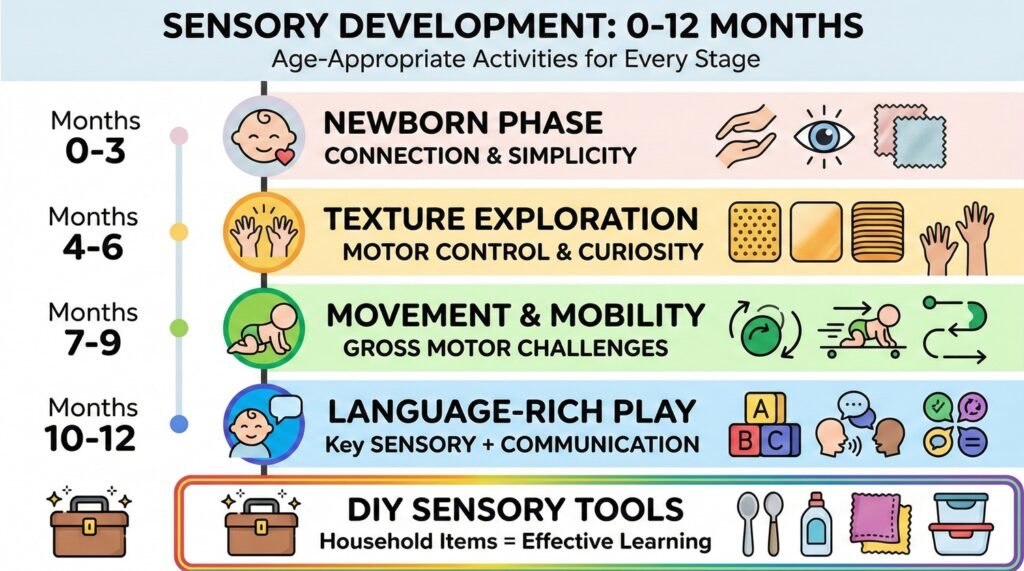
Babies don’t develop all their senses at once, and understanding this progression helps you choose suitable activities. Newborns actually can’t see colors initially.
Their color vision typically develops around four to six months.
But even before that happens, they can benefit enormously from high-contrast patterns, particularly black and white designs, which support visual development.
During the first three months, your baby is building the foundation for all future learning. Their world is primarily close-up, they want to be near you, to feel your skin, to hear your voice.
This is why skin-to-skin contact provides genuinely developmental benefits.
The warmth, texture, and rhythm of your heartbeat provide rich sensory input that helps regulate their nervous system.
Around four to six months, babies become noticeably more tactile. Their hands are opening more often, and they’re reaching for objects with increasing accuracy.
This is the perfect window to introduce varied textures because they’re developmentally primed to explore through touch.
You’ll notice they want to grab everything and, yes, put it in their mouths, which is actually another way they gather sensory information.
By seven to nine months, mobility changes everything. Babies who are rolling, scooting, or crawling have completely different sensory needs than those who are primarily stationary.
They need opportunities to move through space, to experience their body’s relationship to their environment, to practice transferring weight and balancing.
As you approach the 10 to 12 month mark, language becomes increasingly central to sensory experiences. Your baby is connecting words with objects, actions, and sensations.
This is when narrating your sensory activities becomes particularly powerful for development.
Sensory Activities for the First Three Months
The newborn phase feels simultaneously endless and impossibly short, doesn’t it? During these early weeks, sensory activities are beautifully simple and focused on connection.
Skin-to-skin contact remains the gold standard sensory activity for this age. Place your baby against your bare chest as often as possible.
The combination of warmth, heartbeat rhythm, breathing movement, and skin texture provides multi-sensory input that supports regulation and bonding.
Gentle touch and tickle games help your baby develop body awareness. Try softly stroking different parts of their body, naming each part as you go.
You might say “here are your tiny toes” while gently wiggling them, or “this is your soft belly” while making circles with your palm.
These moments build neural pathways connecting physical sensation with language.
Visual stimulation matters even before color vision fully develops. Create or purchase a mobile with high-contrast patterns and hang it where your baby spends awake time.
You can also make a simple DIY version using a clothes hanger, string, and black and white printed images.
The movement of the mobile as it sways adds an extra dimension to the visual experience.
Music and sound play a bigger role than many parents realize. Your voice is the most important instrument you have.
Sing lullabies, make up silly songs, narrate your daily activities.
The melodic patterns and rhythm of music support auditory development and early language acquisition. You might also play gentle background music during awake time, though silence is equally valuable for helping babies learn to self-regulate.
Try the anticipation game during diaper changes. Each time you change your baby, gently touch different body parts and say “beep” or another consistent sound.
Over time, usually within a few weeks, you’ll notice your baby watching your hand and anticipating where you’ll touch next.
This simple game builds cause-and-effect understanding and focus.
Exploring Textures from Four to Six Months
This is when sensory play really expands in wonderful ways. Your baby’s improved motor control and growing curiosity make texture exploration particularly rewarding.
Create a fabric collection using items you already own. Gather a soft fleece blanket, a silk scarf, a piece of corduroy, velvet ribbon, a terrycloth towel, and a piece of wool.
Let your baby touch and grasp each one while you describe what they’re feeling.
You might say “this one is really soft and smooth” or “this you have bumps, doesn’t it?” Your narration helps build vocabulary even though they can’t speak yet.
Touch-and-feel books become valuable tools during this phase. Look for sturdy board books with varied textures embedded in the pages.
As you read together, guide your baby’s hand to each texture and describe it enthusiastically.
Books with high-contrast colors and simple patterns work particularly well because they mix visual and tactile stimulation.
Rattles and noise-making toys support both auditory development and cause-and-effect learning. When your baby shakes a rattle and hears the sound, they’re making the connection between their action and the result.
You can create homemade versions by partially filling sealed containers with dried beans, rice, or pasta.
Just make absolutely certain the seal is completely secure, I recommend using strong tape around the lid for extra safety.
Mirror play introduces self-awareness in a really fascinating way. Prop a baby-safe mirror where your baby can see their reflection during tummy time or while sitting supported. Make faces together, stick out your tongue, smile widely.
Your baby is beginning to understand that the image in the mirror responds to their movements, which is an early step toward recognizing themselves.
The ribbon pull activity is simple but engaging. Take several ribbons or fabric strips of different colors and textures.
Hold one end securely and let your baby grasp and pull the other end.
This builds grip strength while providing varied tactile input. Just never leave your baby unattended with ribbons because of safety concerns.
Movement and Mobility Activities for Seven to Nine Months
Once your baby is moving independently, even if just rolling or scooting, sensory activities should incorporate more gross motor challenges.
Encourage rolling practice by placing interesting objects just slightly out of reach during floor time. A brightly colored scarf, a new textured toy, or even a crinkly piece of paper can motivate your baby to roll toward it.
Each time they move their body through space, they’re gathering proprioceptive input that helps them understand where their body is in space.
Transferring objects between hands is a crucial developmental skill that looks deceptively simple. Offer your baby objects that are easy to grasp, like a small soft book, a large scrunchie, or a silicone teether.
Watch as they explore the object with one hand, then transfer it to the other hand.
This seemingly simple action needs tremendous coordination and builds neural pathways that support future fine motor skills.
Water play becomes incredibly engaging at this age. Set up a shallow water table, large plastic bin, or even just use the bathtub with a few inches of water.
Add measuring cups, sponges, or floating toys.
The sensory experience of water is unique, it moves, it’s wet, it makes splashing sounds, it reflects light. Just remember that water activities need your complete, undivided attention at all times.
Create texture stations around a baby-safe area. Place a soft blanket in one spot, a textured bath mat in another, a smooth wooden board in a third location.
Let your baby move between these different surfaces, experiencing how each one feels different against their hands and knees.
Food exploration adds taste to the sensory mix. Once your baby has started solids, let them touch and squish safe foods like O’s cereal, cooked pasta, or small pieces of soft fruit.
This gets messy, and that’s actually the point.
The sensory input from squishing food between their fingers is really valuable, even though it means more cleanup for you.
Language-Rich Activities for Ten to Twelve Months
As your baby approaches their first birthday, combining sensory activities with language becomes increasingly important and effective.
The home tour activity is simple yet powerful. Carry your baby around your home and name everything you see.
Touch different surfaces as you go, the cool window glass, the soft couch cushion, the smooth kitchen counter.
This builds vocabulary while providing varied tactile experiences. You might say “let’s touch the cold refrigerator” or “feel how soft this pillow is.”
Create obstacle courses using cushions, pillows, and safe furniture. Set up a path that needs your baby to crawl over a pillow, around a cushion, and under a chair.
This type of movement provides intense vestibular and proprioceptive input while building problem-solving skills.
Stay close to confirm safety, especially near furniture.
Sound identification games help develop auditory discrimination. Gather several containers and fill each with different materials, rice in one, beans in another, bells in a third.
Seal them securely and let your baby shake each one, noticing the different sounds.
You can also hide a musical toy and encourage your baby to find it by following the sound.
Interactive songs with movements mix many sensory systems beautifully. “Itsy Bitsy Spider” involves visual tracking of hand movements, tactile input from finger touches, auditory input from singing, and vestibular input if you sway while singing.
“Wheels on the Bus” is another excellent choice because each verse involves different movements and sounds.
Hidden sound exploration works particularly well outdoors or near windows. When you hear a dog barking, bird chirping, or car passing, say “do you hear that? That’s a dog barking!” Watch if your baby turns toward the sound source.
This builds auditory localization skills and connects sounds with their sources.
Creating DIY Sensory Tools That Actually Work
You don’t need to spend a fortune on specialized sensory toys. Some of the most effective tools can be made from household items.
Sensory bottles are incredibly versatile and easy to make. Take a clear plastic water bottle and fill it with visually interesting items.
You might add colored water with glitter, dried pasta in rainbow colors, pompoms, or small bells.
Seal the lid with strong glue and tape, then let your baby shake, roll, and examine the bottle. Each type of filling creates a different sensory experience.
A discovery basket is simply a container filled with safe household objects. Use a low basket or bin and fill it with items like a wooden spoon, a small soft brush, a silicone spatula, a clean cloth diaper, a small cardboard box, and other interesting but safe objects.
Your baby will enjoy pulling items out, examining them, and eventually putting them back in. Rotate the items weekly to maintain interest.
The fabric pull box takes minimal effort to create. Find a small cardboard box and cut a hole in the top.
Fill it with scarves, soft washcloths, and fabric scraps.
Babies love pulling fabric through the hole, and it builds fine motor skills while providing tactile variety.
Homemade texture boards offer focused tactile exploration. Get a sturdy piece of cardboard and glue different textured materials to it, sandpaper, bubble wrap, felt, corrugated cardboard, aluminum foil, velvet ribbon.
Make sure everything is securely attached and supervise your baby as they explore each texture.
The oat exploration activity is wonderfully simple. Pour plain rolled oats into a large shallow container.
Let your baby run their hands through the oats, grab handfuls, and watch them fall.
You can add variety by creating two containers, one with dry oats and one with oats mixed with a little water to change the texture entirely. This gets messy, so put down a mat or do it outside.
Common Challenges and How to Navigate Them
Sensory activities don’t always go as planned, and that’s completely normal. Understanding common challenges helps you adapt rather than abandon activities.
Some babies show sensory sensitivity toward certain textures or sounds. If your baby pulls away from a particular texture or seems distressed by certain sounds, respect their response.
Sensory preferences and tolerances vary widely.
You can gradually introduce challenging sensations in very small doses, but never force an activity if your baby seems genuinely upset.
The mess factor stops many parents from trying sensory activities, and I completely understand that hesitation. Start with contained activities like sensory bottles that create no mess at all.
As you become more comfortable, you can progress to messier activities like water play or food exploration.
Having cleanup supplies ready before you start makes the whole experience less stressful.
Short attention spans are developmentally normal for babies. Don’t expect your six-month-old to engage with an activity for 20 minutes.
Even two to three minutes of focused exploration represents quality sensory input.
Offering many short activities throughout the day works better than pushing for extended engagement with a single activity.
Safety concerns are legitimate and important. Always supervise sensory activities, especially those involving small objects, water, or food.
Regularly inspect homemade sensory toys for wear and tear.
If a sensory bottle starts to leak or a fabric box shows signs of deterioration, replace or repair it immediately.
Frequently Asked Questions
What textures are safe for babies to explore?
Soft fabrics like fleece, cotton, and silk are excellent starting textures for babies. You can also introduce slightly rougher textures like corduroy or terry cloth once your baby is comfortable with softer materials.
Avoid anything with small parts that could come loose, sharp edges, or materials that could irritate sensitive skin. Always supervise texture exploration to confirm your baby doesn’t put unsafe items in their mouth.
When can babies start tummy time activities?
You can start tummy time from the very first days after birth, beginning with just a minute or two at a time. Place your newborn on your chest while you recline so they can practice lifting their head.
As they get stronger, move to a firm surface like a play mat.
By two to three months, most babies can handle several tummy time sessions throughout the day, building up to 20-30 minutes total.
How do I make sensory bottles for babies?
Start with a clean, clear plastic bottle with a secure lid. Fill it about halfway with your chosen materials, this could be colored water with glitter, dried beans, rice, small pompoms, or a combination.
Don’t overfill, as you want the contents to move around when shaken.
Seal the lid with strong adhesive glue and wrap the edges with duct tape for extra security. Always check the bottle before giving it to your baby to confirm the seal remains intact.
What are high contrast images for babies?
High contrast images are pictures or patterns with stark color differences, typically black and white. These images are easier for young babies to see because their vision is still developing.
Simple patterns like stripes, checkerboards, bulls-eyes, and geometric shapes work particularly well.
You can find free printable high contrast cards online or create your own using black paper and white surfaces.
Can sensory play help with baby sleep?
Sensory activities can support better sleep by providing suitable stimulation during wake windows, which helps babies build up healthy sleep pressure. Activities that involve movement, like rolling or crawling, are particularly helpful for physical tiredness.
However, avoid overstimulating sensory activities close to bedtime.
Wind down with calmer sensory experiences like gentle touch or soft music before sleep.
How often should I do sensory activities with my baby?
You can incorporate sensory activities throughout your baby’s wake windows, aiming for several short sessions each day rather than one long session. Even five to ten minutes of focused sensory play two to three times daily provides valuable developmental input.
Follow your baby’s cues, if they seem engaged, continue the activity.
If they turn away or become fussy, that’s their signal they’ve had enough.
What is a sensory bin for babies?
A sensory bin is a container filled with materials that provide interesting tactile experiences. For babies, this might be a shallow plastic bin filled with safe items like fabric scraps, large wooden blocks, silicone toys, or natural items like large smooth stones.
For older babies who no longer mouth everything, you can add materials like dried pasta, rice, or beans.
Always supervise sensory bin play carefully.
Are store-bought sensory toys worth it?
Store-bought sensory toys can be convenient and well-designed, but they’re definitely not necessary. Many homemade sensory activities provide equal or better developmental value at a fraction of the cost.
If you do purchase toys, look for ones that offer varied textures, sounds, or visual interest.
Quality matters more than quantity, a few well-made sensory toys used regularly are better than a bin full of unused items.
Key Takeaways
Sensory activities for babies provide diverse, suitable input that supports rapidly developing neural pathways. The most effective activities use household items rather than expensive specialized toys, making rich sensory experiences accessible to all families.
Age-appropriate activities recognize developmental stages, with newborns benefiting from simple experiences like skin-to-skin contact and high-contrast visuals, while older babies need more complex challenges involving movement, texture variety, and language integration.
Consistency matters more than perfection. Even brief daily sensory experiences, just five to ten minutes of focused exploration, build developmental skills across many domains including motor control, cognitive function, language acquisition, and self-regulation.
The sensory foundation you’re building now supports increasingly complex learning as your baby grows into toddlerhood and beyond.