I’ve watched countless babies light up during sensory sessions, and honestly, seeing their development unfold in real time stays one of the most fascinating aspects of early childhood. Baby sensory creates deliberate experiences that help rapidly developing brains make sense of the world around them.
During these sessions, babies engage in carefully structured activities that target their five primary senses along with the lesser-known but equally important vestibular and proprioceptive systems. These activities serve a specific developmental purpose that builds the neural foundation for everything that comes later.
Let me walk you through what actually happens when you take your baby to one of these classes or create these experiences at home.
Understanding the Developmental Foundation
Your infant enters the world with roughly 100 billion neurons ready to start forming connections. These neurons need to create synapses to become functional, and during the first year of life, your baby’s brain creates these connections at an astonishing rate of about one million per second.
Sensory experiences are essentially the fuel for this neural development. Every time your baby touches a new texture, sees a contrasting color, or hears a different sound, their brain builds pathways that will support everything from language development to emotional regulation later in life.
The sensory activities are strategically designed to provide the specific types of stimulation that research shows supports optimal brain development during critical windows.
The concept draws heavily from neuroscience research showing that enriched environments during infancy lead to more robust neural networks. If your baby’s brain is a garden, sensory experiences are the water and sunlight.
Without enough stimulation, some potential connections simply won’t form.
With the right experiences at the right times, you’re helping your baby build a strong foundation for all future learning.
Visual Stimulation Activities
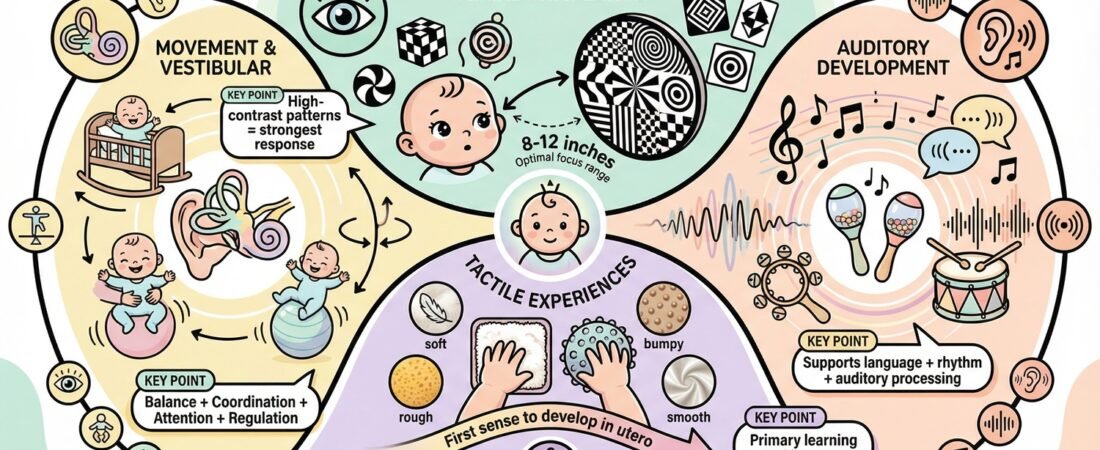
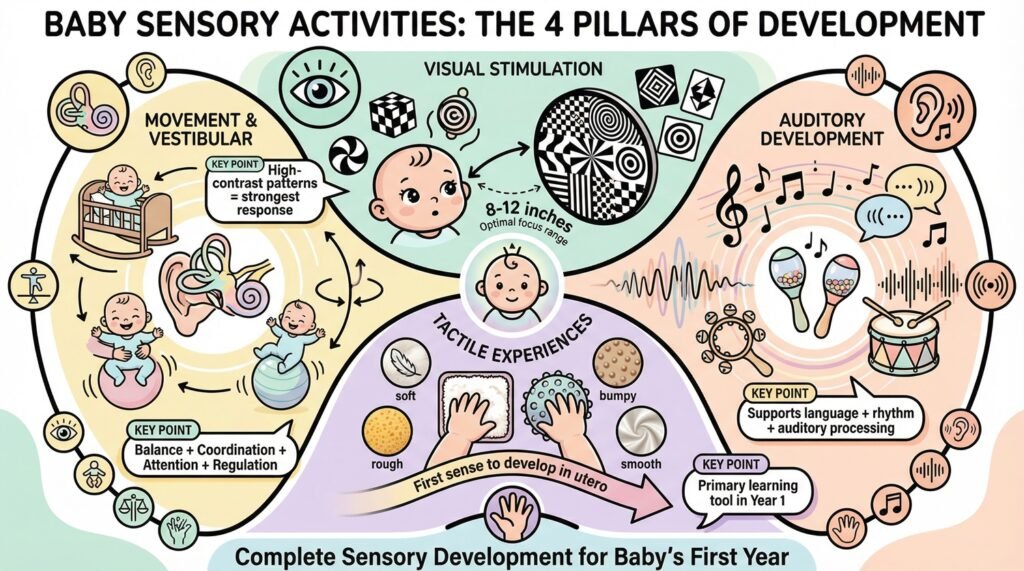
One of the first things you’ll notice in a baby sensory session is the emphasis on high-contrast visuals, particularly black and white patterns. Newborns can only see about 8 to 12 inches in front of their faces, and their developing visual systems respond most strongly to stark contrasts.
During typical sessions, babies are shown geometric patterns, stripes, and bold shapes. Instructors often use large cards or fabric panels with these designs, moving them slowly within the baby’s visual range.
You might see checkerboards, concentric circles, or zigzag patterns.
The movement is deliberate and slow because babies need time to track objects with their eyes, and this tracking motion builds the neural pathways that support later skills like reading.
As babies get older, typically around three to four months, the sessions introduce more colors. Red is usually added first because babies can distinguish it earliest after black and white.
You’ll see activities involving colored scarves, ribbons, or balls being moved in predictable patterns, up and down, side to side, or in gentle circles.
The instructors watch for the babies’ eye movements, encouraging parents to notice when their little ones successfully track an object from one side to the other.
Light play becomes increasingly important as babies approach six months. Many sensory sessions incorporate bubble machines, fiber optic lights, or disco balls that create moving light patterns.
These activities teach babies about cause and effect, spatial relationships, and help develop their ability to shift focus between near and far objects.
I’ve seen babies who initially couldn’t follow a bubble suddenly lock onto one and track it all the way to the ground, and that moment represents real neurological development happening right then.
Auditory Development Through Sound Exploration
The sound component of baby sensory classes extends far beyond just playing music. Sessions expose babies to a carefully curated range of auditory experiences that support language development, rhythm recognition, and auditory processing.
Sessions typically begin with a hello song that has a consistent melody and rhythm. This repetition helps babies start to recognize patterns in sound, which is fundamental to language acquisition.
You’ll notice instructors use their voices in exaggerated ways, higher pitches, elongated vowels, and clear consonant sounds.
This “parentese” or infant-directed speech captures babies’ attention more effectively than normal speech patterns and supports phonemic awareness.
Instrumental variety is another key element. During a single session, babies might hear shakers, drums, bells, rattles, rain sticks, and various percussion instruments.
Each produces a different timbre and frequency, and exposing babies to this variety helps develop their ability to discriminate between sounds.
This skill becomes crucial later when they’re trying to distinguish between similar phonemes in language, like “ba” and “pa.”
Many sessions incorporate sound exploration time where babies are given age-appropriate instruments to manipulate themselves. A six-month-old might be given a rattle or a crinkle toy, while a ten-month-old might explore a small drum or xylophone.
The act of creating sound through their own actions teaches cause and effect in a really concrete way.
They learn that their movements have consequences in the world, which is a foundational concept for later problem-solving skills.
Silence is also strategically used. After a particularly stimulating musical activity, many instructors will create a quiet moment, sometimes just speaking softly or allowing ambient sounds to be heard. This contrast helps babies develop their ability to regulate their attention and arousal levels.
They learn that sensory experiences have beginnings, middles, and ends, that the world doesn’t maintain one constant level of stimulation.
Tactile Experiences and Touch-Based Learning
The tactile component of baby sensory gets really hands-on, literally. Touch is the first sense to develop in utero, and it stays a primary way babies learn about their environment throughout the first year.
In early sessions with younger babies, touch activities often involve the parents’ hands. Baby massage is often incorporated, using gentle strokes with different pressures on the baby’s arms, legs, back, and tummy.
This provides proprioceptive input that helps babies develop body awareness.
When you stroke down your baby’s arm from shoulder to fingertips, they’re receiving information about where that arm exists in space and how it connects to the rest of their body.
Texture exploration becomes more elaborate as babies gain better motor control. You’ll see texture trays or sensory bins filled with materials like natural sponges, silk fabric, fake fur, bubble wrap, or crinkle paper.
Younger babies might simply have these materials brushed gently against their palms or bare feet, while older babies are encouraged to reach for and grasp different textures themselves.
One particularly effective activity I’ve observed involves texture boards, large panels covered in different materials mounted at a height where babies doing tummy time can reach them. You might see sections of sandpaper next to corduroy next to smooth plastic next to soft velvet.
Babies will often spend several minutes running their hands over these different surfaces, and you can actually see their concentration as they process these different sensory inputs.
Messy play emerges around six to nine months when babies have better sitting balance and hand control. This might involve playing with cooked pasta, pudding, jello, or water with added safe colorants.
The squeamishness some parents feel about mess is really worth pushing through because these activities provide incredibly rich sensory input.
When a baby squishes pudding between their fingers, they’re learning about viscosity, temperature, and cause and effect. They’re also often bringing their hands to their mouths, which combines oral sensory input and helps reduce oral sensitivities that can later affect feeding.
Movement and Vestibular Stimulation
The movement component of baby sensory classes addresses the vestibular system, the sensory system that detects head position and movement in space. This system is housed in the inner ear and plays a crucial role in everything from balance to coordination to attention and arousal regulation.
Even in very young babies, instructors incorporate gentle movement activities. Parents might be guided to slowly rock their babies side to side, up and down, or in gentle circles while singing.
The key word here is “gentle”, the developing vestibular system can be easily overstimulated, which is why you’ll never see anyone tossing babies in the air or doing rapid movements in these sessions.
As babies gain head control, tummy time becomes a major focus. But sensory classes take tummy time beyond just placing babies on their stomachs on the floor.
You might see babies positioned on textured mats, on gentle inclines, or on slightly unstable surfaces like a rolled towel or small exercise ball (always with full support from an adult).
These variations need the baby to make constant tiny adjustments to maintain their position, which builds core strength and balance.
Bouncing activities become prominent once babies can sit with support, usually around five to six months. Parents might hold their babies facing outward on their laps and do gentle bounces to songs with strong beats.
This rhythmic vestibular input combined with auditory input helps mix many sensory systems.
Some classes use large exercise balls where babies can bounce while seated between a parent’s legs, which adds proprioceptive input as well.
Rolling and spinning activities appear for older babies who are mobile. An instructor might have parents place babies on large pieces of stretchy fabric and gently pull them in circles, or roll them like a log across a soft mat.
These experiences provide intense vestibular input in a controlled way, and they’re also really important for developing spatial awareness and building tolerance for movement that will later support activities like running, climbing, and even reading, which needs the eyes to move smoothly across a page.
Social and Emotional Development Components
What often surprises parents is how much of baby sensory focuses on social and emotional development. While the activities target specific sensory systems, they always happen in a social context that supports attachment and emotional regulation.
Circle time is standard in most sessions. Babies and their caregivers sit in a circle, and activities happen both in the center and within person parent-baby pairs.
This structure let’s babies observe other babies, which is a really important part of early learning.
Even though babies under one year aren’t engaging in cooperative play, they’re watching each other, and research shows this observation supports imitation skills and social interest.
The instructor models specific interaction styles for parents. You’ll notice really exaggerated facial expressions, lots of smiling, and careful attention to the baby’s cues.
When a baby looks away or shows signs of overstimulation, good instructors will point this out and model taking a break.
This teaches parents to read their baby’s signals and respond appropriately, which supports secure attachment and helps babies learn to regulate their own arousal levels.
Many activities incorporate peek-a-boo variations, which address object permanence, the understanding that things continue to exist even when you can’t see them. An instructor might hide a toy under a scarf and wait for the baby to pull it off, or hide their own face briefly and reappear.
These games seem simple, but they address a fundamental cognitive concept that develops throughout the first year and supports everything from language to problem-solving to emotional security.
Turn-taking activities appear with older babies. An instructor might roll a ball to a baby and wait for them to roll it back, or hand a shaker to a baby and then ask for it back.
These exchanges are the precursors to conversation and teach the fundamental social concept that interactions have a back-and-forth rhythm.
Creating Sensory Experiences at Home
Once you understand the principles, you can create really effective experiences at home without special equipment. The key is thinking about how to target different sensory systems in intentional ways.
For visual stimulation at home, you can create contrast cards using black marker on white paper or print free patterns online. Hang them near your changing table or where your baby does tummy time.
As your baby gets older, add primary colors, red, blue, yellow.
You can tape colored cellophane over a flashlight and shine it on walls or ceilings. A small mirror is incredibly engaging for babies and helps with visual tracking and self-recognition.
Auditory experiences are everywhere once you start thinking about them. Fill plastic bottles with different materials, rice, beans, water, bells, and secure the lids with strong tape.
Play different genres of music throughout the day.
Record yourself singing the same song repeatedly so your baby can hear the familiar melody even when you’re busy. Nature sounds, recordings of rain, ocean waves, or birds, provide varied auditory input.
For tactile experiences, gather materials from around your house. Create a treasure basket filled with safe items of different textures: a clean sponge, a wooden spoon, a silk scarf, a rubber ball, a metal measuring cup.
Let your baby explore under supervision.
Make sensory bags by filling sealed plastic bags with hair gel and adding small items to move around, then tape them securely to a highchair tray or floor.
Water play doesn’t need a special water table. Your bathtub works perfectly, or even a large mixing bowl with a towel underneath for younger babies.
Add different objects, cups for pouring, sponges for squeezing, plastic toys that float and sink.
The sensory input from water is incredibly rich, temperature, pressure, sound, visual effects.
Movement activities at home can be as simple as dancing while holding your baby, doing gentle bounces on your lap, or placing your baby on different surfaces. A blanket over grass feels different than a blanket over carpet, which feels different than a clean towel on a hardwood floor.
These variations all provide different sensory input.
Adapting Activities for Different Ages and Temperaments
Sensory activities need to be adjusted based on both your baby’s age and their person temperament. A session suitable for a three-month-old will look completely different from one for a ten-month-old, and even babies the same age have different tolerance levels for stimulation.
For newborns to three months, activities should be really gentle and brief. These babies are easily overstimulated, so think about short bursts of specific sensory input with plenty of quiet time in between.
High-contrast images shown for just a minute or two, gentle massage, soft singing, and simply being held in different positions all qualify as sensory activities for this age.
From three to six months, babies can typically handle longer sessions and more variety. This is when tracking activities become really effective, when tummy time can incorporate more textures and visuals, and when babies start reaching for objects intentionally.
You can introduce slightly more complex auditory experiences and begin basic texture exploration.
Six to nine months is when sensory play gets really dynamic. Babies are sitting, often starting to crawl, and actively exploring with their hands and mouths.
This is the prime time for sensory bins, messy play, and cause-and-effect toys.
Movement activities can be more vigorous, though still gentle and controlled.
Nine to twelve months brings mobility and intention. Babies are crawling or walking, following simple directions, and starting to imitate.
Sensory activities can involve more problem-solving, more variety, and longer duration.
You can introduce more complex social games and activities that need planning and sequencing.
Temperament matters just as much as age. Some babies are sensory-seeking, they love intense input and seem to want more, more, more.
Others are sensory-sensitive, they get overwhelmed easily and need gentler, shorter experiences with more recovery time.
Neither is better or worse, they’re just different, and activities should be tailored accordingly.
Watch for your baby’s cues. Signs of engagement include wide eyes, focused attention, reaching toward the stimulus, smiling, or vocalizing.
Signs of overstimulation include looking away, arching back, crying, hiccuping, or becoming glassy-eyed and still.
When you see these stress signals, reduce stimulation and provide comfort.
Frequently Asked Questions
What age should babies start sensory play?
Babies can start sensory activities from birth. Newborns benefit from gentle sensory experiences like high-contrast visuals held 8-12 inches from their face, soft singing, and light touch through baby massage.
The activities just need to be really gentle and brief for very young babies, then gradually increase in complexity and duration as they develop.
How long should a baby sensory session last?
For newborns to three months, keep sessions to 5-10 minutes. From three to six months, 15-20 minutes works well.
Babies six months and older can often handle 30-45 minute sessions, but always watch for signs of overstimulation and end early if needed. Quality matters more than duration, five focused minutes providing intentional sensory input has value.
Can baby sensory classes help with development delays?
Sensory activities can support babies with developmental delays by providing targeted input that encourages skill building. However, if you’re concerned about your baby’s development, talk to your pediatrician or a pediatric occupational therapist who can assess your baby and recommend specific interventions tailored to their needs.
What are signs my baby is overstimulated during sensory play?
Common signs include looking away or avoiding eye contact, arching their back, crying or fussing, hiccuping, turning red or pale, becoming very still and quiet, or showing jerky movements. Some babies also rub their eyes, pull their ears, or become glassy-eyed when overstimulated. When you notice these cues, stop the activity and provide calm comfort.
Do I need to buy special toys for baby sensory activities?
You don’t need special toys. Many effective sensory activities use household items, wooden spoons, metal measuring cups, fabric scraps, safe containers filled with rice or beans, cardboard boxes, or crinkly paper.
The goal is to provide varied sensory input, which you can achieve with everyday objects just as effectively as purchased toys.
How does tummy time relate to sensory development?
Tummy time provides many types of sensory input simultaneously. It gives vestibular input as babies lift and turn their heads, proprioceptive input as they push against the floor, tactile input from the surface beneath them, and visual input as they look around.
Tummy time builds the core strength, head control, and motor skills that support all other developmental areas.
What is the vestibular system and why does it matter for babies?
The vestibular system, located in the inner ear, detects head position and movement in space. It controls balance, coordination, and helps regulate attention and arousal levels.
Activities that gently move babies through space, rocking, bouncing, rolling, stimulate this system.
A well-developed vestibular system supports later skills like sitting, crawling, walking, and even reading.
Can babies do water sensory play?
Yes, water provides excellent sensory input. Babies can explore water during bath time or in shallow containers with supervision.
Water offers tactile, temperature, visual, and auditory input.
Add cups for pouring, sponges for squeezing, or toys that float and sink. Always supervise water play closely and never leave a baby unattended near water.
How do I know which sensory activities my baby prefers?
Watch your baby’s responses carefully. Signs of interest include sustained attention, reaching toward the activity, smiling, vocalizing, and returning to the activity many times.
Babies will look away or fuss at activities that don’t interest them.
Some babies love movement while others prefer visual or tactile experiences. Follow your baby’s lead and offer what engages them most.
Key Takeaways
Baby sensory activities target many sensory systems, visual, auditory, tactile, vestibular, proprioceptive, and sometimes olfactory, to support rapid brain development during the first year of life. The activities are based on neuroscience research showing that specific types of sensory input during critical periods support optimal neural pathway formation.
Sessions typically include high-contrast visuals that progress to colors, varied auditory experiences from music to instruments to voice play, extensive tactile exploration with different textures and temperatures, and movement activities that develop the vestibular system.
Social and emotional development happens simultaneously with sensory development through turn-taking, imitation, and learning to read social cues. You can create effective sensory experiences at home using simple household items once you understand the principles of targeting different sensory systems intentionally.
Activities must be adapted based on both chronological age and person temperament, with careful attention to signs of engagement versus overstimulation. Repetition with variation builds stronger neural pathways than one-time experiences, so consistent, varied sensory input is more valuable than occasional elaborate activities.