I remember the first time my daughter grabbed a handful of cooked spaghetti during dinner. The look of absolute wonder on her face as those slippery noodles squished between her tiny fingers was priceless.
What I thought would be just another messy meal turned out to be a profound learning moment, and my introduction to understanding what sensory play really means for babies.
Most parents know babies need stimulation, but the concept of sensory play often gets reduced to buying expensive toys with different textures. That works to some extent, but it really just scratches the surface of what sensory exploration can offer your baby’s developing brain. The reality is that sensory play encompasses so much more than touch, and understanding how to facilitate these experiences can genuinely transform how your baby learns about their world.
In this guide, I’ll break down what sensory play actually means for infants, why it matters more than you might think, and how to apply it effectively at different stages of your baby’s first year and beyond.
Understanding Sensory Play Beyond the Basics
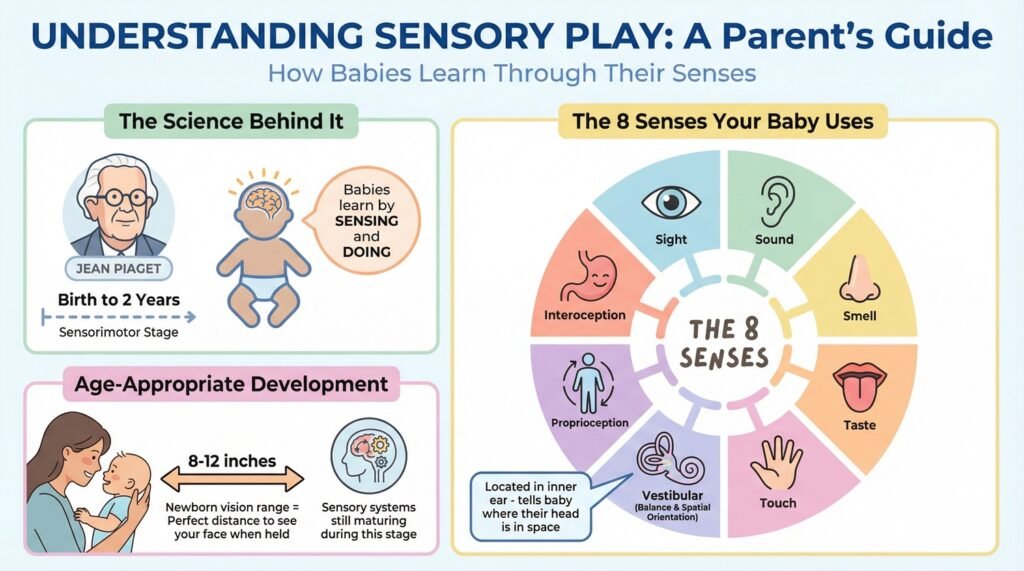
Sensory play refers to any activity that stimulates one or more of your baby’s senses: touch, smell, taste, sight, hearing, and the often-forgotten senses of movement and body position. While that might sound straightforward, the magic happens in how babies process these sensory inputs to build neural pathways that form the foundation for all future learning.
When your baby squishes their fingers into yogurt or watches a mobile spin above their crib, their brain is forming millions of connections. These connections build a library of sensory information that helps them understand cause and effect, develop problem-solving skills, and eventually master complex tasks like walking, talking, and reading.
The theoretical framework behind sensory play draws heavily from Jean Piaget’s work on cognitive development, particularly the sensorimotor stage from birth to about two years old. During this period, babies literally learn by sensing and doing.
They don’t have the language or abstract thinking capabilities to learn through instruction, so they rely entirely on direct sensory experiences to understand their environment.
What makes this particularly interesting is that sensory play focuses on integration. Your baby’s brain needs to learn how to take information from many senses simultaneously and create a coherent understanding of what’s happening.
When they’re playing with a rattle, they’re not just hearing sound or seeing movement or feeling texture in isolation.
Their brain is working incredibly hard to combine all those inputs into a single experience labeled “rattle.”
The Eight Senses You Need to Know About
Most people stop counting at five senses, but modern developmental research has identified eight distinct sensory systems that babies are actively developing. Understanding all eight changes how you approach sensory play completely.
The traditional five, sight, sound, smell, taste, and touch, are the obvious ones. Your baby uses these constantly to gather information about objects, people, and their environment.
But the three extra senses are equally critical and often underutilized in typical play scenarios.
The vestibular sense relates to balance and spatial orientation. It’s centered in the inner ear and tells your baby where their head is in space and whether they’re moving.
Every time you gently swing your baby, rock them, or help them roll over, you’re providing vestibular input.
This sense is absolutely foundational for later physical development, from sitting up to walking to running without falling.
Proprioception is your baby’s sense of where their body parts are in relation to each other without looking. It comes from receptors in muscles and joints.
When your baby pushes against your hands during tummy time or kicks their legs forcefully, they’re developing proprioceptive awareness.
This sense is what eventually allows them to feed themselves without looking at their hand the entire time or navigate stairs without staring at their feet.
The eighth sense, interoception, relates to internal body signals like hunger, fullness, needing to use the bathroom, or feeling emotionally overwhelmed. While this develops more slowly, early sensory experiences help babies start recognizing and responding to these internal cues.
Age-Appropriate Sensory Activities That Actually Matter
The sensory activities suitable for a two-month-old look vastly different from those suitable for a ten-month-old. Matching the complexity of sensory experiences to your baby’s developmental stage is really important for both safety and effectiveness.
Birth to Three Months
During this stage, your baby’s sensory systems are still quite immature. Their vision is limited to about eight to twelve inches, conveniently, roughly the distance to your face when you’re holding them.
High-contrast images in black, white, and red are most visible to them because their color vision is still developing.
For touch, focus on varied gentle textures against their skin. Different fabrics during skin-to-skin contact, soft brushes lightly stroking their arms and legs, or even the sensation of different temperatures during bath time all provide valuable input. The key is gentle and brief.
Newborns can become overstimulated quickly.
Auditory experiences should include your voice above all else. Introduce gentle music, nature sounds, or even the rhythmic sound of a washing machine.
Babies at this age are particularly tuned into prosody, the rhythm and intonation of speech, more than actual words.
For vestibular stimulation, slow rocking, gentle swaying while you hold them, and supervised tummy time all contribute to their developing sense of balance and body position.
Four to Six Months
As your baby gains more control over their movements, sensory play can become more interactive. They’re now reaching for objects intentionally and bringing everything to their mouths, which is actually a sophisticated form of sensory exploration.
Water play during bath time becomes much more engaging at this stage. Let them splash, feel the water running over their hands, and experience how water behaves differently than solid objects.
The cause-and-effect learning happening here is substantial.
Fabric books with different textures on each page provide multisensory input. Your baby sees the colors and shapes, feels the textures, hears the crinkly material inside, and yes, tastes the corners when they inevitably end up in their mouth.
Simple food-based sensory play can begin if your pediatrician has cleared you for starting solids. A small amount of mashed banana on their high chair tray gives them a safe, edible material to explore.
They’ll squish it, spread it, and eventually realize it tastes good too.
Seven to Twelve Months
This is when sensory play really opens up. Your baby has developed the fine motor skills to manipulate objects more deliberately, the gross motor skills to change positions independently, and the cognitive capacity to engage in more complex exploratory behavior.
Sensory bins become possible, though with significant modifications for safety. Instead of traditional fillers like rice or beans that present choking hazards, consider using larger items like scarves, large pom-poms, or crinkly paper.
The container itself should be shallow and wide, allowing your baby to easily reach everything without leaning in dangerously.
Homemade sensory bags offer contained mess while still providing tactile input. Seal hair gel, water beads, or even cooked pasta inside a heavy-duty freezer bag, tape the edges with strong packing tape, and let your baby squish and push the contents around.
The visual movement combined with the resistance against their hands creates fascinating sensory feedback.
Food continues to be an excellent sensory material at this age. Cooked spaghetti, yogurt, applesauce, and cooked sweet potato all have distinct textures and are completely safe if ingested. Set your baby up in just a diaper during these activities and embrace the mess, the learning happening is worth the cleanup.
The Science of Neural Development Through Sensory Input
Understanding what’s happening in your baby’s brain during sensory play helps you appreciate why it matters so much. At birth, babies have roughly one hundred billion neurons, about the same number they’ll have as adults.
What changes dramatically is the number of connections between those neurons.
During the first three years of life, your baby’s brain forms about one million new neural connections every single second. These connections, called synapses, are formed in response to experiences.
Sensory experiences are the primary driver of this synapse formation during infancy.
The brain initially overproduces synapses, creating far more connections than will ultimately be needed. Through a process called synaptic pruning, connections that are used often are strengthened, while those that aren’t used are eliminated. This “use it or lose it” principle means that the sensory experiences you provide literally shape the architecture of your baby’s brain.
Different types of sensory input stimulate different brain regions. Visual experiences activate the occipital lobe, sounds stimulate the temporal lobe, and touch activates the parietal lobe.
But when many senses are engaged simultaneously, it creates more robust neural networks because many brain regions are activated and connected.
This is why multisensory experiences are particularly powerful for learning. When your baby plays with a rattle, the simultaneous engagement of many senses creates cross-modal associations.
The brain learns that this particular visual stimulus goes with this particular sound and this particular feeling in their hand.
Creating Effective Sensory Experiences at Home
You don’t need expensive equipment or elaborate setups to provide rich sensory experiences for your baby. In fact, some of the most effective sensory activities use items you already have around your house.
The key principle is variety within safety boundaries. Your baby’s brain learns by comparing and contrasting experiences, so providing diverse sensory inputs helps them develop more nuanced understanding.
But every material and activity needs to be evaluated through a safety lens first.
For tactile experiences, gather materials with genuinely different textures. Smooth silk fabric, rough washcloth, bumpy textured rubber mat, soft cotton ball, firm wooden spoon, squishy foam, and slippery bar of soap all provide distinct tactile information.
Let your baby feel these materials against their hands, feet, and even gently against their cheeks or arms.
Temperature adds another dimension to tactile play. Slightly cool water versus lukewarm water feels remarkably different to a baby’s sensitive skin. A cold teething toy from the refrigerator provides different sensory input than a room-temperature one.
Always keep temperature changes mild.
You’re trying to provide noticeable variety, not shock their system.
For visual sensory play, focus on contrast, movement, and complexity. Black and white patterns remain engaging even after the newborn period because of their high contrast.
Watching scarves fall slowly through the air helps develop visual tracking skills.
Mirrors are endlessly fascinating because they provide visual feedback of movement, your baby sees their own hand move in real time, strengthening the connection between motor planning and visual processing.
Auditory experiences should include volume variation, different tones and pitches, rhythmic versus arrhythmic sounds, and the location of sound sources. Shaking a maraca near your baby’s right ear, then their left, then above their head helps them develop auditory localization skills.
Singing the same song at different tempos helps them recognize familiar patterns despite variation.
Common Challenges and Practical Solutions
Implementing sensory play consistently presents several predictable challenges, and knowing how to navigate them makes the difference between giving up and creating sustainable routines.
The Mess Factor
Sensory play is inherently messy, and that mess can feel overwhelming, especially when you’re already exhausted from caring for a baby. The solution means containing and managing it strategically as opposed to trying to eliminate it entirely.
Set up sensory activities in spaces that are easy to clean. A highchair over a vinyl mat, the bathtub, or outside on a patio all work well.
Keep cleanup supplies immediately accessible so you’re not dreading the aftermath.
Let your baby play in just a diaper when using particularly messy materials. Take photos before you start cleaning up.
Capturing the joy and engagement helps you remember why the mess was worth it.
Overstimulation Concerns
Some babies have lower thresholds for sensory input and can become overwhelmed quickly. Signs of overstimulation include turning away, arching their back, crying, or becoming glassy-eyed and checked out.
The solution is observing and responding to your person baby’s cues. Some babies can engage in sensory play for twenty minutes while others max out at five.
Some love vigorous vestibular input like being bounced, while others prefer gentle swaying.
Start with lower-intensity sensory experiences and watch how your baby responds. You can always add more stimulation, but you can’t unsend sensory input that’s already overwhelmed their system.
If your baby consistently seems overwhelmed by typical sensory experiences, that’s worth discussing with your pediatrician. Some babies have sensory processing differences that benefit from professional support, but many simply have temperamental preferences for certain types of input over others.
Safety Versus Learning
The tension between wanting to provide rich sensory experiences and keeping your baby safe is real and constant. Babies learn by mouthing objects, but that creates choking risks.
They learn through exploration, but that means they might grab something hot or sharp.
The solution is supervision paired with thoughtful material selection. During dedicated sensory play time, you’re present and watching, which allows you to offer materials that need monitoring.
Choose food-based materials when possible for babies who are still mouthing everything.
Save activities with smaller pieces for times when you can provide undivided attention.
Create “yes spaces” where your baby can explore freely without constant intervention. A baby-proofed room with various safe sensory materials means you can relax your vigilance slightly while they’re still getting valuable sensory input.
Adapting Sensory Play to Your Baby’s Unique Profile
Not all babies respond to sensory input the same way, and recognizing your baby’s unique sensory preferences helps you tailor activities for most engagement and learning.
Some babies are sensory seekers. They want more, bigger, louder, faster input.
These babies often enjoy vigorous movement, don’t startle easily at loud sounds, and will repeatedly engage with highly stimulating materials.
For these babies, you can lean into more intense sensory experiences like bouncing, dancing to upbeat music, or playing with materials that provide strong sensory feedback.
Other babies are more sensory sensitive. They’re easily overwhelmed and prefer gentler, more predictable input.
These babies might startle at moderately loud sounds, dislike sudden movements, or cry when they encounter certain textures.
For these babies, introduce new sensory experiences slowly, stick with calmer activities like gentle rocking or quiet music, and always provide an exit route if they become uncomfortable.
Many babies fall somewhere in the middle, seeking certain types of input while being sensitive to others. Your baby might love visual stimulation but dislike having messy textures on their hands.
They might want constant movement but prefer quieter environments.
Pay attention to what truly engages your baby versus what seems to stress them out. Your baby’s sensory preferences will also shift over time.
A baby who was sensory sensitive at three months might become a sensory seeker by nine months.
Stay flexible and keep offering varied experiences, noting what resonates at each stage.
Building Complexity Over Time
As your baby develops, sensory play should evolve to match their increasing capabilities. The goal is always to provide experiences that are challenging enough to promote learning but not so difficult that they become frustrating.
Around nine to twelve months, your baby can handle sensory experiences that need more problem-solving. Instead of just feeling different textures passively, they can now pull scarves out of a tissue box, transfer objects between containers, or stack blocks with different textures.
These activities combine sensory input with emerging cognitive skills like object permanence and cause-and-effect understanding.
Introducing obstacle courses for crawlers provides multisensory input. Cushions to crawl over, tunnels to move through, and different textured mats to traverse all engage many sensory systems simultaneously while building motor skills.
The vestibular and proprioceptive input from navigating varied terrain is particularly valuable.
Sound-making activities become more sophisticated. Instead of just listening to sounds, older babies can create them intentionally, banging wooden spoons on different surfaces to hear how the sound changes, shaking containers with different items inside, or dropping objects to hear them fall.
Integrating Sensory Play Into Daily Routines
The most sustainable approach to sensory play means recognizing and enhancing the sensory opportunities already present in your daily routines as opposed to always setting aside special times for dedicated activities, though those have value too.
Diaper changes offer repeated chances for tactile input. Gently massage your baby’s legs and arms, let them feel the texture of the changing pad versus a soft blanket, or give them a small toy with interesting texture to hold during changes.
Mealtimes are naturally sensory-rich. Even before your baby starts self-feeding, they can touch and explore the food on their tray.
The different temperatures, textures, and smells all provide valuable input.
As they begin feeding themselves, the proprioceptive input of bringing food to their mouth and the fine motor practice of picking up small pieces add layers of sensory-motor integration.
Getting dressed provides opportunities to name body parts while providing touch input. “I’m putting the sleeve on your arm, now your other arm.” Different fabrics feel different against their skin. Pulling a shirt over their head gives them a moment of visual darkness followed by reemergence, a simple but engaging sensory experience.
Bath time is perhaps the ultimate built-in sensory activity. The water temperature, the feeling of water being poured over their skin, the echoing acoustics of the bathroom, the sight of water flowing and splashing all engage nearly all sensory systems at once.
Adding bath toys with different textures, squirters that teach cause and effect, or even foam letters that stick to the tub wall when wet all enhance the sensory richness.
Frequently Asked Questions
What age should you start sensory play with babies?
You can start sensory play from birth. Newborns benefit from simple sensory experiences like skin-to-skin contact, listening to your voice, and looking at high-contrast images.
The activities just need to be suitable for their developmental stage and kept gentle and brief to avoid overstimulation.
How long should sensory play sessions last?
This varies dramatically based on your baby’s age and temperament. Newborns might only engage for one to two minutes before needing a break.
By six months, some babies can handle ten to fifteen minutes.
By their first birthday, some babies enjoy twenty to thirty minutes of sensory exploration. Watch your baby’s cues as opposed to following rigid time guidelines.
What are sensory bins for babies?
Sensory bins are containers filled with materials that babies can touch, scoop, pour, and explore. For young babies, these need to use large, safe items like scarves or large pom-poms as opposed to small items like rice or beans that present choking hazards.
The bin should be shallow enough that your baby can reach everything easily.
Is sensory play messy?
Yes, effective sensory play usually involves some mess because babies learn by fully engaging with materials, which often means squishing, spreading, and yes, sometimes throwing. You can manage the mess by choosing suitable locations like high chairs over mats or bath tubs, and dressing your baby in minimal clothing during messy activities.
Can you do sensory play without buying special toys?
Absolutely. Some of the best sensory materials are household items.
Wooden spoons, metal bowls, fabric scraps, ice cubes, cooked pasta, cardboard boxes, crinkly paper, and safe kitchen utensils all provide rich sensory input without costing anything extra.
What if my baby doesn’t like sensory play?
Some babies are more cautious or sensitive to certain sensory inputs. Start with very gentle, familiar experiences and gradually introduce variety.
Let your baby observe before touching if they seem hesitant.
Some babies prefer certain types of sensory input over others, and that’s completely normal.
Do sensory activities help with speech development?
Yes, indirectly. Sensory play builds the neural connections that support all learning, including language development.
Activities that strengthen oral motor skills, like blowing bubbles or exploring different food textures, specifically support the physical aspects of speech production.
How do you clean up after sensory play?
Keep cleanup supplies nearby before you start. For food-based sensory play, a damp cloth handles most of it.
For activities with materials like foam or paper, a small handheld vacuum works well.
Doing sensory activities before bath time means you can simply transition to the tub when play is finished.
Key Takeaways
Sensory play directly supports brain development by creating the neural connections that form the foundation for all future learning. The sensory experiences you provide during the first year shape your baby’s brain architecture.
There are eight sensory systems to engage, not just five. The vestibular, proprioceptive, and interoceptive senses are equally important as the traditional five senses and often get overlooked in typical play.
Age-appropriate activities are essential. What works at two months will bore a ten-month-old, and what’s suitable at ten months would overwhelm a newborn.
Match the complexity of sensory experiences to your baby’s current developmental stage.
Multisensory experiences that engage several senses simultaneously create stronger neural networks than single-sense stimulation. When many brain regions activate together, they form more robust connections.
Effective sensory play doesn’t need expensive toys. Household items, food, natural materials, and your own voice and movement provide rich sensory input without special purchases.
Every baby has unique sensory preferences. Observing your person baby’s responses and adjusting accordingly matters more than following generic activity recommendations.
Mess reflects real learning. Managing mess strategically as opposed to avoiding it entirely preserves the developmental benefits of sensory exploration.
Daily routines like diaper changes, meals, and bath time offer natural sensory opportunities that don’t need extra time commitments. Recognizing and enhancing these built-in sensory moments makes sensory play sustainable.
Progress in sensory processing shows up as longer attention spans, more complex exploratory behavior, improved motor control, and better regulation in stimulating environments. These changes show your baby’s brain is effectively processing and integrating sensory information.