When my sister-in-law asked me to help her choose an activity gym for her first baby, I realized how overwhelming this decision really is. You’re standing there, faced with price tags ranging from $50 to $300+, and every product promises to perform to your baby’s developmental potential.
Making the wrong choice means wasted money and potentially missing out on crucial developmental support during those first precious months when your baby’s brain is forming connections at lightning speed.
The stakes are higher than most new parents realize. Research on infant brain development shows that babies who receive appropriate sensory stimulation and tummy time support reach motor milestones earlier and with more confidence.
The activity gym you choose becomes part of your baby’s daily routine, potentially used for thousands of hours over the first year.
A high-quality gym that engages your baby for 30 minutes daily adds up to over 180 hours of developmental play by six months. The difference often comes down to understanding what babies actually need at different stages versus what looks impressive in Instagram photos.
Let me walk you through how to make this decision with confidence.
Understanding What Babies Actually Need from Activity Gyms
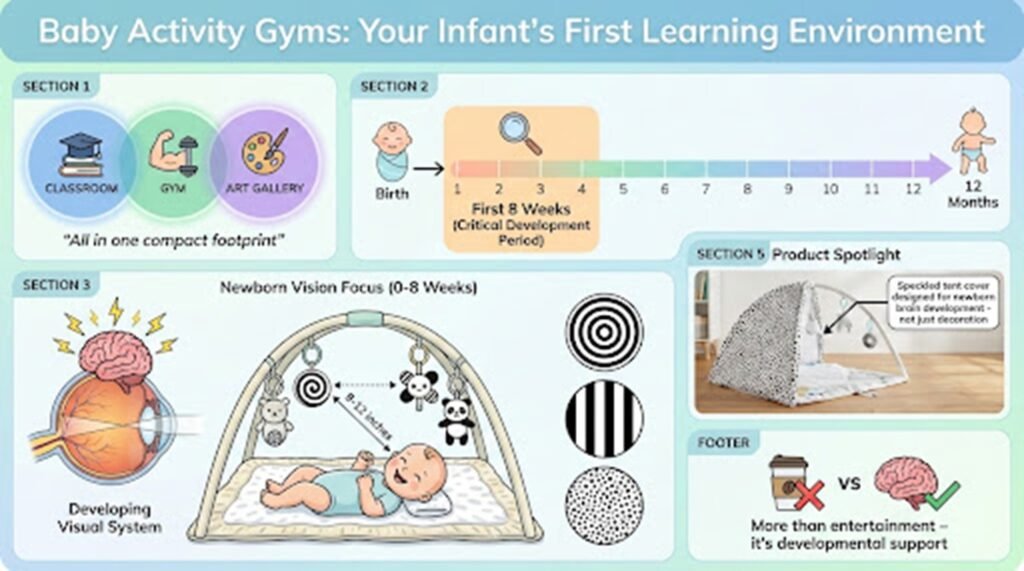
The basic purpose of an activity gym extends far beyond keeping your baby entertained while you drink coffee. These structures serve as your infant’s first classroom, gym, and art gallery rolled into one compact footprint.
From birth through roughly 12 months, babies progress through distinct developmental phases that benefit from specific types of stimulation.
During the first eight weeks, newborns primarily need high-contrast visual elements positioned about 8-12 inches from their face, which is the exact distance they can focus. Their visual system is still developing, and bold black-and-white patterns provide the strongest neural stimulation.
The Lovevery Play Gym includes a black-and-white speckled tent cover specifically for newborns.
This feature functions as brain development support, not decoration.
Around three months, babies start reaching and batting at objects, transitioning from passive observation to active engagement. Hanging toys, varied textures, and cause-and-effect elements become crucial during this phase.
The Baby Einstein Kickin Tunes mat works really well here because babies can accidentally trigger the piano with kicks, then gradually learn to activate it intentionally.
That progression from random action to purposeful movement represents genuine cognitive development happening in real-time.
By six months, most babies are working on rolling, sitting, and coordinating both hands together. They need toys they can grasp, manipulate, and even mouth safely.
The best activity gyms accommodate this progression by offering removable toys that can be repositioned or replaced as skills advance.
I’ve seen parents frustrated when their five-month-old loses interest in a gym that worked beautifully at two months. That usually happens because the gym lacked developmental adaptability.
Material quality matters more than most marketing suggests but less than premium brands would have you believe. Yes, FSC-certified wood and organic cotton are genuinely better for babies who will inevitably chew on everything.
But the $100 difference between standard safe materials and certified organic materials might be better spent on other developmental tools if budget is tight.
What you absolutely cannot compromise on is avoiding gyms with small detachable parts that pose choking hazards, unstable arches that could collapse, or materials treated with harmful chemicals. These safety concerns should guide your least standards regardless of price point.
Evaluating the Top Contenders in Real-World Conditions
The Lovevery Play Gym consistently earns its reputation through thoughtful design choices backed by child development research. What impressed me most when examining this gym was the included developmental guide, not just the aesthetic appeal (though the Scandinavian-influenced design is genuinely beautiful).
This booklet walks parents through age-appropriate ways to use each feature, transforming a product into an educational tool.
At $269, the price definitely requires consideration. When you break down the cost per month of use, it comes to roughly $22 if used for 12 months, which becomes more reasonable.
Parents consistently report that this gym stays engaging longer than cheaper choices, which often get abandoned by four or five months.
That longevity directly addresses one of the biggest pain points I’ve observed: the graveyard of abandoned baby gear cluttering homes because items only served a brief developmental window.
The three wooden arches are significantly sturdier than the typical collapsible fabric-covered arches found on budget models. I’ve watched babies grab and pull on these arches as they learn to sit up, and the structure stays completely stable.
That stability matters for safety, obviously, but it also matters for confidence-building.
When babies can pull on objects without them toppling over, they’re more willing to take physical risks that advance their motor skills.
The Baby Einstein Kickin Tunes mat occupies an interesting position as the budget option that genuinely delivers developmental value. When I first encountered this gym, I was skeptical because products marketed with licensed characters often prioritize branding over functionality.
But the interactive piano element addresses something crucial that many premium gyms miss: immediate feedback that teaches cause and effect.
Babies are scientists constantly running experiments about how the world works. When they kick their legs and music plays, neurons are literally connecting in their developing brains.
The fact that this feature works consistently, unlike some cheaper electronic toys that malfunction quickly, makes it genuinely worth the $100-150 price tag.
The included tummy time pillow also adds value by providing proper support for newborns who find tummy time frustrating without positioning aids.
However, this gym has limitations that become obvious around six to seven months. The mat itself provides less cushioning as babies become more active.
The toys, while colorful and varied, lack the sophistication of those included with premium options.
And the overall aesthetic screams “baby gear” in a way that bothers parents trying to maintain a cohesive home design. For families where budget is the primary concern and a gym just needs to work well for six months, these tradeoffs make sense.
The Lalo Play Gym represents the intersection of sustainability, aesthetics, and functionality. Constructed from FSC-certified beech wood with a Lyocell mat derived from eucalyptus trees through an eco-friendly process, this gym appeals specifically to environmentally conscious families who won’t compromise on materials.
At $125, it occupies the middle price range while delivering premium materials.
What makes Lalo distinctive is its commitment to minimalism. There are no electronic features, no excessive toys dangling from every possible attachment point, and no bright primary colors competing for attention.
This restraint actually serves developmental purposes.
Research on infant attention suggests that babies benefit more from focused engagement with fewer high-quality objects than from constant exposure to multiple competing stimuli. The Lalo approach gives babies space to really explore each element without overwhelming their developing sensory systems.
The limitation here is that this gym works best for younger babies, roughly newborn through six months. It lacks the climbing elements or advanced features that keep older babies engaged as they transition toward crawling and pulling up.
Families who choose Lalo often need to transition to a Pikler triangle or similar climbing structure earlier than those who invested in more feature-rich gyms.
Whether that’s a problem depends entirely on your family’s approach to baby gear. Some parents prefer specialized items for each stage, while others want most longevity from each purchase.
Making the Right Choice for Your Specific Situation
I’ve noticed that the “best activity gym” question often masks deeper concerns about parenting decisions and resource allocation. First-time parents especially struggle with distinguishing necessary investments from marketed wants.
Let me walk through how different family situations should approach this decision.
For families with limited budgets where every dollar counts, the Baby Einstein Kickin Tunes mat delivers solid developmental value without requiring financial stress. But I’d actually suggest considering used premium options as an choice.
The Lovevery Play Gym holds its value remarkably well on secondhand markets, and because the mat is machine washable and the wooden components are durable, a used one in good condition performs identically to new.
I’ve seen these selling for $150-180 used, which positions them competitively against new mid-range options while delivering premium features.
The calculation changes completely if you’re planning multiple children. Suddenly that $269 Lovevery investment divides across two or three babies, dropping the per-child cost to $90-135.
Premium gyms are specifically designed to withstand multiple children because the materials don’t degrade quickly and the classic design doesn’t feel dated years later.
Budget options, conversely, often show wear after one baby’s use, making them less suitable for hand-me-down purposes.
For families living in apartments or homes with limited space, the storage question becomes paramount. The Melissa & Doug Ocean Easy-Fold Play Gym addresses this pain point more directly than any competitor.
The arches fold completely flat at the push of a button while the mat and toys stay attached, eliminating the frustrating reassembly process that makes other foldable gyms impractical for daily use.
At $150-200, the price competes with other mid-range options while solving a specific problem that genuinely impacts daily life. I’ve talked with parents who initially dismissed the storage concern as minor, then found themselves leaving the gym set up in their living room permanently because disassembly was too annoying.
That permanent footprint creates tension in homes where space is precious.
The Melissa & Doug model genuinely folds and unfolds in under 30 seconds, making it realistic to store between uses.
Environmentally conscious families face a different calculation. The sustainability features of options like Lalo, Piccalio, or CassaroKids carry price premiums, but these reflect real costs of responsible sourcing and manufacturing.
FSC certification confirms wood comes from responsibly managed forests.
Water-based finishes cost more than conventional paints but eliminate VOC exposure. Lyocell production uses 99% less water than conventional cotton growing.
Whether these premiums are worth paying depends on how you weight environmental impact in purchasing decisions. What I appreciate about the premium eco-friendly brands is their transparency.
They clearly explain what makes their materials different as opposed to using “natural” as vague marketing language.
That transparency helps parents make informed tradeoff decisions.
Common Mistakes That Undermine the Investment
The biggest mistake I see parents make is choosing based primarily on how the gym looks in product photos as opposed to evaluating developmental appropriateness. A gym covered in bright colors, lights, and dangling toys looks exciting in images, but research increasingly suggests that visual complexity can actually overwhelm young babies as opposed to engaging them.
Their developing brains process stimulation differently than older children or adults.
Many pediatric occupational therapists recommend starting with simpler gyms that allow you to control stimulation levels. The Lovevery design philosophy embraces this approach by including the black-and-white tent cover for newborns, then gradually introducing more complex visual elements as babies mature.
You’re matching the gym to the baby’s developmental stage as opposed to presenting everything at once.
Another frequent error is underestimating how quickly babies outgrow certain features. Gyms marketed with lots of electronic elements often get abandoned earlier because babies become bored with the same sounds and lights.
Meanwhile, gyms with versatile, open-ended features like mirrors, varied textures, and moveable toys stay engaging longer because babies find new ways to interact with them as their skills develop.
I’ve also observed parents choosing gyms based primarily on price without calculating cost-per-use. A $60 gym that gets used for three months delivers worse value than a $200 gym used for 12 months.
The real question is what you spend divided by hours of quality engagement your baby receives.
Asking friends about how long their babies actually used specific gyms provides more useful information than reading marketing materials about age ranges.
The cleaning factor catches many parents off guard. Babies are remarkably skilled at generating mess through spit-up, diaper leaks, and general drool constantly.
Gyms with machine-washable mats save enormous time and frustration compared to spot-clean-only models.
The difference between throwing a mat in the washing machine versus trying to hand-clean a foam mat with embedded electronics becomes significant when you’re doing it weekly.
Some parents also overlook the safety implications of gym construction. Arches should be stable enough that babies can’t pull them over as they gain strength.
Toys should attach securely without small parts that could detach and create choking hazards.
The Consumer Product Safety Commission maintains standards for infant products, but not all gyms undergo third-party safety testing. Premium brands typically provide clear safety certifications, while budget options may skip this verification step to reduce costs.
Building Developmental Support Beyond the Gym
What genuinely matters more than any specific product is creating regular opportunities for your baby to engage in developmentally appropriate play. The best activity gym in the world won’t support growth if it’s only used occasionally.
I’ve noticed that parents who incorporate gym time into consistent daily routines, like after morning feeding or before afternoon nap, see their babies engaging more deeply and progressing through milestones more confidently.
The pediatric guidance on tummy time provides a useful framework here. Start with short sessions of 5 minutes, three times daily, for newborns.
This feels manageable for parents and babies.
As your baby strengthens, gradually extend to 10 minutes, then 15-20 minutes by three months. By six months, many babies happily engage with play gyms for 30+ minutes, giving parents genuinely useful independent play time.
This progression only works if the gym stays interesting, which is where developmental appropriateness becomes crucial. Rotating toys every few weeks helps maintain novelty.
Even premium gyms with excellent toy selections benefit from occasional changes.
Swap in a new texture toy, reposition the mirror, or introduce a simple household item like a wooden spoon alongside the designed toys.
I particularly appreciate the Lovevery approach of including age-based guidance because it helps parents understand what to expect at different stages. When you know that your three-month-old is working on hand-eye coordination and your activities can specifically support that skill, you’re using the gym purposefully as opposed to just placing your baby there and hoping for the best.
Beyond the gym itself, combining structured play time with unstructured floor time creates the most supportive developmental environment. Babies need opportunities to move freely without equipment, practice rolling without arches overhead, and eventually crawl without obstacles.
The gym serves as one tool in a broader developmental toolkit.
People Also Asked
What age should I start using a baby activity gym?
You can start using a baby activity gym from birth, but newborns benefit most from high-contrast visual elements positioned 8-12 inches from their face. During the first few weeks, keep sessions short at around 5 minutes, three times daily.
As your baby gains neck strength around 6-8 weeks, they’ll start engaging more actively with hanging toys and different textures.
Are expensive baby gyms worth it?
Expensive baby gyms can be worth the investment if they’re used consistently for 8-12 months and especially if you’re planning multiple children. A $270 gym used by three children costs $90 per child, which is competitive with budget options.
Premium gyms typically feature sturdier construction, developmentally appropriate toys, and materials that hold up through extended use and multiple washings.
How long do babies typically use activity gyms?
Most babies use activity gyms from newborn through 6-8 months, though some premium models engage babies up to 12 months. Usage depends heavily on the gym’s adaptability to different developmental stages.
Babies typically lose interest when they start crawling and prefer exploring their environment, usually around 7-9 months.
What should I look for in a tummy time mat?
Look for a tummy time mat with adequate cushioning to protect against hard floors, machine-washable fabric for easy cleaning, and high-contrast patterns to engage newborns. The mat should be large enough that your baby won’t roll off easily as they get older.
Avoid mats with small detachable parts that could become choking hazards.
Can I use a baby gym on carpet?
Yes, you can use a baby gym on carpet, and it actually provides extra cushioning. However, make sure the gym sits stable and level on your carpet type.
Some gyms with thin legs may sink into plush carpet and become unstable.
For high-pile carpets, consider placing a firm play mat underneath to create a stable base.
Do baby gyms help with development?
Baby gyms support multiple areas of development including visual tracking, hand-eye coordination, reaching and grasping skills, and tummy time strength. The key is consistent use and matching activities to your baby’s current developmental stage.
A gym alone doesn’t guarantee developmental progress, but it provides structured opportunities for skill practice when used regularly.
What’s the difference between a play mat and an activity gym?
A play mat is typically a padded surface for floor play without overhead structures. An activity gym includes arches or frames that hold hanging toys above the baby.
Activity gyms provide more sensory stimulation for younger babies who aren’t yet mobile, while play mats work better for older babies who are rolling, sitting, or crawling.
Are wooden baby gyms better than plastic ones?
Wooden baby gyms offer durability, aesthetic appeal, and sustainability advantages. They typically withstand multiple children and don’t contain plastics that might leach chemicals.
However, quality plastic gyms that meet safety standards work perfectly fine developmentally.
The choice often comes down to personal preference regarding home aesthetics and environmental priorities as opposed to developmental outcomes.
Key Takeaways
The best activity gym for your baby depends on matching specific features to your family’s needs, space constraints, and budget realities. The Lovevery Play Gym earns its premium price through exceptional longevity and developmental sophistication, making it genuinely worthwhile for families who can afford the investment or who plan multiple children.
The Baby Einstein Kickin Tunes mat delivers surprisingly good value for budget-conscious families, proving that developmental support doesn’t need premium spending.
The Lalo Play Gym serves families prioritizing sustainability and minimalist design, while the Melissa & Doug foldable option solves the very real problem of storage in space-constrained homes. What matters more than your specific choice is implementing consistent, purposeful play that advance as your baby develops.
Document engagement patterns to understand what actually captures your baby’s attention. Rotate toys regularly to maintain novelty.
Create daily routines that incorporate gym time naturally.
Match the complexity of activities to your baby’s current developmental stage as opposed to overwhelming them with everything at once. Choosing an activity gym represents one of your first significant parenting investment decisions, and the research skills you develop through this process will serve you through countless future decisions about baby gear and resource allocation.