I used to think the whole Montessori toy thing was just clever marketing. You know, slap a “Montessori” label on a wooden block, charge triple the price, and watch parents line up with their wallets open.
But then I actually started paying attention to how my friends’ kids interacted with different types of toys, and honestly, the difference was pretty striking.
The confusion around Montessori toys versus regular toys is completely understandable. Walk into any toy store and you’re overloaded with thousands of options, all claiming to be educational, developmental, or somehow essential for your child’s future.
Meanwhile, you’re just trying to figure out what’s actually worth the investment and what’s going to end up in the donation pile three months from now.
Here’s what I’ve really come to understand about this distinction, and why it matters more than I initially thought. The gap between Montessori toys and regular toys goes much deeper than wood versus plastic or expensive versus affordable.
The difference shows up in how we think about childhood learning, what we believe children are actually capable of, and honestly, what we’re trying to accomplish with the objects we bring into our homes.
The Philosophy Behind the Toys
The fundamental difference starts with intention. Montessori toys exist because Dr. Maria Montessori spent years observing children and uncovered something that seems obvious now but was pioneering then: children are naturally driven to learn.
They don’t need to be entertained into education.
They need materials that match their developmental stage and allow them to explore concepts through their own hands and minds.
Regular toys emerged from an entertainment industry perspective. The goal was engagement, excitement, and keeping kids occupied. There’s nothing inherently wrong with that approach, but it comes from a completely different starting point.
One asks “how can we facilitate learning?” while the other asks “how can we capture attention?”
What really fascinates me is how this philosophical difference plays out in actual toy design. When you understand the why behind each type of toy, the physical differences start making a lot more sense.
Montessori materials are created with specific developmental milestones in mind.
A shape sorter becomes a carefully designed tool for understanding spatial relationships, developing fine motor control, and building problem-solving skills through trial and error.
Traditional toys often incorporate many functions, bright colors, sounds, and moving parts because the assumption is that more stimulation equals better engagement. But here’s the thing I’ve noticed: that assumption doesn’t always hold up in practice.
Sometimes more actually means less, less focus, less deep engagement, less opportunity for sustained concentration.
Design Characteristics That Matter
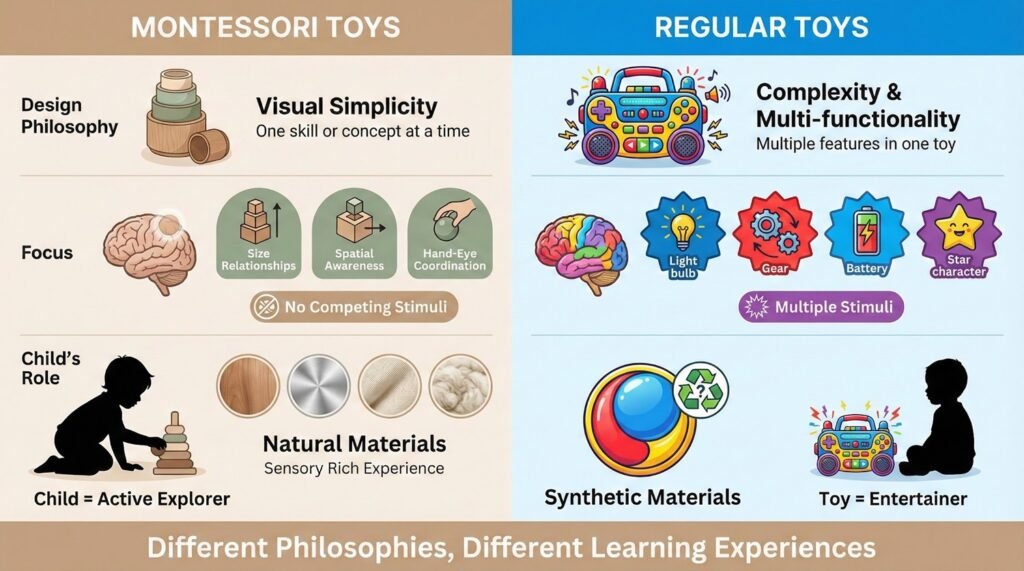
The visual simplicity of Montessori toys is really deliberate, not just aesthetic preference. These materials typically focus on one skill or concept at a time, which cognitive development research actually supports.
When a child works with a set of nesting cups, they’re exploring size relationships, spatial awareness, and hand-eye coordination without competing stimuli pulling their attention in many directions.
Regular toys tend to embrace complexity and multi-functionality. A single toy might light up, play music, have moving parts, need batteries, and feature characters from popular media.
Again, this isn’t inherently bad, but it serves a different purpose.
The toy itself becomes the entertainer as opposed to the child being the active explorer.
Material choice reflects these different philosophies too. Montessori toys predominantly use natural materials like wood, metal, cotton, and wool.
There’s a sensory richness to these materials that plastic simply can’t copy.
Wood has weight, texture, temperature, and even smell. These sensory inputs provide valuable information to developing brains about the physical world.
I’ve watched kids handle wooden blocks versus plastic ones, and the difference in how they approach them is genuinely noticeable. The wooden blocks get stacked more carefully, balanced more thoughtfully.
The plastic ones get dumped and scattered. Neither behavior is wrong, but they represent different types of engagement with the materials.
The heavier, more substantial feel of wood seems to naturally encourage more thoughtful handling. Kids slow down with wooden materials in a way they don’t with lightweight plastic.
Open-Ended Versus Prescribed Play
This distinction is probably the most significant practical difference I’ve observed. Montessori toys are intentionally open-ended, meaning there’s no single “right” way to use them. A set of wooden blocks can become a tower, a bridge, a sorting game, or an imaginary city.
The child brings their own ideas and creativity to the material.
Regular toys often have prescribed uses. Action figures are meant to act out scenarios, usually related to their franchise.
Electronic toys have specific functions triggered by specific buttons.
Puzzle games have one fix solution. There’s certainly value in these experiences, but they’re fundamentally different from open-ended exploration.
The open-ended nature of Montessori materials means they grow with the child. A simple set of stacking rings that a one-year-old uses to practice hand-eye coordination becomes a counting tool at two, a color-sorting activity at three, and a pattern-making material at four.
The longevity alone makes them worthwhile investments.
But there’s something deeper happening too. Open-ended toys need the child to bring their own imagination and problem-solving to the activity.
They can’t just push a button and watch something happen.
They have to think, experiment, and create. This active engagement shapes how children approach challenges more broadly.
A kid who spends their early years working with materials that demand creative thinking develops different cognitive patterns than a kid whose toys do most of the work for them.
The Role of Real-World Connection
Montessori toys often mirror real-world objects and activities. Child-sized cleaning tools, cooking utensils, and gardening equipment aren’t technically toys at all, they’re functional tools scaled appropriately.
This connection to real life serves many purposes.
It confirms children’s want to join in meaningful work, it builds practical skills they’ll actually use, and it respects their capability to engage with authentic tasks.
Traditional toys often exist in fantasy realms disconnected from daily life. Superhero figures, fantasy creatures, and branded characters populate children’s play spaces.
There’s absolutely room for imagination and fantasy in childhood, but the balance matters.
When most toys are fantasy-based, children miss opportunities to practice and master real-world skills that build genuine competence and confidence.
I’ve noticed that children given opportunities to work with real materials develop a different relationship with their environment. They see themselves as capable participants as opposed to passive observers waiting until they’re “old enough” to do real things.
A three-year-old who regularly helps prepare food with real child-safe knives and cutting boards develops genuine knife skills, confidence in the kitchen, and understanding of how meals come together.
A three-year-old who plays with plastic food in a toy kitchen develops imaginative play skills but not functional cooking abilities.
Sensory Input and Overstimulation
The sensory profile of toys affects how children engage with them more than most people realize. Montessori materials provide rich but not overwhelming sensory input.
The weight of wooden pieces, the texture of fabric, the sound of objects clicking together, these inputs tell the child’s understanding without overwhelming their nervous system.
Regular toys, especially electronic ones, often provide intense sensory stimulation. Flashing lights, loud sounds, bright colors competing for attention.
For some children this creates excitement and engagement.
For others, especially those with sensory sensitivities, it triggers overstimulation and actually decreases the quality of play.
I’ve watched what happens when you remove battery-operated toys from a play environment. There’s usually an adjustment period where kids seem bored, but then something interesting happens.
They start actually playing.
Not just pressing buttons and watching reactions, but creating scenarios, building structures, inventing games. The absence of pre-programmed entertainment creates space for genuine creativity.
The first few days can be rough, kids will complain they have nothing to do, they’ll wander around looking lost.
But push through that transition and you’ll see play patterns shift toward more imaginative, sustained engagement.
Independence and Self-Directed Learning
Montessori toys are designed for independent use. A child should be able to choose the material, use it purposefully, and return it to its place without adult intervention.
This might seem like a small detail, but it’s actually transformative for developing executive function skills like planning, decision-making, and self-regulation.
Many regular toys need adult involvement or supervision. They have small parts that need monitoring, complex setups that need help, or electronic functions that need troubleshooting.
Again, not inherently problematic, but it changes the dynamic from child-led to adult-facilitated play.
The independence factor extends to problem-solving too. Montessori materials are designed with built-in error control, meaning the child can recognize and fix mistakes without external feedback.
A puzzle piece either fits or doesn’t.
Blocks stack or fall. The material itself provides the feedback, which builds self-correction abilities and persistence.
When a tower falls, the child doesn’t need an adult to say “try again” or “that didn’t work”, they can see it themselves and adjust their approach.
This immediate, natural feedback loop teaches problem-solving in a way that adult correction or electronic prompts simply can’t copy.
Quality Over Quantity Philosophy
The Montessori approach strongly emphasizes fewer, higher-quality toys as opposed to abundance. This goes against mainstream consumer culture, where more is generally considered better.
But there’s solid reasoning behind the minimalist toy approach that goes beyond just aesthetics or philosophy.
When children have fewer toys available, they engage more deeply with what they have. They explore new ways to use familiar materials.
They develop longer attention spans because they’re not constantly moving to the next shiny object.
They take better care of their belongings because each item has value as opposed to being disposable or replaceable.
Regular toy culture often embraces abundance. Toy collections grow continuously through birthdays, holidays, and impulse purchases.
Storage becomes a challenge.
Clutter accumulates. And paradoxically, children often complain they have nothing to play with despite being surrounded by hundreds of toys.
I’ve heard this exact complaint from probably a dozen different parents, their kid is standing in a room overflowing with toys, claiming to be bored.
I’ve seen families implement toy rotation systems where only a portion of toys are available at any time, and the difference is remarkable. Instead of overwhelm and scattered attention, there’s focused engagement with the available materials.
Children rediscover old favorites when they’re rotated back into availability.
The same quantity of toys provides much more value through intentional limitation.
Concentration and Focus Building
Montessori materials are specifically designed to encourage concentration. The simple, uncluttered design removes distractions.
The purposeful nature of the activity creates engagement.
The open-ended possibilities allow for extended exploration. When you watch a child deeply engaged with Montessori materials, there’s a quality of focus that’s really beautiful.
Many regular toys actually interrupt concentration as opposed to building it. Toys that make noise when you press buttons interrupt the child’s thinking process.
Toys with many functions pull attention in different directions.
Toys tied to media franchises trigger associations with shows or characters as opposed to present-moment engagement.
Building concentration skills in early childhood has long-term implications for learning, work, and life satisfaction. The ability to focus deeply, resist distraction, and sustain attention on challenging tasks doesn’t just happen automatically.
It develops through repeated practice, and the materials children engage with during formative years either support or undermine that development.
A five-year-old who can focus on a single activity for thirty minutes is developing neural pathways that will serve them throughout their entire education and career.
Natural Consequences and Problem-Solving
Montessori toys operate on natural consequences as opposed to artificial rewards. Blocks fall down if they’re not balanced properly.
Puzzle pieces don’t fit if they’re in the wrong spot.
Liquids spill if containers are tipped. These natural consequences provide immediate, clear feedback that teaches cause and effect, physics, and problem-solving.
Electronic toys often provide artificial feedback, sounds, lights, or phrases that reward or redirect behavior. While this can be engaging, it doesn’t connect to natural laws and consequences.
The feedback comes from the toy’s programming as opposed to from the natural properties of materials and actions.
Learning through natural consequences builds genuine understanding. When a child discovers through repeated experience that carefully balanced blocks don’t fall, they’re learning actual physics principles.
When a toy simply says “try again!” after pressing the wrong button, they’re learning the toy’s programming, not underlying concepts.
There’s a huge difference between understanding why something doesn’t work versus just knowing that the toy told you it was wrong.
Cost Considerations and Long-Term Value
Let’s address the elephant in the room: Montessori toys are often expensive. A simple wooden rainbow stacker can cost five times what a plastic equivalent costs.
This price difference is a legitimate barrier for many families and a source of frustration when people feel priced out of what’s marketed as superior options.
However, the cost analysis changes when you consider longevity and versatility. Quality wooden toys last for decades, literally.
They survive many children, get handed down to cousins, and still function perfectly.
They don’t break easily, batteries never die because they don’t have any, and they don’t go out of style because they were never tied to trends.
Regular toys, especially plastic and electronic ones, have much shorter lifespans. Batteries corrode, plastic pieces break, electronic components fail, and franchise-based toys become irrelevant when the associated media loses popularity.
The upfront cost is lower, but the replacement rate is higher.
You might pay $15 for a plastic toy that lasts six months, or $60 for a wooden toy that lasts fifteen years and three children. The math actually works out in favor of the expensive option when you calculate cost per use.
There’s also the hidden cost of toy clutter and overwhelm. Constant accumulation of inexpensive toys creates storage problems, cleaning challenges, and environmental waste.
The mental and physical space required to manage large toy collections has real costs even if those costs aren’t financial.
Making Montessori Principles Accessible
You don’t actually need to buy expensive branded Montessori toys to implement Montessori principles. Understanding the characteristics that make materials effective means you can find or create alternatives that serve the same purpose.
Household items often work beautifully as Montessori materials. Real dishes for meal preparation, actual tools sized appropriately, natural objects collected from nature, and simple materials like fabric scraps, cardboard boxes, and containers.
These cost nothing or very little but provide authentic learning opportunities.
Thrift stores and secondhand markets often have quality wooden toys at a fraction of retail cost. Older, simpler toys that predate the electronic revolution often embody Montessori principles without carrying the Montessori brand.
Wooden blocks, simple puzzles, stacking toys, and basic building materials show up regularly in used toy collections.
I’ve found some of the best Montessori-aligned materials at garage sales and thrift shops for just a few dollars.
DIY Montessori materials are surprisingly achievable for people with basic craft skills. Sensory bottles, color sorting activities, practical life stations, and many other classic Montessori materials can be created at home with minimal expense.
The internet provides endless tutorials and templates for creating your own materials.
A set of fabric scraps in different textures makes an excellent sensory material. Empty containers in graduated sizes create a nesting activity.
Dried beans and scoops provide pouring practice.
Practical Implementation Strategies
If you’re convinced of Montessori principles but facing a playroom full of regular toys, transformation doesn’t have to happen overnight. Gradual shifts work better for both children and family budgets than dramatic overhauls.
Start by observing which current toys actually get used meaningfully. Many toys sit untouched, those can be removed immediately without anyone noticing.
Toys that get brief attention before being abandoned are next candidates for removal.
Keep the items that generate sustained, engaged play even if they don’t perfectly fit Montessori criteria.
Implement toy rotation to reduce overwhelm without eliminating options. Box up portions of current toys and rotate monthly.
This immediately creates calmer play spaces and often reveals which toys actually have value versus which were just taking up space.
The first rotation might surprise you, kids will completely ignore some toys you thought were favorites and rediscover others you’d forgotten about.
As toys break or children outgrow them, replace them more intentionally. Instead of another branded character toy, perhaps a set of wooden blocks.
Instead of the latest electronic gadget, maybe quality art materials.
Gradual replacement means each new addition is chosen thoughtfully as opposed to accumulated randomly.
Create stations or spaces for different activity types, art area, building zone, practical life station, reading corner. Organization itself supports more focused engagement regardless of specific toy choices.
Clear spaces with defined purposes help children engage more deeply than chaotic, overstuffed environments.
Frequently Asked Questions
What makes a toy Montessori?
Montessori toys focus on one skill at a time, use natural materials, allow for independent use, include built-in error control, and connect to real-world activities. The toy should invite exploration as opposed to prescribe specific actions, and children should be able to use it successfully without adult direction.
Are Montessori toys better for child development?
Montessori toys support specific developmental goals like concentration, independence, problem-solving, and fine motor skills through their thoughtful design. They encourage active engagement as opposed to passive entertainment, which research shows benefits cognitive development.
However, children develop successfully with various toy types when play environments are supportive overall.
Can regular toys be used in Montessori ways?
Yes, many regular toys can be used following Montessori principles. Simple building blocks, art supplies, puzzles without electronic components, and basic toys that allow open-ended play align with Montessori philosophy even if they’re not marketed as such.
The key is selecting toys that encourage active exploration and skill-building.
Why are Montessori toys so expensive?
Quality Montessori toys typically use solid wood and natural materials, involve skilled craftsmanship, and are built to last decades as opposed to months. The higher upfront cost reflects durable construction and thoughtful design.
However, their longevity means lower cost per use over time compared to cheaper toys that break quickly.
Do Montessori toys work for toddlers?
Montessori materials work especially well for toddlers because they match toddlers’ developmental needs for independence, order, and hands-on learning. Simple puzzles, stacking toys, posting boxes, and practical life activities like pouring and scooping support toddler development more effectively than toys with lights and sounds that need little active engagement.
What toys do Montessori schools use?
Montessori classrooms use specific materials designed by Maria Montessori and subsequent educators, including practical life materials like pouring sets and dressing frames, sensorial materials like the pink tower and color tablets, mathematics materials like number rods and golden beads, and language materials like sandpaper letters.
Are wooden toys better than plastic toys?
Wooden toys offer sensory benefits that plastic can’t copy, including natural weight, texture, temperature variation, and pleasant smell. They’re more durable and environmentally sustainable.
However, the material matters less than the toy’s design, a well-designed toy encourages engagement and skill-building regardless of whether it’s wood or plastic.
How many toys should a child have?
Children benefit from fewer, higher-quality toys as opposed to large collections. Experts often recommend 10-20 well-chosen items that rotate regularly as opposed to 100+ toys available simultaneously.
Fewer options reduce overwhelm, encourage deeper engagement, and make cleanup manageable.
The specific number matters less than ensuring each toy serves a clear purpose.