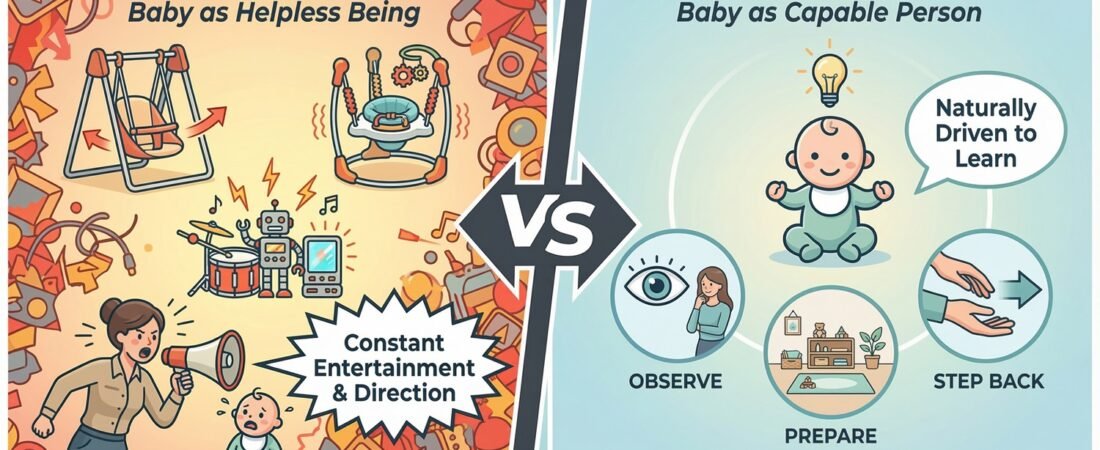
Understanding how to raise confident, independent babies through a time-tested educational philosophy
I remember the first time I walked into a Montessori infant classroom. I expected chaos, noise, maybe some crying.
Instead, I found something that genuinely surprised me: calm.
Babies were moving freely on soft mats, reaching for wooden toys placed deliberately within their grasp, and caregivers were quietly observing rather than constantly entertaining. It looked nothing like the brightly colored, plastic-filled nurseries I’d grown accustomed to seeing.
That visit changed my entire perspective on infant development. The Montessori method for babies doesn’t accelerate milestones or create baby geniuses.
The approach respects your baby as a capable human being from day one and creates an environment where they can develop naturally, at their own pace, with your support rather than your constant direction.
You want to know if Montessori is really worth the hype, or if it’s just another expensive trend that needs a Pinterest-perfect nursery. Let me walk you through what this method actually entails, how it works in real life, and why parents are increasingly choosing this approach for their littlest learners.
The Foundation of Montessori Infant Care
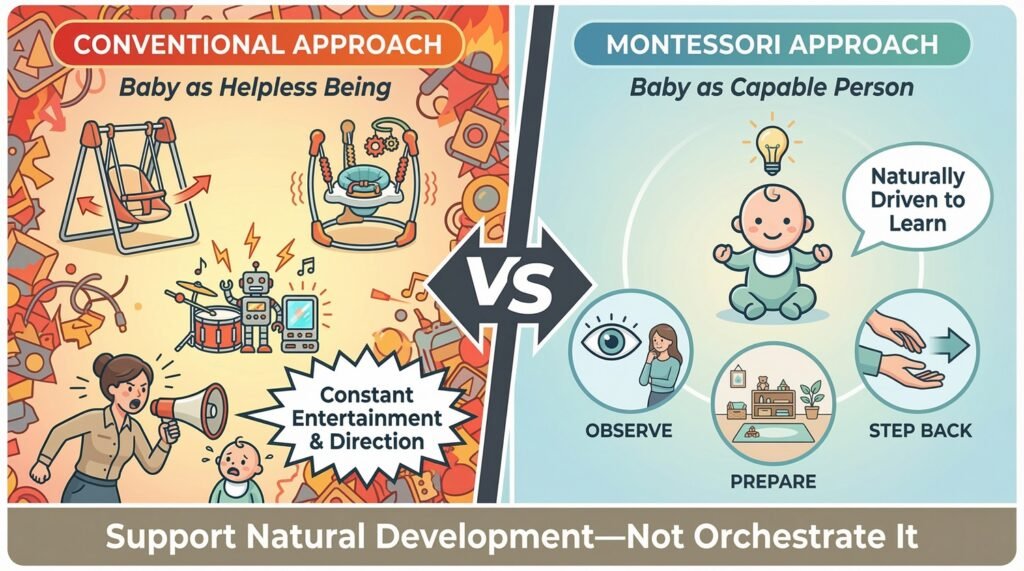
When you look at conventional baby care, there’s often an underlying assumption that babies are helpless beings who need constant entertainment and direction. We prop them in swings, bounce them in jumpers, surround them with battery-operated toys that light up and sing, and basically orchestrate their entire day.
The Montessori method takes a completely different approach.
Montessori for babies rests on one powerful premise: your infant is a capable, curious person who’s naturally driven to learn and develop. Your job is to prepare an environment that supports their natural development, observe what they’re interested in, and then step back.
This really resonated with me when I started applying these principles with my own children. I noticed that when I stopped hovering and directing every moment, they actually engaged more deeply with their surroundings.
They concentrated longer.
They figured things out on their own. And honestly, it took pressure off me too, because I wasn’t responsible for being a constant source of stimulation.
The method was developed by Dr. Maria Montessori, an Italian physician who observed children extensively in the early 1900s. She uncovered that children learn best through self-directed activity, hands-on exploration, and collaborative play.
While her initial work focused on older children, she later developed principles specifically for infants and toddlers, recognizing that the foundation for all learning happens in those crucial first three years.
Five Core Principles That Guide Montessori Infant Care
Let me break down the five basic principles that make Montessori work for babies. These are practical guidelines that shape how you interact with your baby every single day.
Respect for the Child serves as the absolute cornerstone. This means treating your baby as a full person who deserves dignity, consideration, and agency.
In practice, it looks like narrating what you’re doing during diaper changes instead of just doing it to them.
Asking permission before picking them up, even though they can’t verbally respond yet. It sounds a bit unusual at first, I’ll admit, but when you start doing this, you notice subtle cues from your baby that show they’re listening, processing, and responding.
I started saying things like, “I’m going to pick you up now to change your diaper. I’m putting my hands under your back.” It felt awkward initially, but within weeks, I noticed my daughter would lift her arms slightly or adjust her body to help. She was participating in her own care because I’d treated her as a partner in the process rather than an object to be managed.
The Absorbent Mind describes the phenomenon where babies soak up everything from their environment without conscious effort. Between birth and age three, your baby’s brain is in a unique developmental phase where learning happens automatically through observation and experience.
They’re absorbing language patterns, social interactions, physical movements, and emotional responses just by being in your presence.
This principle has huge implications for how you structure your baby’s day. If they’re absorbing everything unconsciously, then the quality of what surrounds them really matters.
A chaotic, overstimulating environment teaches their brain that the world is overwhelming and unpredictable.
A calm, orderly environment teaches them that the world is manageable and makes sense.
Sensitive Periods are developmental windows when your baby is particularly receptive to learning specific skills. There’s a sensitive period for language, for movement, for order, for small objects.
These periods are different for every child and can only be identified through careful observation.
You can’t force a sensitive period to happen, but you can recognize when your baby is in one and provide materials and experiences that support it.
I watched my son go through a sensitive period for grasping around five months. He was absolutely obsessed with picking up anything he could reach.
Instead of offering him complex toys, I put out simple wooden rings, fabric balls, and natural objects of varying sizes.
He spent hours practicing his pincer grip, completely focused and satisfied. That concentration wouldn’t have developed if I’d missed the window or offered inappropriate materials.
The Prepared Environment is probably the most visible aspect of Montessori. This is the intentionally designed space that meets your baby’s current developmental needs. The space allows your baby to move freely, access materials independently, and experience order and beauty.
A prepared environment for a young baby might include a floor bed instead of a crib, allowing them to see their room and eventually get in and out of bed independently. It includes low shelves with a small, rotating selection of toys rather than an overwhelming toy box.
It features natural materials, soft lighting, and clear spaces for movement.
Everything in the environment has a purpose and a place.
Auto-Education, or self-directed learning, recognizes that babies are intrinsically motivated to learn. They don’t need external rewards or punishments.
They don’t need you to constantly show them how things work.
Given the right environment and materials, they’ll figure things out through exploration and repetition.
This was probably the hardest principle for me to internalize because our culture really emphasizes teaching and directing children. But when I stepped back and let my kids struggle a bit with challenges suitable to their age, I saw them develop persistence, problem-solving skills, and genuine pride in their accomplishments.
The satisfaction on a baby’s face when they finally grasp a toy they’ve been reaching for is completely different from the passive response when you just hand it to them.
What a Montessori Environment Actually Looks Like
Let me paint you a realistic picture of a Montessori infant space, because I think there’s a lot of confusion about what’s actually necessary versus what’s just aesthetic preference.
You walk into the nursery and immediately notice it feels spacious and calm. There’s a floor bed, basically a mattress on a low frame or directly on the floor, positioned so the baby can see the room.
This gives your baby visual access to their environment and, eventually, the ability to get in and out of bed independently when they’re developmentally ready.
There’s substantial open floor space with soft mats or rugs. This is really the heart of a Montessori infant environment.
Babies need room to roll, scoot, crawl, and eventually pull up and cruise.
Unlike traditional nurseries dominated by cribs, changing tables, and play equipment, Montessori spaces prioritize floor space above almost everything else.
Against one wall, there’s a low shelf, maybe twelve to eighteen inches high, with a carefully curated selection of materials. And here’s where Montessori diverges dramatically from conventional wisdom: there are only three to five items on the shelf at any given time.
Not dozens of toys.
Not bins overflowing with stuffed animals. Just a few purposeful objects that match the baby’s current developmental stage.
For a three-month-old, this might include a wooden rattle, a silk scarf, and a simple black-and-white contrast card. For an eight-month-old, it might be a ball, a wooden puzzle with large knobs, and a basket of natural objects to explore.
The items rotate based on observation of the baby’s interests and emerging skills.
The materials themselves are predominantly natural. Wood, metal, fabric, leather, natural rubber.
Natural materials provide authentic sensory experiences. They have weight, temperature, texture, and sometimes subtle scents.
They connect babies to the real world rather than a synthetic approximation of it.
There’s typically a mirror mounted horizontally at floor level so babies can see themselves during tummy time and floor play. Self-recognition develops over time, and having visual feedback of their movements supports body awareness and motor planning.
The color palette tends toward natural, muted tones. Soft whites, warm woods, gentle grays, occasional earth tones.
This creates visual calm that allows babies to focus on one thing at a time rather than being overwhelmed by competing stimuli.
One thing you won’t find is a lot of battery-operated toys, character merchandise, or equipment that restricts movement like bouncers, exersaucers, or walkers. Montessori philosophy sees these as impediments to natural development rather than aids.
How Caregiving Practices Differ in Montessori
The environmental setup is only half of the equation. The way you interact with your baby on a day-to-day basis is equally important, and this is where Montessori can feel really counterintuitive if you’re used to conventional baby care advice.
The primary mode of a Montessori caregiver is observation. Not passive watching, but active, intentional observation to understand what your baby is working on developmentally, what interests them, what frustrates them, and what brings them joy.
This observation tells everything else you do.
I started keeping brief notes about what my kids gravitated toward during free play time. I noticed patterns I would have completely missed otherwise.
My daughter consistently chose items she could bang together, signaling she was exploring cause and effect and enjoying auditory feedback.
My son repeatedly practiced transferring objects from one hand to the other, working on midline crossing and bilateral coordination.
These observations told me what materials to offer next and when to rotate items off the shelf. Without this intentional watching, I would have just guessed at what they needed or, more likely, bought whatever was marketed as age-appropriate.
When you do interact directly with your baby in Montessori, you move slowly and deliberately. During diaper changes, dressing, feeding, or bathing, you narrate what you’re doing and invite cooperation.
You wait for responses.
You treat these care routines as opportunities for connection and communication rather than tasks to rush through.
This really changed my relationship with caregiving activities. Instead of seeing diaper changes as interruptions to more important activities, I started seeing them as valuable one-on-one time.
I slowed down.
I made eye contact. I asked my baby to help by lifting their legs or pushing their arm through a sleeve.
These moments became enjoyable for both of us.
You offer choices even to very young babies. This might look like holding up two different rattles and seeing which one your baby reaches for.
Or offering two books and letting them show preference through gaze or gesture.
These aren’t earth-shattering decisions, but they talk that your baby’s preferences matter and that they have some control over their experience.
Perhaps most challenging, you resist the urge to constantly entertain or intervene. When your baby is focused on an activity, you don’t interrupt with praise or suggestions.
When they’re struggling with something, you don’t immediately jump in to fix it.
You let them work through problems that are within their developmental capacity to solve.
This was genuinely hard for me at first. I wanted to help.
I wanted to show them easier ways to do things.
But I learned that my intervention often broke their concentration and robbed them of the satisfaction of independent achievement. A baby who struggles for three minutes to grasp a toy and finally succeeds has learned persistence, problem-solving, and developed their motor skills.
A baby who has the toy handed to them has learned that adults solve problems for them.
From Birth Through the First Year
Let me walk you through what Montessori actually looks like during different stages of your baby’s first year, because the approach advances significantly as your baby develops.
Birth to Three Months: During this newborn phase, Montessori focuses primarily on respectful caregiving and creating a calm environment. Your baby isn’t ready for intentional play with materials yet.
Instead, you’re establishing the foundation of trust and security through responsive care.
You might place your baby on a mat on the floor during alert times, giving them freedom to move their arms and legs without the restriction of swaddling or positioning devices. Above them, you might hang a simple mobile at the right height and distance for their developing vision.
Montessori actually has a series of specific mobiles designed for different visual developmental stages, each introducing new complexity as the baby’s vision matures.
The Munari mobile, with its geometric black and white shapes, is typically the first. Then comes the octahedron mobile with its holographic paper that catches light.
These aren’t the overstimulating plastic mobiles that play music and light up.
They’re simple, beautiful, and perfectly calibrated to what newborns can actually perceive and process.
Three to Six Months: This is when babies start deliberately reaching for objects and developing intentional movement. The Montessori environment expands to include grasping toys within reach.
A wooden ring on a ribbon, a simple rattle, a soft fabric ball.
You continue prioritizing floor time over containers. Your baby is working on rolling, and they need space to practice.
I remember being at a playgroup where most babies were in swings or seats while the Montessori babies were on mats on the floor.
The difference in their movement capabilities was already noticeable. The babies with unrestricted floor time were rolling earlier and with more confidence.
Six to Nine Months: Most babies in this stage are working on sitting independently, beginning to crawl, and developing their pincer grasp. The Montessori shelf now includes items that support these emerging skills.
Objects to transfer from hand to hand help develop midline crossing. A ball encourages crawling as it rolls away.
Materials with different textures satisfy their need for sensory exploration.
A basket with a few safe household objects like a wooden spoon, a small metal bowl, and a natural bristle brush provides authentic experiences with real materials.
This is also when you might introduce a weaning table and chair, scaled to your baby’s size. As they begin eating solid foods, they can sit at their own table rather than always in a high chair.
This promotes independence and allows them to join more fully in family meals.
Nine to Twelve Months: Babies at this stage are typically crawling confidently, pulling up to stand, and possibly cruising or taking first steps. They’re deeply interested in how things work and love practical activities.
The Montessori environment now includes more complex materials. Simple puzzles with large knobs.
Nesting boxes or stacking cups.
A coin box where they can practice posting objects through slots. Baskets organized by category, one with balls of different sizes, another with vehicles, another with animals.
You’re also introducing more practical life activities. A low mirror where they can see themselves during care routines.
A small shelf in the bathroom where they can reach their own hairbrush and washcloth.
These tiny adjustments talk that they’re capable of participating in their own care.
Common Challenges and Realistic Solutions
Let me address some of the real obstacles people encounter when trying to implement Montessori with babies, because it’s definitely not always smooth sailing.
The cost of authentic Montessori materials can be expensive, and that’s a real barrier for many families.
You don’t need to buy everything from specialty Montessori retailers.
Many household objects serve the same developmental purposes.
A set of measuring cups for nesting and stacking works just as well as expensive wooden nesting boxes. A whisk and metal bowl provide the same sensory experience as specialty toys.
Natural objects from outside, smooth stones, pinecones, leaves, offer rich sensory exploration for free.
The key is choosing items that are safe, aesthetically pleasing, and serve a developmental purpose.
That said, there are some Montessori materials that are genuinely worth the investment if your budget allows. The mobiles are thoughtfully designed and you can use them across many children.
Quality wooden toys last for years and can be passed down or resold.
A good low shelf becomes the foundation of your child’s space throughout their early childhood.
Maintaining the prepared environment with limited space can feel overwhelming. Not everyone has a dedicated nursery or extra room for Montessori setups.
I’ve seen people successfully implement Montessori principles in apartments, shared bedrooms, even modified closets.
The solution is to prioritize floor space above everything else. If you only have one small room, make sure there’s clear floor area for movement.
The shelf can be tiny, even just a small bookcase turned on its side.
The floor bed can be just a mattress on the floor that gets stored during the day if needed. The principles matter more than the square footage.
Family members or caregivers who don’t understand or support the approach can undermine your efforts. This is genuinely tricky because consistency across caregivers makes a big difference.
If grandparents are showering your baby with plastic toys and constantly entertaining them, it can conflict with what you’re trying to establish.
I’ve found that explaining the reasoning behind Montessori principles helps more than just imposing rules. When grandparents understand that you’re trying to help your baby develop concentration and independence, not just being controlling about toys, they’re often more receptive.
Sharing articles or videos about the research behind the approach can help too.
Sometimes you just have to accept that your home will look different from other caregiving environments, and that’s okay. Children are remarkably adaptable.
As long as your home provides the consistency they need, they’ll adjust to different expectations in different settings.
Doubting whether you’re doing it right can feel overwhelming. Montessori can feel intimidating because there are “proper” ways to do things, and it’s easy to worry you’re messing it up.
Montessori is a philosophy to adapt, not a rigid set of rules to follow perfectly.
If you’re observing your baby, responding to their needs, providing a relatively calm environment with some freedom of movement, and treating them with respect, you’re implementing Montessori principles. It doesn’t have to look like the beautiful photos on Instagram.
It just has to work for your family.
Balancing Montessori principles with practical realities needs flexibility. Sometimes you need to use a stroller even though it restricts movement.
Sometimes you need twenty minutes of screen time to make dinner.
Sometimes the house is chaotic and overstimulating because life is chaotic.
Montessori is about intentionality rather than perfection.
You’re making conscious choices based on developmental principles rather than just defaulting to whatever is marketed or convenient.
Some days you’ll nail it. Some days you’ll compromise.
Both are fine.
People Also Asked
Can babies sleep in a floor bed safely?
Yes, babies can sleep safely in a floor bed when the room is properly baby-proofed. Remove any hazards from the floor level, secure furniture to walls, cover outlets, and confirm there are no small objects within reach. Many parents start with a floor bed from birth, while others transition once their baby begins rolling.
The key is making the entire room safe since your baby will eventually have access to everything at floor level.
What age should I start Montessori with my baby?
You can start Montessori principles from birth. The earliest months focus on respectful caregiving practices like narrating your actions during care routines and providing freedom of movement during awake times.
The visual mobiles designed for newborns are often the first Montessori materials parents introduce.
The approach adapts as your baby grows, with new materials and increased independence at each developmental stage.
Are Montessori toys better for baby development?
Montessori materials tend to be simple, made from natural materials, and designed to isolate one skill or concept. This simplicity allows babies to focus deeply and understand cause and effect more clearly than with complex toys that do many things. However, what matters most is offering a small selection of purposeful objects suitable to your baby’s developmental stage, whether those are official Montessori materials or thoughtfully chosen household objects.
Do I need a Montessori school for my baby?
No, you don’t need a Montessori school to apply Montessori principles. Many families successfully implement Montessori at home without formal schooling.
The core principles of respect, observation, freedom of movement, and a prepared environment can be applied regardless of your childcare situation.
Some parents choose Montessori programs for the trained teachers and prepared classroom environment, while others prefer adapting the philosophy at home.
How do I set up a Montessori nursery on a budget?
Start by prioritizing floor space over furniture. A simple mattress on the floor works as a floor bed. Use a small bookshelf turned on its side as a low shelf for materials.
Shop thrift stores for wooden toys, baskets, and simple objects.
Collect natural materials from outside like smooth stones, pinecones, and shells. Many household items like wooden spoons, metal bowls, and fabric scraps serve as excellent Montessori materials without any cost.
What’s the difference between Montessori and regular daycare?
Montessori infant programs emphasize freedom of movement, self-directed exploration, and respectful caregiving. Babies spend most of their time on the floor rather than in containers like swings or bouncers.
Caregivers focus on observation and following each baby’s person rhythm rather than group schedules.
Materials are natural, simple, and carefully chosen for developmental appropriateness. Regular daycares vary widely but often include more equipment, plastic toys, and structured group activities.
Can I mix Montessori with attachment parenting?
Yes, Montessori and attachment parenting complement each other well. Both emphasize responsive caregiving, respecting the child, and building secure attachment.
You can wear your baby when they need closeness while also providing floor time for independent exploration when they’re alert.
Many families successfully mix close physical contact during the early months with gradually increasing independence as their baby develops.
Key Takeaways
The Montessori method for babies views your infant as a capable person who develops naturally through self-directed activity within a properly prepared environment rather than through constant adult instruction or entertainment.
The five core principles of respect for the child, the absorbent mind, sensitive periods, the prepared environment, and auto-education work together to create conditions where natural development flourishes without excessive intervention.
A Montessori infant environment prioritizes open floor space for unrestricted movement, includes carefully selected natural materials on low accessible shelves, maintains visual order and calm, and eliminates equipment that restricts natural motor development.
Caregiving in Montessori emphasizes observation over constant interaction, slow and respectful care routines, offering suitable choices, and allowing babies to struggle with age-appropriate challenges rather than immediately intervening.
Implementation looks different at each stage of the first year but consistently focuses on matching the environment and materials to your baby’s current developmental work.
Common challenges like cost, space limitations, and unsupportive family members can be addressed through creative adaptations while maintaining core principles, and the approach adapts successfully across different family structures, budgets, and parenting philosophies.