When can a baby use an activity gym? This question comes up constantly in parenting groups, pediatrician offices, and late-night internet searches. The answer shapes how you support your baby’s development during those crucial early months.
Activity gyms represent one of those purchases that can either become a centerpiece of your baby’s day or sit unused in the corner, taking up space and reminding you of money you could have spent elsewhere. Getting the timing right makes all the difference.
Babies can technically start using activity gyms from birth, though most parents wait somewhere between 2 weeks and 3 months. That range exists for good reasons, and understanding where your baby falls within it determines whether the gym becomes a valuable developmental tool or just another piece of baby equipment you thought you needed.
The window of peak usefulness runs roughly from those early weeks through about 8 months. During this period, activity gyms support specific developmental milestones related to vision, motor control, sensory processing, and cognitive growth.
Outside this window, babies either lack the physical capabilities to engage meaningfully with the gym or have progressed beyond what it offers.
Understanding Your Baby’s Developmental Readiness
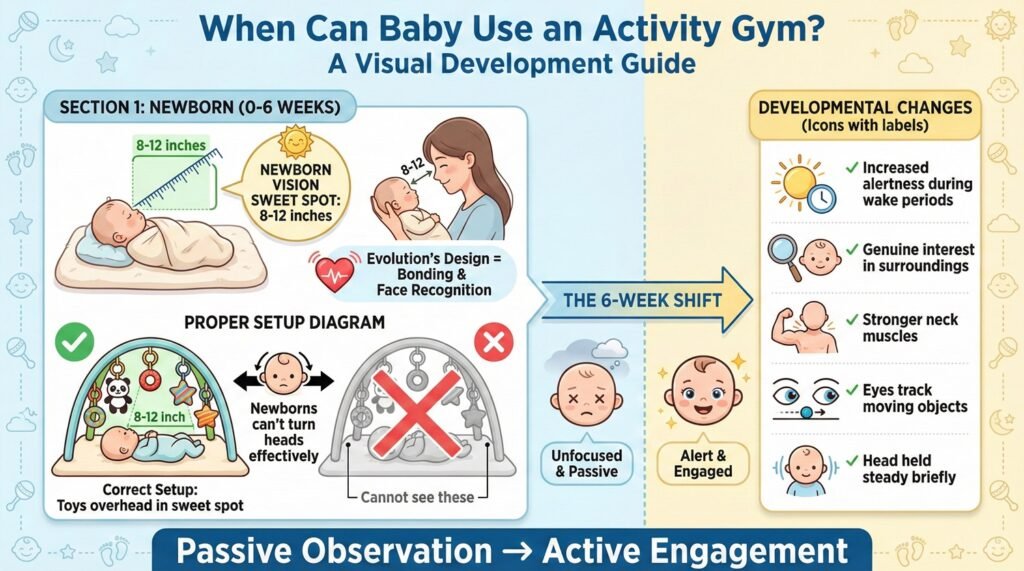
Your newborn’s world is incredibly small. During those first weeks, babies see clearly only within 8 to 12 inches from their face.
This limited visual range matches perfectly with the distance from a baby’s face to their parent’s face during feeding or holding.
Evolution designed it this way to encourage bonding and facial recognition before babies get distracted by everything else.
This biological reality dictates how you set up an activity gym for the youngest babies. Hanging toys need to sit directly overhead, positioned within that 8 to 12 inch sweet spot.
Your newborn cannot turn their head effectively yet, so toys positioned off to the sides serve no purpose.
They literally cannot see them.
Around 6 weeks, something shifts noticeably. Babies become more alert during wakeful periods.
They start looking around with what genuinely seems like interest as opposed to just unfocused gazing.
Their neck muscles strengthen enough to hold their head steady for brief moments, and their eyes track moving objects with increasing accuracy. This marks the transition from passive observation to active engagement.
The progression continues in fairly predictable patterns. Between 2 and 3 months, babies start reaching toward objects.
Their aim is terrible and their grasp stays uncoordinated, but each try strengthens neural pathways connecting vision to movement.
They bat at toys more through accidental contact than deliberate action, yet every hit teaches their brain something about distance and force.
By 3 to 4 months, neck control improves dramatically. Babies lift their heads confidently during tummy time and maintain steady head positions while lying on their backs.
Reaching becomes more purposeful, though execution stays clumsy.
You can see the determination on their faces as they work to grab those dangling toys.
The 4 to 6 month window brings rapid changes. Babies develop intentional grasping, transfer objects between hands, and engage actively with their environment.
This period delivers most activity gym value because babies possess both the physical capability and cognitive interest to truly interact with all the features.
They understand cause and effect at a basic level, realizing that batting a toy makes it swing or that pulling brings things closer.
Setting Up for Success at Each Stage
How you configure the activity gym matters just as much as when you introduce it. For newborns, simplicity wins over complexity every time.
Too many hanging toys, flashing lights, or loud sounds overwhelm a nervous system still learning to regulate sensory input.
Start with one or two soft, high-contrast toys positioned at that optimal 8 to 12 inch distance. Black and white patterns work especially well because newborns see contrast more easily than subtle color variations.
A single toy with bold patterns gives your baby something interesting to focus on without creating sensory overload.
I’ve seen countless parents hang toys across every inch of the arch, thinking more stimulation equals faster development. What actually happens is the baby gets fussy and overstimulated, then the parent decides the gym was a waste of money.
Less really does work better during those first couple of months.
As your baby grows, adjust toy positioning to encourage different movements. Around 2 to 3 months, when reaching begins, lower the toys slightly so they’re within grasp.
Move some toys toward the sides as opposed to keeping everything centered overhead.
This setup encourages your baby to rotate their body and turn their head, building core strength and coordination through small movements that seem insignificant but add up developmentally.
Tummy time becomes increasingly important during these months, and activity gyms serve double duty here. Many babies resist tummy time on plain surfaces because it feels like hard work with no reward.
The same babies often tolerate tummy time much better on an activity gym because the visual interest motivates them to lift their heads.
Position toys slightly forward and to the sides during tummy time to encourage that head lifting and turning that builds neck and upper body strength.
The critical transition happens when rolling begins, typically between 4 and 6 months. Once your baby rolls consistently from back to front or front to back, those overhead hanging toys become obstacles as opposed to attractions.
Your baby needs open space to practice rolling without objects blocking their movement.
This is when you remove the arch completely but continue using the padded mat as a comfortable play surface.
Recognizing the Signs of Transition
Babies talk clearly when they’ve outgrown the activity gym, though you need to know what signals to watch for. The first sign usually shows up physically.
Your baby starts rolling away from the gym toward other areas of the room.
Rather than staying contentedly under the arch, they roll to the edge of the mat and seem frustrated by the boundaries confining them.
Interest level drops noticeably too. A baby who before spent 20 minutes happily engaged suddenly fusses after 5 minutes and clearly wants to be somewhere else.
This doesn’t mean your baby is bored in the way adults get bored. Rather, their brain is demanding new challenges and experiences at a level of complexity the activity gym cannot provide.
When sitting skills emerge, either independently or with support, another transition point arrives. Sitting babies want toys at their level where they can manipulate objects with both hands.
They want to examine things closely, bring objects to their mouths, and explore how different items relate to each other.
The activity gym’s design doesn’t support these new skills effectively.
Most babies naturally phase out activity gym use between 6 and 8 months, though person variation is enormous. Some babies lose interest by 5 months, others happily play under their gym until 10 months.
Neither timeline is right or wrong.
What matters is matching the tool to your specific baby’s developmental needs at any given moment.
Common Mistakes That Limit Effectiveness
The biggest mistake parents make is introducing the activity gym too late. Waiting until 4 or 5 months means you’ve missed the prime window for supporting early reaching, batting, and visual tracking skills.
While a 4-month-old certainly benefits from an activity gym, you’ve lost several months of potential developmental support during a period of rapid neural growth.
The opposite mistake happens too. Some parents try the gym with their 3-week-old, see no interest, and pack it away concluding it was pointless.
Developmental readiness at 3 weeks looks completely different than at 6 weeks.
Your baby needs time to grow into the activity gym as opposed to showing immediate engagement.
Overstimulation represents another common problem. Activity gyms with lights, sounds, music, and a dozen hanging toys seem appealing in stores, but they genuinely overwhelm young babies.
The constant sensory input prevents babies from focusing on any single element, reducing developmental benefit.
Neutral, calming activity gyms with simple, high-contrast toys actually support development better than flashier versions.
Positioning errors limit effectiveness significantly. Parents often place the gym in high-traffic areas thinking social stimulation helps.
Babies actually need quiet, calm environments to focus on the gym’s features.
A spot away from television noise, sibling activity, and household chaos allows your baby to concentrate on the developmental work of reaching, grasping, and exploring.
Safety oversights concern me most. Some parents position activity gyms on elevated surfaces like beds or couches, creating fall risks.
Others don’t regularly check that toys stay securely attached. As babies gain strength, they pull surprisingly hard on hanging elements.
A toy that comes loose poses a choking hazard. Activity gyms belong on the floor, on a non-slip surface, with all elements checked regularly for security.
Maximizing Long-Term Value
Activity gyms typically cost between $50 and $200 depending on features and quality. Making that investment stretch needs strategic thinking about extending usability beyond the obvious 2 to 8 month window.
The simplest extension strategy involves removing the arch but continuing to use the mat. Many activity gym mats are generously sized, well-padded, and feature interesting textures and designs.
Even after your baby outgrows the hanging toys, the mat serves as a comfortable play surface for sitting, rolling, and early crawling practice.
Some designs include crinkly fabrics, attached mirrors, or textured elements that stay engaging well into the first year.
Convertible designs offer another approach. Some activity gyms transform into ball pits, tunnels, or play tents for toddlers.
These multi-stage products typically cost more upfront, but they deliver value over a much longer timeframe.
A gym that converts into a toddler tent might serve your child from birth through age three, dramatically improving the cost-per-use calculation.
Material quality directly impacts longevity. Activity gyms with machine-washable components withstand the inevitable spit-up, drool, and diaper leaks.
Being able to throw the mat and fabric toys into the washing machine means you’ll actually keep using the gym as opposed to abandoning it once it gets grimy.
Some parents successfully pass activity gyms between siblings or friends, multiplying their value. Choosing durable construction with neutral designs as opposed to gender-specific colors makes this easier.
A well-built activity gym can genuinely serve multiple children if designed to withstand repeated use and cleaning.
Adapting to Individual Differences
Babies develop along remarkably similar trajectories, but timing and pace vary enormously. Some babies hit milestones early, others take their time, and both patterns fall well within normal ranges.
This person variation means you need to stay flexible about activity gym timing as opposed to rigidly following age guidelines.
Premature babies need adjusted expectations. A baby born six weeks early operates on a different developmental timeline than their birth age suggests.
For activity gym purposes, think in terms of adjusted age calculated from the due date as opposed to birth date, at least for the first year.
Babies with developmental delays or physical challenges benefit from activity gyms too, but may need modifications. Positioning toys lower, using higher contrast colors, or simplifying sensory input can make the gym more accessible.
These adaptations should happen in consultation with your baby’s healthcare team, who can provide specific guidance based on your child’s needs.
Temperament plays a surprisingly large role in activity gym success. Some babies are naturally more physically active and love batting at toys from an early age.
Others are more visually oriented, content to simply look at hanging elements without much reaching.
Neither approach is better. Understanding your baby’s temperament helps you adjust expectations and setup accordingly.
Building Developmental Skills Systematically
Activity gyms support multiple developmental domains simultaneously, which makes them valuable tools when used appropriately. Visual development benefits from high-contrast patterns, varied colors, and moving elements.
Babies learn to track objects with their eyes, shifting gaze from one toy to another and following movement across their field of vision.
Motor skill development happens through reaching, batting, grasping, and kicking. Each try to touch a hanging toy strengthens arm muscles and refines hand-eye coordination.
The inevitable misses are just as valuable as successful grasps because your baby’s brain is calculating distance, force, and trajectory with each attempt.
Sensory integration occurs as babies process multiple inputs simultaneously. They see the toy, feel its texture when they manage to grasp it, hear the sound it makes when struck, and combine all that information into understanding about how objects work.
This multi-sensory processing builds neural connections that support more complex learning later.
Cognitive development emerges through cause and effect learning. Babies find out about that batting a toy makes it swing, that pulling on something brings it closer, that different objects make different sounds.
These lessons seem simple, but they represent basic learning about how the physical world operates.
Frequently Asked Questions
Can newborns use activity gyms safely?
Yes, newborns can use activity gyms safely from birth when positioned properly on the floor with simple, high-contrast toys hung 8 to 12 inches overhead. Keep sessions short, around 5 to 10 minutes, and always supervise.
Avoid overstimulation by starting with just one or two toys as opposed to filling the entire arch.
What age do babies reach for toys on play gyms?
Most babies start reaching for toys between 2 and 3 months old, though early tries are uncoordinated. You’ll see batting and swiping motions before true grasping develops around 3 to 4 months. Intentional, successful grasping typically emerges between 4 and 5 months.
How long should my baby spend on the activity gym each day?
Young babies might engage for 5 to 10 minutes at a time, while 3 to 5 month olds often stay interested for 15 to 20 minutes. Follow your baby’s cues as opposed to forcing specific timeframes.
Multiple short sessions throughout the day work better than one long session.
Do I need to remove the activity gym arch when my baby starts rolling?
Yes, remove the arch once your baby rolls consistently in either direction. The overhead toys become obstacles that prevent free movement and rolling practice.
Continue using the mat as a play surface but take down the hanging elements to give your baby space to develop mobility skills.
Are activity gyms worth buying or just unnecessary baby gear?
Activity gyms deliver genuine developmental benefits during the 2 to 8 month window when used appropriately. They support visual tracking, reaching, grasping, and sensory integration skills.
Whether they’re worth the investment depends on your budget, available space, and whether you’ll use the gym consistently during that developmental window.
What features should I look for in a baby activity gym?
Look for machine-washable materials, adjustable toy heights, simple designs without excessive lights and sounds, sturdy construction, and neutral colors if you plan to use it for multiple children. High-contrast toys work better than pastel colors for young babies.
Avoid gyms with small detachable parts that pose choking hazards.
Key Takeaways
Start introducing an activity gym between 2 weeks and 3 months when your baby shows increased alertness and interest in their surroundings, understanding that ideal timing depends entirely on your person baby’s developmental readiness as opposed to rigid age guidelines.
Position toys appropriately for your baby’s stage by keeping them 8 to 12 inches overhead for newborns, within arms reach for 2 to 3 month olds, and removing the arch entirely once rolling begins around 4 to 6 months to allow freedom of movement.
Less stimulation often works better than more, particularly for young babies whose nervous systems can easily become overwhelmed by excessive visual, auditory, and tactile input happening simultaneously on overly complex activity gyms.
Watch for your baby’s signals that they’re ready to transition beyond the activity gym, including rolling away repeatedly, decreased interest in hanging toys, and preference for exploring larger spaces that the gym’s boundaries restrict.
Extend the value of your activity gym investment by continuing to use the mat after removing the arch, choosing convertible designs that transform for toddlers, and selecting machine-washable materials that withstand repeated cleaning through months of use.
Safety stays paramount throughout your activity gym use, requiring floor placement on non-slip surfaces, regular checks of toy attachments, suitable supervision during all play sessions, and removal of the overhead component once rolling begins.
Individual variation in development means age guidelines serve as general frameworks as opposed to rigid rules, so stay flexible and responsive to your specific baby’s capabilities, interests, and temperament instead of comparing your child to developmental charts or other babies.