If you’re navigating the overwhelming world of baby gear and wondering whether that colorful activity gym sitting in your cart is actually worth it, and more importantly, when your little one can even use it, you’re absolutely not alone. I’ve watched countless new parents agonize over this decision, and honestly, the information out there can be really confusing and contradictory.
Today, I’m breaking down everything you need to know about activity gym timing, from those first fragile weeks through the point where your baby graduates to bigger adventures.
Understanding What an Activity Gym Actually Does
Before we dive into the timing question, let’s talk about what these contraptions are really designed to accomplish. An activity gym consists of a padded mat with an overhead arch or frame that holds dangling toys, mirrors, and other sensory objects.
The entire setup creates a controlled, stimulating environment where your baby can safely explore their developing senses and motor skills.
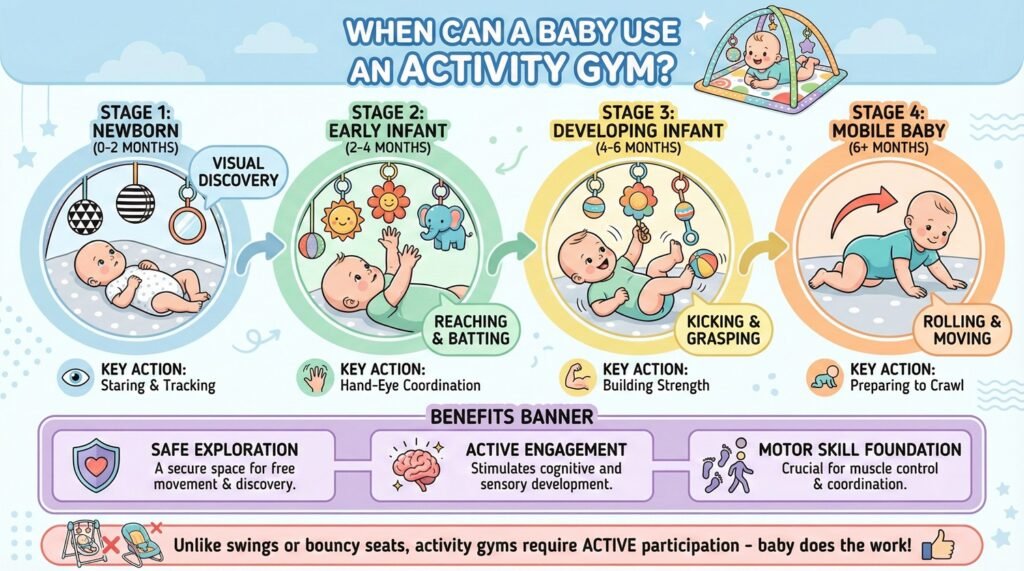
The magic of these gyms comes from their simplicity. Unlike elaborate swings or bouncy seats that do the work for your baby, an activity gym requires them to engage actively.
Your newborn lies there, staring up at contrasting patterns and slowly beginning to understand that those fuzzy objects above them are separate from the world around them.
As they grow, they’re reaching, batting, kicking, and eventually rolling. All of these are basic movements that build toward crawling, sitting, and walking.
What really matters here is understanding that an activity gym serves as a developmental tool that supports several critical areas: visual tracking, hand-eye coordination, muscle strength (especially during tummy time), sensory processing, and cognitive development. When you view it through this lens, the timing question becomes less about convenience and more about developmental readiness.
The Surprisingly Early Start Window
You can actually introduce an activity gym much earlier than you’d think. We’re talking 2 to 3 weeks of age, though I typically recommend waiting until around week 3 or 4 for practical reasons that have nothing to do with your baby’s readiness.
During those first couple of weeks, you’re honestly just trying to survive. Sleep deprivation hits differently when you’re responsible for keeping a tiny human alive, and adding another element to your routine, even a useful one, can feel overwhelming.
So while your newborn could technically benefit from brief activity gym sessions at 2 weeks old, giving yourself that extra week or two to establish feeding routines, sleep patterns, and basic sanity is perfectly reasonable.
When you do start, we’re talking really short sessions here. Like, genuinely brief.
3 to 5 minutes most.
Your newborn’s attention span is practically nonexistent at this stage. They’re working incredibly hard just to focus their eyes and process the sensory information flooding their brand new nervous system.
Five minutes of staring at high-contrast patterns and dangling toys is actually a significant workout for their developing brain.
The First Two Months: Building Foundations
During the 0 to 2 month period, your baby’s relationship with their activity gym is pretty straightforward. They’re primarily in observation mode, lying on their back and taking in visual stimuli.
Start with just 1 to 2 minutes per session if your baby seems content, gradually working up to around 5 minutes by the time they hit 2 months.
The key developmental wins during this phase aren’t dramatic. You’re not going to see your baby suddenly grab a toy or roll over.
Instead, you’re supporting visual development and early muscle engagement.
Those high-contrast black and white patterns help babies learn to focus and track objects with their eyes. Mirrors introduce them to faces, even if they don’t recognize it as their own yet.
The gentle sensory input from different textures, sounds, and colors helps their brain start categorizing and making sense of their environment.
One thing I really want to emphasize here is the importance of reading your baby’s cues. If they’re fussing, arching their back, or showing signs of overstimulation like looking away, crying, or becoming very still, the session is over.
Don’t push it.
At this age, less is genuinely more. You’ll have plenty of time to extend sessions as they grow.
Months 2 to 4: The Engagement Shift
Something really cool happens around the 2 month mark. Your baby starts showing actual interest in what’s happening around them.
They’re not just passively receiving stimulation anymore.
They’re beginning to engage. You’ll notice them tracking toys more deliberately, studying patterns more intently, and maybe even cracking their first real social smiles when you lean over the gym to interact with them.
This is when you can comfortably extend sessions to 10 to 15 minutes, ideally 2 to 3 times daily. The frequency matters here because repetition is how babies learn.
Each session reinforces neural pathways, strengthens muscles, and builds familiarity with cause and effect concepts.
When they accidentally bat at a toy and it makes a sound, their brain is forming connections that will eventually lead to intentional reaching and grasping.
Around 3 to 4 months, you’ll start seeing those first intentional reaches. Your baby will spot a toy they want and actively try to grab it.
They’ll miss.
A lot. But that’s the entire point.
Every failed try is teaching their brain about spatial awareness, distance, and motor control.
This is where the adjustability of your activity gym becomes important. Toys should hang low enough to encourage reaching but not so low that they hit your baby in the face when they’re just lying there.
The 3 to 6 Month Sweet Spot
If activity gyms have a golden age, this is it. Between 3 and 6 months, babies are fully engaged participants who can spend 15 to 20 minutes at a time exploring their gym.
Some resources suggest up to 30 minutes total daily, and honestly, if your baby is happy and engaged, there’s no reason to cut them off.
The 3 month mark specifically is when tummy time on the gym really takes off. Your baby should be comfortable with 15 to 30 minutes of tummy time per session, up to 4 times daily or at least an hour total throughout the day.
This sounds like a lot, and it is, but remember that tummy time doesn’t have to happen all on the activity gym.
You can do tummy time on your chest, on a regular blanket, or anywhere that allows them to build those crucial neck and shoulder muscles.
What makes the activity gym particularly valuable for tummy time is the built-in motivation. When your baby lifts their head, they’re rewarded with interesting visual stimuli: toys, mirrors, patterns.
This creates a natural incentive to practice the movement over and over, which is exactly what they need to build strength.
During this phase, you’ll also notice increased kicking and leg movement. Your baby is discovering that their lower body exists and that they can control it.
Gyms with toys positioned near their feet encourage this kicking, which strengthens core muscles and coordination.
All of this is laying groundwork for rolling over, which typically happens somewhere between 4 and 6 months.
Months 6 to 9: The Mobility Transition
Once your baby hits 6 months, things get really interesting. They can now handle 20 to 30 minute sessions, but here’s the catch: they probably won’t want to.
This is the age when sitting up, scooting, and early crawling tries begin, and suddenly, a stationary gym feels limiting.
This doesn’t mean the gym becomes useless. It just means you need to get creative.
If your gym has adjustable arches, you can raise them higher so your sitting baby still has access to toys.
If toys detach, you can place them around the mat for your baby to scoot toward. The gym changes from a place where things happen above them to a safe, defined space where they can practice new skills.
Watch for the rolling milestone carefully. Once your baby is consistently rolling from back to front and front to back, you need to remove any overhead toys that could become hazards if they roll into them unexpectedly.
The mat itself stays useful for supervised floor play, but the arch with dangling toys becomes less central to the experience.
When to Pack It Away
Most babies start losing interest in activity gyms somewhere between 9 and 12 months. The signs are pretty obvious.
They’re constantly trying to escape the boundaries of the mat, they’re crawling or cruising to other parts of the room, and they’re showing way more interest in anything that isn’t the gym.
This is completely normal and developmentally suitable. Your baby has outgrown the stationary setup because they’re ready for bigger challenges.
Some parents feel guilty about moving on from gear that they invested money in, but here’s the reality: every piece of baby equipment has a limited useful window. The activity gym served its purpose by supporting critical developmental milestones during those first several months.
Now your baby needs space to move, explore, and practice new skills like pulling up, cruising along furniture, and eventually walking.
That said, don’t necessarily donate the gym immediately. Many parents find that the detachable toys continue to be favorites for months after the gym itself gets packed away.
Toys with mirrors, crinkly fabric, or interesting textures often make great standalone play items well into the toddler years.
Safety Considerations You Cannot Ignore
Let’s talk about the safety piece, because this matters way more than getting the timing exactly right. First and absolutely foremost: never leave your baby unattended on an activity gym.
I don’t care if you’re just stepping away for five seconds to grab your phone.
Babies develop new skills without warning, and the first time they roll over could be the moment you’re not watching.
Set up the gym on a flat, stable surface. Carpet is great for cushioning, but make sure the mat itself doesn’t slide around.
Check the stability of the arch or frame before every single use.
It takes two seconds, and it’s worth it. Toys should be securely attached, and you should regularly inspect them for loose parts, frayed fabric, or anything that could become a choking hazard.
Material selection matters more than most parents realize. Look for gyms made with non-toxic materials and water-based paints or dyes.
Your baby will inevitably mouth everything within reach, so you want to minimize exposure to potentially harmful chemicals.
Bonus points if you can find gyms with removable, machine-washable mats and toys, because trust me, things will get messy.
Height adjustment is a safety feature, not just a convenience. As your baby grows and develops new skills, you need to raise toys higher or remove them entirely to prevent accidents.
That adorable dangling giraffe becomes a face-hitting hazard once your baby starts practicing intense rolling movements.
Maximizing Developmental Benefits
Getting the timing right is only half the equation. How you use the activity gym matters just as much as when you introduce it.
Here’s what I’ve learned makes the biggest difference.
First, variety keeps things interesting. Don’t just plop your baby under the same toys in the same position every single session.
Rotate toys regularly, even if that means swapping out a rattle for a different rattle.
Babies notice the change, and novelty stimulates cognitive development. Change up the positioning too.
Sometimes back, sometimes tummy time, sometimes lying at a slight angle if your gym accommodates that.
Interaction amplifies everything. An activity gym doesn’t replace parental engagement.
Get down on the floor with your baby.
Point out toys, make silly sounds, show how to bat at hanging objects. Your voice, your face, your presence, these are more stimulating to your baby than any toy ever could be.
The gym provides the tools, but you provide the context and emotional connection that makes learning meaningful.
Timing your sessions strategically makes a huge difference in engagement quality. Don’t stick your baby on the gym right before a nap when they’re fussy and tired, or immediately after eating when they’re likely to spit up.
The sweet spot is usually mid-morning after a feed and a diaper change, when babies tend to be most alert and happy.
A second session in the afternoon works well for many families.
Common Challenges and Real Solutions
Even with perfect timing and setup, things don’t always go smoothly. Here are the issues I see most often and what actually works to address them.
Challenge number one: your baby hates tummy time, even on the attractive activity gym. This is incredibly common.
Tummy time is hard work, and some babies really resist it initially.
Start with just 30 seconds to 1 minute and build up gradually. Try rolling up a small towel and placing it under their chest for support.
Get down at eye level and engage with them face-to-face.
Sometimes having a sibling or parent right there makes all the difference.
Challenge number two: your baby seems bored or uninterested in the gym. This usually means either the toys aren’t developmentally suitable anymore, or they’re overly familiar.
Switch things up.
Attach new household items that are safe for babies: a wooden spoon, a silicone spatula, a small fabric book. Sometimes the most mundane objects are the most fascinating to babies.
Challenge number three: your baby gets overstimulated quickly. Some gyms are genuinely too busy visually for sensitive babies.
If you’ve got flashing lights, music, bright colors, and ten different toys all going at once, it’s sensory overload.
Strip it back. Remove half the toys.
Turn off sounds.
Create a calmer environment and see if tolerance improves.
Challenge number four: you’re worried your baby isn’t “doing” enough on the gym compared to other babies. Stop.
Seriously, just stop comparing.
Developmental milestones have ranges for a reason. Some babies are early rollers but late crawlers.
Some never army crawl and go straight to hands-and-knees crawling.
The activity gym is a tool, not a test, and there’s no grading curve.
People Also Asked
What age is too early for a baby activity gym?
Most babies can start using an activity gym as early as 2 to 3 weeks old, though 3 to 4 weeks is often more practical for families still adjusting to life with a newborn. At this stage, sessions should be extremely brief, just 3 to 5 minutes most.
The baby is primarily observing and processing visual information, which is already a significant cognitive workout for their developing brain.
How long should a 2 month old be on a play mat?
A 2 month old baby can typically handle 5 to 10 minute sessions on a play mat or activity gym, repeated 2 to 3 times throughout the day. Watch for signs of overstimulation like fussing, looking away, or becoming very still.
These cues mean the session should end immediately.
Short, positive experiences are far more beneficial than pushing for longer sessions.
Can newborns use activity gyms?
Yes, newborns can use activity gyms starting around 2 to 3 weeks of age. However, sessions need to be very short, typically just 1 to 5 minutes.
Newborns are primarily in observation mode, focusing on high-contrast patterns and beginning to track objects with their eyes.
Always supervise closely and confirm the baby is positioned safely on their back.
Is tummy time better on a mat or activity gym?
Both options work well, and variety benefits babies most. Activity gyms offer built-in visual motivation, toys and mirrors positioned at head level, which encourages babies to lift and hold their heads up.
Regular mats work great for chest-to-chest tummy time with a parent or for practicing in different locations.
Using both throughout the day provides different experiences and prevents boredom.
When do babies start reaching for toys on play gym?
Most babies begin intentionally reaching for toys between 3 and 4 months of age. Before this, around 2 to 3 months, you might see accidental batting or swiping at toys as they gain arm control.
Those early failed tries are actually teaching spatial awareness and motor control.
By 4 to 5 months, most babies can grasp and hold toys with increasing accuracy.
How much tummy time should a 3 month old get?
A 3 month old baby should get 15 to 30 minutes of tummy time per session, with a goal of at least 60 minutes total throughout the day. This can be broken into many shorter sessions.
Tummy time strengthens neck, shoulder, and core muscles essential for rolling, sitting, and eventually crawling.
Using an activity gym for some of these sessions provides visual motivation.
What to look for when buying a baby activity gym?
Look for sturdy construction with a stable base, adjustable arches that can be raised as baby grows, non-toxic materials and water-based dyes, removable and washable fabric components, and a variety of textures and sensory features. High-contrast patterns work best for young babies, while detachable toys add versatility.
Avoid gyms with excessive lights and sounds that might overstimulate sensitive babies.
Key Takeaways
Activity gyms can be introduced as early as 2 to 3 weeks of age, with 3 to 4 weeks being ideal for practical family adjustment reasons.
Start with extremely short sessions of 3 to 5 minutes for newborns and gradually increase duration as your baby grows and shows interest, reaching 20 to 30 minutes by 6 to 9 months.
The gym supports many developmental areas including visual tracking, motor skills, sensory processing, and cognitive development throughout the first year.
Safety requires constant supervision, regular equipment checks, suitable setup on stable surfaces, and adjustments as your baby develops new skills.
Most babies naturally transition away from activity gyms between 9 and 12 months as mobility increases and stationary setups no longer provide sufficient challenge.