I used to think I was being a really responsible parent when I downloaded that literacy app everyone was raving about. It had bright colors, interactive features, and supposedly taught letter recognition while keeping my toddler entertained. I’d hand over my phone during particularly challenging moments, waiting rooms, grocery store lines, those desperate late-afternoon hours when dinner prep and meltdowns collide.
But something felt off. My daughter would swipe through stories at lightning speed, barely registering the words.
She’d get frustrated when animations didn’t load fast enough or when the “next” button didn’t respond immediately to her tapping.
And honestly? We weren’t really reading together anymore.
I was just supervising her screen time, occasionally glancing over to make sure she hadn’t somehow navigated to YouTube.
Then I stumbled across research from Dr. Tiffany Munzer at University of Michigan, and it completely shifted my perspective. Her team studied parent-toddler pairs reading both physical books and tablet apps, and the difference was striking, not subtle, not marginal, but genuinely significant.
Parents talked more, engaged more meaningfully, and children responded with better focus and emotional regulation when holding actual books.
That’s when I uncovered toddler book subscriptions, and it genuinely changed our reading dynamic. Instead of scrolling through endless digital options or making emergency Target runs for new books, thoughtfully curated titles started arriving at our door.
My daughter began associating reading with anticipation and ritual as opposed to with screens and distraction.
Why Physical Books Create Superior Learning Environments
The neuroscience here is actually fascinating. When toddlers interact with physical books, they’re engaging many sensory systems simultaneously, tactile sensation from turning pages, visual processing of static images, auditory input from your voice, and spatial awareness of the book as an object.
Digital apps, despite their interactivity, create a fundamentally different cognitive experience.
Munzer’s research found that parents using tablets with their toddlers talked significantly less often and with lower conversational quality compared to physical book reading sessions. The apps themselves became the primary focus, with parents essentially supervising technology as opposed to facilitating learning.
Children, particularly those prone to emotional dysregulation, showed more negative responses to parents during tablet reading.
This matters tremendously for language acquisition. Between ages two and three, children are in a critical language development window where conversational turns, the back-and-forth exchanges during shared activities, directly forecast vocabulary growth and later academic success.
When screens mediate that interaction, they fundamentally reduce the conversational richness that drives development.
Physical books naturally prompt dialogue. You point at illustrations, ask open-ended questions, make connections to your child’s experiences, and pause to let them process.
Apps, conversely, demand attention themselves, animations play, sound effects trigger, interactive elements need tapping.
The book becomes secondary to the technology delivering it.
I noticed this immediately when we switched to a physical book subscription. Reading sessions stretched longer because we weren’t racing through digital pages.
My daughter started pointing out details in illustrations I’d missed, asking questions about character motivations, making predictions about what might happen next.
These weren’t features of particularly sophisticated books, they were natural outcomes of slowing down and actually engaging with stories together.
The tactile experience of physical books also contributes to memory formation in ways that digital reading doesn’t copy. Researchers have found that spatial memory, remembering where information appeared on a page, helps with comprehension and recall.
When children can physically hold a book, feel the weight of pages, and track their progress through a story by seeing how much is left, they develop better narrative understanding than when swiping through screens where every page looks essentially identical.
Understanding the Subscription Advantage Over Traditional Purchasing
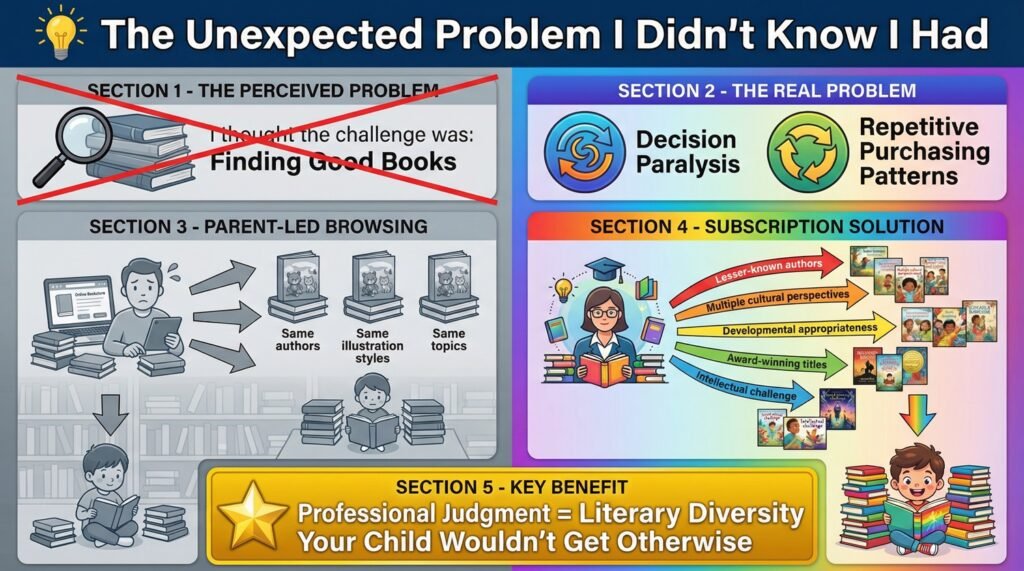
Here’s what I didn’t expect about book subscriptions, they solved a problem I didn’t realize I had. I thought the challenge was finding good books, but actually, the bigger issue was decision paralysis combined with repetitive purchasing patterns.
When I browsed bookstores or online retailers, I’d gravitate toward familiar authors, similar illustration styles, and topics I personally enjoyed. My daughter was inadvertently getting a reading diet that reflected my preferences as opposed to exposing her to genuine literary diversity. Book subscriptions, particularly those with educator-led curation, deliberately push against this tendency.
Services employing child development specialists or librarians bring professional judgment about developmental appropriateness, thematic variety, and quality literature that most parents simply don’t have time to research. They’re identifying lesser-known authors, diverse cultural perspectives, and books that challenge children intellectually without overwhelming them.
When professionals curate selections, you get exposure to award-winning titles you’d never explore browsing Amazon’s bestseller lists.
The financial math also works out surprisingly well. Quality board books and picture books typically cost fifteen to twenty dollars each when purchased individually.
A subscription delivering three to four books monthly for twenty-five to thirty dollars provides better value while eliminating shipping costs and browsing time.
Over a year, you’re building a substantial home library for less than sporadic retail purchases would cost.
But beyond economics, subscriptions create temporal structure around reading that’s genuinely valuable. When books arrive monthly, they naturally segment into thematic periods.
You spend several weeks deeply engaging with a small set of titles as opposed to having overwhelming shelf choice that paradoxically reduces engagement with person books.
This limited selection forces repeated reading, which developmental research shows is exactly how toddlers build comprehension and vocabulary.
I also found that subscriptions eliminated the guilt I felt about spending money on books my daughter might reject after one reading. Since I’m paying a flat monthly rate regardless of which specific books arrive, there’s no sense of wasted money if she doesn’t immediately love something.
Ironically, this reduced pressure actually led to more willingness to try unfamiliar stories, and she ended up loving books I never would have purchased based on cover alone.
Selecting a Subscription That Matches Your Developmental Stage and Philosophy
Not all subscriptions curate the same way, and this matters significantly for alignment with your parenting approach and your child’s current developmental needs.
If you follow Montessori principles, you’ll want subscriptions that prioritize realistic imagery over fantastical illustrations, practical life themes, and books that respect children’s autonomy and natural curiosity. Montessori-aligned selections typically feature photographs or realistic artwork of real environments, children engaging in authentic activities, and narratives that support independence and problem-solving.
These books avoid anthropomorphized animals and fantasy elements in favor of helping children understand the actual world around them.
Waldorf-inspired subscriptions take a completely different approach, emphasizing imaginative play, fairy tales, seasonal rhythms, and connection to nature. These services often include authors like Elsa Beskow and stories rich with archetypal characters and moral development themes.
Waldorf philosophy intentionally delays reading instruction, so book selections for young children focus on oral storytelling quality and images that stimulate imagination as opposed to provide literal depiction.
Beyond educational philosophy, developmental stage matching is critical. An eighteen-month-old needs sturdy board books with simple vocabulary, bold clear images, and perhaps one sentence per page.
A three-year-old is ready for longer narratives, more complex emotional themes, and picture books that support extended parent-child conversation with nuanced plots and character development.
Some services like Tiny Humans Read explicitly offer sibling boxes that deliver both board books and picture books in a single subscription, recognizing that many families have children at many reading stages simultaneously. Others like Bookroo allow you to switch between categories as your child develops or even alternate monthly between different book types based on what your shelves need.
I’d really recommend confirming flexibility before committing. Your toddler’s reading readiness can advance quickly, and being locked into an inappropriate category for months creates frustration.
The best subscriptions let you adjust age ranges, skip months when your shelves are full, and talk about books you already own to prevent duplicates.
Also consider whether you want books focused on literacy skills versus broader social-emotional learning. Some subscriptions emphasize alphabet recognition, phonics preparation, and pre-reading concepts.
Others prioritize books about feelings, friendships, family dynamics, and character development.
Neither approach is inherently superior, the right choice depends on what gaps exist in your current collection and what developmental areas you want to emphasize.
Maximizing Developmental Benefits Through Active Reading Strategies
Here’s what transformed our subscription from convenient book delivery into genuine developmental intervention, I stopped treating reading time as passive entertainment and started approaching it as interactive learning.
Research consistently shows that the quality of parent-child conversation during reading matters exponentially more than the quantity of books or time spent. Dr. Munzer’s work emphasizes that dialogic reading, where parents ask open-ended questions, expand on children’s responses, and make connections to real-world experiences, drives language development far more effectively than simply reading text aloud.
When each subscription book arrives, I spend the first read-through just experiencing the story together without interruption. This builds narrative comprehension and let’s my daughter absorb the complete arc.
On subsequent readings, I introduce conversational elements strategically.
I ask prediction questions before turning pages: “What do you think will happen when the rabbit opens the door?” I prompt emotional identification: “How do you think the bear is feeling right now? Have you ever felt that way?” I make connections to our experiences: “Remember when we saw ducks at the park like these ducks in the book?”
These aren’t complicated techniques, but they genuinely change the cognitive experience. My daughter shifted from passive listening to active processing.
She started answering questions, then asking her own questions, then eventually narrating parts of familiar stories herself.
The subscription format supports this approach beautifully because you’re not constantly introducing new books. With three or four titles arriving monthly, you naturally read each many times throughout the month.
This repetition is developmentally crucial, children build deeper comprehension, memorize language patterns, and gain confidence through familiarity.
By the third or fourth reading, my daughter often “reads” along with me, reciting memorized phrases and predicting what comes next.
I also started using the supplementary materials that some subscriptions provide. Services like Twinkl Book Club include discussion guides, comprehension activities, and craft projects aligned with each book.
Initially, these felt like extra work, but they genuinely extend learning beyond the reading session itself.
After reading a book about ocean animals, we did a simple sorting activity with picture cards. Following a story about gardens, we planted seeds and talked about growth.
These extensions transform abstract narratives into concrete, sensory experiences that cement learning.
My daughter retained vocabulary from books much better when we could connect words to physical activities.
Creating Systems That Sustain Engagement Over Time
The biggest challenge with any book subscription isn’t the first month, it’s maintaining engagement after the novelty wears off and books start accumulating.
I implemented a rotation system that solved this completely. Instead of keeping all books accessible simultaneously, I maintain an active shelf with five to seven current titles while storing others in bins organized by theme or season.
Every few weeks, I rotate books out, and suddenly “old” books feel new again.
This prevents the paradox of choice that overwhelms toddlers when faced with thirty books simultaneously. Decision paralysis is real for young children, and reducing options actually increases engagement with person titles.
My daughter will now spend fifteen minutes with a single book when it’s one of five choices versus two minutes when confronted with overwhelming shelf variety.
The rotation system also let’s me align books with current interests or developmental moments. When my daughter became fascinated with construction vehicles, I pulled all our truck-themed books into the active rotation.
When she started asking questions about emotions, I rotated in books specifically addressing feelings and social situations.
I also created a dedicated reading space that’s genuinely inviting, a comfortable floor cushion, good lighting, a small basket for current books. This physical environment signals that reading time is special and separate from other activities.
When we settle into that space, my daughter knows we’re transitioning into focused, screen-free time together.
The spatial consistency creates a ritual that she initiates herself now, often bringing me books and pointing toward our reading corner.
The subscription delivery itself became part of our ritual. When the package arrives, we do a mini “unboxing” ceremony where my daughter opens it, we look at each book together, and she chooses which one we’ll read first.
This anticipation and agency around book selection increases her investment in the reading experience.
For families struggling with consistent routines, I’d really suggest anchoring reading time to existing transitions, after breakfast, before naptime, as part of the bedtime sequence. Subscriptions work best when they feed into predictable rhythms as opposed to requiring new schedule creation.
We read subscription books specifically after lunch before quiet time, so my daughter associates that arrival time with our established routine.
Addressing the Digital Balance Question
Choosing a physical book subscription means prioritizing tangible reading experiences without completely eliminating digital content. That approach is neither realistic nor necessarily optimal.
The goal is intentional media use as opposed to blanket prohibition.
I still use carefully selected audiobook versions of our subscription books during car rides. This extends engagement with familiar stories in contexts where physical books aren’t practical.
The key difference is that audiobooks supplement as opposed to replace our interactive reading sessions.
My daughter hears stories she already knows, which reinforces vocabulary and narrative structure without introducing the visual distraction of screens.
Some subscriptions include digital components, access to online activities, author videos, or printable materials. I treat these as extensions that happen after we’ve thoroughly engaged with the physical book.
The digital elements never become the primary experience.
After we’ve read a book together many times and done related activities, watching a short video of the author reading it or discussing their illustration process adds depth without replacing the tactile reading experience.
For families using educational apps, research suggests that minimizing distracting features substantially improves their effectiveness. Apps with fewer animations, no advertisements, and simple interfaces perform better than highly interactive ones because they don’t compete for attention as aggressively.
If you’re maintaining some app use alongside a book subscription, prioritize simple, focused applications over feature-rich choices.
The American Academy of Pediatrics recommends limiting screen time for children ages two to five to one hour daily of high-quality programming. A book subscription provides a concrete choice for filling time that might otherwise default to screens.
When my daughter asks to watch something, I can redirect to choosing a book from our subscription collection, and it genuinely works because those books feel special and exciting.
I’ve also found that having fresh books regularly arriving reduces the temptation to use screens as novelty. When my daughter seems bored with available activities, new subscription books provide stimulation and engagement without needing to introduce digital entertainment.
Frequently Asked Questions
What age should I start a book subscription for my toddler?
You can start book subscriptions as early as six months, though most services begin around twelve months when babies can sit independently and manipulate board books. The earlier you establish reading routines, the more natural they become as your child grows.
How many books should a toddler have access to at once?
Research on decision-making suggests limiting visible choices to five to seven books for toddlers. Rotating books every two to three weeks keeps the collection feeling fresh while preventing overwhelming choice that reduces engagement with person titles.
Are board books better than picture books for two-year-olds?
Board books work better for children who still mouth objects or handle books roughly. By age two and a half to three, most children can manage paper pages carefully, making picture books with more complex narratives developmentally appropriate.
Many subscriptions offer hybrid options with both formats.
Can book subscriptions help with speech delays?
Physical books combined with dialogic reading techniques support language development effectively. The interactive conversation that physical books facilitate creates exactly the conversational turns that speech therapists recommend for addressing delays.
Subscriptions confirm you have fresh, engaging content to support these interactions.
How do I prevent duplicate books in my subscription?
Most quality subscriptions allow you to create a “books we own” list either during signup or through customer service. Spend time documenting your current collection and updating this list quarterly to prevent duplicates as your library grows.
What makes Montessori book subscriptions different?
Montessori-aligned subscriptions prioritize realistic imagery, practical life themes, and books featuring real children in authentic situations. They avoid fantasy elements, anthropomorphized animals, and abstract concepts in favor of helping children understand the actual world through observation and experience.
Do book subscriptions save money compared to buying individually?
Quality children’s books typically cost fifteen to twenty dollars each retail. Subscriptions delivering three to four books monthly for twenty-five to thirty-five dollars provide better per-book value while eliminating shipping costs, browsing time, and impulse purchases that often go unread.
How long should reading sessions be for toddlers?
Follow your child’s attention span as opposed to arbitrary time goals. Most toddlers can focus for five to fifteen minutes depending on interest level and book complexity.
Multiple short sessions throughout the day build more language exposure than forcing one long session.
Can I skip months if we have too many books?
Most subscription services allow pausing or skipping months, though policies vary. Check flexibility options before subscribing, particularly if you receive books from many sources or have limited storage space.
Are bilingual book subscriptions available?
Several services offer bilingual options with books featuring both English and another language, or entirely in Spanish, French, Mandarin, or other languages. These support multilingual development and cultural representation simultaneously.
Key Takeaways
Physical book subscriptions create fundamentally different learning environments than digital apps by facilitating parent-child conversation, reducing screen-related distractions, and promoting deeper engagement with person stories through repeated reading. The research is clear that tablets reduce conversational quality and quantity during reading sessions, directly impacting language acquisition during critical developmental windows.
The subscription model solves decision paralysis and repetitive purchasing patterns while providing professional curation that exposes children to literary diversity they wouldn’t encounter through parent-selected books alone. Educator-led selection introduces award-winning authors, diverse cultural perspectives, and developmentally suitable challenges that most parents lack time to research independently.
Matching subscription philosophy to your educational approach, whether Montessori, Waldorf, or another framework, confirms books reinforce as opposed to contradict your broader parenting values and developmental goals. The difference between realistic versus fantastical content, skill-focused versus social-emotional themes, and simple versus complex narratives significantly impacts how books support your specific child-rearing philosophy.
Active reading strategies including dialogic techniques, rotation systems, and supplementary activities transform subscription books from passive entertainment into interactive developmental interventions that drive language acquisition and literacy skills. The quality of conversation during reading matters exponentially more than quantity of books or time spent, making strategic engagement essential for maximizing subscription value.
Maintaining balance between physical books and intentional digital use creates realistic media ecosystems where screens serve specific purposes as opposed to default options for filling time or managing behavior. Subscriptions provide concrete choices to screen time while supporting the limited, high-quality digital use that modern families realistically navigate.