I remember the first time I walked into a Montessori classroom and noticed something was conspicuously absent. There were no dress-up corners overflowing with princess costumes, no plastic kitchen sets with miniature pots and pans, and definitely no superhero capes hanging on hooks.
Instead, children were actually preparing real snacks, washing real dishes, and arranging real flowers in glass vases.
My initial reaction was confusion, maybe even a bit of concern. Wasn’t pretend play supposed to be essential for childhood development?
This question has sparked countless debates among parents, educators, and child development experts for over a century. The Montessori approach to pretend play remains one of the most misunderstood and controversial aspects of this educational philosophy.
Many people assume Montessori is against imagination altogether, which creates a pretty unfortunate misconception that keeps families from exploring what this method actually offers.
The truth is far more nuanced and, frankly, more interesting than most people realize.
What Maria Montessori Actually Observed
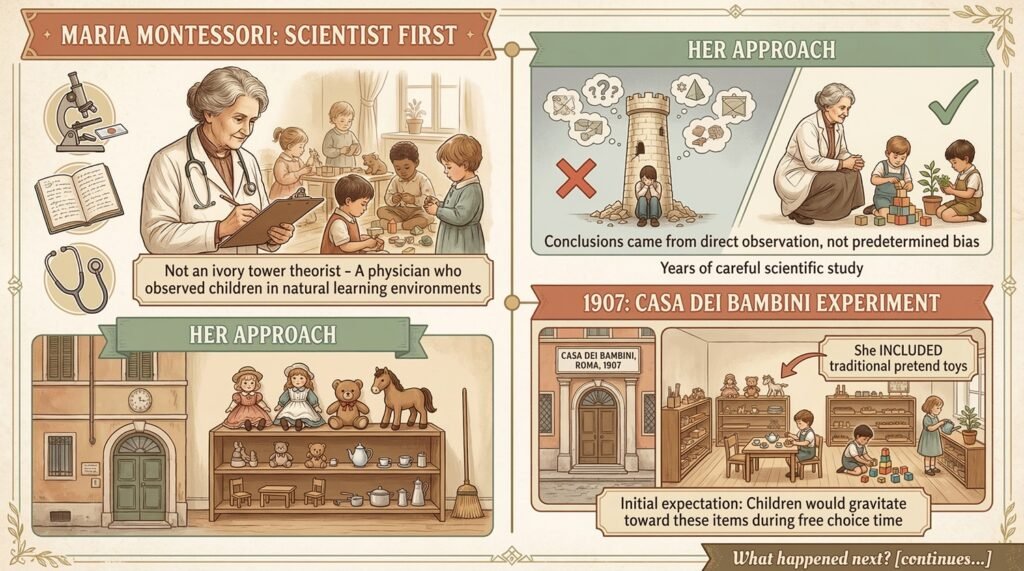
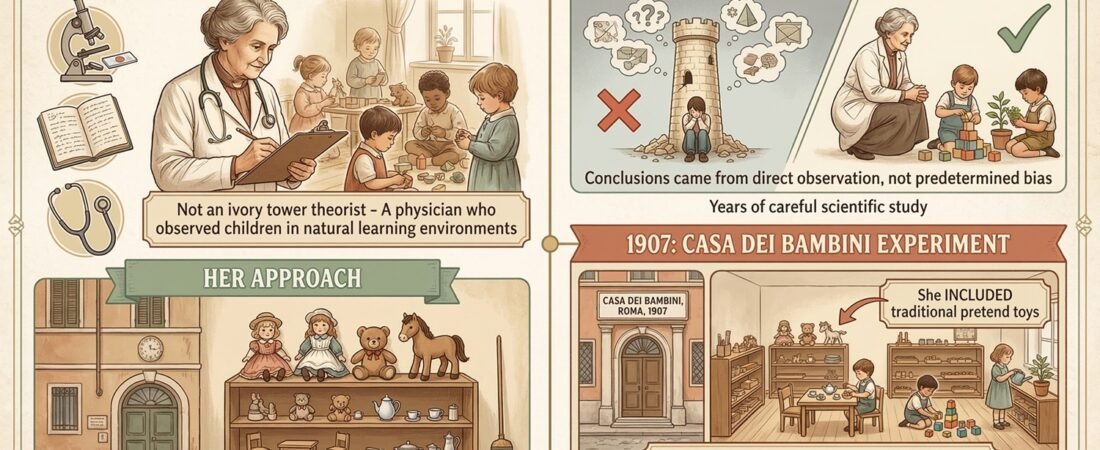
Maria Montessori didn’t develop her educational philosophy sitting in an ivory tower theorizing about childhood. She was a scientist first, a physician who spent years carefully observing children in their natural learning environments.
Her conclusions about pretend play came directly from what she had seen, not from any predetermined bias against imagination or creativity.
When Montessori first established her Casa dei Bambini in Rome in 1907, she actually did include traditional toys in the classroom. She brought in dolls, toy animals, and miniature household items, expecting children to gravitate toward them during free choice time.
What happened next surprised her completely.
The children largely ignored these fantasy-based toys, showing them brief attention before abandoning them for something else entirely. They wanted to work with real materials that had actual purpose and function.
One particularly striking observation involved a small child who bypassed the toy kitchen setup entirely to help prepare actual food in the classroom.
Another child showed zero interest in a toy broom but was absolutely captivated by the opportunity to sweep real crumbs off the floor with a child-sized but fully functional broom.
These weren’t isolated incidents. Montessori documented pattern after pattern of children choosing reality-based activities over pretend choices when given the genuine choice.
She watched as children returned day after day to activities involving real objects, real tasks, and real outcomes.
The dolls sat untouched while children lined up to polish silver. The toy dishes gathered dust while children carefully washed actual glasses and plates.
This led her to a hypothesis that challenged prevailing educational wisdom. Perhaps children weren’t actually seeking escape into fantasy worlds during their crucial developmental years.
Perhaps they were desperately trying to understand and master the real world around them, and adults were inadvertently directing them away from this natural inclination by pushing fantasy-based play.
Montessori began removing the fantasy toys from her classrooms and replacing them with real materials adapted to children’s size and capabilities. The response from the children confirmed her hypothesis.
Concentration deepened. Independence increased. Children showed greater satisfaction and pride in their accomplishments.
They were thriving with reality-based experiences in ways they hadn’t with pretend play.
The Critical Distinction Between Imagination and Fantasy
Here’s where things get really interesting, and where most of the confusion originates. Montessori didn’t reject imagination.
She made a very specific distinction between two different types of mental activity that we often lump together under the umbrella term “pretend play.”
Imagination, in Montessori’s framework, is the ability to mentally construct something based on real experiences and knowledge. A child who has helped prepare sandwiches many times can imagine new sandwich combinations.
A child who has observed how plants grow can picture a garden they’d like to create.
A child who has built with blocks can envision a structure before they begin building. This type of imaginative thinking is absolutely essential and deeply valued in Montessori education.
Children use imagination to solve problems, create art based on things they’ve observed, and make connections between different experiences.
Fantasy, on the other hand, involves elements that have no grounding in reality or the child’s actual experience. Talking animals, magical powers, anthropomorphized objects, and supernatural beings all fall into this category.
Montessori observed that introducing these fantasy elements during the crucial early years actually created confusion for children who were still working incredibly hard to understand how the real world actually functions.
Think about it from a young child’s perspective. They’re simultaneously trying to figure out that dogs bark, cats meow, gravity makes things fall, water is wet, and their actions have consequences.
Now imagine layering on top of that framework the idea that sometimes dogs talk, sometimes people fly, and sometimes the laws of physics simply don’t apply.
For adults who’ve already established a solid understanding of reality, we can easily toggle between reality and fantasy. We understand that Harry Potter exists in a fictional universe separate from our own.
We can appreciate animated movies while recognizing that actual animals don’t burst into song.
For young children, that distinction isn’t yet clear or stable. When you tell a three-year-old that bears can’t really talk after reading them a book where bears have entire conversations, you’re expecting them to master abstract reasoning they haven’t developed yet.
The confusion goes deeper than just mixing up real and pretend. When children spend significant time in fantasy scenarios, they’re building neural pathways around information that doesn’t correspond to how the world actually works.
They’re essentially learning incorrect information that later needs to be unlearned or corrected. That cognitive energy could instead be spent absorbing accurate information about reality.
The Developmental Timeline That Changes Everything
Montessori identified what she called “sensitive periods,” which are windows of time when children are biologically primed to absorb specific types of information with unusual ease and intensity. From birth to around age six, children are in a sensitive period for order, language, movement, and sensory refinement.
During this time, they possess what Montessori called the “absorbent mind,” which soaks up information about reality without conscious effort.
This developmental stage is characterized by concrete thinking. Young children are literal learners who take in information at face value and incorporate it directly into their understanding of how the world works.
They observe patterns, test cause and effect relationships, and build mental schemas based on repeated experiences.
Abstract thinking, including the ability to consciously separate fantasy from reality, develops later, typically becoming more sophisticated around ages seven to twelve.
Research in developmental psychology has consistently supported this observation. Jean Piaget’s stages of cognitive development describe the preoperational stage from ages two to seven as being characterized by concrete, literal thinking and difficulty with abstract concepts.
Children in this stage often struggle with distinguishing appearance from reality and have difficulty understanding that something can simultaneously be real and pretend.
They might become genuinely frightened by someone in a costume because they can’t yet separate the costume from the person underneath.
When we introduce elaborate fantasy scenarios during this concrete thinking phase, we’re essentially asking children to master abstract thinking before they’re developmentally ready. A four-year-old watching a movie where animals talk and solve human problems is being asked to simultaneously hold two contradictory pieces of information: animals can’t talk, but these animals are talking.
That’s abstract thinking.
That’s metacognition. That’s cognitively demanding in ways we often don’t recognize because adults do it efficiently.
The Montessori approach respects this developmental timeline. During the concrete thinking years, children receive primarily reality-based input.
They learn about actual animals and how they actually behave.
They engage with real materials and observe real outcomes. They build extensive knowledge about cause and effect, natural laws, and how the world genuinely operates.
Then, when their brains develop the capacity for abstract thinking around age seven, they’re ready to appreciate and learn from fantasy, mythology, and fictional narratives.
Montessori elementary programs include plenty of imaginative work, creative writing, and exposure to literature that includes fantasy elements.
What Practical Life Really Offers
So if Montessori classrooms minimize fantasy-based pretend play, what replaces it? Practical Life activities form the foundation of Montessori education and deserve way more attention than they typically receive.
Practical Life encompasses real, purposeful activities that children observe adults doing in daily life. Pouring water from one container to another.
Buttoning and unbuttoning.
Sweeping. Polishing.
Arranging flowers.
Preparing food. Washing dishes.
These aren’t simplified or “pretend” versions of these activities.
They’re the actual activities themselves, adapted to the child’s size and capabilities.
The beauty of Practical Life work is that it simultaneously develops many competencies. When a three-year-old carefully pours water from a small pitcher into a glass, they’re developing fine motor control, hand-eye coordination, concentration, sequential thinking, and self-regulation.
They’re calculating angles, judging distance, controlling muscle movements, and adjusting based on immediate feedback.
They’re also experiencing genuine accomplishment because they’ve completed a real task with a real outcome. The water is actually in the glass.
They can actually drink it.
This authentic accomplishment builds self-efficacy in ways that pretending to pour pretend tea simply cannot match. The difference is substantial.
When children engage in pretend activities, there’s no real feedback mechanism.
Whether they “pour” carefully or haphazardly, the outcome is the same because nothing actually happened. With real activities, children receive immediate, concrete feedback. The water either stays in the glass or spills.
That feedback loop is how children learn to calibrate their movements and improve their skills.
I’ve watched children spend thirty minutes perfecting their technique for slicing a banana. Not because an adult forced them, but because they were genuinely invested in mastering this real skill.
The concentration they show during these activities is remarkable and noticeably different from the more scattered attention I’ve observed during fantasy-based play scenarios.
When engaged in Practical Life work, children often enter what psychologists call a flow state, completely absorbed in the task, unbothered by distractions, wholly focused.
Practical Life activities also connect children to their community and culture in meaningful ways. When children join in food preparation, they’re learning about nutrition, cultural food traditions, social customs around meals, and their role as contributing members of a household or classroom community.
They’re learning that their contributions matter, that they’re capable of meaningful work, and that they belong to something larger than themselves.
These are genuinely rich learning experiences that plastic food and toy kitchens simply cannot copy.
The indirect preparation that happens through Practical Life activities is equally valuable. Children pouring water are preparing their hands for writing.
Children using tongs to transfer objects are developing the pincer grip needed for holding a pencil.
Children following multi-step sequences to prepare food are developing executive function skills they’ll use for complex academic work later. Every Practical Life activity serves many purposes, building foundations that support all future learning.
The Research That Supports Reality-Based Learning
For decades, Montessori’s stance on pretend play was dismissed by mainstream early childhood education as overly rigid or even harmful. However, recent research has started validating her observations in fascinating ways.
A series of studies conducted by researchers at the University of Virginia examined children’s preferences when offered choices between real activities and pretend versions of the same activities. The results were striking.
Children ages four to six demonstrated strong preferences for real activities over pretend versions of the same activities.
When asked to explain their choices, children consistently mentioned wanting to accomplish something real, to be helpful, and to feel capable and effective.
One particularly interesting finding was that children’s preference for real activities increased with age during the early childhood years, suggesting that this preference aligns with developmental maturation rather than working against it. The children weren’t choosing real activities because they lacked imagination.
They were choosing them because real activities better matched their developmental needs and intrinsic motivations.
The older the children got within the early childhood range, the more pronounced their preference for authentic work became.
Additional research on self-efficacy in young children has demonstrated that authentic accomplishments build confidence and competence more effectively than simulated successes. When children finish real tasks, they receive genuine feedback from the environment.
The floor either is or isn’t clean after sweeping.
The water either stays in the glass or spills. The plant either gets watered or it doesn’t.
This concrete, immediate feedback helps children calibrate their actions and develop realistic assessments of their capabilities.
They learn what they can actually do, which builds genuine confidence based on real competence.
Studies on concentration and flow states in children have also revealed something compelling. Children show longer periods of sustained attention and deeper engagement with reality-based activities compared to fantasy-based play scenarios.
This extended concentration during the early years has been linked to stronger executive function, better self-regulation, and enhanced academic performance in later years.
The ability to focus deeply, continue through challenges, and finish tasks thoroughly are skills that serve children throughout their entire lives.
Common Challenges Parents Face
Implementing a more reality-based approach at home often sounds wonderful in theory but can feel really challenging in practice, especially when you’re swimming against the tide of mainstream culture.
The first challenge is usually social pressure. When your child attends birthday parties where everyone receives goody bags filled with plastic toys and fantasy-themed trinkets, or when relatives insist on buying elaborate pretend play sets as gifts, maintaining your family’s values around reality-based learning can feel incredibly awkward.
You might worry about your child feeling left out or different from peers.
Grandparents might express concern that you’re depriving your child of normal childhood experiences.
I’ve found that the key here is focusing on what you can control within your own home environment while remaining flexible about what happens elsewhere. You don’t need to police every toy your child encounters at a friend’s house or confiscate gifts from well-meaning grandparents.
Instead, you can create a home environment that prioritizes real materials and authentic activities while recognizing that occasional exposure to fantasy play in other settings isn’t going to derail your child’s development.
Most children can handle having different rules and expectations in different environments.
Another significant challenge is convenience. Pretend play with toys needs far less supervision and involvement than authentic activities.
Handing a child some dolls to play with takes seconds.
Helping them bake real muffins needs time, patience, and accepting that your kitchen will look like a disaster zone. Reality-based activities are genuinely messier, take longer, and need more adult participation, especially in the beginning stages.
This increased effort is a real consideration, especially for working parents or those managing many children. However, I’ve also observed that this front-loaded effort pays substantial dividends.
Children who regularly join in real activities become increasingly able and independent.
The four-year-old who has been helping prepare snacks since age two can eventually do so with minimal supervision. The initial investment of time and patience gradually decreases as the child’s capabilities increase.
By age five or six, children who’ve been doing Practical Life work for several years can often finish entire tasks independently, actually reducing demands on parents.
People Also Asked
Does Montessori allow any imaginative play?
Montessori education absolutely supports imaginative play, especially as children develop abstract thinking capabilities around age seven. The distinction is between imagination based on real experiences and fantasy disconnected from reality.
Young children in Montessori environments use imagination constantly when they build with blocks, create art, solve problems, and think about past or future events.
Elementary-aged Montessori students engage extensively with mythology, creative writing, and imaginative projects.
What toys are allowed in Montessori?
Montessori environments typically include open-ended materials like wooden blocks, art supplies, musical instruments, puzzles based on real images, and objects from nature. The focus is on materials that allow for creative use based on the child’s imagination rather than toys that dictate a specific fantasy scenario.
Real tools scaled to child size are preferred over toy versions.
Can Montessori children read fairy tales?
The Montessori approach suggests waiting until children have established a solid understanding of reality before introducing fantasy literature, typically around age six or seven. Before that age, books featuring realistic scenarios, actual animals behaving naturally, and true stories are emphasized. Once children develop abstract thinking skills, fairy tales, myths, and fantasy literature become valuable tools for exploring complex themes and cultural traditions.
How does Montessori develop creativity without pretend play?
Creativity develops through open-ended activities with real materials. Children create art based on observation, build structures with blocks, compose music, solve practical problems, and use imagination grounded in real experiences.
This approach actually supports deeper creativity because children have extensive knowledge about how things actually work, which becomes the foundation for innovative thinking.
What do Montessori children do instead of playing house?
Montessori children join in actual household activities. They prepare real food, clean real dishes, care for plants, organize spaces, and contribute meaningfully to their classroom or home community.
These authentic activities provide the satisfaction of genuine accomplishment and develop real competence rather than simulating adult activities.
Key Takeaways
Montessori made a crucial distinction between imagination based on real experience and fantasy disconnected from reality, observing that young children in the concrete thinking stage benefit most from reality-based experiences rather than fantasy scenarios.
Children from birth through about age six possess absorbent minds primed to understand the real world and show strong preferences for authentic activities over pretend choices when given genuine choices.
Practical Life activities serve many developmental purposes simultaneously, building motor skills, concentration, independence, self-efficacy, and community connection while providing the deep satisfaction of authentic accomplishment.
The reality-based approach in early childhood creates a stronger foundation for later abstract thinking and creativity by providing children with extensive knowledge about how the world actually functions.
Implementation needs patience with messes and mistakes, careful observation of your child’s interests and capabilities, environmental modifications that support independence, and willingness to resist cultural pressure toward fantasy-based play and toys.