When you’re staring at rows of baby toys trying to figure out what’s actually going to help your kid develop skills (and not just end up in the donation bin three months later), the options get overwhelming fast.
Most stuff looks good in photos but falls apart quickly, has annoying sounds you can’t turn off, or takes up your entire living room without actually engaging your baby for more than five minutes.
Manhattan Toy shows up differently in parent reviews. People talk about these toys lasting through many kids, actually supporting motor development, and not looking like an eyesore in your home.
That’s worth paying attention to.
The brand focuses on wooden activity centers and developmental toys that skip the battery-powered chaos. No flashing lights, no repetitive songs that make you want to throw the toy out the window.
Just well-made stuff that encourages kids to actually play and explore.
What Makes Manhattan Toy Stand Out
Manhattan Toy designs toys for many age ranges at once, which means you’re not constantly replacing things as your baby grows. The focus stays on hands-on exploration and motor skill building.
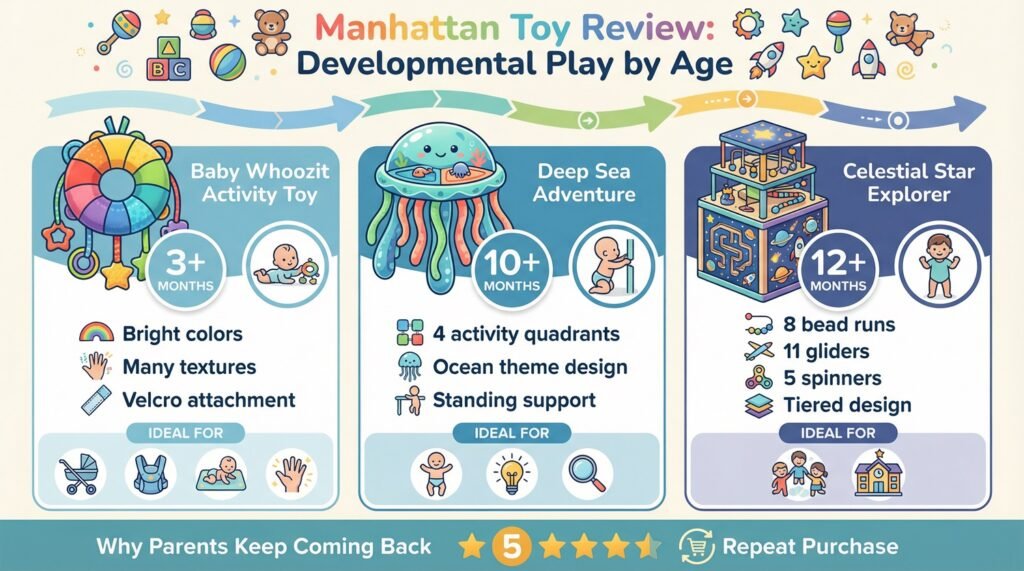
Their Celestial Star Explorer is a good example. This wooden activity center has eight wire bead runs, eleven shape gliders, five spinners, and a sliding door with a space theme.
It’s not the kind of thing that looks worn out after a few weeks of toddler abuse.
Parent reviews consistently mention durability… no splinters, no wobbling after months of use, and artwork that doesn’t peel off when kids inevitably try to pick at it.
The Deep Sea Adventure takes a similar approach with a jellyfish design and four activity quadrants. What’s interesting is that parents report both younger toddlers and older kids playing with it together, which doesn’t happen with most toys.
Usually something is either too simple or too complex, but these activity centers seem to hit a sweet spot.
| Product | Age Range | Key Features | Best For |
|---|---|---|---|
| Celestial Star Explorer | 12+ months (standing independently) | 8 bead runs, 11 gliders, 5 spinners, tiered design | Multiple kids playing together, daycare settings |
| Deep Sea Adventure | 10+ months (pulling up to stand) | 4 activity quadrants, jellyfish design, standing support | Kids learning to stand, sensory exploration |
| Baby Whoozit Activity Toy | 3+ months | Bright colors, many textures, velcro attachment | Stroller/carrier attachment, tummy time, early grabbing skills |
How These Toys Actually Perform
The real test is what happens when toddlers get their hands on these things daily.
Reviews mention that the bead runs move smoothly without getting stuck, and the spinners have enough resistance to be satisfying without being frustrating. That balance matters because too-easy toys get boring fast, but too-hard toys just make kids give up.
Some of the gliders sit pretty snug in their tracks though. Younger toddlers who haven’t built up hand strength yet might struggle with those initially.
But that’s kind of the point… the resistance helps build those fine motor skills over time.
The Multi-Kid Factor
One thing that comes up repeatedly is how well these work when many kids play at the same time. The tiered vertical design means siblings or daycare kids can access different parts without constantly fighting over the same piece.
If you’ve got twins, or many young kids close in age, this feature alone might save your sanity. Most toys create conflict zones, but these activity centers seem to reduce the constant “that’s mine” battles.
Stability Questions
The Deep Sea Adventure gets praise for helping babies practice standing. Parents mention 10-month-olds holding onto it while exploring the activities, which helps them build confidence standing independently.
But there’s a catch. If your kid is the type to lean heavily or pull hard on things, the toy can tip over.
It’s not super top-heavy, but it’s also not anchored to the floor.
Something to consider based on your kid’s personality and how they typically interact with toys.
Placement matters here. Putting it on carpet helps with stability compared to hardwood floors.
And like with all baby gear, supervision stays important.
Breaking Down the Features
Motor Skill Development
These toys target many developmental areas at once. Fine motor skills improve when kids manipulate the beads, turn the spinners, and slide the gliders.
Each activity needs slightly different hand movements and grip strength.
Gross motor development happens as kids reach, shift their weight, and stand to access different sections. The variety keeps things interesting and continues challenging developing abilities.
For younger babies who aren’t standing yet, the Baby Whoozit Activity Toy offers a different approach. It’s a smaller, portable option with bright colors and varied textures.
The velcro attachment let’s you hang it from strollers, baby activity gyms, or high chairs.
Parents of 3-month-olds report their babies love punching and kicking at it while learning to grab the small loops. It works well for tummy time too, giving babies something visually interesting to focus on while building neck and shoulder strength.
Design That Doesn’t Make You Cringe
One consistent comment in reviews is how good these toys look. The Celestial Star Explorer gets described as “beautiful enough to leave out” and “actually enhances the room instead of making it look like a daycare.”
This matters more than you might think. When a toy looks decent, you’re more likely to keep it accessible where your kid can actually use it.
Ugly toys tend to get shoved in closets or corners, which defeats the whole purpose.
The Deep Sea Adventure’s jellyfish design is visually appealing without being overly busy. It catches kids’ attention without the chaotic visual overload of toys covered in cartoon characters and random bright patterns.
Material Quality and Cleaning
The wooden construction holds up well over time. Proper finishing prevents splinters and the paint/artwork doesn’t chip or peel with regular use.
For baby activity gyms and developmental toys that get touched constantly, dropped occasionally, and probably drooled on regularly, material quality makes a big difference. Cheaper toys start showing wear within weeks… paint chipping, parts loosening, surfaces getting rough or sticky.
The wood and quality finishing on Manhattan Toy products means you can wipe things down easily without worrying about damage. No complicated cleaning instructions, no fabric parts that need machine washing (though some baby activity gyms do offer that feature, which has its own benefits).
The Honest Pros and Cons
What Works Really Well:
The construction quality is solid. No wobbly parts, no loose pieces, no gaps where little fingers could get pinched.
The artwork stays intact through months of use. This seems like a small thing until you’ve dealt with toys where the decorative elements start peeling off after a few weeks.
Multiple activity stations mean kids at different skill levels can all find something engaging. A younger toddler might focus on the spinners while an older sibling works on the more challenging gliders.
The design encourages cooperative play instead of competition. When many kids can play at once without conflict, everyone benefits.
Battery-free operation means no annoying sounds, no surprise music at 6am when a toy accidentally gets bumped, and no hunting for replacement batteries.
The visual design actually looks good in your home. You won’t feel the need to hide it when people come over.
The Legit Downsides:
These toys take up space. The Celestial Star Explorer especially needs a dedicated floor area.
It doesn’t fold up for storage or tuck away easily.
If you’re in a small apartment, this could be a dealbreaker.
They’re not appropriate for very young babies. The Celestial Star Explorer is meant for kids who can already stand confidently on their own, not for babies still learning to pull up.
Using it too early just leads to frustration.
Some elements provide more resistance than younger toddlers can handle initially. Those snug gliders might challenge kids who haven’t developed enough hand strength yet.
The price sits higher than basic choices. You’re paying for quality materials and construction, but the upfront cost is definitely more than budget options.
Assembly is required, though most of it comes pre-assembled. Still, you’ll need to put some parts together, which takes time and effort.
If you’re considering Manhattan Toy products, you can check current pricing and availability here to see what fits your budget and timeline.
What Parents Actually Say
Reviews from different settings show consistent patterns. Living rooms, daycare centers, pediatric waiting rooms… these toys capture and hold kids’ attention across various environments.
That broad appeal suggests the engagement is real, not just parents being biased about something they bought for their own kid.
Grandparents buying these as gifts report feeling good about the purchase quality. The durability signals thoughtfulness, and kids actually use them repeatedly instead of playing with something once and forgetting about it.
Families with many kids appreciate that different ages can play together. A one-year-old and a three-year-old can both engage with the same toy without one completely dominating it or the other being unable to join.
Daycare providers value these specifically because they support group play, provide developmental benefits, and don’t create the chaos of battery-operated toys with sounds and lights. When you’re managing many toddlers simultaneously, those factors really matter.
Is It Worth the Money
Baby activity gyms and developmental toys range from dirt cheap to ridiculously expensive. Manhattan Toy products sit in the mid-to-premium range, which reflects the materials and longevity.
The math changes when you consider how long these toys last. If you’re planning to use it with many kids or pass it down to younger siblings, the upfront cost gets distributed across years of use.
Budget choices exist everywhere, but they typically don’t survive months of daily toddler use without showing significant wear. Pieces go missing, surfaces get damaged, parts break or come loose.
Manhattan Toy products maintain their condition over extended periods, which means they stay safe and engaging for longer. That matters when you’re talking about something your kid interacts with every day.
The resale value is worth mentioning too. Well-maintained Manhattan Toy items hold their value in secondary markets because other parents recognize the quality.
When you’re done with it, you can recoup some of your investment by selling it instead of just throwing it away.
Compare different developmental play options here to see how Manhattan Toy stacks up against choices in your price range.
Who These Toys Work Best For
If you’re a first-time parent trying to figure out what actually supports development versus what’s just marketing hype, the track record here is pretty solid. These toys do what they claim without overpromising.
Grandparents looking for substantial gifts that won’t fall apart or get tossed aside will appreciate the quality. Spending money on something that actually gets used and lasts makes the investment feel worthwhile.
Daycare providers and people running family childcare programs dealing with many kids benefit from the cooperative play design. Fewer conflicts over toys means less time spent mediating and more time for actual learning and play.
If you’re focused on eco-conscious purchasing and prefer wooden, non-toxic materials over plastic, Manhattan Toy’s manufacturing approach aligns with those values.
Families on tight budgets for toy replacement find these cost-effective long-term because they actually last through many children instead of needing constant replacement.
One thing to consider though… if you have very limited floor space or need toys that can be easily stored away, the larger activity centers might not work for your situation. Some of the smaller options like the Baby Whoozit would be better fits.
The Bottom Line
Manhattan Toy delivers on developmental play through thoughtful design, quality materials, and genuine durability. The toys engage kids across different skill levels and ages without relying on batteries, sounds, or flashing lights that drive parents up the wall.
The visual design is attractive enough that having the toy in your main living area doesn’t feel like a compromise. It’s not going to win design awards, but it’s not going to make your space look like a chaotic playroom either.
These aren’t perfect products. They need space, they cost more than cheaper alternatives, and some features might be challenging for younger kids initially.
But the pattern in parent reviews shows long-term satisfaction instead of the usual trajectory of excitement followed by disappointment and storage.
If you have room in your home and want something that supports motor development while actually surviving real-world use, Manhattan Toy activity centers and baby activity gyms deliver real value.
Browse Manhattan Toy’s full collection here to see the specific options and find what matches your kid’s current age and developmental stage.
The space-themed Celestial Star Explorer appeals to kids who love outer space and colors. The Deep Sea Adventure works well for ocean-themed rooms or kids fascinated by sea creatures.
The smaller portable options like Baby Whoozit give you flexibility for travel, strollers, and moving between rooms.
Read detailed reviews from parents who’ve used these long-term to get a fuller picture before making your decision. Real experiences from families who’ve had these toys for months or years provide better information than marketing descriptions ever will.
Manhattan Toy products sit in that category of baby gear where you’re paying more upfront but getting significantly better quality and longevity. For some families, that trade-off makes perfect sense.
For others with different priorities or constraints, it might not.
The key is understanding what you’re actually getting, what the limitations are, and whether it matches your specific situation. These toys work really well for what they’re designed to do, but they’re not the right solution for every family or every space.